
Guide
Ensuring People Success: The Essential Guide to Modern Talent Management
Global HR
Get the resource for free
Traditional talent management is breaking. Is your organization keeping up?
Most companies invest heavily in their people, yet many struggle to translate that investment into sustained performance. Between Gen Z employees leaving after "meaningless" reviews and a global skills shortage, the "dusty drawer" approach to HR is no longer an option.
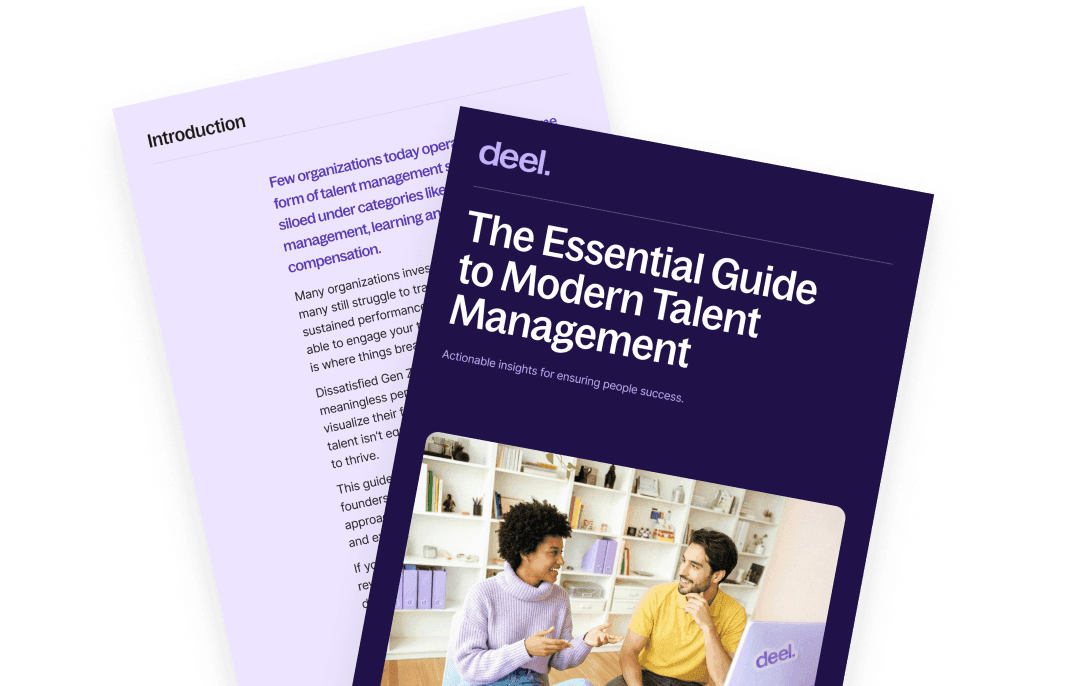
The Essential Guide to Modern Talent Management provides a practical, integrated framework to move beyond siloed HR processes. Discover how to build a resilient workforce where performance, development, and compensation work together to drive growth from within.
What’s Inside the Guide?
This comprehensive resource offers actionable insights from Deel’s People Success leaders to help you modernize your talent strategy:
- The Evolution of Talent: Understand the shift from retrospective judgment to ongoing, forward-looking growth conversations.
- The 5 Building Blocks: Learn how to implement clear job architecture, continuous feedback cycles, and employee-driven development.
- A 7-Step Implementation Roadmap: A pragmatic guide to defining your philosophy, building competency frameworks, and training managers to be talent linchpins.
- The Role of AI: See how AI-powered systems are enabling predictive analytics for retention and automated skill mapping.
- Real-World Case Studies: Explore how leading organizations like Adobe, Spotify, and Cisco have redesigned their talent systems for agility.
Why Modern Talent Management Matters Now
The business landscape is changing faster than ever. According to ManpowerGroup, 74% of employers struggle to find the skilled talent they need, while 88% fear losing their existing people.
By shifting from static job descriptions to dynamic capability building, your organization can increase resilience and stop relying solely on expensive external hiring. Research shows that performance-focused organizations are 4.2x more likely to outperform their peers.
We need agile systems of performance. For organizations grappling with hypergrowth and transformation, talent management must be a strategic bridge between people and goals.
—Alice Burks,
Director of People at Deel
FAQs
What is the difference between traditional and modern talent management?
Traditional talent management often relies on "dusty drawer" annual reviews and siloed HR processes like disconnected learning or compensation modules. Modern talent management integrates these into a continuous "people success" system where performance data flows across the organization to inform real-time development and career progression.
Why should our organization move away from annual performance reviews?
Research shows that 41% of employees view annual reviews as useless for career development, and 43% see them merely as administrative rituals. Shifting to a continuous cadence—such as quarterly snapshots—helps managers provide real-time course correction and aligns performance with fast-moving business goals.
How does job architecture help with employee retention?
Clear job architecture defines the scope, levels, and expectations for every role, removing subjectivity from growth conversations. When employees can visualize exactly what behaviors and skills are required to reach the next level, they are less likely to leave due to a lack of career clarity.
What role does AI play in a modern talent system?
AI acts as a "copilot" for managers and HR by automating administrative tasks like summarizing feedback. It also provides "talent intelligence" by analyzing data patterns to predict retention risks or automatically suggest personalized development plans based on an employee's specific skill gaps.
How can we encourage employees to take ownership of their own development?
Modern systems shift development from "HR-owned" to "employee-empowered". By providing tools where employees can link their personal career aspirations directly to performance feedback and internal learning opportunities, growth becomes a daily habit rather than a top-down mandate.