
Report
Global Talent Migration: The Geopolitics Report
Immigration
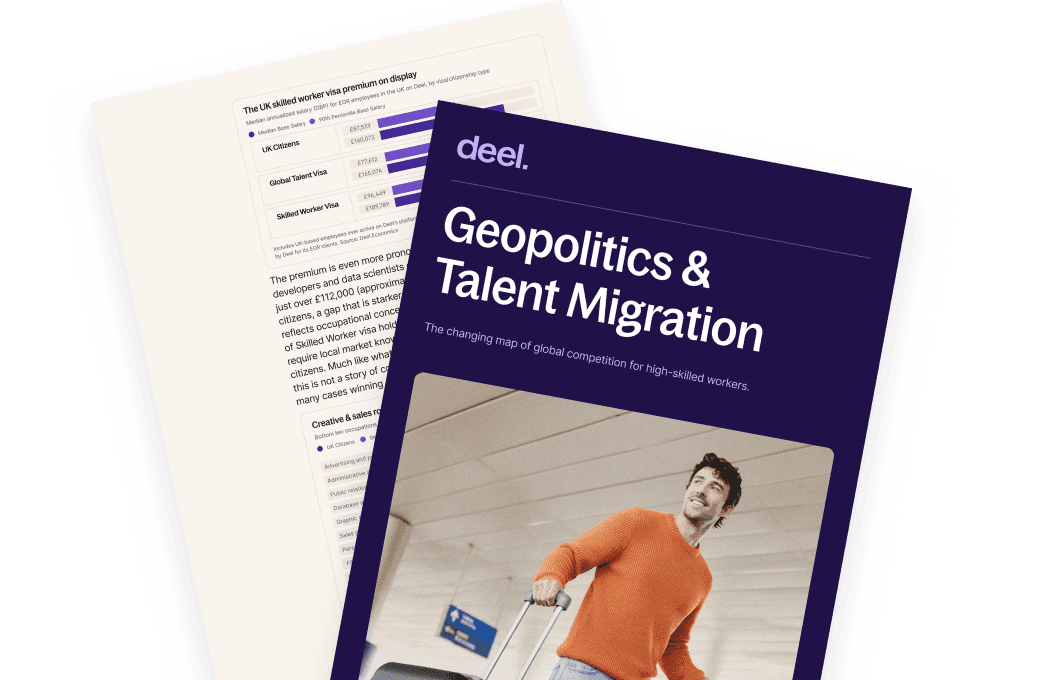
Get the resource for free
September 2025 marked a turning point. The US introduced a $100,000 H-1B supplemental filing fee, raising the cost of entry for high-skilled workers. Around the same time, other governments were moving in the opposite direction.
Canada built an H-1B holder recruitment program. Germany shortened the path to permanent residency to 21 months for German speakers. The UK sharpened its proposition for top-tier talent. The UAE expanded its Golden Visa program.
This isn't about immigration politics. It's about competitive strategy. Governments have started treating talent acquisition like they treat critical minerals or semiconductors. The countries that figured this out early are winning.
What every executive needs to know
The data behind this report draws on real hiring flows from 40,000+ companies across 150 countries — covering where workers move, what they earn, and what breaks down.
Here's what we found:
- International talent out-earns local workers. Across every market we analyzed, companies sponsor workers to compete for the best people - not to cut costs. The premium holds from the UK to the US to the UAE
- A global race for talent is underway. The US is competing on selectivity; Canada, Germany, China, and the UK are competing on access and speed. The competition is now explicit
- Processing speed determines who wins the hire. Digital-first systems are pulling ahead. Paper-based ones are costing companies their hires
Who should read this
This report is for decision makers. CEOs who need to understand how talent flows are changing. Policymakers working on immigration reform. People leaders who need to understand why their hiring is getting harder in some markets and easier in others. Economists who want to see data from a platform that actually moves money and people across borders.
Deel's policy team and economist did the analysis, leaning on the expertise of the mobility team. The data comes from 40,000 companies hiring across 150 countries. We watch where money goes, where people move, and where things break down.
Webinar: Global talent is moving. Is your mobility strategy?
Join Deel's policy, economics, and immigration experts on June 11 for a live walkthrough of the report. See what it takes to separate companies that can adapt to changing immigration and migration rules from those that scramble.
FAQs
Why is global talent migration a CEO issue now?
Because the US has shifted from the default answer to a high-cost one. .For twenty years, if you wanted top tech talent, you figured out H-1Bs. With the new $100,000 supplemental fee, the cost of a single hire now runs well over $100,000 before salary.. Smaller companies are looking for routes that don't require a San Francisco-sized legal budget.
Which countries are actually winning?
The US is pursuing a high-selectivity strategy, prioritizing high-wage talent. Others are competing on access and cost. Canada is directly targeting H-1B holders and offering a three-year path to permanent residency. Germany has a fast-track program that gets you to permanent residency in 21 months if you're in a shortage sector. The UK has got Global Talent visas and a High Potential Individual route that lets top university grads in the door fast. The UAE's Golden Visa program is drawing STEM talent from across the Middle East and India. These aren't accidents or random policy experiments. They're deliberate economic strategies.
How does Deel help companies navigate this?
Deel Mobility is a single platform that handles work permit applications, compliance tracking, and relocation support across 100+ countries. It integrates directly with your HRIS, reducing manual handoffs and keeping workforce data in sync – no data entry duplication, no manual updates. It handles both entity-sponsored and EOR-sponsored work authorizations. The AI automates document preparation and surfaces compliance alerts before deadlines become problems.
Automation handles document preparation and compliance tracking, reducing the manual overhead that slows conventional immigration processes. When you're competing for the same engineer effectively everyone else wants, that speed matters.
Why are companies moving away from US-centric hiring pipelines?
Because the math doesn't work anymore. The $100,000 H-1B supplemental fee from September 2025, plus legal fees and processing costs, , can push a single international hire past $106,000 before salary.. Before they start working and not including salary. February 2026 brought another change that prioritizes higher-salary applicants—an advantage for senior engineers, but a barrier for recent graduates and smaller companies.
The fee didn't reduce demand. The H-1B cap was still hit. But it raised the bar for everyone but the largest enterprises, and global hiring infrastructure has become essential where it once wasn't.
What does slow immigration processing actually cost?
More than most executives think. A delayed work permit means a delayed start date, which means lost productivity and often a candidate who takes a faster offer from somewhere else.
The costs pile up. Compliance exposure from missed deadlines. Legal fees for re-filings. HR time absorbed by case management that should be automated. In the Netherlands and Italy, we've seen companies delay office openings because paper-based systems and unpredictable timelines made hiring there too risky.
What immigration policy changes should executives watch?
Digitization first. Canada and the UK moved to digital-first immigration systems. That makes processing faster and more predictable.
Quota reform second. Most visa systems were designed when EOR hiring was niche, not mainstream. Right now, most governments don't formally recognize EOR entities as eligible visa sponsors. That's changing. The countries that move first will unlock significant hiring volume, particularly for smaller companies.