
Checklist
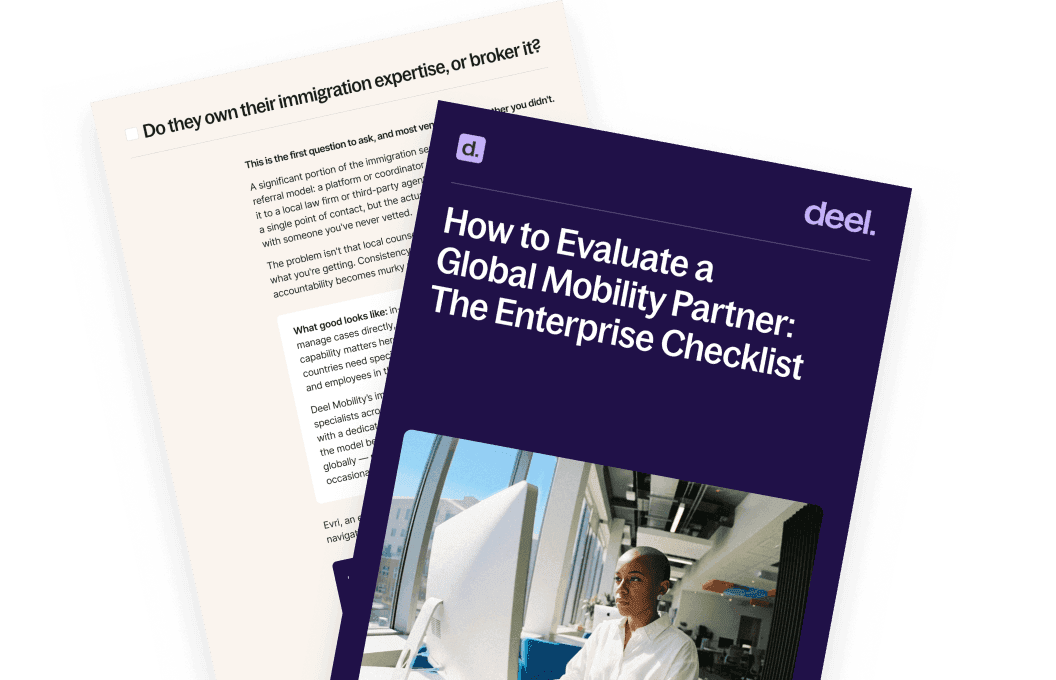
How to Evaluate a Global Mobility Partner: The Enterprise Checklist
Immigration
Get the resource for free
Most enterprise mobility programs don't fail because of a bad vendor. They fail because the wrong vendor was chosen before the right questions were asked.
This mobility checklist gives HR and mobility leaders a structured framework to evaluate global mobility partners on the criteria that actually matter at scale — from immigration expertise and country coverage to compliance infrastructure and enterprise track record.
What's inside
Choosing a global mobility provider is one of the highest-stakes decisions in any long-term mobility strategy. Get it wrong and you inherit fragmented processes, unexpected costs, compliance gaps, and an employee experience that generates more escalations than it resolves — whether you're managing international assignments across ten countries or a single global assignment in a complex jurisdiction.
This mobility checklist cuts through vendor pitches to the eight questions every enterprise should ask before signing. It covers how to assess whether a partner owns their immigration expertise or brokers it through third parties, what genuine country coverage looks like beyond headline numbers, and how to evaluate whether a platform offers a real system of record or just a reporting layer over existing chaos.
It also includes the questions most evaluation processes skip — what an SLA should actually commit to, how to assess the employee experience before you're locked in, and how to tell whether a partner has genuinely operated at enterprise scale or is growing into it on your program's budget.
Each criterion includes a benchmark for what good looks like and a set of questions to bring directly into vendor conversations.
Who will benefit
- Heads of Global Mobility and Mobility Managers — a structured evaluation framework to pressure-test vendor claims and run a more rigorous RFP process
- VP and Director-level People and HR leaders — clarity on the infrastructure, expertise, and compliance standards required before committing to a long-term mobility partner
- Legal and Compliance leads — a compliance-focused lens on immigration vendor selection, covering right-to-work monitoring, SLA accountability, and audit-readiness
- Enterprise organizations scaling across multiple regions — a practical tool for identifying gaps in your current program and setting a higher bar for the next partner you bring in
FAQs
What will this guide teach me about global mobility partner evaluation?
The checklist walks through eight criteria for evaluating a global mobility partner at enterprise scale — covering immigration expertise, country and permit coverage, platform capabilities, compliance infrastructure, service model flexibility, SLA accountability, employee experience, and enterprise track record.
Each criterion includes a benchmark for what good looks like and a set of questions to bring directly into vendor conversations.
What does the checklist say enterprises should look for in a global mobility provider?
The guide identifies in-house immigration expertise as the first filter — specifically whether a provider manages cases directly or routes them through third-party referrals.
It then covers what genuine country coverage includes beyond headline numbers, how to tell whether a platform is a real system of record or just a reporting layer over fragmented vendors, and why HRIS integration is non-negotiable for enterprise programs operating across multiple regions.
Does the guide explain the difference between self-serve and managed global mobility models?
Yes. The checklist covers how to evaluate whether a provider's service model can scale with your program, and explains what to look for in both a self-serve model — where your team manages cases directly with built-in compliance tooling — and a managed immigration service model, where the provider owns execution end to end.
It also addresses whether platform visibility changes depending on the model you choose, which is a common gap in vendor offerings.
What does the guide say about evaluating enterprise experience in a mobility partner?
The checklist pushes beyond brand logos to references from organizations with comparable footprint, volume, and complexity. It covers the specific questions to ask about high-volume periods, difficult jurisdictions, and how the partner handles cases that go off-track.
It also explains what documented proof points — like visa success rates and case turnaround times — tell you that general claims about "global coverage" and "best-in-class service" don't.
What compliance criteria does the guide cover for immigration vendor selection?
The guide covers both ongoing compliance capabilities — right-to-work monitoring, permit renewal automation, expiry alerts, and policy change tracking — and the security and data certifications that enterprise procurement teams typically require.
It also explains what an SLA should actually commit to versus what falls outside any provider's control, which is where most vendor conversations get vague.
Who is this enterprise mobility checklist designed for?
The checklist is written for enterprise HR, mobility, and people ops leaders who are either selecting a global mobility partner for the first time or re-evaluating an existing one.
It's particularly useful for organizations with a growing international footprint where immigration is currently split across multiple vendors, local counsel, and disconnected tools — and where a lack of visibility is creating compliance risk.