
Checklist
Interview Guide for Hiring Managers + Checklist
Global HR
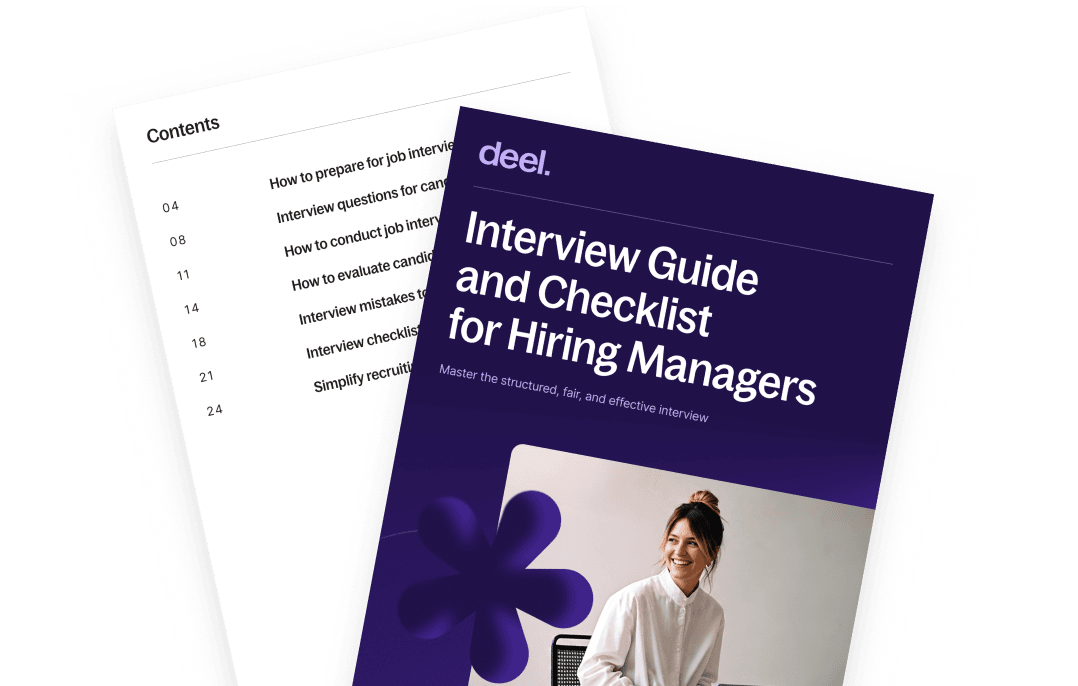
Get the resource for free
The job interview is often the final stage of the recruiting process—a chance for hiring managers to meet candidates face-to-face and probe deeper into their experience, capabilities, and personalities.
Yet, by its nature, the interview format is a blank canvas. Recruiters could ask pretty much anything (within certain legal boundaries), and candidates must scrabble to find an answer that presents them in the best possible light. This lack of structure can be problematic, removing the possibility of a level playing field and making it harder to pinpoint the right people for your roles.
Who will benefit from this guide?
Are you a hiring manager, an HR professional, or a recruitment team member involved in the interview process in any way?
If you’ve ever struggled to ask questions that extract meaningful responses from candidates or felt confused about how to score candidate answers, this guide is for you.
You’ll learn about the importance of creating a structured, repeatable process to hire the most suitable candidates for your open roles while giving each applicant a fair chance to prove their worth to your organization.
This is a process you can use in any size of business—from SMEs to enterprise companies and from solo hiring managers evaluating a range of candidates to full hiring teams comparing interview scores between them.
Interview guide overview
This guide includes:
- Preparation steps you must take for a smooth and effective interview process
- Guidance and best practices to maintain consistency during the interview process
- A selection of technical, situational, value-based, and behavioral questions to ask, and the key to asking relevant follow-up questions
- Post-interview evaluation steps
- How to communicate effectively with the successful and unsuccessful candidates
- Common mistakes to avoid in your interview process
- A checklist of steps to work through before, during and post-interview
- How Deel ATS can support your entire recruitment process
Download our interview experience guide today to provide a fair and streamlined process and elevate your quality of hire.
FAQs
What is the rule of three in recruiting?
The rule of three in recruiting is a guideline for selecting top candidates to move forward in the hiring process. It involves:
- Interviewing three candidates for the final selection
- Meeting three stakeholders or decision-makers to ensure diverse perspectives
- Evaluating three aspects for every candidate: skills/qualifications, experience, and company culture fit
This rule encourages hiring teams to maintain focus, avoid analysis paralysis, and streamline decision-making.
What are the six steps involved when recruiting and hiring staff?
The six key steps in recruiting and hiring staff are:
- Define the role and requirements:
- Identify the need for the position and clarify the job title, responsibilities, skills, and qualifications
- Create a detailed job description that aligns with organizational goals
- Source candidates:
- Use various channels such as job boards, company websites, employee referrals, social media platforms, and recruitment agencies to attract candidates
- Screen and shortlist potential candidates:
- Review candidates’ resumes and cover letters to identify candidates who meet the job’s basic requirements
- Conduct initial phone or video screenings to evaluate communication skills, experience, and interest
- Interview the best candidates:
- Conduct structured interviews with selected candidates, often using behavioral or situational questions
- Include multiple interviewers or panels to gather diverse perspectives
- Evaluate and select the top candidate(s):
- Assess interviewees based on skills, experience, cultural fit, and alignment with organizational values
- Use standardized scoring rubrics to ensure fairness and consistency
- Make an offer and kick off onboarding:
- Extend an offer, negotiate terms if needed, and complete pre-employment formalities (background checks, paperwork)
- Onboard the candidate by integrating them into the company with orientation and training programs
How can a hiring manager assess a candidate’s cultural fit?
Hiring managers can assess cultural fit using these approaches:
- Behavioral interview questions: Ask questions like, “Describe a time you faced conflict in a team and how you resolved it,” and evaluate whether the candidate’s behaviors and values align with the organization’s culture
- Situational scenarios: Present hypothetical scenarios and analyze candidates’ responses to test alignment with organizational values (e.g., collaboration, innovation)
- Cultural competency assessments: Use tools or surveys to assess how the candidate’s values and working style align with the company’s mission and values
- Team collaboration exercises: Include group interviews or problem-solving exercises to observe how the candidate interacts with potential teammates
- Reference checks: Ask previous employers about the candidate’s adaptability, teamwork, and alignment with company values
By combining these methods through the talent acquisition process, hiring managers can gauge how well a candidate will integrate into the workplace culture.
What stakeholders are typically involved in an interview process?
Key stakeholders in an interview process include:
- Hiring manager: Responsible for defining the role, conducting interviews, and making the final decision
- Recruiter/HR specialist: Manages the recruitment process, sourcing, initial screenings, and candidate communication
- Team members/peers: Provide input on how the candidate will collaborate within the team
- Department leaders/executives: May participate in senior-level hiring decisions to align hires with organizational strategy
- Subject matter experts (SMEs): Evaluate technical skills through tests or project assessments
- Interview coordinator (optional): Handles logistics such as scheduling and communication with candidates
For a successful interview process, collaboration among stakeholders ensures a well-rounded assessment of candidates.
How do hiring managers make hiring decisions for a specific role?
Hiring managers typically use a combination of the following methods:
- Candidate assessment: Evaluate resumes, portfolios, and work samples to assess qualifications and use structured interviews to gauge technical and soft skills
- Criteria weighting:
- Prioritize must-have and nice-to-have skills based on the job description.
- Assign weights to skills, experience, and cultural alignment to create an objective scoring system.
- Collaboration with stakeholders: Gather feedback from interview panels for diverse perspectives and align decisions with organizational needs and team dynamics
- Reference checks: Verify past performance, reliability, and compatibility through reference calls
- Instinct and judgment: Consider how well the candidate aligns with the company’s long-term vision and team culture
Hiring managers aim to balance objective evaluations with subjective judgment to find the best fit.
More resources
- What Is Candidate Experience? [+How to Build a Good One]
- Job Description Templates—find templates for individual contributors, managers, and executives across 12 departments
- 30+ Internal Interview Questions to Ask Your Applicants
- 12 Examples of Unconscious Bias & Ways to Overcome Them
- Sample Onboarding Plan for New Hires