Article
3 min read
Before You Automate Payroll: Where Humans Must Stay In Control
AI

Author
Michele Bouaziz
Last Update
September 29, 2026

Table of Contents
Deterministic vs. judgement work
Three levels of human involvement
Control is how you build trust
The foundation problem
Don't buy the hype
The principle
I overheard someone talk about a time their paycheck had been processed wrong, not slightly, but significantly. Their first question wasn't "was this a human mistake or an AI mistake?" Their question was simpler: when does it get fixed?
That conversation stuck with me because it crystallized something about HR and payroll that doesn't apply to other domains where we're deploying AI. When a paycheck isn't correct, no one cares what caused it. The source of error doesn't matter to the person relying on their paycheck. What matters is the outcome. And that's why the approach to automation in HR and payroll has to be fundamentally different.
Deterministic vs. judgement work
We need to be careful about automating payroll, since it's a high-risk space. It involves people's pay, their livelihoods, and the laws that govern both. At the end of the day, you own what happens in your system. I notice a lot of enthusiasm to automate everything in HR: the hiring process, compliance, and payroll. And I get it, automation is powerful. But payroll isn't like automating customer support or email drafts.
When you run payroll, you're responsible for paying people correctly, on time, according to the laws of the jurisdictions they work in. When you make a hiring decision, you're responsible for equal employment law. When you process terminations, you're responsible for severance, benefits, and data privacy. AI can help with all of these things, but it can't replace your responsibility for them.
This reflects a principle of design, not a technology limitation. A lot of organizations get stuck treating all automation the same way, by focusing only on whether a process can be automated. The better approach is to evaluate which parts need human involvement and which parts humans should stay in complete control over.
AI runs across Deel. It's embedded into every product: hire, manage, pay, and equip. AI belongs across the whole business, but not on every step of it. You get scale by being disciplined about where each piece of the work goes: rules where the answer has to be exact, AI for the reasoning, and a person on the decisions that carry meaningful risk. In payroll and compliance, that discipline isn't optional, and it's exactly how we run Deel's own operations.
That also means automation at Deel doesn't always mean AI. Fixed rules handle what's exact. agents step in only where AI reasoning is needed. Every run leaves a full audit trail, and anything that needs a decision routes to the right person as a task.
Payroll is high-risk because errors have immediate consequences for real people. Hiring is high-risk because it affects livelihoods and involves legal requirements. Terminations are high-risk because they involve severance, benefits, legal compliance, and human dignity. But not all work in HR and payroll carries the same weight.
Is it a repeatable task that doesn't need much reasoning, like pulling data and consolidating it into a summary? That's significantly easier to automate, and those are the things you should tackle first, rather than trying to automate judgement and human decisions.
This is the key distinction: some work is deterministic, following a clear rule and executing without judgement or nuance. Other work requires judgement and human understanding of context.
Deterministic work is automation-friendly. Judgement work is human-essential.
Deel AI
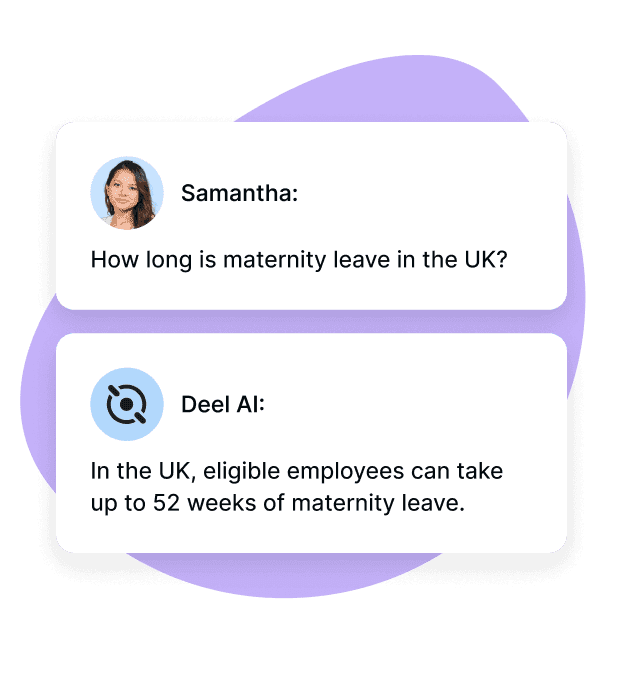
Get global HR insights fast with Deel AI
Three levels of human involvement
There isn't a binary between fully automated and fully manual. Before you automate something, or send something that AI created for you, make sure a human is setting up the specific workflows, looking at the audit trails, and confirming everything is accurate. Once a process is in place, that's when you can start thinking about how humans can be less involved, but it's a phased process. That's the design principle behind three levels of human involvement: humans set the rules, humans review the output, and humans make the final call on high-stakes work.
Some things should never use AI at all. When the answer has to be exact, a fixed rule handles it, not a model making its best guess. A tax rate, a statutory deduction, a compliance threshold: these are known values, not judgement calls, so they run on deterministic logic. AI gets reserved for the parts that require reasoning, and a person for the parts that carry consequence.
At Deel, for example, we've made a deliberate choice that payroll will never be automated fully end-to-end. But we do use AI to look for errors, with an automation that catches them and brings them to the attention of the team. AI does the heavy lifting on exception detection while a person approves before anything goes out.
Going through that process is what builds trust. You can't separate the design from the outcome.
Control is how you build trust
One of the biggest misconceptions I see is that human-in-the-loop is a limitation. It's something you do when you're not confident yet, something you'll eventually remove. I disagree with that view. Keeping a human in the loop is what gives you control: transparency, the ability to approve before anything goes out, an audit trail, reasoning behind every action, and the sources it pulled from. This is the foundation of trust-building.
Think about any software system you actually trust. You trust it because you can see what it's doing, audit it, and know there's a trail if something goes wrong. You know who to talk to and how to fix it. The organizations that feel in control of their automated systems are the ones with visibility into what those systems are doing.
IT and Security teams ask a version of this question before they approve anything: can they inspect what the system does. At Deel, we can show them. Guardrails they can review, every action logged, permissioned, and auditable, backed by SOC 2 Type II, ISO 27001, ISO 27701, and ISO 42001 certification, a seat on the EU AI Act Advisory Forum, and a risk review on every AI product we ship.
That's what visibility looks like in practice, and it's why control has to come before autonomy, not after it.
The foundation problem
This is where I see a lot of organizations struggle. They assume that if you just give AI access to your data, it will figure out what to do. It won't. AI is only as good as its foundation: your data, workflows, rules, and clarity about what you're trying to do. It needs that foundational data to give you accurate output.
Most companies run payroll in one system, HR in another, and compliance tracking in a spreadsheet or a third tool. Any AI layered on top only ever sees a fragment of what's actually happening. It can't reconcile a policy change in HR with what payroll is about to run, because it never saw the HR change in the first place. A fragmented foundation produces fragmented AI, no matter how capable the model is.
This is why we built Deel the way we did. Hire, pay, manage, and comply sit on one platform, on one underlying data model. AI grounded in Deel works from the same data across those functions instead of stitching together exports from disconnected tools. That's the difference between AI that can actually reason across your workforce and AI that's guessing at half the picture.
What does that mean in practice, even with a unified foundation? Your payroll rules need to be documented not the way people think they do it, but the way they actually do it. Your hiring approval workflows need to be written down and agreed upon. Your compliance rules need to be clear.
That doesn't eliminate trial and error. I might spend a whole day trying to do something, then figure out I need to delete everything and start with a new prompt and new data sources. This is hard work and it isn't glamorous, but it's the process behind building a solid foundation. You can't automate what you haven't clarified.
Deel HR
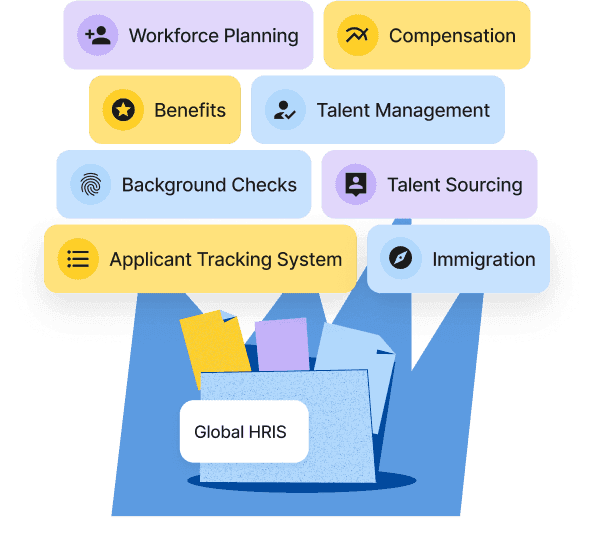
One place for simplified, smarter global HR
Don't buy the hype
I notice a lot of organizations feeling pressure to automate everything right now because everyone else seems to be doing it, but here's the thing. Not everyone should automate the same things the same way. Don't buy into the hype that everybody's automating AI and everybody's an expert, because it's not true.
A healthcare organization can't automate patient care. A financial institution can't automate compliance decisions. A mid-market company operating in 15 jurisdictions has different options than a single-market business. Set that pace wisely. Understand your own situation, start small, and iterate. If you're not sure where to start, Deel's privacy team offers AI compliance and governance consulting to help you figure that out.
The most important thing is getting your hands dirty, and you're never gonna get to that optimization until you learn the basics, which might be a little bit expensive at first, but hopefully the output is value saved, money saved, scale without headcount.
The principle
In the rush to automate everything, smart leaders are asking: should we automate this, and if so, which parts, and where do humans need to stay in control? Control beats autonomy. When you design with that principle, the technology becomes a tool that works for you. When you skip it, the technology becomes a risk.
Having that human interaction is vital to your company values and your company approach to employee engagement, but it doesn't apologize for the fact that we do believe that there's some bits of automation, some AI support that make sense for our company.
Deel Payroll
Run payroll on one platform, globally

Michele is the Product Marketing Lead:Michele Bouaziz is the Product Marketing Lead for AI, Platform, and Knowledge at Deel. She believes the best AI is the kind you barely notice. It works in the background, catches problems early, and frees people up for work that matters. She specializes in taking agentic systems from early idea to real-world impact. AI, Platform, and Knowledge at Deel. She specializes in the 0→1 productization of agentic systems, and focuses on "Background AI"— automated workflows that run silently across a company’s data graph 24/7 to solve high-dollar problems.