
Article
11 min read
Running Payroll in ChatGPT: What AI Can and Can’t Do For Your Team
AI
Global payroll

Author
Shannon Ongaro
Last Update
January 28, 2026

Key takeaways
- AI has its place in payroll, but only when it improves accuracy and confidence without weakening controls or accountability.
- Chat-based tools can support payroll work, but they can’t replace the governed systems and processes payroll depends on.
- The real value of AI in payroll is helping strong teams catch issues earlier, work through exceptions faster, and manage complexity at scale.
AI is rapidly reshaping how work gets done. And as ChatGPT becomes a familiar interface across daily workflows, it’s natural to ask whether payroll could be next.
Teams already use conversational AI to answer questions, draft communications, and surface insights. While extending that interface into payroll feels intuitive, payroll isn’t just another workflow. It’s one of the most regulated, high-risk operational functions inside a business.
The question isn’t whether AI belongs in payroll. It’s how it should be applied without compromising accuracy, compliance, or accountability.
Why payroll is different from most AI-enabled workflows
Payroll sits at the intersection of people, money, and regulation, which means errors aren’t theoretical. They impact employees directly and expose businesses to legal and financial risk.
Unlike content creation or analytics, payroll must contend with:
- Constant regulatory change across jurisdictions
- Hard cutoffs tied to pay cycles and banking timelines
- Legal responsibility that cannot be completely delegated to a system or vendor
This is why speed alone is not the right success metric for AI in payroll. Accuracy, confidence, and control matter more.
Learn more about what you should and shouldn’t automate in Payroll: Payroll Automation Guide: Benefits, Solutions, and Processes
The real role of AI in payroll: Assist, don’t abstract
AI has enormous potential in payroll, but it’s not a replacement for controlled systems of record. The highest-value applications tend to fall into three categories:
Always-on intelligence
AI can continuously monitor payroll data across periods, identifying anomalies, unexpected changes, and outliers that humans might miss. This allows teams to address issues earlier, when corrections are still easy.
Guided resolution
Rather than executing changes autonomously, AI can help payroll teams move faster by identifying exceptions, recommending next steps, and supporting safe execution within defined permissions.
Pattern recognition at scale
As organizations expand across countries and entities, AI becomes beneficial for spotting trends and risks that are difficult to see in fragmented systems.
In all three cases, AI works best as an amplifier of strong payroll operations—not a shortcut around them.
Deel Payroll

ChatGPT as an interface: Promising, but not a control plane
It’s likely that ChatGPT—and similar tools—will become common interface layers across work. Payroll-adjacent use cases such as answering policy questions, summarizing changes, or guiding users through actions are natural extensions.
Chat can be an effective entry point, but it can’t replace the governance and traceability required underneath. Where expectations need recalibration is around running payroll end-to-end through chat.
For complex organizations, that model introduces real risk:
-
Bad data scales fast: AI accelerates errors just as efficiently as correct inputs
-
External change is constant: Compliance rules, tax rates, and banking requirements evolve continuously
-
Accountability doesn’t disappear: The business remains responsible when something goes wrong
-
Controls still matter: Approvals, audit trails, and role separation aren’t optional in payroll
Governance becomes more important as AI becomes more powerful
One of the biggest misconceptions about AI in payroll is that automation reduces the need for controls. In reality, the opposite is true.
As AI accelerates workflow, review points must be clearer, not looser. Auditability must also be preserved, not abstracted away, and ownership should be explicit.
The questions that matter when evaluating AI in payroll
For teams navigating AI decisions, the most useful conversations start with operations, not tools.
Key questions include:
- Where does payroll friction actually occur: Inputs, approvals, exceptions, compliance, or corrections?
- How complex is the workforce (countries, entities, pay structures, approval layers)?
- Where do errors typically originate: HRIS changes, time data, manager inputs, leave rules?
- What governance requirements are non-negotiable?
- Is the goal speed, accuracy, and compliance confidence, or all of the above?
These answers should help you shape how and where AI is introduced.
Deel AI
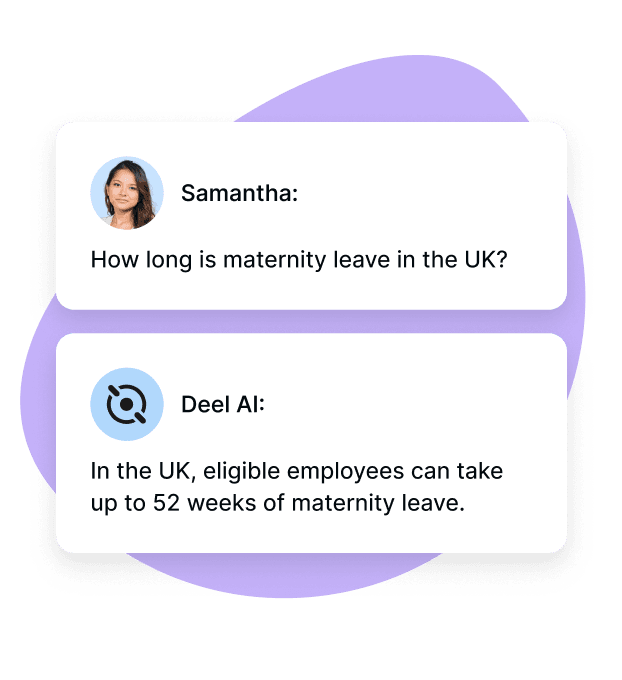
Where platforms like Deel are focusing
Anyone can add a chat interface to payroll. The hard part is making sure the right people stay in control, the data stays accurate, and compliance holds up across every cycle.
Against this backdrop, payroll platforms like Deel are taking a more measured approach to AI. Rather than treating chat interfaces as the system, the focus is on:
- Embedding intelligence directly into payroll workflows
- Using agents to guide and assist, not bypass controls
- Supporting extensibility so organizations can apply AI within their own governance models
- Meeting users in emerging interfaces like ChatGPT without weakening systems of record
As a result, you can use Deel Payroll to deliver accurate, compliant outcomes at scale while keeping accountability intact. Book a demo to see Deel Payroll in action and talk with an expert about our AI-powered features.
Shannon Ongaro is a content marketing manager and trained journalist with over a decade of experience producing content that supports franchisees, small businesses, and global enterprises. Over the years, she’s covered topics such as payroll, HR tech, workplace culture, and more. At Deel, Shannon specializes in thought leadership and global payroll content.


