
Global Work Glossary
- Results for ""
Table of Contents
How biometric verification works
Biometric verification across the worker lifecycle
Biometric verification and data privacy
Key facts
Protect your workforce with biometric verification and Deel Security
FAQ
What is biometric verification?
Biometric verification is the process of confirming a person's identity by measuring unique physical or behavioral characteristics and comparing them against a stored reference. Unlike a password or a document, biometric traits belong to the individual and are difficult to replicate. This makes them a reliable signal in remote work, hiring, and ongoing access control.
How biometric verification works
Biometric verification captures a sample of a physical characteristic, such as a facial geometry scan, fingerprint, or iris pattern, and compares it against a previously stored reference. The system returns a pass or fail based on the degree of similarity between the two samples. A liveness detection check typically runs alongside the biometric scan and confirms the sample comes from a live person rather than a photograph, a pre-recorded video, or a deepfake.
A reliable biometric check generally requires a high-quality reference image, controlled capture conditions, and a liveness signal collected at the same time. Face matching extends the chain from biometric sample to verified identity by comparing the live capture to the photo on a government-issued identity document.
Biometric verification across the worker lifecycle
Organizations apply recurring biometric checks to confirm that the person accessing sensitive systems and requesting changes to payment details is an authorized worker. This protects against impersonators who may have gained access after onboarding.
Teams can also include a biometric step in the offboarding workflow to confirm that the worker completing the exit process matches the employment record. This may reduce the risk of identity fraud or social engineering at the point when system access is revoked and final payments are processed.
Biometric verification and data privacy
In many jurisdictions, privacy regulations classify biometric data as sensitive. Employers must collect it with a valid legal basis, limit how long they retain it, and restrict who can access stored samples. Organizations operating across multiple countries should check local requirements before implementing biometric checks, because the specific obligations vary by country.
Employers might reduce compliance risk by working with a verification provider that operates under recognized data protection standards, documenting the lawful basis for collection, and setting a clear deletion schedule for stored biometric data.
Key facts
Here are some key facts about biometric verification, the risks it addresses, and what security and HR teams should know before deploying it.
Biometric verification compares a live physical sample against a stored reference. It differs from simply uploading a copy of an identity document.
Liveness detection is a companion check that confirms the sample comes from a present person and blocks replayed videos, photos, and deepfakes.
Privacy laws in many jurisdictions treat biometric data as sensitive or special-category. Collection requires a valid legal basis and strict controls on storage and access.
Biometric verification applies throughout the worker lifecycle, not only at hiring: recurring checks at system access points and payment events protect against post-hire impersonation.
A biometric check at hiring that is skipped or incomplete is a gap that fraudsters exploit to place unauthorized workers on payroll.
Combining biometric verification with document checks and deepfake detection gives security teams layered protection against identity fraud.
Protect your workforce with biometric verification and Deel Security
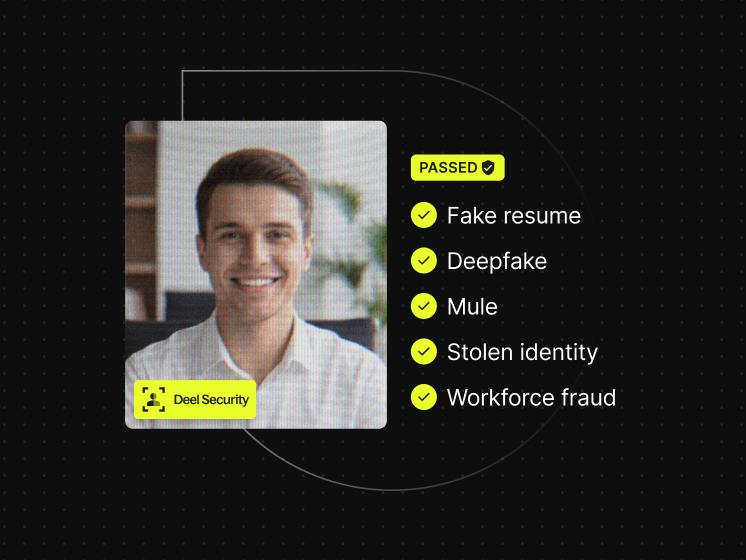
Remote hiring creates openings for impersonators to enter the workforce undetected. We built Deel Security to detect and prevent identity fraud. The solution combines biometric verification, identity verification, and fraud detection powered by artificial intelligence (AI) from candidate screening through post-hire access.
We surface fraud signals early, so your security and HR teams act on verified information rather than chasing indicators after the fact.
Book a demo to see how Deel Security protects your workforce.
Deel Security
Hire real people, keep fraud out from hiring to offboarding
FAQ
Is biometric verification the same as identity verification?
No. Identity verification is a broader process that may include document checks, database lookups, and liveness tests. Biometric verification is one specific step within that process.
What physical characteristics do biometric checks typically capture?
Facial geometry is the most common characteristic in remote hiring contexts because it can be captured through a standard device camera during an online session. Fingerprint and iris scans are also used, particularly where workers are on-site with dedicated scanning equipment.
Can a deepfake bypass a biometric verification check?
A deepfake may pass a basic photo comparison. Liveness detection paired with deepfake detection is designed to identify AI-generated imagery. Attackers increasingly use video spoofing and voice cloning to defeat these controls, which is why liveness signals and anti-spoofing models run together.
What should HR teams do when a biometric check fails?
A failed biometric check should trigger a manual review and a hold on onboarding access until the team resolves the discrepancy. HR teams should document the outcome, escalate to security or compliance staff, and follow the organization's identity dispute process before granting system access or starting payroll.
Does biometric verification apply to contractors as well as employees?
Yes. Employers and platforms that engage contractors face the same impersonation risk as those who hire employees. Employers can apply biometric verification to any worker whose identity needs to be confirmed, regardless of employment classification.
This entry provides general information about biometric verification and does not constitute legal, compliance, or technical advice, and organizations should consult qualified advisers and review applicable regulations before implementing biometric checks, as requirements vary by jurisdiction.