
Global Work Glossary
- Results for ""
Table of Contents
How dark web exposure happens
What dark web exposure reveals
Dark web exposure risks for employers and HR teams
Dark web exposure vs. related security threats
Key facts about dark web exposure
Protect your workforce from identity fraud with Deel Security
FAQ
What is dark web exposure?
Dark web exposure is what happens when an organization's data, employee credentials, or personal information appears on dark web forums or marketplaces, typically after a breach or theft.
The dark web is the part of the internet that standard search engines do not index and that requires specialized software to access. When organizational data surfaces there, threat actors can buy, trade, or use it to launch further attacks against the same organization.
How dark web exposure happens
Data typically reaches the dark web after a breach at the organization itself, a third-party vendor, or a service provider that holds employee or customer records. Phishing campaigns and social engineering tactics may also trick employees into handing over their credentials directly. Once stolen, threat actors often package and sell the data within hours or days.
Organizations may not discover their data on the dark web for weeks or months after a breach. By the time an alert fires, the data may already have been accessed or used elsewhere.
What dark web exposure reveals
Data found on the dark web can include employee passwords, payroll details, national ID numbers, and internal login credentials. For employers, exposed HR or payroll system credentials carry particular risk: a threat actor who obtains valid login details might attempt account takeover to redirect payroll, alter employee records, or access confidential workforce data.
Exposed credentials that grant access to HR platforms or financial tools pose a higher risk than standalone personal data, because they open a direct path into live systems.
Dark web exposure risks for employers and HR teams
An IT or chief information security officer (CISO) team that finds employee credentials on the dark web must treat it as a confirmed compromise, not a theoretical one. Leaked credentials might be used in credential-stuffing attacks, where automated tools try the same username-password pair across multiple services. If employees reuse passwords, one leaked credential could expose several systems at once.
For HR teams, dark web exposure affects the worker lifecycle beyond the initial hire. An employee whose credentials are compromised after onboarding could become an unintended access route for attackers, particularly in remote or distributed teams. Good identity and access management practices help security teams detect and invalidate compromised credentials quickly.
Dark web exposure vs. related security threats
Dark web exposure can lead to other security threats and is closely related to how organizations monitor them. Here's how these concepts differ and connect:
Threat intelligence is the broader practice of collecting and acting on signals about external threats. Dark web monitoring is one input into a threat intelligence program, alongside other data sources.
Account takeover is what a threat actor may attempt using credentials found on the dark web. Exposure gives threat actors the credentials they need to attempt account takeover.
Identity fraud may follow dark web exposure when stolen personal data is used to impersonate a worker or construct a fictitious identity.
Key facts about dark web exposure
Here are some key facts about how dark web exposure works, the risks it poses to employers, and how organizations can detect and respond to it.
Dark web exposure occurs when data or credentials appear on dark web forums or databases after a breach, phishing attack, or insider leak.
The types of data most commonly exposed include login credentials, email addresses, payroll records, and national identification numbers.
Security teams use dark web monitoring services to scan for an organization's domains, email addresses, and leaked credential databases.
Exposed credentials may be used in credential-stuffing attacks, in which automated tools try the same details across multiple services, potentially leading to account takeover.
HR and security teams need clear escalation protocols so a detected exposure triggers prompt password resets, session revocations, and investigation.
Early detection reduces the window between exposure and further compromise, though the data may already have been accessed before an alert fires.
Protect your workforce from identity fraud with Deel Security
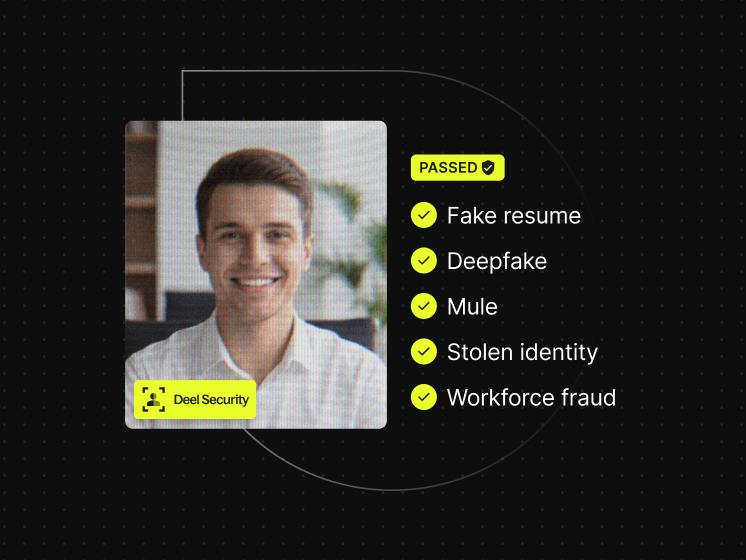
Stolen personal information can be used to impersonate legitimate workers or create fraudulent identities. Deel Security helps businesses detect fake identities, candidate impersonation, and deepfakes throughout hiring, onboarding, and ongoing employment.
Deel Security works with your existing applicant tracking system (ATS), bringing identity fraud alerts into hiring workflows for human review. This helps HR and security teams investigate potential fraud and reduce the risk of fraudulent hires.
Book a demo to see how Deel Security helps protect your workforce from identity fraud.
Deel Security
Hire real people, keep fraud out from hiring to offboarding
FAQ
What counts as dark web exposure for an employer?
For an employer, dark web exposure means the security team must treat affected credentials as confirmed compromises, check HR and payroll systems for unauthorized access, and notify workers as applicable data protection obligations require.
How do organizations discover dark web exposure?
Organizations typically discover dark web exposure through dark web monitoring services that scan known forums and databases for mentions of company domains, employee email addresses, or patterns linked to the organization's systems. Some discover it only after downstream attacks, such as unauthorized payroll changes or account takeovers, have already occurred.
What should HR teams do when employee credentials are found on the dark web?
HR teams should work with IT and security to verify which accounts were exposed, enforce immediate password resets on affected accounts, revoke active sessions, and check for unauthorized access or changes in HR, payroll, and identity systems. If the breach involved sensitive employee data, relevant data protection obligations may apply.
Does dark web exposure always mean the organization was directly breached?
Not necessarily. Exposure can follow a breach at a third-party provider, a credential reuse attack, or a phishing campaign that an employee did not report. The source of the exposure shapes the response and the scope of the investigation.
This entry is for general informational purposes only, does not constitute legal, security, or compliance advice, and is not a substitute for guidance from qualified advisers specific to your circumstances.