
Global Work Glossary
- Results for ""
Table of Contents
How deepfake technology creates synthetic media
How deepfakes threaten identity verification in hiring
Detecting deepfakes in employment screening
Key facts
Deepfakes vs. related synthetic media threats
Detect deepfakes and identity fraud with Deel Security
FAQ
What is a deepfake?
A deepfake is artificial intelligence (AI)-generated synthetic media in which machine-learning models fabricate or replace a real person's face, voice, or body in an image, audio clip, or video. The name combines "deep learning" with "fake," as deepfakes use generative AI models trained through deep learning to create convincing fake content. For employers and security teams, deepfakes matter most as an identity fraud risk in remote hiring, background screening, and onboarding.
How deepfake technology creates synthetic media
Deepfake systems train on large datasets of real imagery, audio, or video to learn the patterns of a person's appearance or voice. A generative model synthesizes new content by swapping, animating, or cloning those learned patterns onto different footage or recordings. This output can be convincing enough to fool visual inspection without specialized detection tools.
How deepfakes threaten identity verification in hiring
A candidate may use a real-time deepfake overlay during a live video interview to appear as a different person, or submit an AI-fabricated identity document. These attacks bypass visual inspection and some automated screening steps, so one person can pass as another throughout the hiring process. Organizations running fully remote hiring pipelines face the highest exposure, because no one verifies candidates in person.
Detecting deepfakes in employment screening
Deepfake detection tools analyze visual artifacts, unnatural blinking or lighting patterns, and mismatches between audio and lip movements that generative models typically leave behind. Some platforms cross-reference biometric data captured during verification against existing records to flag substitution attempts. Security teams that layer automated signals with human review achieve the most reliable defense, since no single detection method fully neutralizes the latest synthetic media.
Key facts
Here are some key facts about how deepfakes work, the risks they pose to employers, and how organizations can detect and prevent them.
Deepfakes use generative AI trained on real data to create convincing images, audio, or video that imitate a real person
Fraudsters can (and do) use deepfakes during remote interviews to impersonate candidates and hide their true identities
Deepfakes can also be used after hiring to impersonate employees and attempt to gain access to sensitive information or systems.
Identity verification and liveness detection, combined with human review, help employers identify impersonation attempts, although no method is foolproof.
Regulatory bodies in multiple jurisdictions are developing disclosure requirements and prohibitions for synthetic media to combat this, but requirements vary by geography and use case.
Deepfakes vs. related synthetic media threats
Deepfakes are one way fraudsters use AI to fake or steal someone's identity. Here are three related threats employers should know about:
Voice cloning uses AI to imitate a real person's voice, making it sound like they're speaking when they're not.
Video spoofing injects a fake video stream into a live session to deceive someone during a live video call or interview.
Synthetic identity fraud combines real and fabricated personal information to create a fake identity, rather than impersonating a specific person.
Detect deepfakes and identity fraud with Deel Security
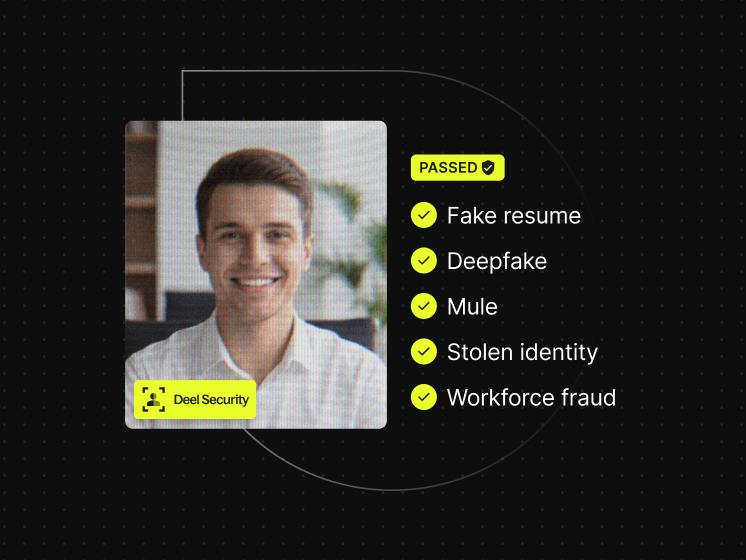
Deepfakes make it harder to know who's really behind a job application, video interview, or employee account. Deel Security helps you spot these threats with AI-powered fraud detection, identity verification, and checks throughout the worker lifecycle.
From detecting deepfakes during interviews to identifying impersonation attempts after hiring, Deel Security helps protect your business without slowing down genuine candidates.
Ready to protect your workforce from deepfakes and identity fraud? Book a demo to learn more.
Deel Security
Hire real people, keep fraud out from hiring to offboarding
FAQ
Can a deepfake pass a standard background check?
A background check relying on document images and self-reported data may not detect a deepfake, because it does not verify the live person presenting those documents. Checks that include liveness detection or face matching add a verification layer that makes deepfake substitution harder.
How does deepfake fraud relate to identity fraud?
Identity fraud covers any misuse of another person's credentials or personal data. A deepfake attack is one specific method of committing identity fraud: AI-generated content impersonates the target visually or vocally during a verification step.
What should HR teams do when they suspect a deepfake?
The standard response is to pause the hiring process, request a follow-up call on a platform with active liveness checks, document the incident, and notify the information security or compliance team. Logs of the original session give investigators the evidence needed to assess the attempt.
Are deepfakes only a concern in hiring?
Deepfakes appear in financial fraud, social engineering, and disinformation far beyond hiring. In an employment context, the main risks involve video interviews, AI-fabricated identity documents, and voice-based verification systems targeted with voice-cloning attacks.
This entry is for general informational purposes only and is not a substitute for advice from qualified legal advisers on data-protection and synthetic media compliance obligations.