
Global Work Glossary
- Results for ""
Table of Contents
What does identity verification do
How identity verification works in hiring and onboarding
Identity verification threats: deepfakes, proxies, and synthetic identities
Identity verification vs. background checks
Key facts
Strengthen identity verification with Deel Security
FAQ
What is identity verification?
Identity verification is the process of confirming that a person is who they claim to be, using government-issued documents, biometric signals, or automated digital checks. Organizations may use identity verification at different stages of the employee lifecycle, from the first candidate screening through onboarding, employment, and offboarding, to protect organizations from impersonation and fraud.
What does identity verification do
Identity verification checks confirm that the credentials a person presents actually belong to them.
Document verification: Checks government-issued photo IDs, such as passports or national identity cards, for authenticity and consistency with the information provided.
Biometric verification: Compares a person's facial features against their identity document. Techniques such as liveness detection help confirm that a real person is present rather than a photo, video, or other spoofed representation.
Automated digital checks: Analyze signals such as device information, metadata, and location inconsistencies to flag potential fraud or suspicious activity.
Combining these methods can strengthen identity verification and reduce the risk of impersonation, forged documents, and AI-generated fraud.
How identity verification works in hiring and onboarding
Most identity verification takes place before a worker's first day. In the United States, employers must complete Form I-9 to verify every new hire's identity and employment authorization, under requirements set by US Citizenship and Immigration Services (USCIS). Employees fill in their section on or before their first workday, and employers review and attest to the supporting documents within three business days.
The form recognizes three categories of acceptable documents:
List A: Establishes both identity and employment authorization.
List B: Establishes identity only.
List C: Establishes employment authorization only.
For global hires, the authority that governs the equivalent check varies by country, and organizations should confirm local requirements before making a hire. Employers cannot inspect physical documents in person for remote hires, so digital verification services let an authorized representative review documents remotely using live video or automated image capture.
Identity verification threats: deepfakes, proxies, and synthetic identities
But why is identity verification needed? As AI makes it easier to create convincing fake identities, images, videos, and voices, organizations face new challenges in confirming that people are who they claim to be. Common identity verification threats include:
Deepfakes: AI-generated images, videos, or audio that can be used to impersonate someone and potentially deceive biometric verification systems.
Proxy interviews: Situations where a third party completes a video interview on behalf of the actual candidate, misrepresenting who is being assessed.
Synthetic identity fraud: The use of real and fabricated personal information to create a convincing but false identity.
To address these threats, verification systems may combine additional challenge checks, behavioral analysis, and cross-referencing of multiple data sources. No single method eliminates every risk, making layered verification an important part of fraud prevention.
Identity verification vs. background checks
Identity verification and background checks are not the same thing. While both help employers make informed hiring decisions, they serve different purposes:
Identity verification answers the question, "Is this person who they claim to be?"
Background checks examine a person's history, credentials, or records, depending on the type of check conducted.
Identity verification can help establish that a background check is being conducted on the correct person. Without it, employers risk relying on information associated with a claimed identity rather than the actual candidate. Candidate impersonation fraud might exploit this gap, particularly in remote hiring processes where employers may not meet candidates in person.
Key facts
Here are some key facts about identity verification, the threats it addresses, and what it means for HR and security teams.
Identity verification confirms who a person is, not their history or suitability for a role.
Document checks, biometric verification, and automated digital signals are the three main layers of identity verification in a remote hiring context.
In the US, Form I-9 requires employers to verify every new hire's identity and employment authorization before or on their first workday, under USCIS requirements.
AI-generated media, including deepfakes and voice cloning, might defeat single-layer biometric checks, so organizations may want layered verification across document, biometric, and digital signal checks.
Identity verification does not end at hiring: identity fraud and account takeover can occur at any point in the worker lifecycle.
Remote hiring may create more openings for identity threats, since digital checks replace in-person document review and carry their own risks.
Strengthen identity verification with Deel Security
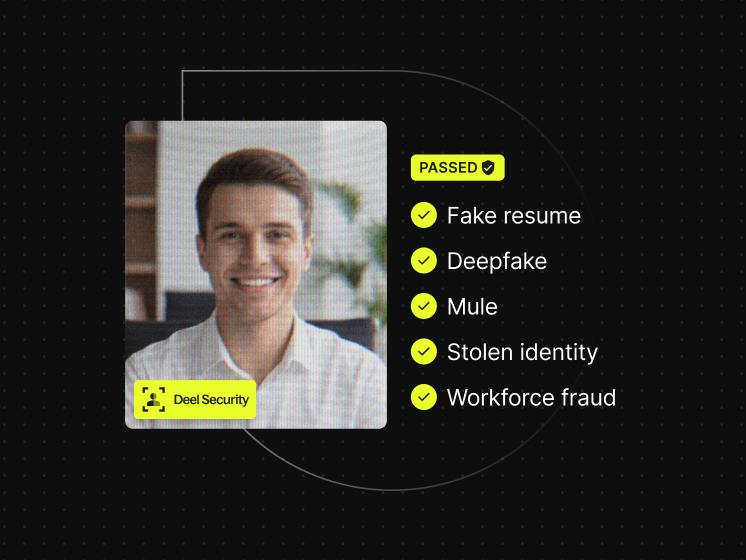
Remote teams face identity fraud risks at every stage of the worker lifecycle, from candidate screening to offboarding. Deel Security helps detect fake identities, deepfakes, and impersonation attempts during hiring, onboarding, and ongoing employment, so HR and security teams can identify suspicious activity and take action before it puts the business at risk.
By integrating with existing applicant tracking systems (ATS), Deel Security brings identity fraud alerts directly into recruitment workflows, helping hiring teams spot suspicious candidates without switching between tools.
Deel Security
Hire real people, keep fraud out from hiring to offboarding
FAQ
What is the difference between identity verification and authentication?
Authentication is the ongoing process of confirming that the person accessing a system is who they say they are, repeated on every login or session. Identity verification is the one-time step that precedes it: an employer or platform confirms a claimed identity against a government document or biometric record before granting initial access.
Does identity verification replace a background check?
No. Verification confirms who a person is, while a background check reviews their credentials, history, or record. Both steps belong in a complete pre-hire process, with verification normally running first.
What should HR do when identity verification fails?
When a check fails, the hiring or onboarding workflow should pause while HR notifies the security team and documents the finding. The next steps depend on the type of failure, the jurisdiction, and the organization's fraud response policy.
How does identity verification apply after onboarding?
Identity verification is not limited to hiring. Organizations use ongoing checks to detect account takeover, verify workers before they access sensitive systems, and confirm identity when employment details change. This matters especially for remote teams where physical contact with workers is limited.
This entry provides general information only and is not legal, compliance, or security advice: qualified advisers can provide guidance specific to your organization.