
Global Work Glossary
- Results for ""
Table of Contents
How liveness detection works
When is liveness detection used?
Liveness detection vs. related identity checks
Key facts
Protect hiring and onboarding with Deel Security
FAQ
What is liveness detection?
Liveness detection is a biometric security check that helps confirm a real, live person is present during identity verification, rather than someone attempting to deceive the system using a photograph, pre-recorded video, 3D mask, or AI-generated deepfake. It is also known as presentation attack detection (PAD) or anti-spoofing.
Employers, identity verification services, and security teams use liveness detection to eliminate the gaps that standard face matching leaves open: a high-quality photo or a deepfake video might pass a simple image comparison, but liveness detection analyzes signals such as facial movement, depth, and image patterns to help detect fraudulent images and videos.
How liveness detection works
Liveness detection systems analyze a range of camera signals (texture variation, depth, natural micro-movements, and biological cues) to determine whether a real person is present. Two main approaches exist:
Active liveness detection: Asks the person to complete an action, such as blinking, turning their head, or speaking a code. These prompts make it harder for pre-recorded footage to pass the check.
Passive liveness detection: Analyzes images or video in the background without requiring the person to perform any specific action.
Some identity verification workflows combine both approaches with document scanning and face matching. These checks can often be completed in a few seconds.
When is liveness detection used?
Organizations may use liveness detection at different stages of the worker lifecycle to help prevent identity fraud and unauthorized access. Common use cases include:
Hiring and onboarding: Helps confirm that a live person is completing an identity verification check, rather than someone using a photo, video, or deepfake. When combined with face matching and document verification, it can also help detect identity impersonation.
Account access and credential resets: Adds an extra layer of security when workers reset passwords or access sensitive internal systems.
Device changes and re-verification: Helps verify a worker's presence when they register a new device or need to complete an additional identity check.
These checks can help reduce the risk of identity fraud beyond the initial hiring process.
Liveness detection vs. related identity checks
Liveness detection is often used alongside other identity checks, but they are not the same thing. Each serves a different purpose in verifying someone's identity and preventing fraud:
Identity verification: the full process of confirming who someone is through document checks, database lookups, and liveness detection.
Face matching: compares a live selfie to the photo on an ID document and relies on liveness detection to confirm that selfie is genuine before the comparison runs.
Biometric verification: a broader category covering fingerprint, iris, voice, and face checks, within which liveness detection confirms the biometric signal comes from a physically present person.
Deepfake detection: identifies AI-generated media through content analysis after the fact, while liveness detection catches spoofing at the sensor in real time.
Key facts
Here are key facts about liveness detection, the threats it addresses, and what HR and security teams should know.
Liveness detection is typically one step inside a broader identity verification process, alongside document scans and face matching.
The main threat it addresses is a presentation attack, where someone presents a photo, screen, mask, or deepfake in place of a live face.
The two approaches are active liveness (a prompt the person must respond to in real time) and passive liveness (silent frame analysis without any action from the person).
Remote and distributed employers face greater spoofing risk because they verify candidates and workers entirely through video, with no in-person check.
Liveness verification applies beyond hiring: organizations use it at credential reset, sensitive system access, and re-onboarding checkpoints throughout employment.
Some verification providers submit their liveness systems to third-party certification programs for resistance to presentation attacks.
Protect hiring and onboarding with Deel Security
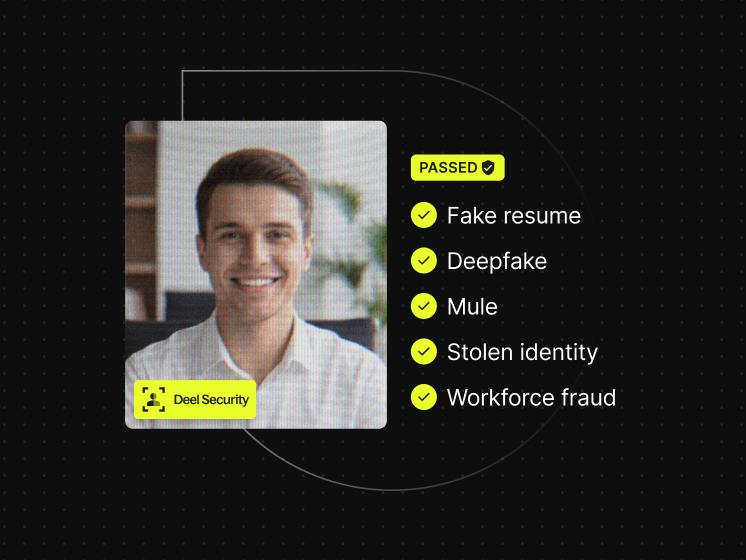
Deel Security helps businesses detect fake candidates, deepfakes, and impersonation attempts throughout hiring, onboarding, and ongoing employment.
It works with your existing applicant tracking system (ATS), bringing identity fraud alerts into recruitment workflows for human review. This helps HR and security teams investigate potential fraud and reduce the risk of fraudulent hires.
Book a demo to see how Deel Security helps protect your business from identity fraud.
Deel Security
Hire real people, keep fraud out from hiring to offboarding
FAQ
What is the difference between liveness detection and face matching?
Face matching compares the photo on an ID document to a live image. Liveness detection confirms that the live image is genuine and not a photo, replay, or deepfake. The two checks complement each other and usually run together in the same identity verification workflow.
Can a deepfake pass a liveness detection check?
A well-implemented liveness check raises the bar for deepfake attacks. Sophisticated detection systems analyze biological signals and depth cues that most generated media fails to replicate, though no single check is infallible. Layered controls (document verification, face matching, and device signals) form the standard approach.
Where in the hiring process does liveness detection apply?
Liveness detection most commonly runs during ID verification, before the organization extends an offer or grants system access at onboarding. Organizations also apply it at later re-verification points, such as credential resets or sensitive-system access.
What happens when a liveness check flags a suspected presentation attack?
Most identity verification systems pause the workflow and route the flagged submission to a manual review queue. A human reviewer examines the media before the organization extends access, an offer, or account provisioning.
Does liveness detection cover all types of biometric fraud?
No. Liveness detection focuses on presentation attacks at the sensor. Other fraud types, such as synthetic identity fraud or social engineering, require different controls alongside identity verification.
This article is for informational purposes only and does not constitute legal, security, or compliance advice, and organizations should consult qualified advisers for guidance specific to their circumstances.