
Global Work Glossary
- Results for ""
Table of Contents
How social engineering attacks work
Social engineering in hiring and across the worker lifecycle
Social engineering vs. related fraud terms
Detecting and preventing social engineering
Key facts
Protect your business from social engineering with Deel Security
FAQ
What is social engineering?
Social engineering is the manipulation of people to gain access, get sensitive information or trigger a harmful action. Unlike attacks that exploit software flaws, it targets the people who use the systems. Attackers might build false trust, create urgency or pose as someone in authority to get around technical defenses.
How social engineering attacks work
Social engineering attacks usually follow a pattern: the attacker researches a target, builds credibility, makes a request that looks legitimate and uses whatever access or information they get. The techniques vary, but the aim is to make the target act before thinking it through.
Common attack types include:
Phishing: deceptive emails from a seemingly trusted sender that push the target to click a malicious link or hand over credentials
Pretexting: a made-up scenario, such as a payroll audit, an IT check or an HR follow-up, used to get information or access
Vishing: phone-based manipulation that poses as IT support, an executive or an official
Baiting: an attractive offer, such as a free download or a software update, that might deliver malware or steal credentials
Tailgating: gaining physical access to a restricted area by following an authorized person through a secured door
Social engineering in hiring and across the worker lifecycle
Social engineering can reach every stage of the worker lifecycle, not only candidate screening. A recruiter taken in by a fake reference, an HR team member pressured by a spoofed executive email and a new hire approached by someone posing as IT support all face the same type of attack.
In hiring, candidate impersonation fraud can be a form of social engineering: a stand-in might complete a proxy interview using a made-up identity instead of the real applicant. Attackers may also use fake job postings to collect personal data from real candidates and then use that data to build synthetic identities.
After hiring, the risk continues. Attacks during onboarding and employment could target payroll details, system credentials or confidential data. Offboarding is another weak point, when attackers might pose as IT or compliance staff and approach departing employees.
Social engineering vs. related fraud terms
Social engineering is different from the terms below, because it describes the method, while each of these describes a specific technique or outcome that can be part of it:
Deepfake: AI-generated audio or video that could make an impersonation more convincing
Voice cloning: a technique that copies a person's voice, which an attacker might use to impersonate an executive or a candidate by phone
Identity fraud: the outcome when a target is tricked into handing over credentials or identity documents
Identity verification: a control that might catch an attempt by confirming a person's claimed identity
Detecting and preventing social engineering
No single technical control stops social engineering on its own, because the attack targets people rather than systems. Organizations can reduce the risk by layering controls across people, process and technology:
Security awareness training that teaches workers to question urgent, unusual or out-of-process requests
Verification steps that need a second-channel confirmation, such as a callback to a known number, for any request involving access, credentials or money transfers
Multi-factor authentication (MFA), so that stolen credentials alone cannot give access
Identity checks during hiring and onboarding that confirm a candidate is who they say they are
Key facts
Here are some key facts about social engineering, the risks it creates for employers and the controls that reduce it.
Social engineering exploits human psychology rather than software weaknesses, so technical defenses alone might not stop it.
Attacks can occur across the full worker lifecycle: candidate screening, onboarding, day-to-day employment and offboarding.
Common techniques include phishing, pretexting, vishing, baiting and tailgating, and attackers might combine them in a single campaign.
Deepfakes and voice cloning could make fake communications more convincing, which can make attacks harder to detect.
Security awareness training and strict verification steps can help as a first line of defense.
Attackers might target organizations of any size, and smaller teams could face higher risk if they have fewer formal controls.
Protect your business from social engineering with Deel Security
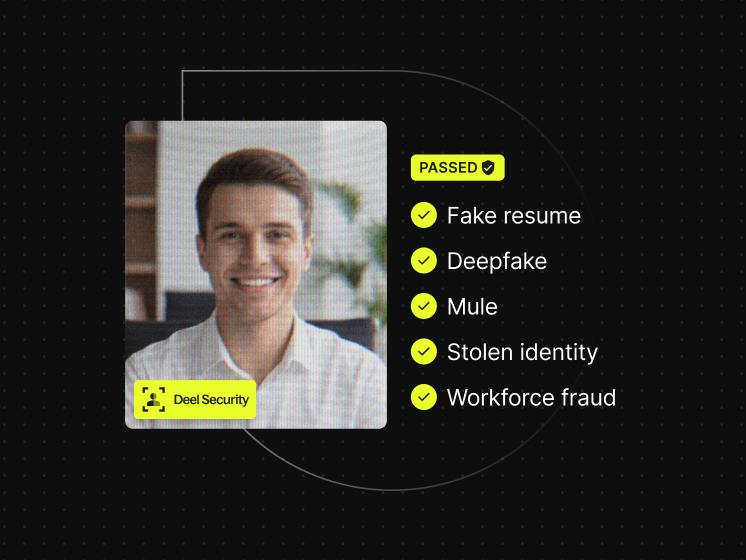
Deel Security helps businesses detect identity-based social engineering threats, including candidate impersonation, deepfakes, and fake identities, across the full worker lifecycle, from recruitment and onboarding to ongoing employment.
Its AI-powered identity fraud detection helps HR and security teams identify suspicious identities, investigate potential impersonation attempts, and reduce the risk of fraudulent individuals gaining access to the organization.
Book a demo to see how Deel Security helps protect your workforce from identity fraud.
Deel Security
Hire real people, keep fraud out from hiring to offboarding
FAQ
What is the difference between social engineering and hacking?
Hacking exploits weaknesses in software to gain access. Social engineering exploits weaknesses in human behavior to reach the same goal. Many attacks combine both: an attacker uses social engineering to steal credentials and then uses them to get into systems.
Can social engineering happen during a job interview?
Yes. In a proxy interview, someone other than the real candidate completes the interview using a made-up identity and a convincing backstory. Social engineering can also be behind fake references and impersonated recruiters, so hiring teams might run identity checks at several stages.
How do organizations verify that a person is who they claim to be?
Identity verification tools confirm that a document is genuine and that the person presenting it matches the document, through checks such as liveness detection and face matching. These controls might catch impersonation attempts that rely on false identity claims.
What should HR teams do when they receive an unusual request?
HR teams should confirm any request that skips a normal process, creates urgency or arrives from an unexpected channel through a second channel before acting on it. Calling a known phone number, instead of replying to the message that made the request, is a simple and useful check.
Are smaller organizations also at risk from social engineering?
Yes. Attackers target organizations of all sizes, and smaller teams might face higher risk because they can have fewer formal controls and may be more likely to trust an unexpected request from an apparent colleague or authority figure.
This entry is for general awareness only. Organizations should consult qualified security advisers for guidance that fits their circumstances.