
Guide
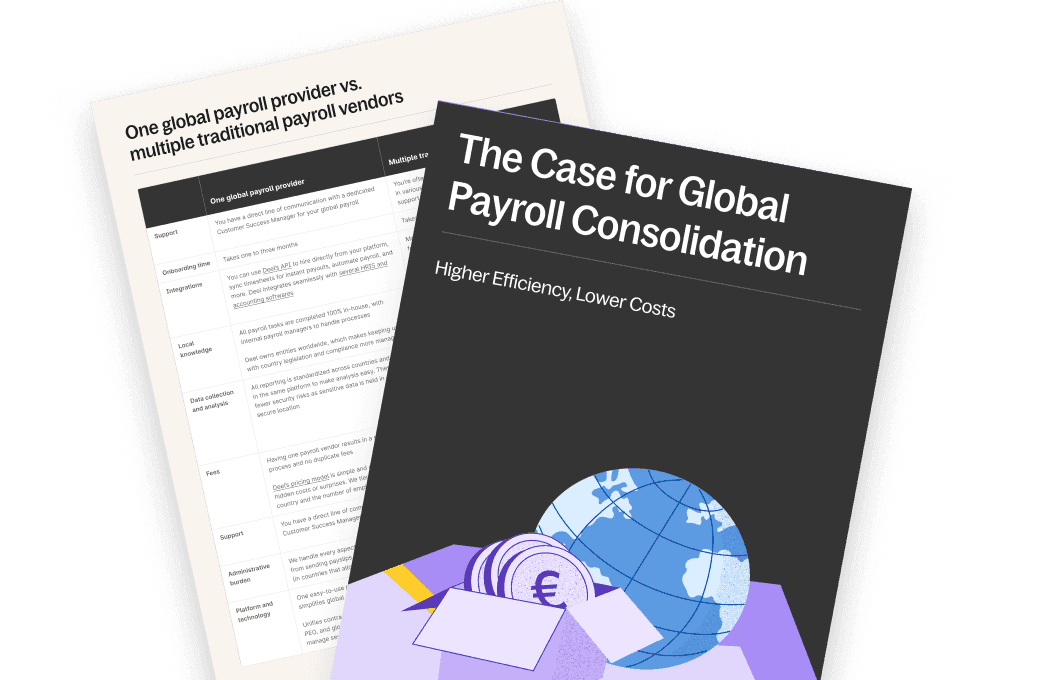
The Case for Global Payroll Consolidation
Global payroll
Get the resource for free
Gain strategic insight on how to consolidate payroll across multiple countries into one system for higher efficiency and lower total cost of ownership.
For global teams, the hidden tax of international expansion often lives in your bank of browser tabs. When you’re juggling six different payroll providers, each with its own interface, logic, and support queue, the risk of delayed payments and compliance gaps is often inevitable. This fragmentation creates data silos, making it impossible to see your total global spend in real time.
But through global payroll consolidation, you can bridge operational chaos and strategic clarity.
By moving to a unified platform, you’re gaining a superior system that increases data visibility, controls workforce costs, and protects your reputation across borders.
Global payroll guide overview
This guide provides a comprehensive roadmap for HR and finance leaders ready to move beyond fragmented legacy systems. Whether you’re managing a US and international workforce or navigating the complexities of a recent merger, this resource breaks down the financial and operational mechanics of a unified approach.
Inside this guide, you’ll find:
- Key signals for when to consolidate global payroll
- A deep dive into consolidation scenarios, from entity-backed hiring to EOR models
- How to reduce ongoing payroll administration costs
- Strategies for improving the employee experience with standardized interfaces
- Technical considerations for automation and multi-currency functionality
- A direct comparison between one global payroll provider and multiple traditional vendors
- Step-by-step breakdown of a simplified payroll process vs. the nine-step traditional lag
Who is this global payroll guide for?
We designed this resource for those who need more than just a localized solution. This guide is for:
- Finance Directors at mid-market and enterprise companies who need a single source of truth for global spend and want to eliminate duplicate vendor fees
- HR Operations Leaders tired of manual data entry across multiple HRIS and payroll tools who want to reclaim hundreds of hours for their teams
- Legal and Compliance Officers focused on mitigating the risks of misclassification and ever-changing local tax regulations across 50+ countries
- Founders and CEOs overseeing rapid international expansion who need a scalable infrastructure that grows as fast as their headcount
How to consolidate payroll across multiple countries into one system
Consolidating your payroll doesn't have to be a disruptive overhaul. When done correctly, it’s a phased transition that replaces manual work with automated precision. Here is how to approach the shift:
1. Identify your data silos
Gather every contract, fee schedule, and reporting format from your current in-country partners. You’ll likely find that your data is trapped in inconsistent structures, making it impossible to run a global "gross-to-net" report without weeks of manual spreadsheet work.
2. Evaluate your worker types
Modern teams aren't just direct employees. Most companies today use a mix of contingent workers, Employer of Record (EOR) workers, and direct employees with their own entities. Your consolidated system must be able to handle all three in one pay cycle to avoid creating new silos.
3. Choose a provider with owned infrastructure
Many "global" providers actually outsource their work to third-party local partners, which adds layers of communication and potential for error. Look for a partner like Deel that uses its own infrastructure and in-house experts to ensure consistency.
4. Sync your HR and IT ecosystem
Payroll shouldn't live on an island. Ensure your new system integrates directly with your HRIS, accounting software, and benefits administration. This creates a natural trigger point where an onboarding event automatically initiates a payroll record.
5. Transition to real-time reporting
Once your data is in one system, move away from month-end surprises. Use built-in analytics to monitor country costs, employer contributions, and tax liabilities as they happen.
Pro Tip: If you are a US-based company expanding abroad, prioritize a platform that handles both 50-state US payroll and international entities. This prevents the common trap of having one system for the US and a separate, subpar system for the rest of the world.
The ROI of consolidating global payroll
The administrative burden of managing local subsidiaries can cost a company between $56,000 and $60,000 USD per year in overhead alone. This includes everything from cooperation taxes and health and safety training to the cost of hiring a payroll manager in every single country.
By consolidating through a unified payroll platform, these specific operational costs—and time—can be reduced. For example, traditional vendor onboarding can take up to eight months. With a consolidated global provider, you can be up and running in as little as one to three months.
From days of work to hours of admin
Real-world results show that consolidation is the ultimate time-saver for lean teams. Take Change.org, for instance. Since switching to Deel Payroll, they have saved more than 300 hours on administration every single month. By moving away from "stuck in the past" platforms, they gained an elevated experience that matches the pace of their global mission.
Similarly, Directional Pizza transformed its fragmented HR and payroll systems into unified and compliant processes across Denmark, the UK, and Sweden with Deel. In the middle of implementation, Directional Pizza acquired a major UK entity, adding 3,000 employees across monthly and bi-weekly pay cycles. They were able to migrate all employees onto Deel, enabling rapid market entry, seamless onboarding, and consistent revenue generation.
Learn how Deel simplifies the global payroll process
Deel Payroll gives you one platform to pay your entire team, whether they are across the street or across the globe. We provide the consistency of a single interface with the depth of local expertise in over 130 countries.
- One product, one platform: Connect payroll, HR, IT, and benefits in a single system. Integrate existing platforms like Workday, SAP, and NetSuite to maintain centralized workflows and data
- Native calculations: Get instant gross-to-net results in 50+ countries without waiting for third-party partners
- Built-in compliance: Access 2,000+ in-house specialists who ensure your taxes and filings are always accurate
- Flexible models: Choose between self-serve payroll for your entities or fully managed services where we handle the heavy lifting
Get your payroll consolidation guide today
Stop chasing local partners and start leading your global strategy. From fragmented spreadsheets to a single source of truth, the path to scalability starts with consolidation.
Download the Case for Global Payroll Consolidation now.
FAQs
What is the biggest risk of using multiple payroll providers?
The primary risk is a lack of compliance visibility. When you use different vendors, you have to trust that each one is staying on top of local regulatory changes, tax code updates, and worker classification laws. A single error in one country can lead to fines costing hundreds of thousands of dollars and significant reputational damage.
How does consolidation improve the employee experience?
A unified system provides a consistent user interface for everyone. Instead of workers in Germany using one portal and workers in Brazil using another, everyone accesses the same platform for their payslips, tax documents, and benefits. This builds trust and ensures that no matter where a team member is located, they receive a consistent experience from your company.
Can a global payroll system handle different worker types?
Yes. A modern consolidated platform manages independent contractors, EOR employees, and direct employees in one place. This eliminates the need for separate payment methods and non-standardized processes that typically burden HR and finance teams.
What is the difference between a traditional vendor and a global payroll provider?
Traditional vendors often rely on a network of third-party in-country partners (ICPs). This creates a system where data is passed through multiple hands, leading to delays and human error. A global payroll provider like Deel uses its own infrastructure, providing a direct line of communication to in-house experts and more efficient onboarding times.
How does automation affect global payroll reporting?
Automation eliminates the manual task of pulling data from multiple sources. With a consolidated platform, your reporting is standardized across all countries. This allows for real-time data analysis, accurate forecasting, and transparent audit trails that are essential for mid-market and enterprise-level financial planning.