
Guide
A Guide to Running Payroll in Australia (2026)
Global payroll
Get the resource for free
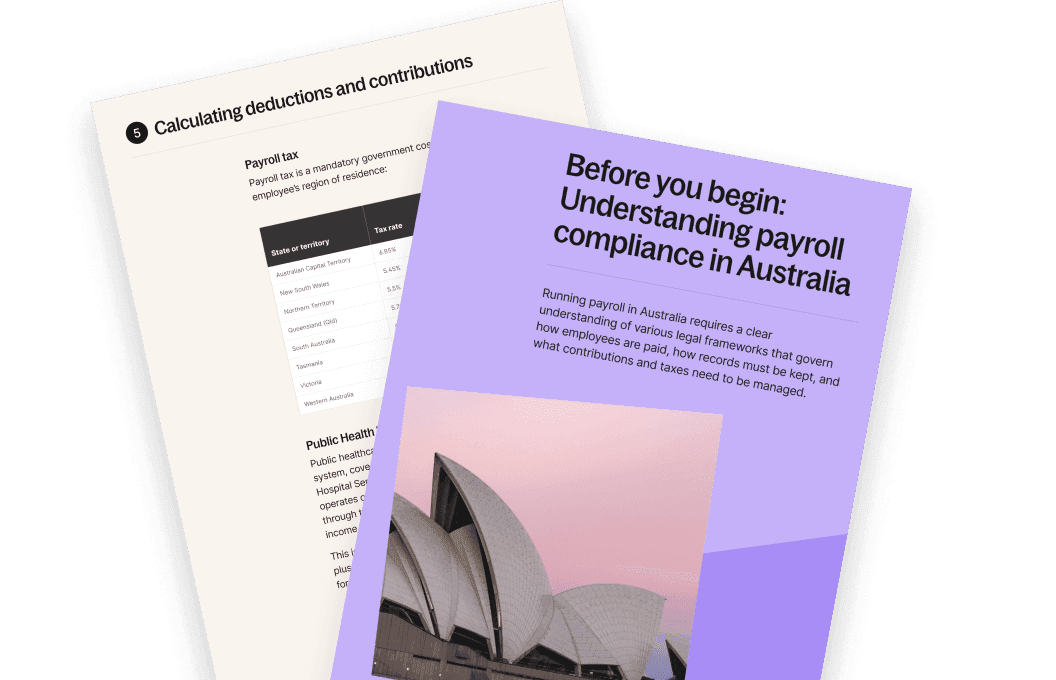
Hiring in Australia gives you access to a world-class talent pool, but it also brings you face-to-face with one of the most complex regulatory environments in the world. Between the Fair Work Act, Modern Awards, and the move toward Payday Super, the "set it and forget it" approach to payroll doesn't exist here.
This free guide acts as your roadmap, helping you navigate everything from Tax File Numbers (TFN) to the nuances of Single Touch Payroll (STP) reporting. Whether you’re a startup founder or a People Ops leader, we’ve distilled the complexity into actionable steps so you can focus on growth, not paperwork.
Australian payroll guide overview
Running payroll in Australia requires a deep understanding of the legal frameworks that govern how employees are paid, how records are kept, and what taxes must be managed. Failure to comply can lead to significant penalties, and directors can even be held personally liable for unpaid superannuation or withholding tax.
Inside this guide, you’ll find:
- A step-by-step roadmap for employer and employee onboarding
- Breakdown of the National Employment Standards (NES) and Modern Awards
- Updated 2025–2026 resident tax rates and Medicare levy surcharges
- Guidance on the 12% Superannuation Guarantee (SG) and the 2026 shift to Payday Super
- Best practices for compliant recordkeeping and tax documentation
- A guide to choosing the right payroll schedule (weekly, fortnightly, or monthly)
- How to handle deductions for Fringe Benefits Tax (FBT) and workers' compensation
Who is this payroll guide for
We designed this resource for:
- Finance and People Ops leaders in growth-stage companies needing to standardize payroll across Australian entities
- Expansion teams looking to understand the financial implications and labor laws before entering the Australian market
- HR generalists looking to support equitable, consistent pay decisions while navigating the complexities of Modern Awards
- Founders and CEOs seeking a clear picture of total employment costs, including mandatory contributions and insurance
- Payroll administrators who need to ensure their systems are ready for the shift to Payday Super in July 2026
Deep dive: Understanding the Australian regulatory landscape
The guide provides a look at the Fair Work Act 2009, which sets the standards for wages and employment conditions. You will learn about the ten minimum entitlements under the National Employment Standards (NES), which apply to all employees in the national system.
We also break down the concept of Modern Awards—industry-specific standards that outline minimum terms of employment. Understanding whether your employees are covered by an Award or an Enterprise Agreement is critical for calculating overtime and penalty rates correctly.
How to use the Australia payroll guide
This tool is designed to guide you through building clear, consistent payroll processes, even if you’re not a local expert.
Step 1: Gather your business essentials
Before you hire your first employee, you must have your business registrations in order. The guide provides a checklist of the key pieces of information you need, including:
- Your Australian Business Number (ABN) and Tax File Number (TFN)
- Registration for Pay As You Go (PAYG) withholding with the ATO
- Selecting a default superannuation fund and registering for the SuperStream system
- Securing mandatory workers' compensation insurance
Step 2: Onboard employees compliantly
Accurate payroll starts with accurate data. We outline the specific details you must collect from every new hire, from their TFN Declaration to their superannuation fund choice (or identifying a "stapled" fund). The guide also covers the mandatory distribution of the Fair Work Information Statement.
Step 3: Classify your workforce and set schedules
Australia offers flexibility in pay cycles—typically weekly, fortnightly, or monthly. However, certain Awards may dictate specific pay days. This guide can help you determine the best schedule for your cash flow while staying within legal requirements.
Step 4: Calculate pay and deductions
The guide provides updated tax tables for the 2025–2026 financial year. You'll learn how to calculate:
- Gross Pay: Including base salary, bonuses, and commissions
- Medicare Levy: The standard 2% levy and applicable surcharges for high earners
- Superannuation: Managing the 12% contribution rate and the maximum contribution base
- Overtime: Understanding the standard 150% and 200% rates often found in Awards
Step 5: Master recordkeeping
In Australia, you must keep comprehensive payroll records for seven years. We provide a full list of what must be included—from leave balances to termination details—to ensure you are always ready for a Fair Work inspection.
Success Story: Beaumont Property Group
Complexity shouldn't slow down your growth. When Beaumont Property Group acquired multiple companies with a variety of working arrangements, they turned to Deel. By automating their payroll, they were able to provide accurate, compliant payments across casual and Award-based roles, removing the risk of human error in Award interpretation.
Pro Tip: From 1 July 2026, the Superannuation Guarantee must be paid on the same day as salary and wages. Employers should start auditing their cash-flow processes now to ensure they can support this move from quarterly to per-pay-cycle remittances.
Get your Australian payroll guide today
Running a business in Australia is a major milestone, but payroll shouldn't be the thing that keeps you up at night. Whether you are managing a small team or a large enterprise, this guide ensures your Australian operations are built on a foundation of compliance and accuracy.
FAQs
What is the national minimum wage in Australia for 2026?
As of 1 July 2025, the national minimum wage is $24.95 per hour for employees aged 21 and over. This rate is reviewed annually by the Fair Work Commission, with updates typically taking effect on 1 July. Occupations covered by Modern Awards often have higher minimum rates.
How do I calculate superannuation for my employees?
Employers must contribute 12% of an employee’s ordinary time earnings (OTE) into a superannuation fund. For the 2025–26 financial year, the quarterly maximum contribution base is $62,500, meaning you are not required to pay SG on earnings above that amount in a single quarter.
What is Payday Super and when does it start?
Payday Super is a government initiative starting 1 July 2026. It requires employers to pay Superannuation Guarantee contributions on the same day they pay salary and wages. This change is designed to ensure employees receive their retirement savings more frequently and to help them track their entitlements in real-time.
How does Single Touch Payroll (STP) work?
STP is a reporting requirement where employers send tax and superannuation information to the ATO every time they run payroll. Using STP-enabled software ensures that your reporting is seamless and that your employees can see their year-to-date tax and super information through their myGov accounts.
What are the main employer payroll costs in Australia?
Beyond the base salary, employers should budget for:
- Superannuation: 12% of OTE
- Workers' Compensation: Typically 0.14% to 1.0% depending on the region
- Payroll Tax: State-based tax that applies if your total wages exceed certain thresholds
- Medicare Levy: Withheld from employee pay but managed through your PAYG system
Disclaimer: Payroll costs and rates included in this guide are accurate at the time of publishing but are subject to change. Always confirm the latest rates and requirements before running payroll.