
Guide
How to Manage a Global Workforce with an Employer of Record (EOR)
Employer of record
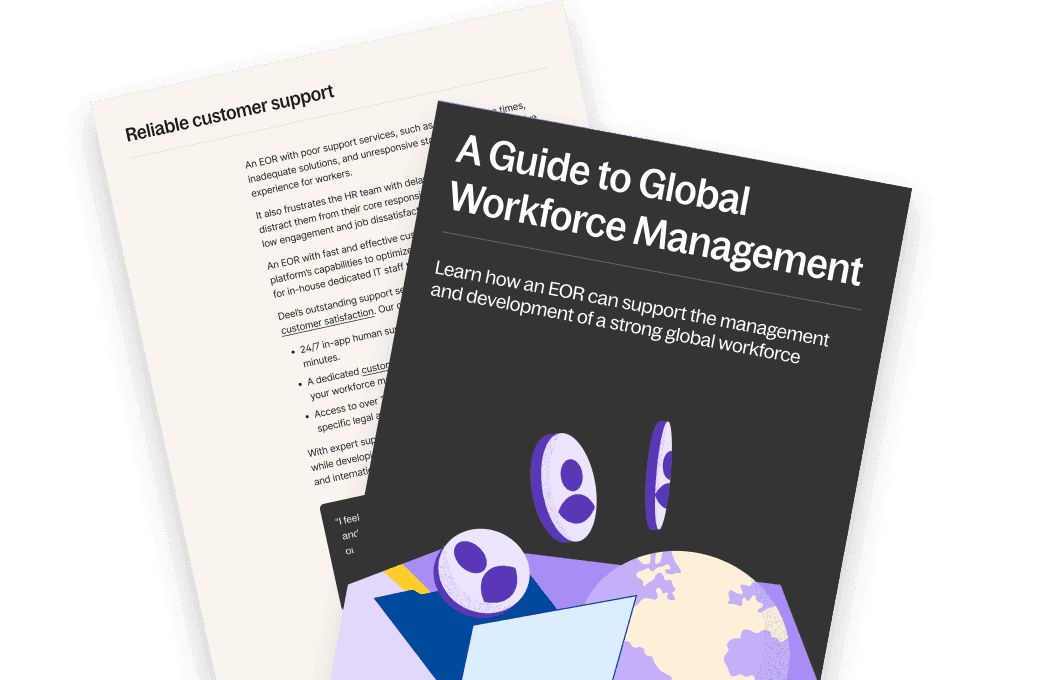
Get the resource for free
Global workforce management becomes complex fast. Employment laws, tax filings, social security obligations, and compliant employment contracts vary across countries.
An Employer of Record (EOR) simplifies global expansion. EOR services act as the legal employer, handling compliance with local labor regulations and employment responsibilities.
The right infrastructure enables scalable growth. With centralized payroll, compliance, and workforce data, companies can expand internationally without setting up a legal entity in every market.
As companies expand beyond their home country, workforce management becomes significantly more complex.
What worked locally—manual HR processes, siloed systems, informal oversight—breaks down when managing remote work across multiple jurisdictions. Leaders face mounting challenges: navigating employment laws, ensuring compliance with local labor requirements, running payroll across currencies, and managing tax filings and social security contributions.
Without the right structure, global expansion creates operational friction instead of competitive advantage.
This is where an Employer of Record (EOR) plays a strategic role.
Rather than setting up a local or legal entity in every country, businesses can use EOR services to hire internationally while maintaining full compliance. The employer of record handles employment responsibilities, ensures compliant employment contracts, and acts as the legal employer on your behalf — allowing you to focus on growth.
What makes this guide different?
This isn’t a high-level overview of global hiring.
This guide focuses specifically on EOR-powered workforce management, including:
How employer of record (EOR) services support global hiring
The employment responsibilities an EOR handles, from payroll to tax filings
Ensuring compliance with local labor laws and social security requirements
The differences between EOR and professional employer organization (PEO) models
When to choose EOR instead of setting up a legal entity
How EOR supports remote work and distributed teams
Transitioning from fragmented systems to scalable workforce management
You’ll gain a clear understanding of how to build a compliant, centralized infrastructure for managing international teams.
Who will benefit from this guide?
HR and People leaders managing global expansion
Operations teams overseeing workforce management across regions
Legal teams ensuring compliance with local labor and employment laws
Finance leaders responsible for tax filings and payroll accuracy
Companies exploring entity setup vs EOR models
Organizations hiring remote employees across multiple countries
What’s inside?
The benefits of EOR-powered workforce management strategies
How a full-service EOR enhances hiring, compliance, and workforce development
A breakdown of employment responsibilities and legal employer obligations
Key compliance considerations across multiple jurisdictions
A comparison of EOR vs professional employer organization (PEO) models
A framework for moving from inefficiency to scalable global success
More resources
FAQs
What does an Employer of Record (EOR) handle?
An Employer of Record handles employment responsibilities including compliant employment contracts, payroll, tax filings, social security contributions, and ensuring compliance with local labor laws.
Do I need to set up a legal entity to hire internationally?
Not necessarily. EOR services allow you to hire globally without setting up a local or legal entity in each country.
How is EOR different from a professional employer organization (PEO)?
An EOR acts as the legal employer in countries where you don’t have an entity. A professional employer organization (PEO) typically requires you to already have a registered entity.
Is EOR suitable for long-term global expansion?
Yes. Many companies use EOR as both a market-entry solution and a long-term workforce management strategy.
Does EOR support remote work?
Yes. EOR services are commonly used to hire and manage remote employees compliantly across borders.