
Guide
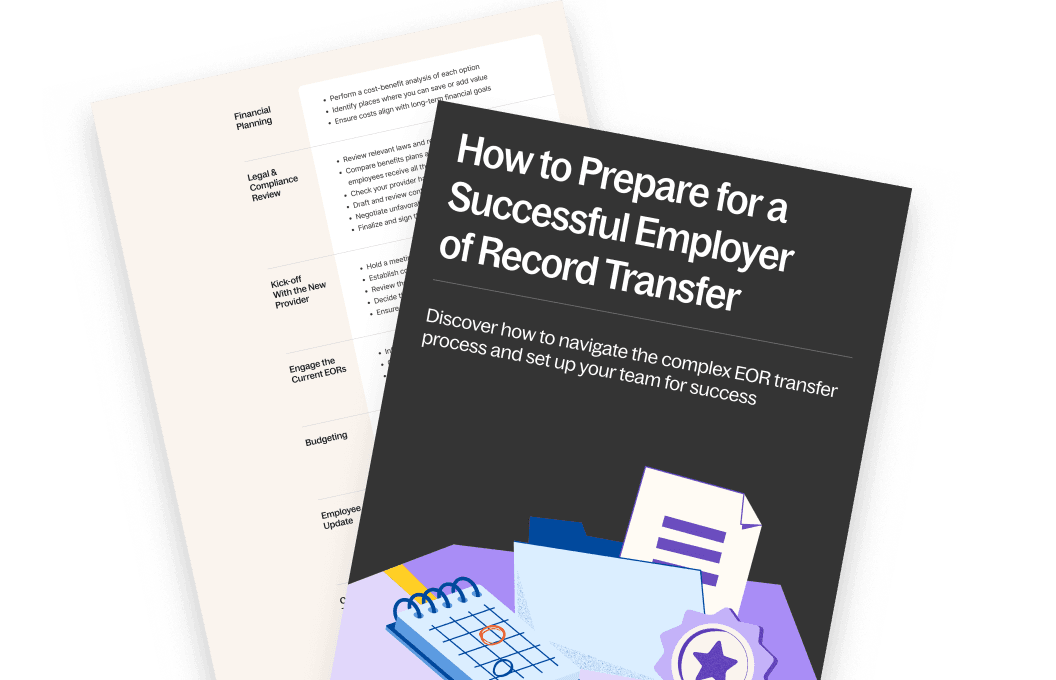
How to Prepare for a Successful Employer of Record Transfer [Checklist Included]
Employer of record
Get the resource for free
Many enterprise companies find that as they scale, managing multiple employer of record (EOR) providers becomes a bottleneck rather than a bridge to growth. Consolidating your workforce under a single global partner is a strategic move, yet the prospect of the transfer itself can be complex.
The EOR transfer process is demanding, involving massive data migrations, diverse legal requirements, and sensitive employee data. Without a clear roadmap, you risk operational disruptions and compliance gaps.
This free guide provides the clarity and framework you need to navigate a successful EOR transfer and capitalize on the benefits of a unified global platform.
EOR transfer guide overview
Moving an entire workforce to a new employer of record requires more than just a signed contract. It requires a meticulous transition plan that protects both your business and your people. This resource breaks down the intricate steps of the transition, so you can move forward with confidence.
When you download the guide, you’ll gain access to:
- A step-by-step breakdown of the EOR transfer timeline from assessment to post-transfer review
- A clear mapping of roles and responsibilities across HR, Finance, IT, and Legal departments
- A comprehensive checklist of employee, payroll, and compliance data you must collect
- Strategies for managing PTO accruals and benefit changes while maintaining employee retention
Who is this EOR transfer guide for?
We designed this resource for large-scale organizations navigating the friction of global expansion. This guide is for:
- VP of People and HR Directors managing 1,000+ employees who need to consolidate multiple EOR vendors into one streamlined system
- Chief Financial Officers looking to reduce the administrative overhead and financial risks associated with fragmented international payroll
- Global Procurement Managers evaluating new EOR partners who need to understand the practicalities of the EOR transfer before finalizing a contract
- Legal and Compliance Officers tasked with ensuring that a massive data transfer meets global privacy standards and local labor laws
How to use the EOR transfer guide
This tool acts as your strategic partner during the transition. To get the most out of it, we recommend following this workflow:
- Audit your current landscape: Identify exactly why your current setup is no longer sustainable, whether it's lack of support, poor software, or rising costs
- Assemble your cross-functional team: Use the roles and responsibilities table to assign tasks to your HR, finance, procurement, info security, IT, and legal leads early in the process
- Map your timeline: Plot the stages from the guide onto your internal project management tool, accounting for notice periods and system integration windows
- Compile data: Follow the provided checklists to gather required documents and data upfront to avoid bottlenecks
- Refine the employee experience: Use the communication tips to navigate change management with your employees, addressing benefits and PTO concerns before they turn into resistance
Streamline your global workforce operations with Deel
Consolidating your EOR services enables compliant global expansion and improved workforce management. By following a proven framework, you can minimize the risk of payroll delays and ensure your team is supported, no matter where they are.
From data migration to employee onboarding, the right preparation ensures a smooth transition to a comprehensive EOR provider that supports your business’ scalability.
Download our guide to learn more about how Deel can be a strategic partner to your enterprise growth.
FAQs
What is an Employer of Record (EOR) transfer?
An EOR transfer is the process of moving your international employees from one third-party legal employer to another. This involves ending the previous employment contracts and signing new ones with the incoming provider, while ensuring continuity in payroll, benefits, and compliance.
How do you prepare for an EOR transfer?
To prepare for an EOR transfer, you must identify all key stakeholders, collect comprehensive employee data, and establish a clear timeline that accounts for notice periods. It is critical to communicate early with employees about how their benefits and PTO might change to maintain trust and retention.
What are the biggest risks during an EOR switch?
The primary risks include data inaccuracies during migration, potential disruptions to payroll, and employee dissatisfaction due to benefit changes. Missing a tax deposit deadline by even a single day can result in significant financial penalties and compliance issues.
Can employees keep their accrued PTO during a transfer?
PTO accruals typically cannot be carried over between different EOR legal contracts. However, companies can manage this by offering a payout for unused time, allowing a grace period for employees to use their balance, or adding the equivalent days to the new contract.
What role does IT play in an EOR transfer?
The IT department evaluates the compatibility of the new EOR’s software with existing internal systems. They also work alongside Infosec to review security certifications and ensure that the large-scale transfer of sensitive employee data meets all required privacy standards.
Why should a company consolidate multiple EORs?
Consolidation simplifies global operations by providing a single source of truth for all employee data. It reduces the administrative burden on HR and Finance teams, offers better visibility into global labor costs, and ensures a consistent experience for employees regardless of their location.