
Guide
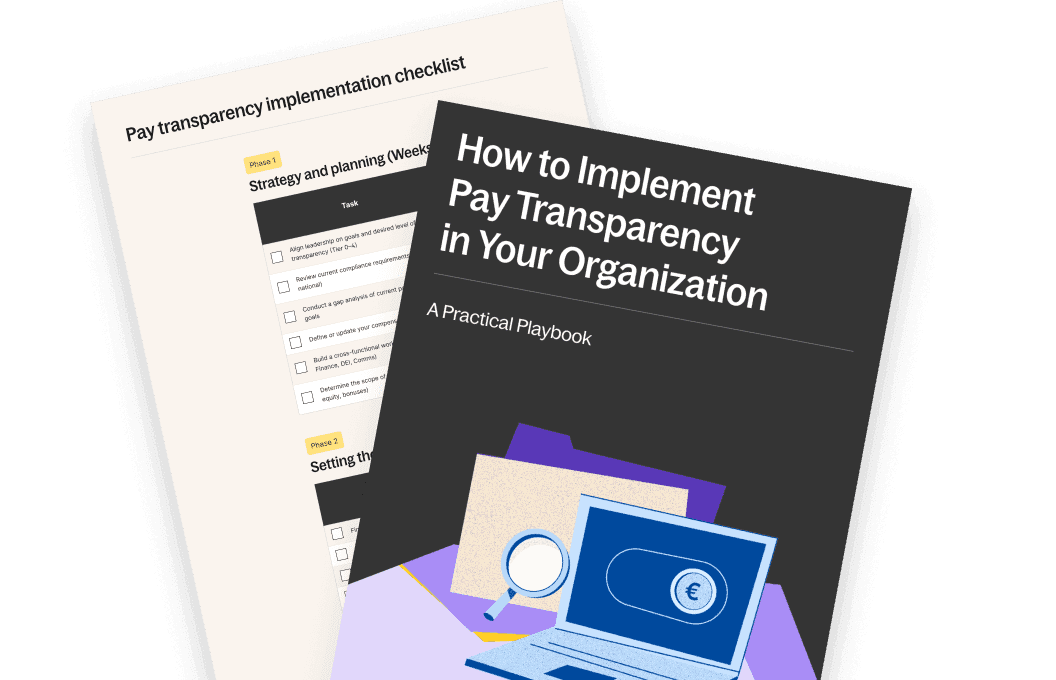
How to Implement Pay Transparency in Your Organization: A Practical Playbook
Global HR
Get the resource for free
Pay transparency is no longer a “nice to have.” With laws like California’s Equal Pay Act and the EU Pay Transparency Directive taking effect, companies can’t afford to wait. But legal compliance is just the start.
When done right, transparency builds trust, strengthens your employer brand, and closes pay gaps. When done poorly or not at all, it creates confusion, exposes inequities, and puts your team on edge.
How to Implement Pay Transparency in Your Organization: A Practical Playbook is a hands-on guide for HR and People leaders navigating the operational, cultural, and legal realities of rolling out pay transparency.
Guide overview
Most companies don’t know where to start with pay transparency. That’s where this playbook comes in. Inside, you’ll get:
A framework to determine your current transparency readiness
Step-by-step guidance for building a compensation philosophy and salary bands
Actionable advice for analyzing and addressing disparities in employee compensation to ensure alignment with your pay transparency goals
Best practices for communicating transparently with employees
Tips for training managers and rolling out changes smoothly
Best practices for maintaining and refreshing compensation bands, keeping your compensation structures relevant, fair, and aligned with market trends
A post-launch maintenance guide to keep your strategy on track
A checklist and timeline to help you stay organized from planning to execution
Who is this guide for
People and HR leaders at high-growth companies
Compliance-conscious execs navigating new regulations
Compensation managers building equitable systems across markets
Anyone launching or leveling up a pay transparency strategy
Whether you’re just starting out or refining an existing approach, this resource helps you avoid missteps and build a pay system people actually trust. Download the guide now.
FAQs
What is the case for salary transparency?
Salary transparency supports:
Pay equity (reduces unexplained differences)
Fairer negotiation (especially for underrepresented groups)
Faster hiring (candidates self-select based on fit)
Stronger retention (less resentment over hidden pay gaps)
Pay transparency also puts HR in a position of proactive control rather than reactive defense.
What is full pay transparency?
Full pay transparency means disclosing:
All salary bands (often internally)
Actual salaries (sometimes public)
Pay criteria used in decisions
Progress on equity goals (like closing gender gaps)
Full pay transparency is quite rare and often linked to progressive employer branding.
Buffer offers a great example of full pay transparency, with all salaries being publicly available. They are also transparent with the way compensation decisions happen, and their Open Salary System, introduced in 2024, which covers three elements:
Market data: Market data of salaries in tech for our company size, from which Buffer derives salaries
Buffer benchmarks: A grid of every role at Buffer with every level within that role. The grid provides a single view of how salaries progress for each role at Buffer
Buffer salaries: The salaries for everyone in the team and the calculations to arrive at each salary.
What is the Pay Transparency Directive?
The EU Pay Transparency Directive is a new regulation requiring companies to share clear information about salary ranges, pay structures, and pay gaps. It includes:
Disclosing salary ranges in job ads
Giving employees access to pay criteria
Requiring reporting on gender pay gaps
Banning pay secrecy clauses
It applies to companies operating in the EU, even non-EU companies with a significant EU presence—over 100 employees living in EU member states—and aims to promote pay equity.
EU member states are expected to translate the Directive’s provisions into national legislation by June 2026.
Should companies post salary ranges?
Yes, and increasingly, they must do so according to regulations. Posting salary ranges:
Builds trust with candidates
Reduces negotiation bias
Saves time screening mismatched applicants
Is legally required in a growing number of jurisdictions (e.g., New York, Colorado, California, British Columbia in Canada)
If you’re hiring in multiple countries or states, it’s safer to default to transparency rather than manage patchwork compliance.
What is an example of a pay transparency policy?
A simple, compliant policy might include:
All job postings include a base salary range
Pay decisions are based on defined criteria (experience, scope, geography)
Employees may request their pay range and the criteria used
HR conducts annual pay equity audits
Such pay transparency policy sets expectations and protects against ad hoc decisions.
Can two employees doing the same job be paid differently?
Yes, two employees doing the same job can be paid differently, but only under justifiable, documented reasons. Such reasons include:
Differences in experience, education, or performance
Location-based cost-of-living adjustments (if consistent)
Without a clear rationale, differences in pay for the same role can raise pay discrimination concerns, especially under transparency laws or internal audits.
What is considered pay discrimination?
Pay discrimination happens when two employees doing substantially similar work are paid differently based on gender, race, age, or other protected characteristics without valid, performance-based, or business-justified reasons.
Transparency makes this risk more visible and legally actionable.
How can organizations prepare for pay transparency?
Some key steps to prepare for pay transparency include:
Audit current pay ranges and actual salaries
Document pay criteria and job leveling
Identify unexplained pay gaps
Align leadership and train managers
Build a framework for publishing or sharing salary ranges
We recommend starting with internal visibility before going public.
How can organizations communicate pay transparency to employees?
To communicate pay transparency to employees, it’s critical to prioritize clarity and structure. Elements you must cover include:
What pay transparency means at your company
What employees can access or expect
How salaries are set and reviewed
Where to go with questions
Use onboarding, handbooks, and manager training to reinforce it.
Which US states have pay transparency laws?
Several states and several cities (like NYC) have pay transparency requirements, including:
Colorado
California
Washington
New York
Illinois
Nevada
Maryland
Connecticut
Rhode Island
Hawaii
Maryland
Minnesota
Vermont
Washington
Each has different rules (e.g., range posting, wage disclosure, salary history bans), so multi-state employers need to stay informed.
Several other jurisdictions have proposed pay transparency laws similar to these. They include West Virginia, Washington, D.C., Virginia, South Dakota, Oregon, Montana, Missouri, Michigan, Maine, Kentucky, and Alaska.
What are the privacy concerns of pay transparency?
Pay transparency can bring major benefits such as equity and trust. Still, it also raises real privacy and workplace culture risks that need thoughtful handling.
Top privacy concerns include:
Employees feeling exposed or judged: Not everyone wants their salary known, even internally. Publicizing individual pay without consent can cause resentment or embarrassment, especially if it exposes legacy discrepancies.
Misinterpretation of pay gaps: People may assume discrimination or favoritism without the full context (e.g., differences in tenure, experience, or geography). Even justified differences can look unfair without explanation.
Manager vulnerability: Pay transparency can expose inconsistent past decisions or unclear criteria. Managers may struggle to explain differences they didn’t originally oversee or document.
Global complexity: Pay structures vary widely in multi-country companies. Revealing pay across regions without local context could lead to confusion or misalignment.
Clear, contextual communication helps, as does pairing transparency with job leveling and rationale. Additionally, In some countries, salary is considered personal data. Always check local rules before sharing individual figures.
More resources
Navigating the Spectrum of Pay Transparency in Your Compensation Strategy
How to Use Benchmarking Data for Compensation Planning and Decision Making
Best Practices for Creating a Location-Based Compensation Strategy
Compensation Training for Managers: Boost Leaders’ Confidence and Employee’s Motivation
From Spreadsheets to Strategy: How Compensation Leaders Can Become Business Advisors
Empowering Managers as Trusted Partners in Compensation Management