
Guide
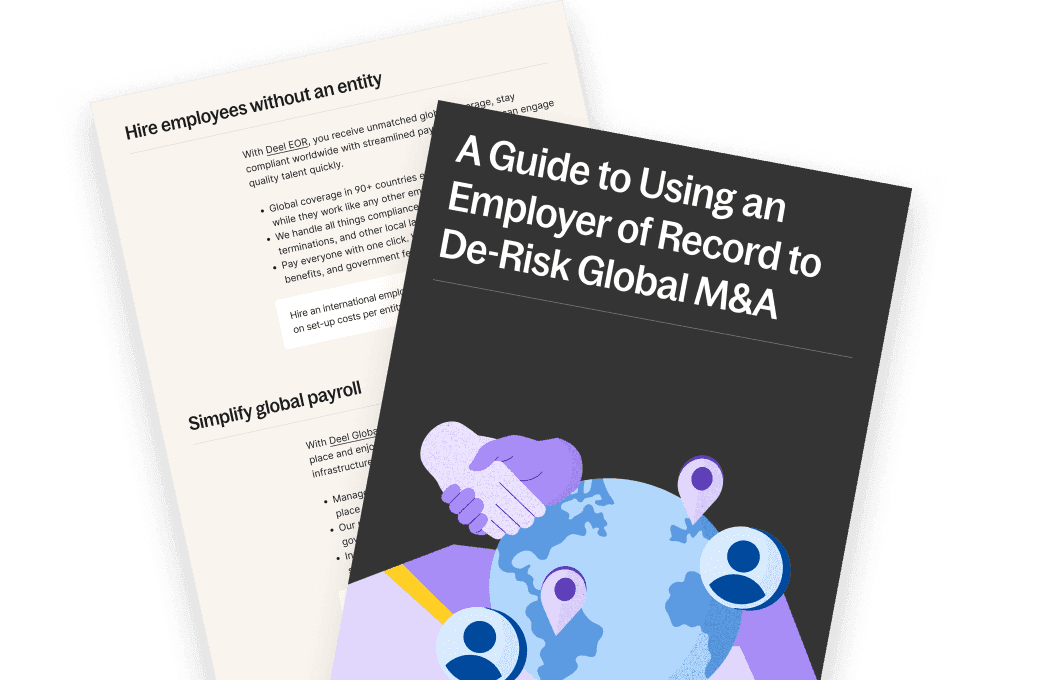
A Guide to Using an Employer of Record to Mitigate Global M&A Risk
Legal & compliance
Employer of record
Get the resource for free
In 2025, global M&A volume reached $5.1 trillion as companies moved to fortify supply chains and diversify services through international investment. But behind every successful deal lies a mountain of regulatory hurdles, system integrations, and talent retention risks that can stall momentum.
When you are moving hundreds of employees across different jurisdictions, the complexity of local payroll laws and labor regulations become a significant friction point. This guide provides insight on how to navigate these complexities using an Employer of Record (EOR). Whether you are managing a carve-out or an acquisition, we’ll outline how to maintain operational continuity without the delay of setting up local entities.
Global M&A Risk Mitigation Guide Overview
The cost of delays in an M&A process not only have financial impacts, but cultural as well. This guide explores the components of international deals that introduce the most significant challenges and provides actionable EOR-driven strategies to overcome them.
From maintaining compliance under the European Commission’s Acquired Rights Directive (ARD) to avoiding permanent establishment risks, we provide the roadmap you need for a smooth transition.
In this guide, you’ll gain insights on:
- EOR use cases in M&A scenarios
- How leveraging an EOR can facilitate key components of M&As, such as post-merger integration, speed to close, talent retention, compliance management, and more
- The M&A process with Deel
- How Deel’s workforce infrastructure supports businesses during M&As and beyond
Who is this global M&A guide for?
We designed this resource for enterprise leaders navigating the high-pressure environment of international business transfers:
- M&A Dealmakers pursuing cross-border investments who need to manage global regulatory compliance
- HR Directors at expanding enterprises struggling with talent retention and cultural integration post-merger
- Finance and Legal Teams looking to reduce consultancy fees and entity setup costs
- Operations Leaders needing to consolidate fragmented payroll and IT systems across multiple countries
How to use an EOR to de-risk your M&A
Leveraging an EOR allows you to move employees and maintain operations without waiting months for local bank accounts or government approvals. Here is how to implement this strategy:
1. Conduct operational due diligence
Before the deal closes, identify the countries where you will inherit employees but lack a legal entity. Assess the headcount in each jurisdiction and determine if an EOR is a viable long-term solution or a temporary bridge while you activate your own entities.
2. Identify and mitigate bottlenecks
Entity setup can take months. The UAE typically takes around nine months, while the Netherlands might take less than one. Use an EOR to onboard employees immediately, avoiding payroll disruptions and ensuring you meet speed-to-hire targets.
3. Execute benefits and payroll harmonization
Ensure the acquired employees receive benefits equal to or better than their previous terms. Deel’s in-house experts help you design locally compliant packages that include statutory coverage and market-aligned perks to prevent attrition.
4. Integrate tech stacks and systems
Consolidate your global workforce data. By integrating with tools like Workday or SAP, you can eliminate duplicate costs and maintain a single source of truth for all worker types, whether they are contractors or EOR employees.
Mitigate M&A risks with Deel
From operational due diligence to final post-merger integration, Deel supports every phase of the M&A lifecycle. We help you save over $200,000 on setup costs per entity while ensuring your new team is onboarded in as little as three days.
Download our Guide to Using an Employer of Record to Mitigate Global M&A Risk to gain a deeper understanding of how to leverage an EOR to benefit your M&A process.
FAQs
What is an Employer of Record (EOR)?
An Employer of Record (EOR) is a third-party company that hires employees on behalf of businesses, handling payroll, tax compliance, and benefits. While the EOR assumes all legal responsibilities, you retain control over the employee’s workload, schedule, and performance.
How can I apply mergers and acquisitions EOR tips to speed up a deal?
Setting up a legal entity to hire in a new country can take months due to local laws and banking delays. An EOR acts as a stopgap, allowing you to hire and pay employees in another country in as little as three days, which can potentially eliminate the need for Transition Services Agreements (TSAs).
What are the risks of misclassification in M&A?
If a selling company has misclassified employees as independent contractors, the buyer inherits that legal liability. Using an EOR ensures that every worker is correctly classified according to local labor laws, protecting the acquiring company from future fines and legal action.
How does the Acquired Rights Directive (ARD) affect M&A?
The ARD is a European Union regulation that ensures employees involved in an M&A transaction are transferred to the new business. In many cases, this legislation means you cannot terminate employees immediately following the transfer, making pre-planning essential for compliance.
When is an EOR not suitable for an acquired workforce?
If you have a large acquired workforce or face elevated permanent establishment (PE) risk due to executive or leadership presence, direct employment through a local entity is a better option. C-level employees generally cannot be transferred using an EOR as it increases PE risk.
What is benefits harmonization?
Benefits harmonization is the process of aligning the benefits of acquired employees with the acquiring company's standards while ensuring they are equal to or better than their previous terms.
How does Deel handle data protection during a merger?
Deel adheres to enterprise-grade security standards to protect sensitive information. By consolidating global employee data into a centralized platform like Deel rather than dispersing it across multiple local providers, you reduce the risk of data leaks and ensure GDPR compliance.