Article
6 min read
How Deel Eliminated 900 Engineering Hours of Firefighting with a 4-Agent AI System
AI

Author
Deel Team
Last Update
August 27, 2026

Scaling payroll looks straightforward in theory. You’re hiring faster, syncing more records, all while staying compliant. But if your failure rate stays roughly constant while your volume goes up, your absolute number of failures climbs at the same pace you're hiring. If your engineering team doesn't grow with it, suddenly you're spending more time investigating failures and less time building what actually matters.
At Deel, we process US PEO payroll for thousands of new hires continuously, and when a sync fails, there’s a new hire waiting on their first paycheck. That made our old triage process impossible to ignore, not because we cared about efficiency metrics, but because of what it was actually costing us.
The real cost of firefighting
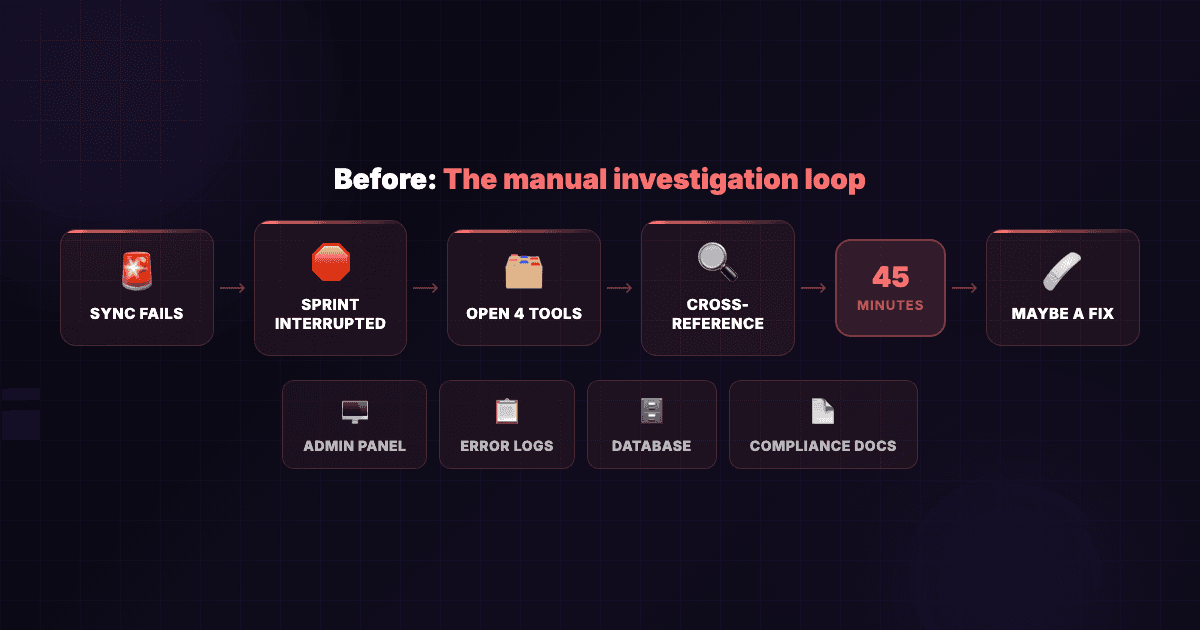
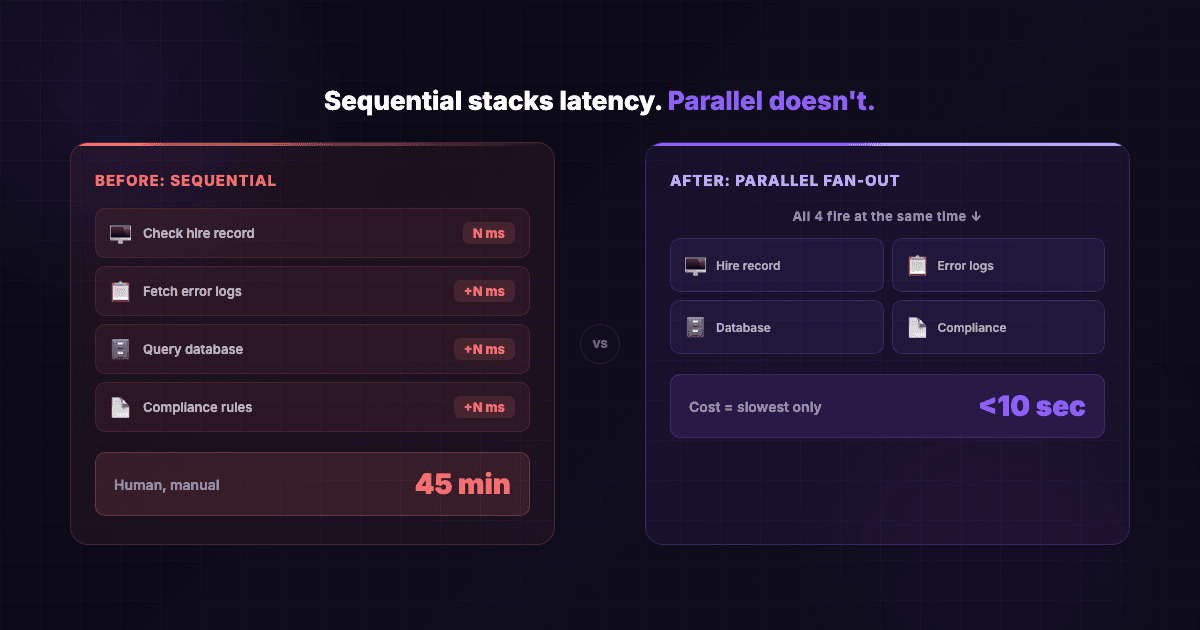
A payroll sync fails, and an engineer drops their sprint work to investigate the problem. What happens next is the pattern we kept seeing repeat: they pull up four separate tools simultaneously — our payroll system, the hire record database, the error logs, and the employment compliance rules — and then spend the next 45 minutes reconstructing what went wrong by cross-referencing error messages and system state across all of them.
A spike of failures, which wasn't uncommon during peak hiring periods, could result in an entire engineering team’s day being consumed by investigating. We were routing our most expensive resource to our least valuable work.
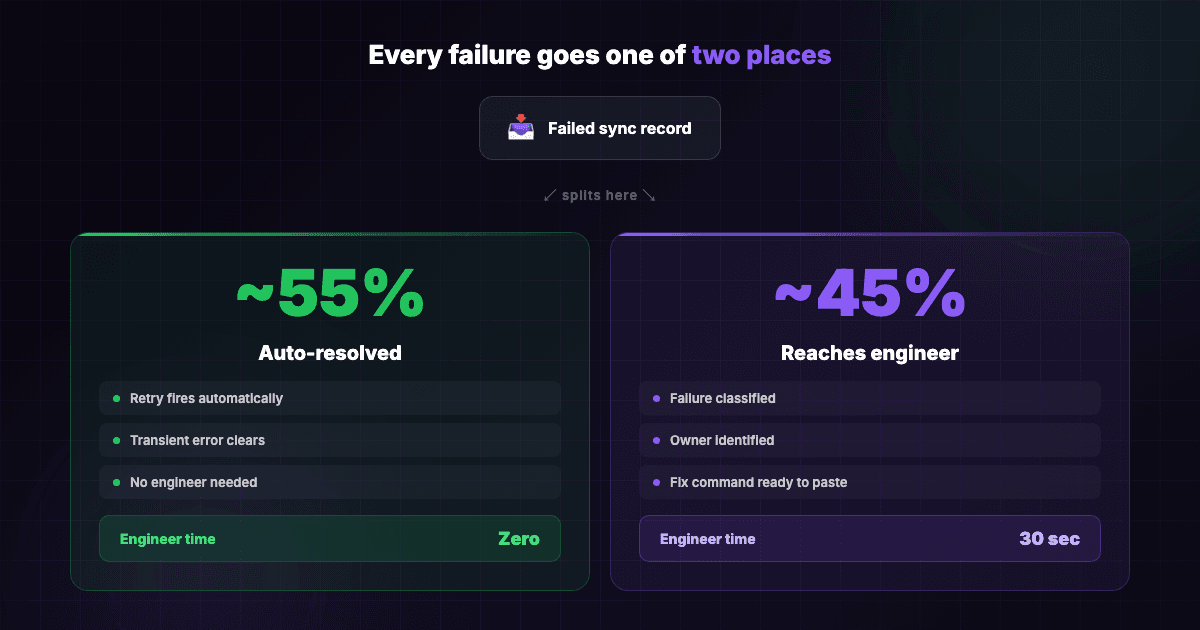
When we looked into it, about 55% of failures were transient; database locks during high-write windows, race conditions on hire records finalizing, and timing issues that resolved themselves. The conditions that caused them were gone by the time anyone looked. Without a system tracking outcomes across every case, that pattern was invisible. Each failure looked like a unique problem worth investigating, since none of them announced themselves as "just retry me."
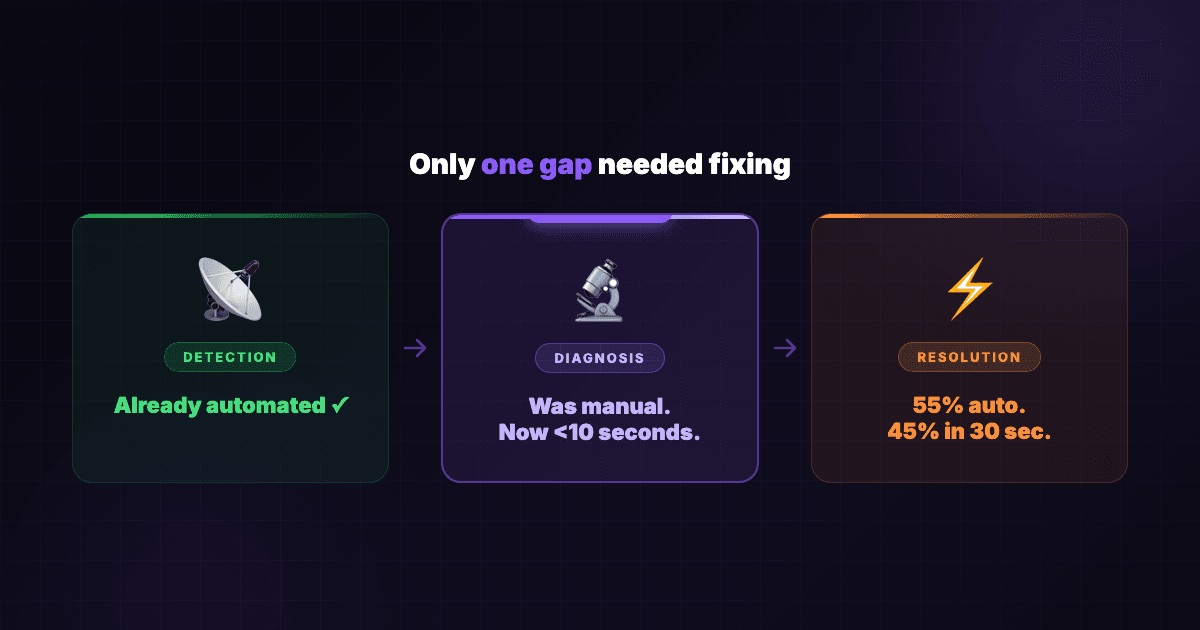
We could have added retry-with-backoff sooner, but you can't confidently fire a retry on a payroll record without first knowing whether the failure is transient or structural. If it's structural, a retry can compound the problem, and so the diagnosis has to happen either way. What the agent changed is that both happen in seconds instead of one happening over 45 minutes.
What we built
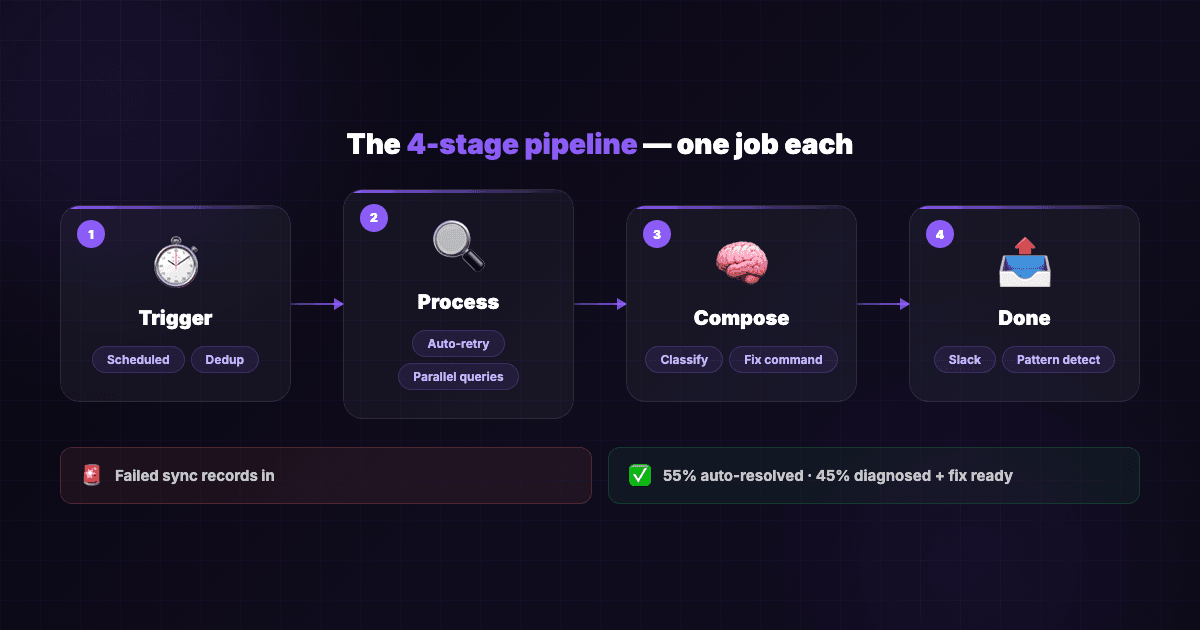
Instead of focusing on how to investigate failures faster, we started asking ourselves how we could avoid investigation altogether. We deployed a four-stage pipeline on Akai, Deel's internal AI orchestration platform, with each stage owning one specific job and handing off cleanly to the next without any manual intervention or need for an engineer to kick it off.
Stage 1: Detection and batching
Every few minutes this stage wakes up, scans the payroll system for failed syncs, deduplicates them, and groups related failures together before handing off a clean batch downstream, all without requiring a Slack ping or human trigger.
Stage 2: Retry and investigation
This stage fires an automatic retry on every failure, and about 55% of the time, that's the entire end of it—the transient error clears itself and no investigation is necessary. For the remaining 45% of cases, it fans out in parallel to check hire record state, pull logs from monitoring systems, query the payroll database, and cross-reference compliance rules all at the same time. None of those operations block each other, which is why diagnosis lands in under 10 seconds even though it's touching four separate systems.
Stage 3: Classification and remediation
This stage translates system noise into actual meaning by categorizing the failure—duplicate SSN, invalid address, missing tax filing status, bad routing data, and others like them—and then it does what used to consume most of an engineer's time: it figures out whose problem this actually is, whether it's on the employer, employee, or Deel side, and writes out the exact command needed to fix it.
Stage 4: Delivery
The final stage packages everything into Slack with one section per failure, copy-paste fix commands, and direct log links, and it also scans across cases to recognize when the same error is repeating across multiple new hires from the same company, surfacing that as a single employer-level setup issue rather than flooding the team with ten individual alerts.
The 45-minute problem we refused to accept
The numbers speak for themselves:
| Metric | Before | After |
|---|---|---|
| Time per triage | 45 minutes | Under 10 seconds |
| Peak capacity | Full engineering day for 4-6 cases | 20+ cases simultaneously |
| Auto-resolved | 0% | 55% |
| Hours reclaimed annually | — | 900+ |
Engineers didn't disappear from the loop, but the headache did. About 55% of cases now self-resolve without anyone touching them, and the rest still reach an engineer. However, now they arrive as a 30-second review rather than a 45-minute investigation, which means the engineer knows exactly what's broken and exactly what needs to happen next.
How we do it
This isn't Deel-specific, and the architecture isn't novel. It maps onto any infrastructure triage challenge you might have. Here's what actually made it work for us:
Sequential stages with parallel operations inside. Each stage runs after the last one completes, but the critical performance win happens inside the Investigation stage, where all data fetches fire at the same time, which means none of them block each other, and that's the difference between a 40-second operation and a 10-second one.
Specific failure taxonomy. The Classification stage has a structured taxonomy of failure types, and the beauty of this approach is that adding a new failure category when you encounter something in production is just a one-line prompt change.
Clean JSON handoffs between stages. Each stage takes clean JSON, does its work, and outputs clean JSON, which means there's no shared state and no mysterious interdependencies.
Immediate retry as the default. Most failures are transient, so the logic is simple: retry immediately, measure what percentage actually clears itself, then investigate what's left.
Beyond payroll
The payroll system is our use case, but the pattern itself scales to anywhere infrastructure gets noisy, whether that's API failures, database incidents, cloud provider errors, or customer support escalations where you have high volume, some signal buried in noise, and you need to separate what can be fixed automatically from what actually needs a human being involved. While the specific tools change, the logic stays the same: retry, diagnose, classify, route.
Most organisations route everything to humans and hope they can sort it out, which works fine until you're hiring fast and the volume overwhelms the team. Automate what you can, and save human judgment for what you can't.
How Deel helps
Deel's platform handles payroll complexity so your engineers don't have to spend their time investigating it, and we do that by using AI-orchestrated workflows to manage the high-volume, low-signal work. Your engineers can focus on what actually needs them: building resilience into the system and making sure these failures don't happen in the first place, rather than spending their days firefighting breakdowns.
Book your Deel demo, and see what it looks like to scale global payroll without the headaches.
Live Demo
Get a live walkthrough of the Deel platform