Article
4 min read
3 Ways to Equip a New Hire Fast When You Can't Wait 2 Weeks for Shipping
IT & device management

Author
Dr Kristine Lennie
Last Update
November 19, 2026

Table of Contents
Why growing teams can't get devices to new hires in time
Solution #1: Order through a platform with local warehouse fulfillment
Solution #2: Keep a small loaner pool for genuine emergencies
Solution #3: Source locally when the market makes global shipping impractical
Stop losing the first week to shipping delays — how Deel IT helps
FAQ
Getting a device to a new hire fast comes down to three things: local warehouse fulfillment, a small loaner pool, and in-country sourcing for harder markets. Deel IT covers all three across 130+ countries, and with Deel IT Self-Serve you can start ordering today — no contract, no minimum order.
A new hire starts in ten days. You confirmed the role yesterday; the device hasn't been ordered, and standard shipping from your usual vendor runs seven to ten business days once the order finally goes in.
So what now? The clock is already running, and the usual process — pick a vendor, agree the spec, route the approval — takes longer than the ten days you have. There are three ways to work around it, and the one that fits depends on your destination country and on what you've already got in place.
Why growing teams can't get devices to new hires in time
Two weeks looks like plenty of time to get a laptop to someone. So why does it so often run out? For a team hiring into a country it hasn't hired into before, there's no vendor relationship waiting, no confirmed spec, and no pricing on file. Everything gets built from scratch, on the clock.
The table below breaks the fourteen days down step by step, with a column for what typically goes wrong at each one. It's worth reading against your own last hire — the step where your process stalls is the one to fix first.
| Day | What happens | Typical duration | What can go wrong (+ extra time) |
|---|---|---|---|
| Day 0 | HR confirms the hire and notifies IT | 0.5 days | IT finds out through a Slack message, or not at all: +1–2 days |
| Day 1–2 | IT identifies a vendor and confirms the device spec | 1–2 days | First hire in this country, so no vendor relationship exists: +2–3 days |
| Day 2–3 | Order submitted for finance or manager approval | 1 day | Approval sits in a queue, or the manager is in another time zone: +1–2 days |
| Day 3–5 | Vendor processes the order and confirms availability | 1–2 days | Spec is out of stock locally and ships from a central hub: +3–5 days |
| Day 5–7 | Device configured and prepared for shipping | 1–2 days | Configuration left for the employee: no delay, but the device arrives unenrolled |
| Day 7–14 | Shipping to the employee's location | 3–7 days | International shipping into a new market: the start date is already gone |
Read the right-hand column, and it gets worse: any two of those delays landing together pushes a fourteen-day process past three weeks.
Solution #1: Order through a platform with local warehouse fulfillment
The table showed where the days go. A lot of that time disappears because each step waits on the one before it — the spec can't be confirmed until a vendor is chosen, the approval can't be routed until there's a price, and nothing ships until all of it clears. Ordering through a platform with a pre-built catalog, an existing vendor relationship, and checkout that needs no prior setup removes those dependencies. The first five days collapse into an afternoon, and because the device ships from inside the employee's country, shipping runs on a domestic timeline instead of an international one.
How to make this work in practice:
Check whether the platform ships from in-country stock: A device leaving a warehouse inside the employee's country skips customs entirely and typically halves the delivery time. Of everything in this section, this is the variable that most often decides whether the device makes the start date.
Confirm you can order without a prior contract or seat minimum: A platform that requires a sales conversation before your first order costs you two to three days you don't have. Credit card checkout removes that step completely.
Check whether the platform tracks the device after delivery: Ordering fast is worth less if the device disappears from view once it lands. Serial number, assigned user, and lifecycle stage should be recorded automatically at order time, not reconstructed later from email receipts.
Confirm the price you see includes duties and taxes: A quote that excludes import charges can turn into a customs invoice weeks later, or a device held at the border. In-country fulfillment avoids most of this, but it's worth confirming rather than assuming.
Why this works: For most markets in Europe, the US, and large parts of Asia-Pacific, a device ordered today arrives well before the start date — and arrives ready to use.
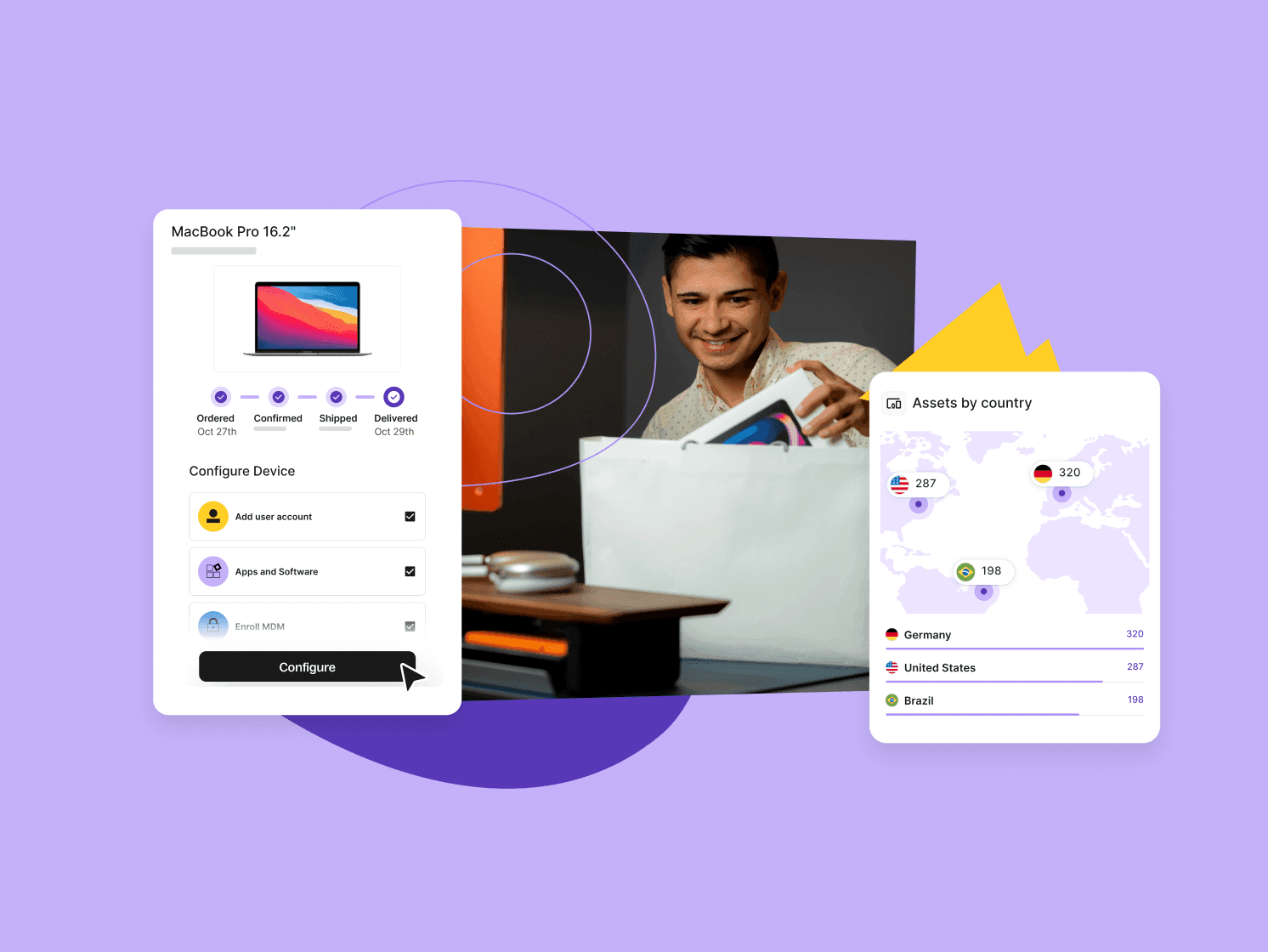
How Deel IT helps: Deel IT ships from local warehouses in 130+ countries with a 99.5% on-time delivery rate, with customs and taxes handled and no vendor relationship, contract, or sales call needed to place a first order. Every device is checked in with its serial number and appears in the asset tracker automatically, so the fleet record builds itself from the first order.
Explore Deel IT Self-Serve → Browse devices and accessories, configure for the destination country, and check out by credit card — no sales call, no contract, no seat minimum. Your first order can ship today.
Read: Why new hires start without equipment — and how to fix it
Solution #2: Keep a small loaner pool for genuine emergencies
Solution #1 works whether or not you planned ahead to implement it. But there's another option that beats it on speed, and it suits smaller teams especially well — as long as you set it up before you need it. Set aside two to four pre-enrolled devices in local storage, so that when a hire comes in at short notice, you can hand one over and they can start with a working, policy-compliant machine while the permanent device is still in transit.
How to build a pool that actually works:
Size the pool to your hiring cadence, not your headcount: Two devices if you hire one to three people a month in that country, three or four if you hire four to eight. Beyond that, a pool gets harder to keep stocked, and it's worth putting the same effort into the ordering process instead.
Enroll every loaner before it goes into storage: A device that needs enrolling on the morning it's needed isn't really a loaner. Everything in the pool should be enrolled, encrypted, and policy-compliant well before anyone is assigned to it.
Assign the loaner a day early, not on the morning: A machine that's been in storage for months will want a charge and a queue of updates before it's usable. Pull it the day before the start date, plug it in, and let it update overnight — so the new hire opens a machine that's ready to work.
Document the handoff before the first one happens: Who assigns the loaner, who tracks where it went, and what happens when the permanent device lands and the loaner needs wiping and returning. A process that lives in one person's head breaks the first time that person is on holiday.
Why this works: The employee starts on time on a compliant device, and the permanent order goes through your normal process with no deadline hanging over it. The scramble disappears because the decision was made months ago.
The catch: A loaner pool is capital sitting idle, and it only covers hires in the country where the devices are stored — which is no help when the hire is in a market you've never shipped to. It also creates a second handover: the employee sets up once on the loaner, then again on the permanent device, and someone has to chase the loaner back and wipe it. For teams hiring into one or two familiar markets, that overhead is worth it. For teams hiring across many countries, it usually isn't.
How Deel IT helps: Deel IT applies MDM enrollment at provisioning, so devices ordered into a loaner pool arrive enrolled, encrypted, and policy-compliant before they're ever assigned. The handoff to a new hire takes minutes instead of an IT session.
See also: DLM vs MDM — what global teams need to know
Solution #3: Source locally when the market makes global shipping impractical
The first two solutions assume shipping into the destination country is viable. In a handful of markets, it isn't. Import duties, customs clearance, and local certification requirements can add two to three weeks to an otherwise standard order into Brazil, India, or much of sub-Saharan Africa — enough that the device arrives after the employee's first month, not their first day.
The way around it is to buy the device inside the country rather than send one in. A local supplier sources and delivers domestically, which takes customs out of the equation entirely — but it only works if you've found that supplier before the hire is confirmed.
How to make local sourcing work:
Look up the destination country's import rules first: Before you commit to any route, check the duty rate, the typical customs clearance time, and whether the device needs local certification. Your local supplier or freight forwarder can confirm all three, and the answer decides whether you import or source in-country.
Line up a local supplier before you need one: Pick your two or three hardest markets and find a business reseller in each — your local entity, an EOR partner, or a country payroll provider can usually recommend one. Get a named contact, a price list, and confirmation they can enroll devices before handover, so the next urgent hire is a phone call rather than a search.
Confirm the specific model is certified for that market: Certification applies to the device, not the category — a model approved in one country isn't automatically approved in another. Ask the supplier to confirm the exact model you're ordering is cleared for sale there before the order goes in.
Build enrollment into the sourcing process: Local sourcing fixes the logistics, not the configuration. Agree with the supplier upfront that devices are enrolled and encrypted before handover, or you've solved the shipping problem and inherited a setup problem.
Why this works: With customs and import duties out of the equation, a device sourced and shipped inside the same country typically arrives in two to four days — faster than international express, and without the compliance risk that comes with importing.
The catch: This doesn't scale. A separate supplier, contract, and invoice in every complex market is a procurement overhead of its own, and it grows with each country you hire into. For one or two hard markets, it's manageable. Past that, you're maintaining a vendor network as a side effect of hiring.
How Deel IT helps: Deel IT ships from local warehouses in 130+ countries, including the markets where importing is hardest. The in-country fulfillment is already in place, with customs and taxes handled, so a first order into Brazil or India works the same way as an order into Germany.
Read: 5 things most companies get wrong about international IT logistics
Before your next hire starts: a quick checklist
The three solutions each fit a different situation. This checklist runs across all of them — work through it for every hire, and the choice of which route to take gets made early enough to matter.
Confirm before you order
☐ IT knows about the hire the same day HR confirms it
☐ The employee's country, start date, and delivery address are all confirmed
☐ You've checked the destination country's import rules and decided whether to import or source in-country
☐ You've identified a vendor or platform holding stock in that market
☐ The spec is settled, and you know what you'd order instead if it's unavailable
Confirm before the device ships
☐ MDM enrollment has been applied at the warehouse, not left for the employee
☐ Tracking has gone to the employee and their manager
☐ Express shipping is selected if the standard timeline doesn't clear the start date
☐ A loaner is assigned if the permanent device might not arrive in time
Confirm before the employee starts
☐ The device has arrived, and the employee has confirmed receipt
☐ Enrollment is verified — the device is enrolled, encrypted, and policy-compliant
☐ Accounts, SSO, and application access are ready on the device
☐ The serial number, assigned user, and delivery date are recorded in your asset tracker
Stop losing the first week to shipping delays — how Deel IT helps
Deel IT takes out the five to seven days that go on vendor selection, spec sign-off, and approval routing before an order is even placed. Browse devices from a global catalog, configure for the destination country, and check out by credit card — no sales call, no contract, no seat minimum. The order goes in the same day the hire is confirmed, the device ships from a local warehouse, and the employee opens a pre-configured, MDM-enrolled machine before day one.
Here is what that looks like in practice:
Global procurement from local warehouses: Deel IT ships to 130+ countries with a 99.5% on-time delivery rate, with customs and taxes handled. For in-country orders, there's no border to cross and no lead time to absorb.
MDM enrollment at provisioning, not post-delivery: Every device leaves the warehouse enrolled, encrypted, and policy-compliant, so the employee opens a working machine rather than a setup task.
Self-serve ordering with no contract or seat minimum: Place your first order or your thousandth on the same platform, by credit card, without a sales conversation. The catalog is live, and checkout is immediate
Asset tracking from the first order: Devices are checked in with their serial numbers and appear in your asset tracker automatically, so device status, ownership, and lifecycle stage sit in one place from the very first order.
Book a demo to learn more.
Deel IT
Procure, deliver, manage, and secure devices anywhere

FAQ
What is the fastest way to get a device to a new hire in under two weeks?
Order through a platform with in-country warehouse stock for the employee's location. International shipping — even express — adds customs clearance time that in-country fulfillment avoids entirely. For most markets in Europe, the US, and large parts of Asia-Pacific, a device ordered today can arrive within two to four days. The other variable is the process before the order is placed: vendor selection, approval routing, and stock checks can consume five to seven days on their own. Removing that process through a self-serve catalog is what makes the two-week window achievable rather than theoretical.
Does express shipping solve the problem?
It helps, but only for part of the problem. Express shipping compresses the transit window — typically to one to two days within Europe and the US. It does not compress the process upstream of shipping: vendor selection, spec confirmation, and approval routing still happen before the order goes in. If those steps take five days, express shipping saves two days of a seven-day problem. The bigger gain comes from removing the upstream process, not from paying for faster transit.
What should I do if the new hire is in Brazil, India, or another high-complexity market?
These markets have import duty structures, local certification requirements, or customs timelines that make international shipping impractical regardless of speed. Brazil's import duties and India's BIS certification requirements are the most common examples. For these markets, local sourcing — or a platform with in-country warehouse stock — is the correct approach. Attempting international shipping into Brazil or India under a two-week constraint will almost always miss the start date.
What happens if the device doesn't arrive before day one?
A pre-enrolled loaner from a small in-office pool is the cleanest fallback — the employee starts on a policy-compliant device and the permanent machine follows. If no loaner is available, the employee will typically start on a personal device, which creates an MDM enrollment gap and a period where company data sits on an unmanaged machine. The better answer is to build the loaner pool before the urgency arrives, and to use a platform with local warehouse fulfillment so the permanent device arrives on time in the first place.
About the author
Dr Kristine Lennie holds a PhD in Mathematical Biology and loves learning, research and content creation. She had written academic, creative and industry-related content and enjoys exploring new topics and ideas. She is passionate about helping create a truly global workforce, where employers and employees are not limited by borders to achieve success.