Article
4 min read
How to Drive Real AI Adoption, Starting With Your People
AI

Author
Alice Burks
Last Update
July 29, 2026

About the author
Alice Burks is Director of People Success at Deel. She has a passion for transforming the workplace and is dedicated to creating a new world of work where individuals have access to the best global opportunities and organizations can connect with top-tier talent. Prior to Deel, Alice was Global Head of Learning at DICE and Global Leadership Development Partner at Trustpilot.
AI is now mainstream at work. 72% of employees globally use AI on a regular basis. That's a remarkable shift in a short period of time.
But looking more closely at those numbers, a different story emerges. Among frontline workers, regular AI use has stalled at just 51%, and hasn't meaningfully moved in two years. Leaders and managers are driving that 72% figure, and much of the workforce is being left behind.
In my view, this isn't a technology problem, since the tools exist and in many cases, companies have already made them available to every employee. This is a training problem, a confidence problem, and a culture problem. All three sit squarely in L&D's territory, which means people teams have a bigger role to play in AI transformation than your organization may currently give you.
The training gap is bigger than you think
The numbers tell the story quickly:
Only 36% of employees feel adequately trained on the AI skills needed for their role. (BCG)
18% of people who are already regular AI users received no formal training at all. (BCG)
Only 7.5% of employees have received extensive AI training; 23% report receiving none whatsoever. (WalkMe)
Three in four employees abandon AI tools mid-task, citing concerns about output quality and poor fit with how they actually work. (Udacity)
Companies lost an average of $104 million in 2024 due to underused tools and poor rollout. (WalkMe)
Sources:
BCG: AI at Work 2025
WalkMe: AI in the Workplace Survey 2025
Udacity: The AI Adoption Gap Report 2025
What this tells us is that most organizations have treated AI adoption as a deployment problem. Buy the tools, announce the rollout, and assume the rest follows. But it doesn't, and a workforce that's technically using AI but not confidently or consistently isn't a success story. It's expensive experimentation with no real payoff, and the people caught in the middle of it often feel more overwhelmed than empowered.
You can't mandate your way to this
The instinct for many organizations is to push harder: send the all-company message, make the training module mandatory, set a deadline. I understand the impulse, but the evidence suggests it doesn't work.
When people don't feel supported by official AI programs, they go around them. Multiple surveys and reports from last year highlighted that most employees are already adopting AI by bringing their own tools to work. They’re using the personal ChatGPT and Claude accounts that they’ve learned on their own time, because they trust what’s familiar and see it as a shortcut to productivity. This creates multiple risks, including compliance and security gaps. It also means your organization’s AI use amounts to another fragmented patchwork of systems, missing the main benefit of AI entirely — consolidation.
The answer is not a stronger mandate. It's a better program.
Complementary reading
Lead with curiosity as well as compliance
The goal in the early stages of any AI adoption program shouldn't be proficiency. It should be reducing fear and building curiosity. People adopt new tools when they feel psychologically safe to try them, fail quietly, and try again.
One of the most powerful levers here is leadership visibility. BCG's research found that the share of employees who feel positive about AI's impact on their career rises from 15% to 55% when they receive strong leadership support. But only about one in four frontline employees say they're currently getting that. The gap between what's possible and what's actually happening is enormous.
At Deel, we've tried to close that gap through mechanisms that make AI adoption social rather than assessed. Two examples that have worked well for us:
Peer sharing calls. We run regular employee-led sessions where we showcase AI success stories born of experimentation. While we have good attendance and participation during our live training sessions, these showcase sessions serve as both inspiration and proof that our AI systems exist to solve day-to-day problems for teams. Having someone say, ‘Here’s the rote work that took up too much time, here’s the app I whipped up to handle it for me, here’s the code for you to use it yourself,’ is more powerful than any e-learning module.
Upvoting ideas. We maintain an open channel where people share prompts, use cases, and workflow hacks, and colleagues can upvote the most useful ones. This crowdsources best practices organically. It also creates visibility: when someone in a completely different function shares something genuinely useful, it travels fast, and people start to see AI fluency as a shared team asset rather than a personal achievement.
The principle behind both of these is the same: make learning visible, make it social, and remove the stakes from experimentation. The best L&D often doesn't look like L&D.
Leadership-driven adoption: enthusiasm isn't enough
Here's something I think leaders need to hear directly: your team is watching you very carefully right now — and not just to see whether you're using AI yourself.
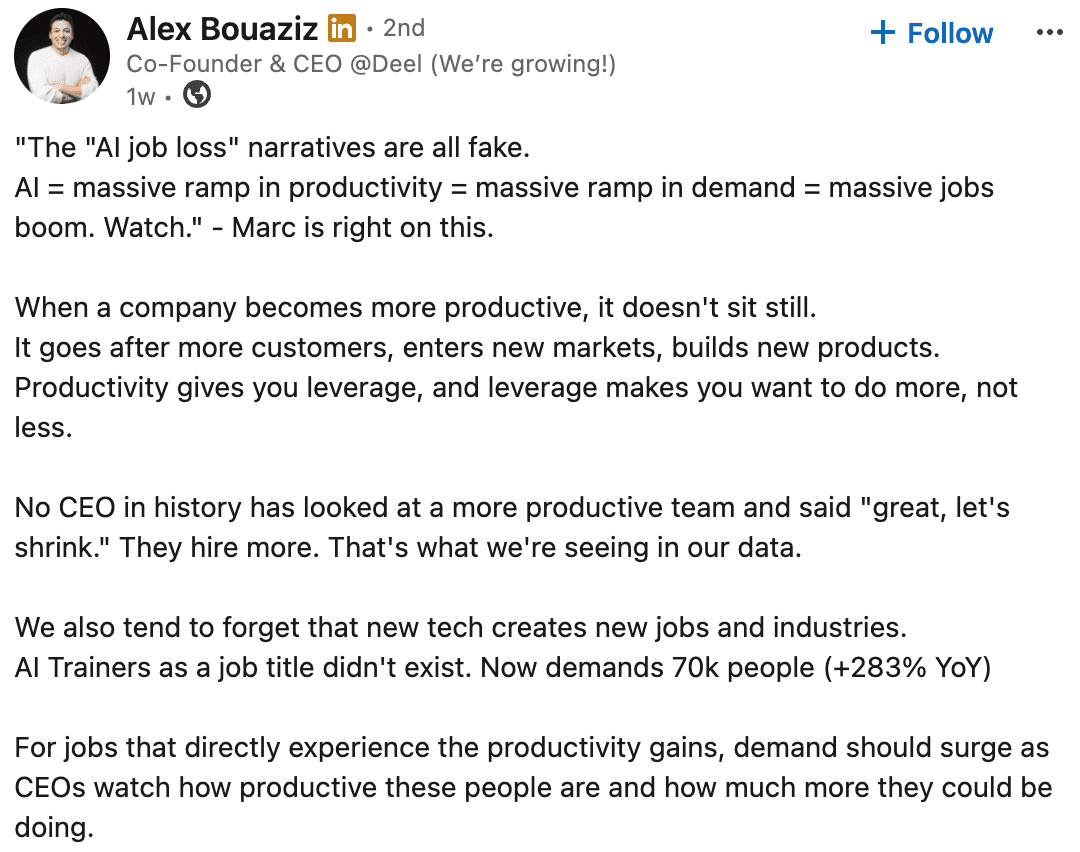
In 2025, companies directly cited AI in announcing 55,000 job cuts, more than 12 times the number attributed to AI just two years earlier. High-profile examples, including Microsoft, Amazon, and Klarna, made headlines for reducing headcount alongside major AI investment. At the same time, multiple sources regularly publish lists citing which roles are the most ‘exposed’ and at risk of being replaced by AI. Your Ops team might be thrilled by AI, but your Marketing team might be sweating.
While our research shows that AI is causing a job shift rather than massive job losses, the perception that AI replaces humans and the anxiety that perception drives are very real. Recognizing that anxiety is key to knowing how to communicate with teams about AI adoption.
That is the emotional backdrop against which your AI adoption program lands. A top-down push that focuses purely on efficiency gains — "this will save us time so we can do more" — doesn't just fall flat in that environment. It actively feeds the anxiety. People hear "save us time" and translate it as "need fewer of us."
So what does good leadership-driven adoption actually look like?
It starts with honesty. Leaders at every level, from department heads to the C-suite, need to be willing to have a real conversation about AI: what it will change, what it won't, and where the organization genuinely doesn't have all the answers yet.
It also requires leaders to model genuine curiosity rather than performative enthusiasm. There's a meaningful difference between a CEO who announces that AI is the future of the company and a manager who opens a team meeting by sharing something they tried with an AI tool that week, including the part where it didn't work as expected. The latter builds trust. The former, in the current climate, can feel like a warning shot.
Think about the managers you've seen handle change well. They're rarely the ones who arrived with the loudest message or the tightest deadline. They're the ones who sat with their teams, asked what was actually hard, and shared their own stumbles along the way. AI adoption is no different. A manager who opens a team meeting by saying, "I tried something with AI this week, and it completely fell over — here's what I learned" does more to boost team confidence than any company-wide rollout communication.
The L&D opportunity of a generation
AI adoption is one of the most significant organizational change challenges of our time. And the levers that make the difference — curiosity, psychological safety, peer learning, manager modeling, structured upskilling — are precisely the things that L&D teams are built to do.
This isn't a technology team's problem to hand back to HR once the tools are deployed. People teams need a seat at the table from the start, because the tools will only ever be as good as the humans using them.
At Deel, we use Engage to build training programs, create competency frameworks, and manage development cycles at scale, including for programs like our AI adoption tracks. If you're thinking about how to build this kind of program for your own organization, we'd be happy to show you how.
Live Demo
Get a live walkthrough of the Deel platform
Alice Burks is the Director of People Success at Deel. She has a passion for transforming the workplace, and is dedicated to creating a new world of work where individuals have access to the best global opportunities and organizations can connect with top-tier talent. Prior to Deel, Alice was Global Head of Learning at DICE and Global Leadership Development Partner at Trustpilot.