Article
6 min read
Enterprise IT Onboarding: How to Deploy Devices to Employees Anywhere
IT & device management

Author
Dr Kristine Lennie
Last Update
May 14, 2026

Key takeaways
Delivering devices to employees around the world becomes much harder at enterprise scale. As companies hire in more countries, IT teams often face inconsistent delivery timelines, growing vendor complexity, and onboarding processes that weren’t built for global operations.
Solving this requires treating device deployment as operational infrastructure rather than a series of manual onboarding tasks. Enterprise IT teams need standardized workflows that connect procurement, provisioning, security, and lifecycle management globally.
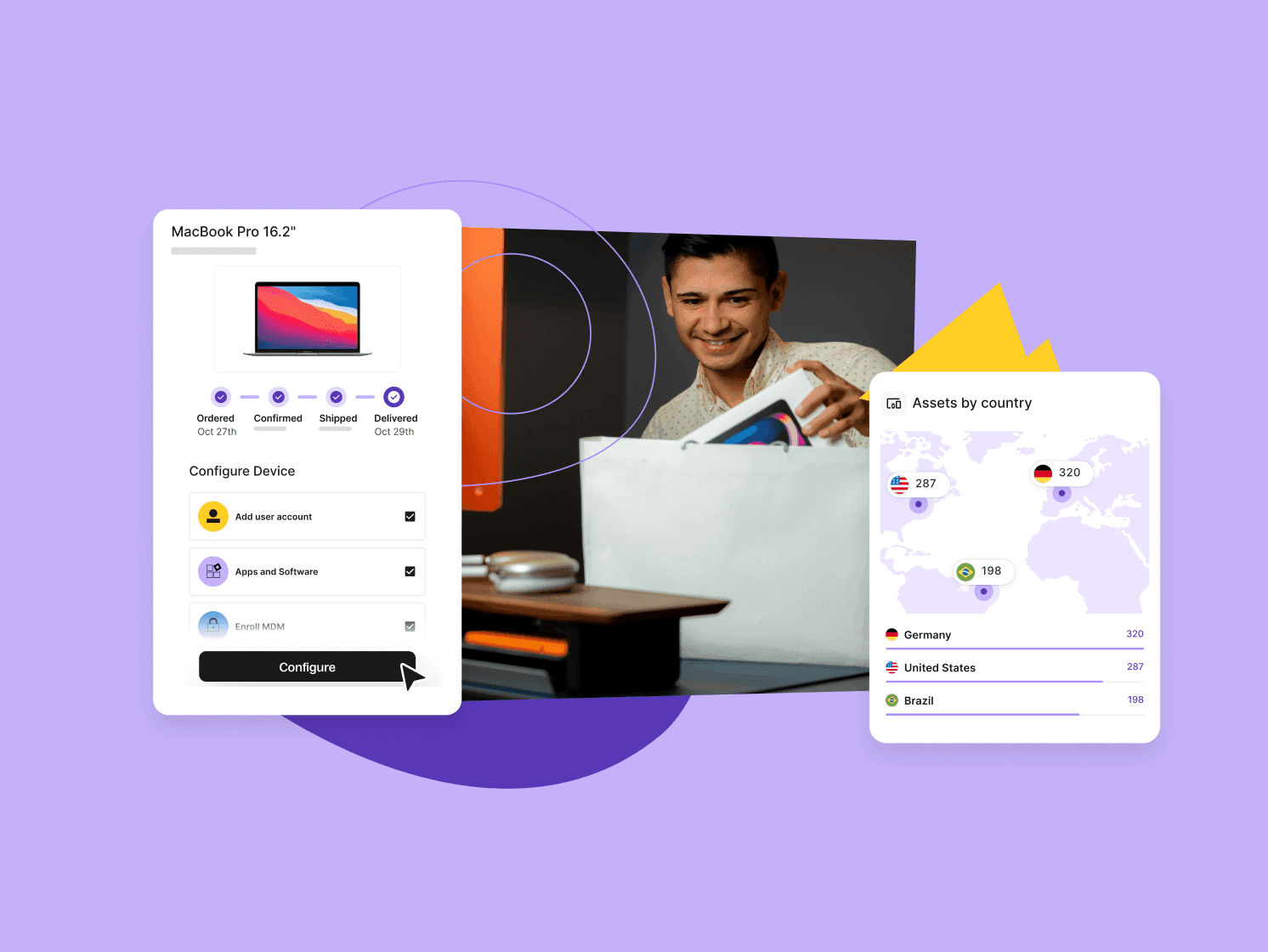
Deel IT gives enterprise teams a single system to procure, configure, and ship devices to employees in 130+ countries, with zero-touch enrollment and MDM integration built in, so new hires are productive on day one without IT managing a separate vendor relationship for every region.
As companies expand into new markets, device deployment becomes increasingly difficult to manage at scale. Processes that once worked for a smaller or more centralized workforce often start breaking down once hiring expands across five, ten, or twenty countries.
For enterprise IT teams, the challenge quickly shifts from logistics to operations. Delays in provisioning, inconsistent onboarding experiences, and fragmented regional processes create growing coordination overhead as the business scales internationally. Most organizations discover that their onboarding workflows were never designed to support that level of global complexity.
This article explores why enterprise device deployment breaks down at scale, how to fix it, and what to look for when evaluating a global IT platform.
When enterprise device deployment stops scaling
For companies of all sizes, device deployment depends on multiple workflows operating together. But as hiring expands internationally, keeping those workflows aligned becomes far more complex. Processes that once felt manageable can gradually create delays, inconsistencies, and operational overhead that make onboarding harder to coordinate and more expensive to scale.
The signs are usually operational before they become strategic:
Inconsistent delivery timelines by country: New hires in some regions receive devices days before their start date, while others wait weeks after onboarding begins
A growing network of regional vendors: IT teams engage a new reseller or logistics partner every time the company hires in a new market
Delayed Mobile Device Management (MDM) enrollment: Devices are enrolled after the first login rather than at provisioning, creating a temporary but significant security gap
Regional inconsistencies in provisioning: Imaging, configuration, and security setup vary by location, leading to uneven compliance standards across the fleet
Fragmented device visibility: IT teams rely on spreadsheets, ticketing systems, and disconnected vendor portals to track shipments and inventory
Operational IT headcount growth: Teams spend more time coordinating procurement and logistics than improving infrastructure or employee experience
Disconnected offboarding workflows: Device recovery happens separately from procurement, with no closed-loop system connecting retrieval back to redeployment
The question becomes: what do enterprise IT teams need in place to maintain smooth device deployment and day-one readiness across multiple countries and regions?
How to deploy devices to employees anywhere: a 4-step framework
Reliable global device deployment is not just about shipping laptops internationally. It requires coordinating procurement, provisioning, security, onboarding, and recovery as a single operational system. Here's a four-step framework for getting it right, from procurement to recovery.
Step 1: Standardize procurement and hardware policies
The first step is reducing regional inconsistency.
Enterprise IT teams should define approved hardware catalogs, operating systems, security baselines, and provisioning standards across departments and regions. Without standardization, every onboarding request becomes a one-off operational decision.
A scalable procurement model should also support:
A single procurement workflow regardless of location: IT teams should be able to order devices globally without creating new vendor relationships or logistics paths for each country
Pre-configured devices before shipment: Employees should receive devices that already include operating systems, security policies, and required applications
Predictable regional delivery timelines: Procurement infrastructure should account for customs, import clearance, and carrier reliability before onboarding timelines are finalized
Centralized fleet visibility: Every device, whether in transit, deployed, in storage, or awaiting reassignment, should be visible in one operational system
At enterprise scale, managing separate reseller relationships in every country quickly becomes operationally unsustainable.
Step 2: Automate provisioning and MDM enrollment
Endpoint management becomes exponentially harder when enrollment depends on manual setup after delivery.
Devices should arrive already configured, encrypted, and enrolled in MDM before the employee signs in for the first time.
That means:
MDM enrollment during provisioning: Devices should enter the fleet already enrolled and policy-compliant before employees access company systems
Security enforcement before shipment: Encryption, update policies, and application controls should already be applied when the device arrives
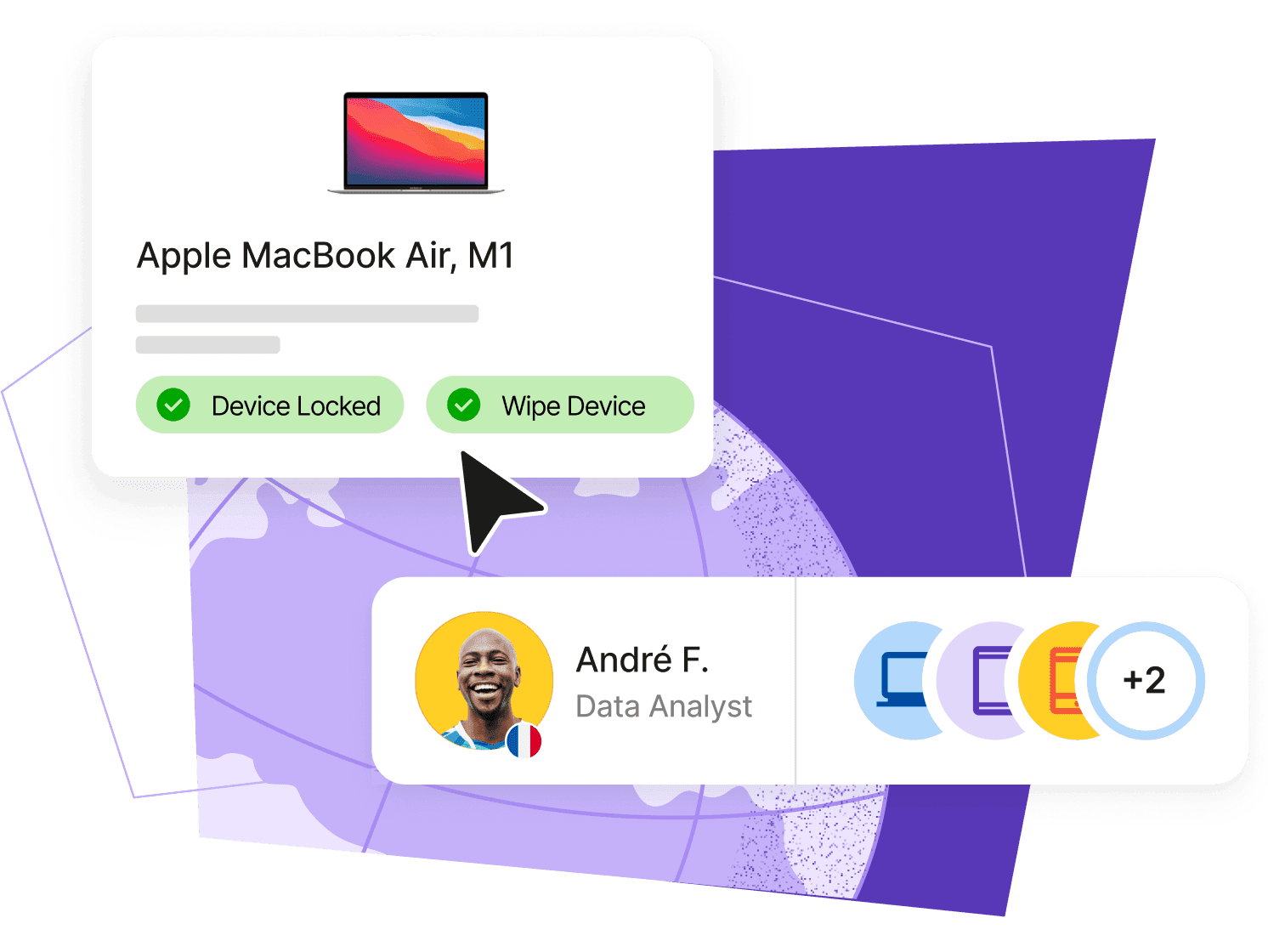
Immediate remote lock and wipe capabilities: IT teams should be able to respond instantly if a device is lost or stolen during transit or onboarding
Continuous compliance monitoring: Enrollment alone is not enough — policy drift and configuration changes should be detected automatically across the fleet
Zero-touch deployment removes onboarding delays while improving security consistency across regions.
Read: How to Improve IT Compliance with Automated Device Management
Step 3: Connect onboarding workflows to HR systems
Many deployment failures happen because IT receives onboarding information too late or through disconnected systems.
Modern enterprise onboarding workflows connect directly to the HRIS, so device deployment begins automatically when a hire is confirmed.
That includes:
Automatic provisioning triggers from the HR system: Device procurement and setup should begin as soon as a hire record is approved.
Role-based configuration tied to employee data: Device specifications, applications, and permissions should be determined by role and location automatically.
Coordinated onboarding workflows: Device delivery, account creation, and access provisioning should operate as one sequence rather than disconnected tasks.
Real-time visibility for HR and managers: People Ops and hiring managers should be able to track deployment status without opening IT tickets.
Step 4: Build lifecycle management into offboarding
Deployment does not end when the device reaches the employee.
At enterprise scale, procurement, retrieval, reassignment, and secure erasure all need to operate within the same lifecycle system.
That means:
Automatic offboarding recovery workflows: Device retrieval should begin immediately when an employee's departure is confirmed.
Certified data erasure before reassignment: Every recovered device should go through documented and auditable erasure before redeployment.
Recovered inventory visible within the same system: Retrieved devices should return directly into assignable inventory rather than disappear into storage.
Lifecycle cost visibility across the fleet: Procurement costs, refresh timing, recovery status, and reassignment history should be tracked centrally.
Without closed-loop lifecycle management, enterprises lose visibility, increase hardware costs, and create unnecessary compliance risk.
How Deel IT helps: Deel IT brings procurement, provisioning, MDM enrollment, onboarding automation, and device recovery into a single global platform. By integrating with Deel HR and your existing HRIS, Deel IT automatically triggers device provisioning and onboarding workflows, enabling enterprise IT teams to ship pre-configured devices to employees in 130+ countries and manage the full device lifecycle from deployment to recovery in one system.
Read: Certified Data Erasure for Compliant Device Offboarding
How to evaluate a global device deployment solution
Not every platform that claims global coverage actually delivers it. The gaps that matter most are rarely in the feature list: they appear in the operational details of how a platform handles procurement, enrollment, and recovery across countries it was not originally built for.
| Evaluation area | What enterprise IT leaders should evaluate | Potential red flags |
|---|---|---|
| Global procurement coverage | Does the platform handle sourcing, configuration, and delivery natively in every country you hire in — including customs, import compliance, and local specs? | Limited coverage, e.g., US and EU, but regional resellers engaged for other markets; customs handled by the customer |
| MDM enrollment timing | Is MDM enrollment applied at provisioning before the device ships, or does it require action at first login? | Enrollment is described as “easy to set up” without specifying when in the lifecycle it occurs |
| HR system integration | Does the platform connect directly to your HRIS so that hire events trigger device workflows automatically? | Integration requires a separate middleware tool or manual data export |
| Offboarding and recovery | Does the platform manage device retrieval, certified data erasure, and reassignment as part of the same system as procurement? | Recovery is described as a separate service or handled by a third-party logistics partner |
| Fleet visibility | Can IT see every device — in transit, deployed, in storage, or being recovered — in a single real-time view? | Visibility limited to shipped devices; in-transit and storage status tracked separately |
| Compliance documentation | Does the platform generate audit-ready records for enrollment, policy enforcement, erasure, and recovery automatically? | Compliance reporting requires manual data export or is not available at the device level |
| Support coverage | Is 24/7 IT support available to employees in every country the platform ships to, within the same system? | Support is limited to business hours or handled by a separate vendor |
Enterprise IT onboarding checklist: device deployment
Use this checklist to assess whether your current deployment process is built to scale globally.
Procurement and logistics
☐ A single procurement workflow covers every country you currently hire in
☐ Devices are sourced, configured, and shipped without engaging regional resellers
☐ Lead times are predictable across all regions and accounted for in onboarding timelines
☐ Hardware standards — keyboard layout, power, and OS configuration — are consistent globally
Endpoint security and MDM
☐ MDM enrollment is applied at provisioning, before the device ships
☐ Encryption, OS update policies, and security configurations are consistent across all regions
☐ Remote lock and wipe are available from the moment a device enters the fleet
☐ Compliance status is monitored continuously, not checked at enrollment only
HR–IT integration
☐ Hiring events in the HRIS automatically trigger device procurement and provisioning
☐ Role and location data from the hire record determine device configuration
☐ HR and managers can see device status in real time without opening an IT ticket
☐ Onboarding workflows span HR, IT, and the new hire as a single coordinated sequence
Offboarding and recovery
☐ Device retrieval is triggered automatically when an employee exits
☐ Certified data erasure is completed and documented before reassignment
☐ Recovered devices are visible as available inventory in the same system as procurement
☐ Fleet cost and lifecycle data are visible in one place across procurement, deployment, and recovery
Deploy devices in 130+ countries with Deel IT
Deel IT centralizes the full device lifecycle, from procurement and provisioning, to MDM enrollment, access management, IT support, and recovery—within a single operational platform connected directly to HR systems.
Here is what that looks like in practice:
Global procurement and deployment across 130+ countries: Source, configure, and ship pre-imaged devices worldwide without managing separate regional vendors, customs coordination, or fragmented logistics workflows
240+ device and accessory options in one catalog: Standardize hardware globally with access to laptops, monitors, peripherals, and accessories from leading manufacturers across regions
Zero-touch provisioning and MDM enrollment: Devices arrive encrypted, policy-compliant, and ready to use before the employee signs in for the first time
Fast global repairs and replacements: Coordinate device repairs, swaps, and replacements quickly across regions to reduce downtime and keep employees productive
24/7 global IT support built into the platform: Reliable support across time zones, with built-in ticketing
HR-triggered onboarding automation: New hire, role change, and offboarding events automatically trigger coordinated device provisioning, access management, and lifecycle workflows
Centralized lifecycle management: Track procurement, deployment, recovery, reassignment, and inventory visibility from a single operational system
Continuous endpoint compliance monitoring: Enforce encryption, OS updates, and security policies across the global fleet with real-time visibility into device health and compliance status
Integrated access management and security controls: Manage Single Sign-On (SSO), Multi-Factor Authentication (MFA), and Role-Based Access Control (RBAC) through workflows connected directly to employee lifecycle data
24/7 global IT support built into the platform: Reliable support across time zones, with built-in ticketing
Deel IT
Automate IT operations in 130+ countries
FAQs
What is zero-touch enrollment, and why does it matter for enterprise device deployment?
Zero-touch enrollment is a process where devices are automatically configured and enrolled in your mobile device management system before they reach the employee — no IT intervention required on arrival. It matters because it removes the manual setup step that typically delays productivity, especially when new hires are distributed globally.
How do companies manage device procurement across multiple countries without a centralized system?
Most companies begin by building one-off relationships with local vendors in each country. That works at a smaller scale, but it creates inconsistent lead times, pricing, and compliance standards as headcount grows internationally.
What causes MDM gaps during employee onboarding?
MDM gaps usually happen when device enrollment is treated as a manual step after shipment rather than part of the provisioning workflow itself. Preventing those gaps requires tying enrollment directly to procurement and deployment.
How should enterprise IT teams structure role-based access provisioning?
Role-based access should be triggered automatically from confirmed hire data rather than assigned manually after onboarding begins. That allows device deployment, application access, and security policies to operate as one coordinated workflow.
Dr Kristine Lennie holds a PhD in Mathematical Biology and loves learning, research and content creation. She had written academic, creative and industry-related content and enjoys exploring new topics and ideas. She is passionate about helping create a truly global workforce, where employers and employees are not limited by borders to achieve success.