Article
2 min read
2026 Guide to After-Hours IT Support for a Global Workforce
IT & device management

Author
Dr Kristine Lennie
Last Update
June 10, 2026

Table of Contents
Why after-hours IT support breaks down for global teams
Step 1: Understand when and why employees need after-hours support
Step 2: Design a follow-the-sun model that won't burn out your team
Step 3: Build the systems that enable 24/7 support
Step 4: Keep support coverage aligned with your workforce
Step 5: Make support knowledge accessible across time zones
Step 6: Reduce avoidable after-hours support requests
Run global after-hours IT support with Deel IT
When your team spans a dozen time zones, "business hours" stops being a useful concept. An employee in Singapore, hitting a VPN issue at 9 AM their time, shouldn't have to wait for someone in Austin to start their day to get help. After-hours IT support is how you close that gap, through the right mix of automation, scheduling, and escalation design.
This short guide walks you through how to build a 24/7 IT support model that keeps distributed teams productive.
Why after-hours IT support breaks down for global teams
Traditional 9-to-5 support models assume employees and IT teams work roughly the same hours. For global organizations, that's rarely the case. The same challenge affects employees working flexible schedules, contractors in different regions, and teams supporting business-critical systems around the clock.
And as organizations expand internationally, after-hours support becomes more than a staffing problem. Support requests need to be routed correctly, incidents escalated quickly, and employees given ways to resolve common issues without waiting for an engineer to become available. Without the right processes and technology, gaps in coverage can lead to slower response times, reduced productivity, and unresolved security risks.
To provide reliable support across time zones, organizations need the right mix of people, processes, and technology. The steps below walk through how to build that foundation.
Step 1: Understand when and why employees need after-hours support
Not every organization needs the same level of after-hours coverage. A company with employees concentrated in one region faces different challenges than a globally distributed workforce operating across multiple time zones.
Before designing a support model, identify the situations that most commonly generate after-hours support requests for your organization. These often include:
Employees working outside the support team's business hours
Access and authentication issues that prevent employees from starting work
Critical system outages or degraded application performance
Device failures that disrupt productivity
Security incidents that require immediate investigation or response
Understanding the volume, timing, and impact of these issues helps determine what type of support model your organization needs. Some teams may require true 24/7 coverage, while others can rely on a combination of automation, self-service resources, and on-call escalation for critical incidents.
It's also important to identify which issues genuinely require an immediate response and which can wait until the next business day. This distinction helps organizations focus on after-hours resources where they have the greatest impact on productivity and business continuity.
Find out how to manage remote IT support
Step 2: Design a follow-the-sun model that won't burn out your team
Once you've identified what requires after-hours support, the next step is determining how that support will be delivered. A follow-the-sun model distributes responsibility across regions so employees can receive assistance during their working hours without requiring a single team to cover nights and weekends indefinitely.
When designing your support model:
Define coverage ownership: Determine which teams or regions are responsible for supporting specific employee populations, systems, or time periods.
Create sustainable on-call rotations: Distribute after-hours responsibilities fairly so no single team absorbs a disproportionate share of overnight or weekend work.
Establish escalation paths: Define which incidents require immediate action, who should be contacted, and when issues should be handed off to another team.
Set clear wake windows: Identify the types of incidents that justify contacting on-call staff outside normal working hours and which can wait until the next shift.
Standardize handoffs between regions: Build 30- to 60-minute overlaps between shifts and document incident status, pending actions, and relevant context in a shared ticketing system.
Transparent policies matter as much as the mechanics. Everyone should know who is on duty, how incidents are prioritized, and how responsibilities transfer between teams. A well-designed follow-the-sun model improves response times, reduces confusion during escalations, and helps prevent burnout across distributed support teams.
Step 3: Build the systems that enable 24/7 support
Once the coverage model is defined, the next step is making sure support teams have the systems they need to deliver it. After-hours support depends on fast routing, automation, visibility, and reliable escalation, especially when fewer people are online.
To support employees effectively outside standard business hours, organizations should invest in:
Centralized ticketing and incident management: Route requests from email, chat, and web portals into a single workflow with consistent triage and escalation rules.
Self-service and AI-powered automation: Resolve routine requests such as password resets, access requests, and VPN issues without requiring engineer intervention.
Monitoring and alerting: Detect outages, performance issues, and security incidents before they affect employees or generate support tickets.
Escalation and incident response tools: Route critical issues to the right support personnel quickly and consistently.
Asset and device management: Give engineers immediate access to device history, configurations, and troubleshooting information when resolving incidents.
These systems should work together rather than operate as disconnected tools. A fragmented technology stack often creates more work for after-hours teams because information is spread across multiple platforms.
One common mistake is generating too many alerts. When engineers receive dozens of notifications that don't require action, alert fatigue sets in, and important incidents get missed. Use deduplication, severity-based routing, and alert correlation to ensure only meaningful issues reach the on-call team.
Not convinced? Learn about the benefits of 24/7 IT support.
Step 4: Keep support coverage aligned with your workforce
After-hours support schedules are only effective if they reflect the reality of your workforce. Employee locations change, contractors join and leave, people take time off, and labor law requirements vary across jurisdictions. When support operations aren't connected to workforce systems, organizations risk creating coverage gaps, assigning shifts incorrectly, and introducing compliance issues.
To keep support coverage accurate as the workforce evolves:
Connect HR and scheduling systems: Ensure on-call assignments reflect employee locations, working hours, leave status, and contract eligibility
Track team availability and coverage ownership: Give managers visibility into who is responsible for specific support windows and where staffing gaps may exist
Integrate payroll and time-tracking data: Automatically calculate on-call compensation, overtime, and other support-related payments based on actual activity
Maintain accurate compliance records: Document schedules, hours worked, and compensation decisions to support audits and local labor law requirements
Connecting these systems reduces manual administration and helps ensure support coverage remains accurate as teams grow and change. It also improves transparency by creating a clear record of schedules, responsibilities, and compensation.
Platforms like Deel bring workforce, payroll, and IT operations together in a single system, making it easier to manage global support coverage without relying on spreadsheets and manual reconciliation.
Read: Integrating IT lifecycle management with global HR
Step 5: Make support knowledge accessible across time zones
Even with the right people, schedules, and systems in place, support teams still need access to the information required to resolve issues consistently. When an incident is handed from one region to another, engineers shouldn't have to rely on chat threads or wait for colleagues in another time zone to come online.
When knowledge is fragmented across documents, messages, and individual team members, support quality becomes dependent on who's available at a given moment. A strong knowledge management strategy helps ensure employees receive the same level of support whether an incident occurs at 2 PM or 2 AM.
To improve consistency across regions:
Maintain a centralized knowledge base: Organize troubleshooting guides, policies, and technical documentation so engineers can quickly find information relevant to their role, region, or systems
Create incident-specific runbooks: Document step-by-step instructions for common issues so engineers can resolve incidents without relying on tribal knowledge
Integrate documentation into support workflows: Make knowledge articles and runbooks accessible directly within ticketing, incident management, and collaboration platforms
Keep documentation current: Review and update content regularly as systems, processes, and support requirements evolve
Modern knowledge platforms can further improve efficiency through AI-powered search and contextual recommendations, helping support teams find answers faster and reduce resolution times.
The goal is simple: any engineer, in any region, should be able to access the information they need to resolve an issue without waiting for another team to come online.
Step 6: Reduce avoidable after-hours support requests
The most effective after-hours support models don't just respond to incidents efficiently—they reduce the number of incidents that require after-hours intervention in the first place.
As your support operation matures, look for opportunities to eliminate recurring issues, automate routine requests, and help employees resolve common problems on their own. This allows support teams to focus their attention on the incidents that genuinely require human expertise.
To continuously improve after-hours support:
Review overnight ticket trends: Identify the issues generating the highest volume of after-hours requests and prioritize long-term fixes.
Expand automation and self-service: Reduce reliance on manual intervention for common requests such as password resets, access issues, and routine troubleshooting.
Address recurring root causes: Investigate repeated incidents and resolve the underlying technical or operational issues behind them.
Refine support processes: Update escalation paths, handoff procedures, and runbooks as teams, systems, and responsibilities evolve.
Adjust coverage as workforce needs change: Reassess staffing, schedules, and regional support requirements as the organization grows.
Regular testing can help validate that support processes still work as intended. Simulating outages, access issues, and other high-priority incidents during non-core hours can uncover gaps before they affect employees.
The ultimate goal isn't simply to provide better after-hours support. It's to create an environment where employees need less after-hours support over time.
Read: How automation replaces 500 hours of IT work annually
Run global after-hours IT support with Deel IT
Delivering after-hours IT support requires more than on-call coverage. Teams need reliable support processes, connected workforce data, automated provisioning and deprovisioning, and device management that works across regions and time zones. Deel IT brings these capabilities together in a single platform, helping organizations support global workforces without increasing operational complexity.
24/7 support for distributed teams: Deel IT helps organizations support employees across regions and time zones, ensuring assistance is available regardless of location or working hours
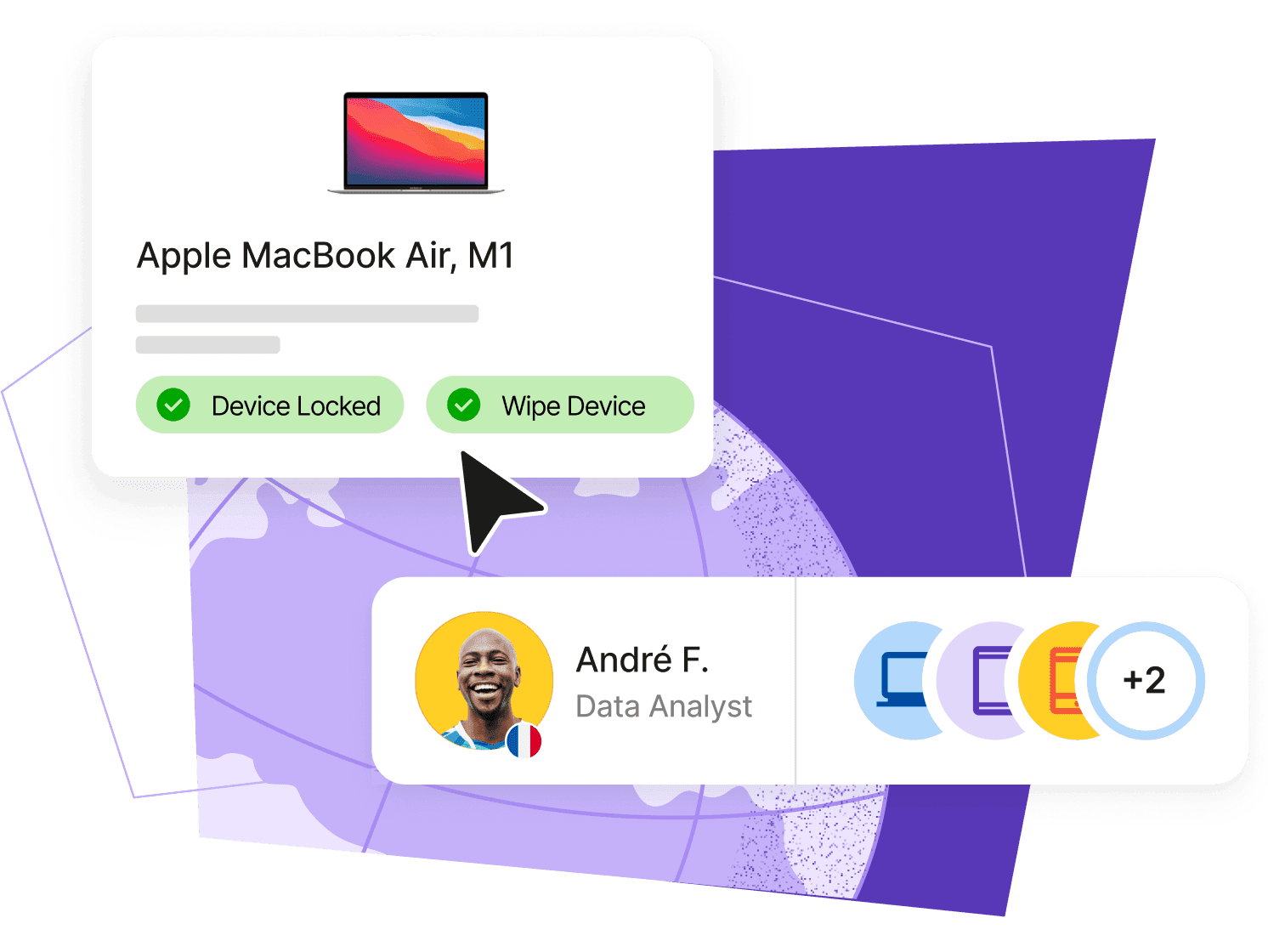
Maintain visibility and control globally: Monitor device compliance, security status, and access activity in real time, and take remote actions such as device lock, wipe, and policy enforcement when needed
Reduce after-hours tickets through automated device management: Zero-touch deployment and Mobile Device Management (MDM) powered by JumpCloud help ensure devices arrive configured, compliant, and ready to use, reducing the number of routine support requests that reach after-hours teams.
Keep access aligned with workforce changes automatically: Access management workflows connect directly to HR lifecycle events, automatically provisioning access for new hires and removing it when employees leave, reducing manual work and minimizing access-related support issues
Strengthen endpoint security without increasing operational overhead: CrowdStrike Falcon provides enterprise-grade endpoint protection and threat detection across managed devices, helping teams maintain security visibility around the clock
Support device repairs and replacements globally: Coordinate repairs, replacements, and hardware logistics across regions through a single provider, helping employees get back to work faster when devices fail
Manage devices, security, and workforce operations from one platform: Device procurement, MDM, endpoint protection, access management, and HR integrations work together in a single system, reducing tool sprawl and improving operational visibility
Book a demo to find out more.
Deel IT
Procure, deliver, manage, and secure devices anywhere

Resources for building your after-hours IT support model
Assess your current automation gaps with: How Automated Is Your IT Provisioning? Self-Assessment
Define your IT policies by using our Free IT Policy Template
Evaluate whether 24/7 support is the right investment for your team. Download: Do You Really Need 24/7 IT Support? Self-Assessment
Connect HR and IT for cleaner lifecycle execution with our Guide to HR-IT Communication for Employee Lifecycle Execution
FAQs
How can AI automation reduce after-hours helpdesk workload?
AI handles the high-volume, repeatable requests that make up most overnight ticket load: password resets, access provisioning, VPN troubleshooting. When these resolve without human involvement, on-call engineers focus only on incidents that genuinely need judgment. Connected platforms can extend this further — automating payroll adjustments, compliance checks, and access changes triggered by after-hours activity.
What are the best practices for fair on-call scheduling?
Distribute shifts across time zones so no single region carries a disproportionate overnight burden. Use predictable rotation patterns so engineers can plan around their on-call weeks. A follow-the-sun model is the most sustainable structure for global teams because it eliminates the concept of a permanent "night shift" for any one region.
How do I stay compliant with on-call rules across multiple countries?
Connect your IT scheduling to your HR and payroll systems so that on-call assignments automatically account for local labor law requirements — rest periods, overtime thresholds, compensation rules. Manual tracking across jurisdictions is too slow and too error-prone to be reliable.
What metrics should I track to evaluate after-hours support quality?
Mean Time to Resolution, escalation rate, wake-up rate, and self-service containment rate together give you a complete picture. Track them by region to identify where coverage or tooling gaps are creating problems.
Dr Kristine Lennie holds a PhD in Mathematical Biology and loves learning, research and content creation. She had written academic, creative and industry-related content and enjoys exploring new topics and ideas. She is passionate about helping create a truly global workforce, where employers and employees are not limited by borders to achieve success.