Article
2 min read
How to Choose the Right IT Support Model for Global Growth
IT & device management

Author
Dr Kristine Lennie
Last Update
June 10, 2026

Table of Contents
Step 2: Evaluate your current IT capabilities and pain points
Step 3: Compare IT support models and choose the right fit
Step 4: Select and evaluate IT support providers
Step 5: Implement and optimize your IT support model
Step 6: Measure performance and optimize service delivery
Expanding into new markets puts new demands on your IT function. As headcount grows across countries and time zones, support becomes more complex, security risks increase, and the processes that worked for a single-region team often start to break down.
The right IT support model can help you scale efficiently while maintaining service quality, security, and compliance. The wrong one can create bottlenecks that slow onboarding, frustrate employees, and strain internal resources.
This guide explains how to assess your needs, evaluate different support models, validate potential providers, and build an approach that can support long-term global growth.
Step 1: Define your growth plans and IT requirements
Before evaluating IT support models, you need a clear understanding of both where the business is heading and whether your current IT function can support that growth.
Start by mapping your plans for the next one to three years, including headcount growth, new markets, compliance requirements, and service expectations. A company planning to hire in five countries over the next 18 months will need a very different support model than one adding a handful of remote employees in existing markets.
The exact requirements will vary from one organization to another, but the questions below provide a useful starting point for identifying the capabilities your IT support model should deliver:
| Question to ask | Why it matters | Potential IT implications |
|---|---|---|
| How quickly do we expect headcount to grow? | Growth increases support demand, device volumes, and onboarding activity. | Faster growth typically requires more scalable support processes, greater automation, and the ability to manage increasing ticket volumes without adding IT headcount at the same rate. |
| Are we expanding into new countries or regions? | Supporting employees across multiple locations introduces logistical, compliance, and time-zone challenges. | International expansion often increases the need for broader support coverage, more complex device logistics, and region-specific compliance capabilities. |
| What security and compliance requirements do we need to meet? | Regulatory obligations often increase as organizations enter new markets. | More stringent compliance requirements may require stronger security controls, standardized processes, audit trails, and additional governance. |
| How important is employee experience? | Delays in onboarding, support, or device delivery can directly affect productivity. | Organizations that prioritize employee experience typically need faster response times, streamlined onboarding, and consistent support across locations. |
| Do we expect the IT team to scale alongside the business? | Hiring IT staff in every region can be expensive and time-consuming. | If IT headcount isn't expected to grow at the same pace as the business, support models will need to absorb additional demand efficiently. |
Your answers will help define the capabilities your future IT support model needs to provide. Add any additional questions that reflect your organization's specific goals, risks, or operating requirements.
The next step is assessing how well your current IT operations meet those requirements today.
Read: IT compliance gaps — how to find and fix them
Step 2: Evaluate your current IT capabilities and pain points
Before selecting a new IT support model, assess what's working well today and where operational gaps exist. The goal is to understand whether your current approach can support future growth, or whether it will become a bottleneck as the business expands.
Review areas such as:
Support performance: Response times, resolution times, ticket volumes, and employee satisfaction scores
Global coverage: Whether employees can access timely support across different regions and time zones
Employee lifecycle processes: The efficiency of onboarding, offboarding, provisioning, and device deployment workflows
Security and compliance: Security controls, incident management processes, and compliance readiness across markets
Operational scalability: Your team's ability to support additional employees, devices, and locations without significant increases in headcount
Pay particular attention to recurring issues, such as onboarding delays, limited after-hours support, inconsistent service levels, or challenges managing devices across multiple countries.
By documenting these gaps early, you can evaluate IT support models against real business requirements rather than assumptions. The clearer your understanding of current challenges, the easier it becomes to identify the model best suited to support future growth.
Step 3: Compare IT support models and choose the right fit
By this stage, you should have a clear understanding of your growth plans, operational requirements, and current IT challenges. The next step is determining which support model is best equipped to address those needs.
No single model is right for every organization. The best choice depends on factors such as growth rate, geographic footprint, internal IT resources, budget, and support expectations. Use the comparison below to evaluate the most common approaches and identify the model that best aligns with your setup and plans.
| Model | Best when... | Key strengths | Potential drawbacks |
|---|---|---|---|
| Tiered helpdesk support | You have growing ticket volumes and need an efficient way to handle routine support requests. | Improves ticket routing, reduces pressure on specialists, and supports predictable workloads. | Escalations can slow resolution for complex issues, and the model may become difficult to manage across multiple regions without additional coverage or automation. |
| Managed services (MSP) | You're expanding rapidly, operating across multiple regions, or need scalable support without significantly increasing IT headcount. | Provides end-to-end IT support and operations, including help desk services, monitoring, security, and device management through a single provider. | Success depends on selecting a provider with the geographic coverage, expertise, and service levels needed to support your growth plans. |
| Co-managed or hybrid support | You have an established IT team but need additional expertise, capacity, or after-hours coverage. | Internal teams retain responsibility for strategy, governance, and business-critical systems, while the provider handles functions such as help desk support, device management, specialist projects, or 24/7 coverage. Maintains internal control while extending support capabilities. | Requires clear ownership of tasks and support processes to avoid delays, duplication of work, or gaps in coverage. |
| Break-fix support | You have relatively straightforward IT requirements and only require occasional support. | Low upfront costs and no long-term commitment. Support is provided only when issues arise, allowing organizations to pay for assistance as needed rather than maintaining an ongoing service contract. | Because support is reactive rather than proactive, organizations may need a different model as they grow and require more consistent coverage. |
| Cloud-based helpdesk and swarming | You support remote or distributed teams and need centralized, location-independent support. | Provides employees with consistent support across locations and helps ensure complex issues reach the right expertise more quickly. | Most effective when support processes, documentation, and communication practices are consistent across the organization, helping deliver a more predictable employee experience. |
Read about the benefits of 24/7 IT support — what distributed teams actually gain
Resources to support your global IT support decisions
Assess how automated your IT provisioning really is with this IT Provisioning Self-Assessment.
Build the business case for 24/7 coverage using this Do You Really Need 24/7 IT Support? self-assessment
Get HR and IT working from the same playbook with our Guide to HR-IT Communication for Employee Lifecycle Execution
Standardize your IT security posture with this IT Security and Compliance Checklist for Remote Workers
Step 4: Select and evaluate IT support providers
Once you've identified the support model that best fits your requirements, the next step is evaluating providers that can deliver it. While multiple vendors may offer similar services on paper, their coverage, processes, expertise, and ability to scale can vary significantly.
Start by asking questions such as:
Can you support employees in all the countries and time zones where we operate?
What service levels do you guarantee, and how are they measured?
How do you handle onboarding, offboarding, device logistics, and access management?
What security certifications, compliance frameworks, and incident response procedures do you maintain?
Which HR, identity, and ticketing systems do you integrate with?
How do you support customers during periods of rapid growth or organizational change?
Don't focus solely on whether a provider answers "yes" to these questions. Instead, look for evidence that supports their claims. Strong providers should be able to explain how their processes work, share examples from comparable customers, and demonstrate how they'll support your specific requirements.
Pay particular attention to any gaps between your requirements and the provider's capabilities. For example, if global coverage is a priority, ask how support is delivered across time zones rather than simply whether 24/7 support is available. If scalability is important, ask how they support customers through periods of rapid hiring or geographic expansion.
Learn about the hidden costs of poor IT asset management (and how to eliminate them).
Step 5: Implement and optimize your IT support model
Switching IT support models mid-growth is inherently disruptive. A phased rollout reduces risk by keeping scope contained while you build confidence in the new arrangement and establish performance baselines.
A successful implementation plan should include:
Clear ownership of documentation, training, and knowledge transfer
Pilot implementations in one or two regions before global rollout
Tailored onboarding materials from the provider for each market
Defined escalation procedures for the incident types most likely to occur during the transition period
Formal runbooks that establish accountability and reduce reliance on institutional knowledge held by individuals
Pilot phases help validate support processes, escalation paths, and employee communications in real-world conditions. Any issues identified can then be addressed before expanding the model to additional teams, regions, or business units.
A well-managed implementation sets the foundation for long-term service quality and scalability.
Learn why most companies overspend on IT hardware (and how to fix it).
Step 6: Measure performance and optimize service delivery
Implementation is only the beginning. As the organization grows, ongoing monitoring helps ensure the support model continues to meet employee needs, business requirements, and service expectations.
Key metrics to track include:
First response time: How quickly employees receive an initial response after submitting a support request.
Mean time to resolution (MTTR): How long it takes to fully resolve support issues.
SLA compliance: Whether the provider is consistently meeting agreed response and resolution targets.
Employee satisfaction scores: How employees rate the quality and effectiveness of support received.
Onboarding and offboarding performance: Whether employee lifecycle processes are completed accurately and on time.
Security incident response times: How quickly security issues are identified, escalated, and resolved.
Regular performance reviews can help identify recurring issues, uncover opportunities for automation, and ensure support processes continue to align with business objectives. As headcount grows and new markets are added, requirements may change, making periodic reviews essential.
The most successful outsourcing relationships focus on continuous improvement, not just service delivery. Ongoing measurement helps ensure your IT support model continues to scale alongside the business.
See: how to manage remote IT support effectively.
Manage global IT support with Deel IT
Deel IT is an end-to-end global IT platform that connects Mobile Device Management (MDM) (powered by JumpCloud), endpoint protection (powered by CrowdStrike Falcon), Identity and Access Management (IAM), device procurement, and logistics across 130+ countries, all triggered automatically by HR lifecycle events.
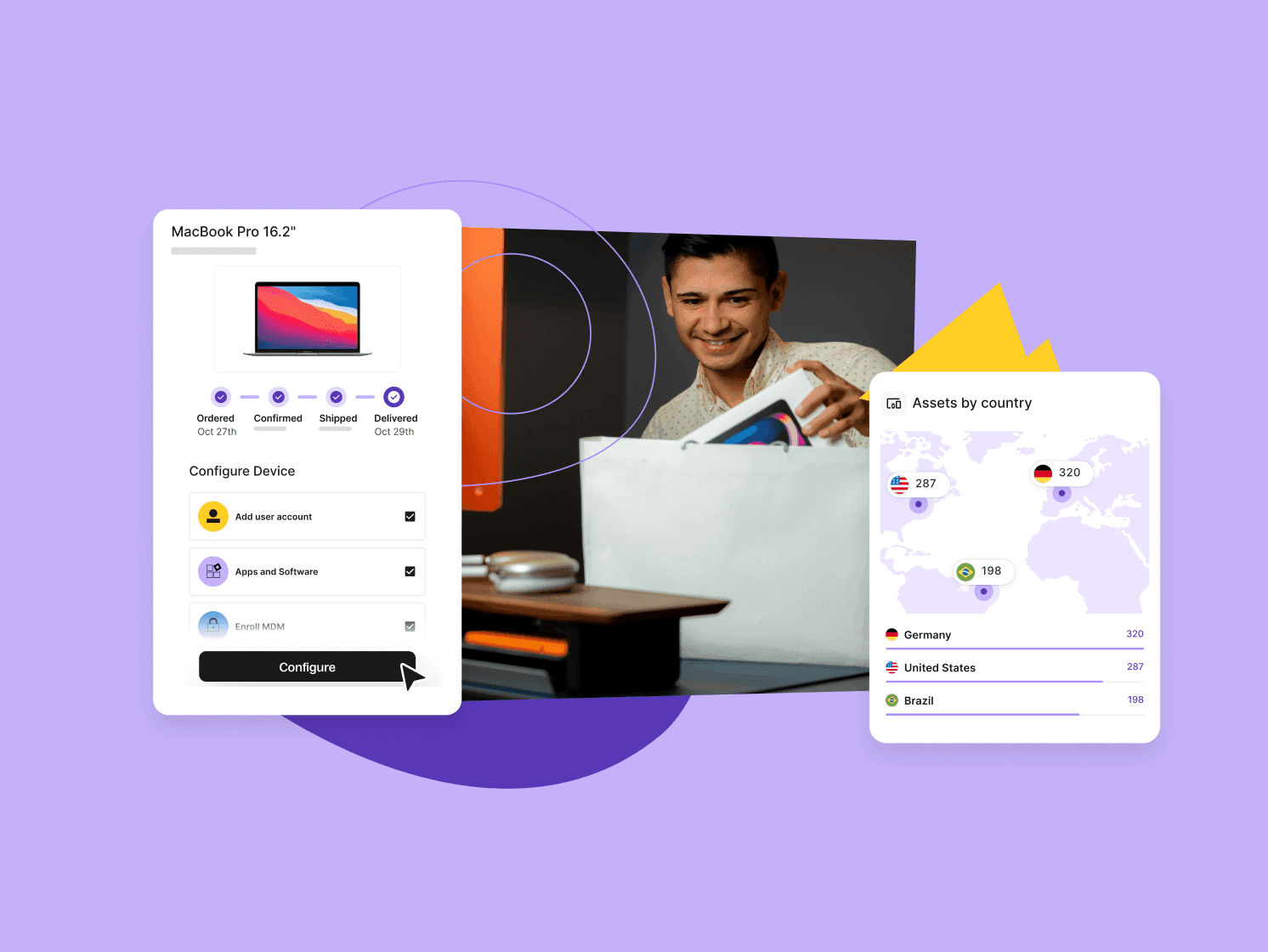
Day-one device readiness, without IT tickets: When a new hire's record is created in your HR system, Deel IT triggers device procurement, configuration, and shipping automatically — so equipment arrives before the employee's first day, not after.
IT operations that follow your headcount, not your org chart: Deel IT scales with your workforce across 130+ countries, handling procurement, provisioning, and support without requiring you to build local IT infrastructure in each new market.
Enterprise-grade threat detection that doesn't slow devices down: CrowdStrike Falcon endpoint protection runs at less than 1% CPU, giving you full detection and response capability without affecting the employee experience.
Access that disappears the moment an employee leaves, not when IT finds out: IAM and Single Sign-On (SSO) integrations revoke access automatically when offboarding is triggered in HR — no manual steps, no gaps.
Compliance posture maintained without manual checks: Automated patching, zero-touch deployment, and policy enforcement keep every managed device compliant across jurisdictions, continuously.
24/7 support that covers the time zones your team actually works in: Deel IT's support function operates around the clock, so distributed teams get help when they need it, regardless of where they are.
One platform instead of a stack of disconnected tools: MDM, endpoint security, IAM, procurement, and logistics in a single platform reduces vendor management overhead and closes the integration gaps where incidents typically fall through.
Book a demo
Deel IT
Procure, deliver, manage, and secure devices anywhere

FAQs
What support features are essential for global IT operations?
Multi-language support, automated ticket routing, AI-driven self-service, and multichannel communication form the operational baseline. Beyond that, you need a provider with demonstrated global data protection and cybersecurity frameworks — support that only works in one language or one time zone isn't a global model.
How can you achieve 24/7 coverage without building a large internal team?
A follow-the-sun model distributes coverage across time zones so there's always a team available without requiring any single team to work around the clock. Pairing this with automation — for ticket routing, self-service resolution, and escalation — significantly reduces the headcount required to maintain continuous coverage.
What's the practical difference between regional and global IT support?
Regional models are optimized for a defined geography: specific hours, specific languages, specific compliance environments. Global models provide continuous coverage across time zones, language-agnostic support, and compliance frameworks that hold up across jurisdictions. The gap between them becomes significant the moment you start hiring or operating in multiple countries.
How do compliance requirements shape IT support decisions?
Providers operating across borders need to demonstrate compliance with the data privacy and security standards that apply in each jurisdiction — GDPR being the most commonly cited, but far from the only one. This affects where data is processed and stored, how incidents are reported, and what certifications the provider needs to maintain. A provider that handles compliance in one region doesn't automatically handle it in another.
Dr Kristine Lennie holds a PhD in Mathematical Biology and loves learning, research and content creation. She had written academic, creative and industry-related content and enjoys exploring new topics and ideas. She is passionate about helping create a truly global workforce, where employers and employees are not limited by borders to achieve success.