Article
4 min read
5 IT Equipment Mistakes Every SMB Makes
IT & device management

Author
Dr Kristine Lennie
Last Update
August 13, 2026

Table of Contents
Mistake #1: Buying devices without a standard configuration
Mistake #2: Ignoring the peripheral setup until someone complains
Mistake #3: Skipping MDM because it felt like an enterprise concern
Mistake #4: No device tracking until something goes missing
Mistake #5: Treating international hires as a one-off logistics problem
Stop patching IT together: Deel IT covers the full stack
Key takeaways
Most SMBs don't have a dedicated IT owner, so equipment decisions get made reactively by whoever has time, creating a patchwork of unmanaged devices and costs that quietly compound before anyone notices the problem.
The solution is to establish a consistent procurement process, standardize device specifications and configurations, and enforce enrollment and access controls from the moment a device is issued, not after it's already in use.
Deel IT helps SMBs replace reactive, ad hoc equipment decisions with a managed process that covers device procurement, configuration, and enrollment from day one, so every hire starts with a properly set-up device and no unmanaged endpoints.
SMBs don't usually set out with a formal IT equipment strategy. Devices are purchased as the team grows, processes evolve over time, and what's manageable with a handful of employees can quickly become harder to coordinate at scale.
Here are the five most common IT equipment mistakes SMBs make, and how to avoid them.
Mistake #1: Buying devices without a standard configuration
Most SMBs buy whatever is available at the time a new hire joins. One employee gets a MacBook Air, the next gets a Windows laptop from a different vendor, and a third gets whatever was left over from a previous hire. There is no standard spec, no consistent OS, and no baseline configuration applied before the device ships.
Here is why this leads to breakdowns:
Security baselines vary by device: Without a standard configuration, encryption settings, OS versions, and security policies differ across the fleet, creating inconsistent exposure
IT support becomes device-by-device: Troubleshooting a mixed fleet with no standard image takes significantly longer than supporting a consistent configuration
Onboarding delays compound: When devices arrive without pre-configured accounts, VPN access, or required applications, new hires spend their first days chasing setup tasks instead of working
Refresh decisions become harder: Without a standard spec, there is no clear baseline to refresh against, so devices get kept too long or replaced inconsistently
Mobile Device Management (MDM) enrollment is inconsistent: Devices ordered from different vendors at different times often miss MDM enrollment entirely, leaving them outside policy coverage
The result: A fragmented fleet that is expensive to support, difficult to secure, and impossible to manage at scale.
How to solve it: Start by defining a standard device specification for each role, including approved laptop models, operating systems, memory, storage, and security requirements. Every new device should be configured the same way and enrolled in MDM before it's issued, so employees receive a consistent, secure setup from day one.
Example baseline laptop standards
Every company will have different hardware requirements, but the goal is the same: define a small number of approved devices that cover the needs of each role. Here's an example of what that could look like:
| Role | Recommended device | Why it works |
|---|---|---|
| General office work (HR, Operations, Marketing) | Dell Latitude 5450 (Intel Core Ultra 5, 16GB RAM, 512GB SSD) or Apple MacBook Air 13.6" M5 (16GB/512GB) | Plenty of performance for Microsoft 365, Google Workspace, Slack, Zoom, and everyday multitasking. |
| Sales & Customer Success | Dell Pro 14 Plus (Ultra 5/16GB/512GB) or HP EliteBook 840 G11 (Ultra 7/16GB/1TB) | Lightweight, premium business laptops designed for travel, video calls, and all-day battery life. |
| Developers & Engineers | Dell Pro 14 Plus (Ultra 7/32GB/512GB), Lenovo ThinkPad T14 Gen 6 (Ultra 7/32GB), or MacBook Pro 14" M4 Pro (24GB/512GB) | Additional RAM and processing power handle IDEs, containers, local builds, and multiple development environments without slowing down. |
| Creative & Design | MacBook Pro 16" M4 Pro or Dell Precision Mobile Workstation | Built for demanding creative applications including Adobe Creative Cloud, video editing, CAD, and 3D workloads. |
| Finance & Data | Lenovo ThinkPad T14 Gen 6 (32GB RAM) or Dell Pro 16 Plus (32GB RAM) | More memory supports large spreadsheets, BI tools, SQL clients, and multiple external displays without compromising performance. |
Looking to put these recommendations into practice? Source the recommended laptops above through Deel IT's global hardware catalog and standardize purchases across your organization.
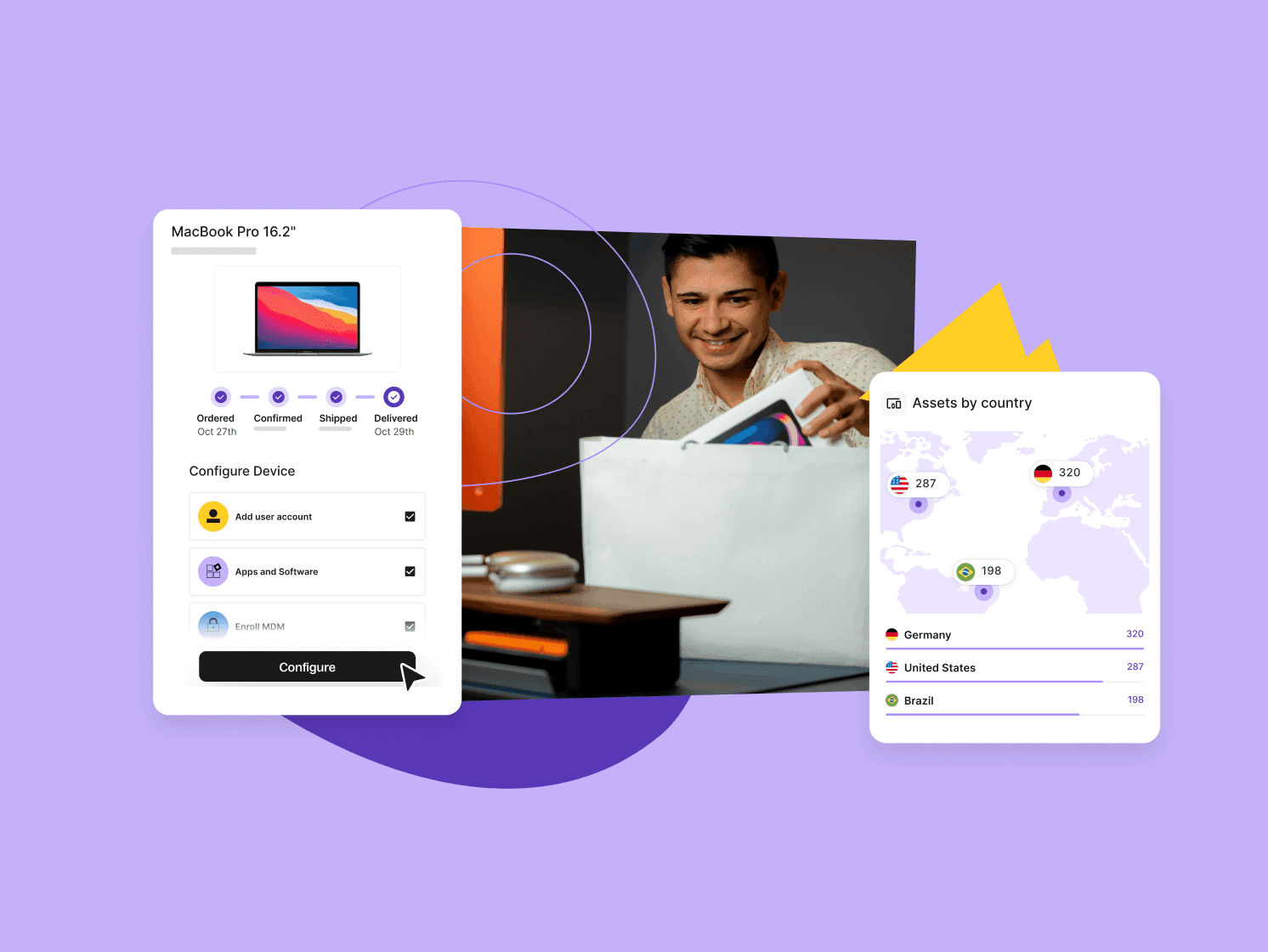
How Deel IT helps: Deel IT ships pre-configured devices directly to new hires with the required operating system, security settings, applications, and management tools already in place. Every device is tracked and managed through a single platform, giving IT teams consistent control while ensuring employees are ready to work from day one.
Find out why new hires start without equipment — and how to fix it.
Mistake #2: Ignoring the peripheral setup until someone complains
SMBs typically focus their equipment budget on laptops and treat everything else as optional. Monitors, headsets, webcams, and keyboards get purchased reactively: when someone asks, when a video call goes badly, or when a home office setup becomes obviously inadequate. There is usually no standard peripheral bundle by role, and no process for ensuring new hires have what they need on day one.
While some roles can work effectively with a basic laptop setup, others rely on additional peripherals to communicate, collaborate, or perform their day-to-day work. Without the right equipment, employees are more likely to experience productivity, communication, and ergonomic challenges. The table below highlights common peripheral gaps across different teams and the business impact when those needs aren't met.
| Team | Typical setup gap | Why it matters |
|---|---|---|
| Customer-facing teams | Rely on built-in laptop cameras and microphones instead of a dedicated webcam and headset. | Poor audio and video quality creates a less professional experience on customer calls and can make communication more difficult. |
| Knowledge workers | Work from a single laptop screen without an external monitor, stand, or ergonomic accessories. | Employees experience more fatigue, reduced comfort, and lower productivity during the workday. |
| Remote & hybrid employees | Receive inconsistent equipment depending on where they work or who orders their hardware. | Uneven workstation setups create an inconsistent onboarding and employee experience across the business. |
| Procurement & IT | Peripherals are purchased individually through expense claims or ad hoc requests. | Accessories become difficult to track, support, replace, and standardize, increasing administrative overhead and unnecessary spend. |
The result: Missing or inconsistent peripherals reduce productivity, create a poorer employee experience, and make it much harder to manage equipment consistently as the team grows.
How to solve it: Treat peripherals as part of the standard workstation rather than optional extras. Define a baseline bundle for each role and order those accessories alongside every laptop so employees receive everything they need from day one.
Role-based peripheral bundles worth standardizing:
Rather than purchasing accessories on request, define a standard bundle for each role. For example:
Customer-facing roles (account executives, CSMs, support agents): Jabra Evolve2 65 wireless noise-canceling headset (from $163) + Logitech C920S Pro Full HD webcam (from $79) + Dell P2425H 24" Full HD monitor (from $250)
Knowledge workers (HR, legal, marketing, operations): Logitech MX Keys combo keyboard and mouse (from $200) + Dell P2425H 24" Full HD monitor (from $250) + Kensington Easy-riser Laptop Stand (from $26)
Analysts and finance roles (data, finance, FP&A): Dell P2725D 27" QHD monitor (from $242) + Logitech MX Master 3S mouse (from $141) + Jabra Evolve2 40 SE USB-C headset (from $100)
Developers and engineers: Dell P2725QE 27" 4K USB-C Hub monitor (from $550) + Logitech MX Master 4 mouse (from $147) + Jabra Evolve2 65 headset (from $163)
Need to equip your team? Source the laptops, peripherals, and accessories featured above through Deel IT's global hardware catalog and standardize equipment by role.
How Deel IT solves this: Deel IT's catalog includes 240+ items covering the full peripheral stack: monitors, headsets, webcams, keyboards, docking stations, and ergonomic accessories — all orderable alongside devices as a single coordinated bundle for each new hire.
Discover these 6 IT accessories for boosting productivity.
Mistake #3: Skipping MDM because it felt like an enterprise concern
Many SMB founders and HR leads assume endpoint management and MDM are tools for large IT teams managing hundreds of devices. So they skip it, relying instead on employees to keep their devices updated and follow security practices manually. That may work for a handful of employees, but it quickly becomes difficult to manage as the business grows.
Without MDM, security and operational risks increase quickly:
Security policies can't be enforced: Without MDM, there's no reliable way to require encryption, enforce operating system updates, or confirm that every device meets your baseline security requirements
Lost or stolen devices remain exposed: If a laptop is misplaced or stolen, IT can't remotely lock or wipe it, increasing the risk of company data falling into the wrong hands
Compliance becomes harder to demonstrate: Frameworks such as SOC 2 and ISO 27001 require evidence that endpoints are managed and secured, and retrofitting MDM across an existing fleet is significantly more difficult than enrolling devices from the start
Offboarding relies on manual processes: When an employee leaves, access revocation, device locking, and data removal depend on people following the correct steps rather than automated controls
IT lacks complete visibility: Without a central management platform, there's no single view of which devices are enrolled, compliant, up to date, or assigned to employees
The result: As the device fleet grows, security becomes harder to enforce, compliance becomes more difficult to demonstrate, and IT loses visibility into the endpoints it's responsible for protecting.
How to solve it: Adopt MDM before device management becomes difficult. Enrol every company-owned device before it's issued to an employee so security policies, software updates, encryption, and remote management are applied consistently from day one.
How Deel IT helps: Deel IT provisions devices with the required security policies and management tools already in place, helping IT teams maintain consistent security and visibility across the device fleet. Devices remain centrally managed throughout the worker lifecycle, with remote lock and certified data erasure available during offboarding.
Read: Improve IT compliance with automated device management
Mistake #4: No device tracking until something goes missing
Early on, a spreadsheet is often enough to keep track of company devices. As the fleet grows, however, maintaining an accurate inventory becomes more challenging. Without real-time visibility into device ownership and lifecycle, routine IT tasks become much harder to manage.
As visibility decreases, operational challenges start to emerge:
Assignment becomes unclear: Without a central asset register, it's difficult to know who has which device, especially as employees change roles or teams
Refresh planning relies on guesswork: If you can't see device age, warranty status, or condition, hardware is often replaced too early—or kept in service long after it should have been refreshed
Returned devices go unused: Laptops that come back from departing employees often sit in storage because there's no process for inspecting, redeploying, or reassigning them
Audits and insurance claims become harder: Compliance reviews, security investigations, and insurance claims all depend on having an accurate, up-to-date inventory of company assets
IT costs are difficult to measure: Without centralised tracking, it's hard to understand how many devices are in use, where they're located, or what the business is spending across the hardware lifecycle
The result: Missing inventory leads to unnecessary hardware purchases, lower recovery rates, and limited visibility into the true cost of managing your device fleet.
How to solve it: Build an asset register from the moment a device enters your fleet. Record ownership, serial numbers, purchase dates, warranty information, and expected refresh dates, then keep those records up to date as devices are reassigned, repaired, refreshed, or retired.
How Deel IT solves this: Deel IT maintains a real-time fleet inventory across every device — ownership, assignment, status, and lifecycle stage — all visible in a single dashboard. Device redeployment, refresh, and recovery are managed from the same system, with certified data erasure documentation at offboarding.
Learn about the hidden cost of global device management at enterprise scale.
Mistake #5: Treating international hires as a one-off logistics problem
When an SMB hires its first employee outside its home country, it's common to manage equipment on a case-by-case basis. This might work for a single hire, but it doesn't scale. Without a repeatable global process, every new country introduces new operational challenges and an inconsistent employee experience.
The operational impact extends beyond shipping alone:
Cross-border logistics require more coordination: Customs paperwork, import duties, and local delivery times vary by country, making ad hoc shipments more difficult to manage and increasing the risk of delayed start dates
Local sourcing can reduce standardization: When devices are purchased from different local suppliers, employees may receive different models or configurations, making it harder to maintain consistent IT standards across the business
Local market requirements add complexity: Device availability, keyboard layouts, power adapters, and other regional differences can complicate procurement and delay onboarding if they aren't planned for
The employee experience becomes inconsistent: Without a global equipment policy, employees performing the same role may receive different devices, peripherals, or configurations depending on where they're located
Managing the device lifecycle becomes more difficult: Refreshes, repairs, replacements, and equipment recovery are harder to coordinate when devices are sourced through different vendors and managed using different processes
The result: Every new country adds operational complexity, international employees receive an inconsistent onboarding experience, and IT loses the standardization needed to manage a global device fleet effectively.
How to solve it: Create a single global equipment policy that applies to every employee, regardless of location. Standardize approved devices, peripheral bundles, security requirements, and lifecycle processes, then work with partners that can source, configure, and deliver hardware locally while keeping every device enrolled and tracked.
How Deel IT helps: Deel IT manages global device procurement and delivery across 130+ countries through a single platform, handling regional logistics, customs, and local requirements. Employees receive a consistent onboarding experience, while IT teams maintain centralized visibility and control across the device lifecycle.
Read: 5 things most companies get wrong about international IT logistics

Guide
The World at Work in 2026: Deel IT
Stop patching IT together: Deel IT covers the full stack
Deel IT is a global IT operations platform built for teams that don't have a dedicated IT function. It handles device procurement, MDM enrollment, access management, and lifecycle tracking from a single system. From laptops and monitors to docks, headsets, keyboards, and mice, the equipment featured in this guide can be sourced directly through Deel IT.
Here is what Deel IT covers for SMBs:
Global procurement across 130+ countries: Source, configure, and ship pre-configured hardware to any new hire
MDM and device security: Every device is enrolled in MDM and configured with the required security policies, encryption, operating system settings, and management tools, helping IT teams maintain a secure, standardized fleet
Real-time fleet visibility: Track every device by owner, status, location, and lifecycle stage in a single dashboard — no spreadsheets, no guesswork
Role-based peripheral bundles: Order the laptops, monitors, headsets, webcams, docks, keyboards, mice, and other accessories your teams need from a catalog of 240+ items, standardized by role
Lifecycle automation tied to HR events: Onboarding triggers device provisioning and access setup automatically; offboarding triggers remote lock, access revocation, and certified data erasure
SaaS and application management: Assign, track, and reclaim application licenses centrally — with usage visibility to eliminate waste and reduce spend
24/7 global IT support: Live helpdesk available in every time zone, embedded in the same platform managing devices and access — so employees get help wherever they are
Deel IT
Procure, deliver, manage, and secure devices anywhere
FAQs
What are the most common IT equipment mistakes small businesses make?
The most common mistakes include buying devices reactively without a standardized spec, skipping enrollment and configuration at setup, and failing to track what equipment exists across the organization. These issues tend to go unnoticed until they create a security gap, an unexpected cost, or a new hire sitting idle on their first day.
How do small businesses manage IT equipment without a dedicated IT person?
Many SMBs assign IT tasks informally to whoever has bandwidth, which leads to inconsistent processes and unmanaged devices over time. A more sustainable approach is to establish a simple procurement and setup checklist that anyone can follow, so device decisions aren't dependent on one person's availability or knowledge.
When should a small business start standardizing its IT equipment process?
The earlier the better — ideally before the team grows beyond a handful of people. Once a mix of unmanaged devices and ad hoc configurations is already in place, standardizing becomes significantly more time-consuming and disruptive to fix retroactively.
What security risks come from unmanaged devices in a small business?
Devices that were never enrolled in a management system or properly configured can expose company data if they're lost, stolen, or accessed by unauthorized users. Without visibility into what devices exist and who has access to what, it's also much harder to respond quickly when something goes wrong.
Dr Kristine Lennie holds a PhD in Mathematical Biology and loves learning, research and content creation. She had written academic, creative and industry-related content and enjoys exploring new topics and ideas. She is passionate about helping create a truly global workforce, where employers and employees are not limited by borders to achieve success.