Article
15 min read
The Hidden Cost of Global Device Management at Enterprise Scale
IT & device management

Author
Dr Kristine Lennie
Last Update
April 29, 2026

Table of Contents
The misframing: enterprise IT often thinks about devices as a procurement problem
Why most device management costs never show up in IT budgets
How fragmentation turns isolated gaps into systemic drag
Why adding headcount, vendors, or tools does not fix the cost problem
The only conclusion: global device management is an infrastructure problem
Unify your device management with Deel IT
Key takeaway
Enterprise IT teams often track device management through procurement metrics like units shipped and hardware spend, which capture procurement efficiency but obscure the hidden costs of managing devices at scale.
In practice, device management functions as operational infrastructure rather than procurement, requiring automation, vendor consolidation, and full lifecycle visibility to control cost and complexity at scale.
Deel IT gives enterprise teams a single system to manage the full device lifecycle across global workforces, reducing the coordination overhead and coverage gaps that accumulate when procurement and operations run separately.
Most enterprise IT teams measure device management by what they can count: units shipped, tickets closed, and hardware costs per head. These metrics matter, but they don’t capture how device management actually operates at scale. According to Flexera's 2025 State of ITAM Report, only 43% of organizations have complete visibility across their technology stack, and that number is falling. As a result, many enterprise IT teams don't always have a clear answer to an important question: What is the current state of every device right now? That gap is where hidden costs accumulate.
Without a unified view of the device lifecycle, underlying costs remain hidden. These show up in the day-to-day work required to keep systems running: coordinating across vendors, managing exceptions, and maintaining consistency across regions and endpoints. They also surface as inefficiencies, including delayed onboarding and day-one-readiness, unpatched devices, and the time IT teams spend resolving gaps across disconnected systems. At scale, this becomes a significant source of operational overhead, compounding over time and making device management increasingly difficult to control.
The reason is simple: organizations are treating global device management as a procurement problem when it is, in fact, an operational infrastructure problem. That misclassification is a major reason costs keep growing even when headcount stays flat, because the work shifts from managing devices to coordinating around them.
The misframing: enterprise IT often thinks about devices as a procurement problem
Most enterprise IT organizations inherited their device management model from an era when employees were in one country, in one office, buying from one vendor. It was a model optimized for price, standardization, and volume negotiation, and for that context, it worked. It solved the problem companies actually had at the time.
But that context no longer exists. Enterprise hiring is now distributed across dozens of countries, contractors sit alongside employees on the same systems, and remote work is not an exception to manage but a baseline to support. To support this shift, IT teams expanded their existing model, adding vendors, regions, and resellers. While this extended coverage, it preserved the wrong model: device management continued to operate as a procurement function instead of an operational system.
The problem: When device management is treated as procurement, success is defined at the point of purchase, with cost-per-device as the primary KPI, while the rest of the lifecycle receives less consistent attention. Devices are shipped as one-off logistics tasks rather than managed continuously, and measurement often focuses on initial setup, such as Mobile Device Management (MDM) deployment, rather than ongoing enforcement. At offboarding, this pattern continues: the focus is on device recovery rather than verified offboarding and ensuring that access is fully revoked and data is securely erased.
The bottom line: Misclassifying device management as procurement fragments the lifecycle into disconnected steps, creating the conditions for hidden and compounding costs as organizations scale.
Find out about the top 6 IT procurement challenges and how to solve them.

Guide
The World at Work in 2026: Deel IT
Why most device management costs never show up in IT budgets
Treating device management as procurement is what makes its true cost hard to see. Why? Because it doesn’t appear on a single budget line. Instead, device management costs are distributed across procurement, IT operations, HR, security, legal, and lost productivity. Because no single function owns it, no single function has full visibility into it.
The problem: The cost of device management is still there, but it shows up in places that aren’t labeled as device management. A delayed laptop becomes lost productivity during onboarding. An unpatched endpoint becomes a security risk whose cost only materializes if something goes wrong. Time spent coordinating vendors and resolving exceptions is absorbed into IT payroll rather than tracked as operational overhead. These costs are misattributed, which makes them harder to connect, measure, or prioritize.
The bottom line: Device management appears efficient at the point of purchase, but its true cost is systematically underestimated because it is distributed across the organization and measured in the wrong places.
Looking to find out more about budgeting and workforce planning? Read: IT Budgeting & Workforce Planning: What HR & IT Leaders Need to Know
How fragmentation turns isolated gaps into systemic drag
Even when the individual costs of device management are understood, fragmentation across the lifecycle causes those costs to compound in ways that are harder to control. Procurement, configuration, enforcement, and offboarding are managed as separate steps, often across different systems and vendors. As a result, issues don’t stay contained: they carry forward from one stage to the next.
The problem: As fragmentation across the lifecycle accumulates, work shifts away from infrastructure and toward coordination and recovery, increasing operational cost without increasing output. Inconsistent device states expand audit exposure and pull teams into remediation work, while exceptions compound across the lifecycle. Over time, gaps at offboarding reappear at onboarding, forcing unnecessary new purchases.
The bottom line: The cost of fragmented device management is not just distributed, it compounds. As organizations scale, disconnected systems and handoffs across the lifecycle increase, shifting IT work away from managing infrastructure and toward coordinating and correcting exceptions.
Read more: Improve IT Compliance with Automated Device Management
Why adding headcount, vendors, or tools does not fix the cost problem
At a certain point, enterprise IT teams respond to device management challenges in a way that is entirely rational: they add resources. More engineers to handle coordination, more tools to improve coverage, more vendors to fill regional gaps, and more processes to standardize workflows. These investments reduce immediate pressure, but they don’t change how the system itself operates.
The problem: Additional headcount absorbs the workload created by fragmentation, but doesn’t remove the source of it. New tools extend capability, but introduce additional systems that must be integrated and maintained. Expanding vendor networks improves procurement coverage, but increases the number of handoffs across the lifecycle. Each response makes the system more manageable in the short term, but more complex over time, adding coordination rather than eliminating it.
According to a ADAPT CIO Edge Survey 2025, 68% of technology leaders are planning to consolidate their vendor landscape, with many targeting a 20% reduction in vendor count. This isn’t a marginal adjustment. It reflects a broader shift away from fragmented, vendor-led models that no longer scale at enterprise level.
The bottom line: The issue isn’t a lack of investment, it’s a mismatch between the problem and the solution. Adding capacity to a fragmented system improves coordination, but doesn’t resolve the underlying issue, and often introduces more vendors, tools, and handoffs that deepen the problem.
Read more: Benefits of 24/7 IT Support
The only conclusion: global device management is an infrastructure problem
When device management costs are spread across functions, compound over time, and persist despite added resources, the issue is not effort; it’s how device management itself is defined.
At enterprise scale, device management is not a procurement or logistics function, but an operational infrastructure, requiring a system designed to run the full lifecycle rather than coordinate it.
The bottom line: The solution is an architectural shift: a unified system to manage the full device lifecycle. Procurement, configuration, enrollment, monitoring, support, and certified retrieval must operate from a single system of record. Security, compliance, and lifecycle visibility should come directly from that source, rather than being reconstructed manually. Day-one readiness depends on consistency across regions, not vendor coordination or local processes. Offboarding, including device retrieval and data erasure, should be treated as a security function, with scalability built into the architecture rather than added through more tools or vendors.
Device Lifecycle Management
Global device logistics, handled
Unify your device management with Deel IT
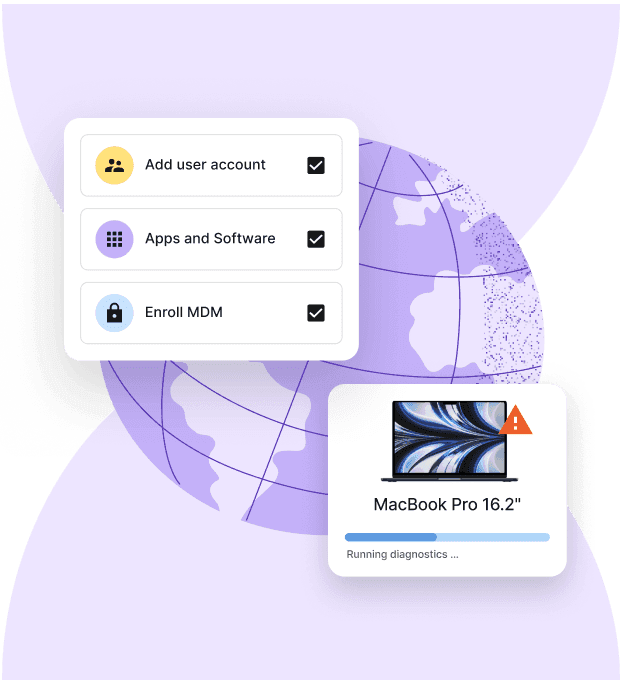
Deel IT was built for the architecture problem enterprise IT actually has: not as a better procurement tool, not an additional MDM platform, but a unified operational layer that closes the seams where the hidden costs accumulate.
Global procurement across 130+ countries: Source, configure, and ship hardware to new hires worldwide, reducing reliance on regional resellers and minimizing country-by-country complexity
Unified MDM enforcement across regions: Deploy and maintain a consistent security baseline across devices, helping reduce configuration drift and audit exposure
Access management integrated into the lifecycle: Provision and deprovision access as devices move through onboarding and offboarding, helping align access with device state
Automated onboarding and offboarding workflows: HRIS-triggered processes coordinate device provisioning, configuration, MDM enrollment, and access changes, enabling consistent day-one readiness while reducing manual handoffs and delays
Device retrieval and data erasure support: Enable compliant offboarding processes with documented data erasure and device recovery workflows
Compliance visibility across the device estate: Centralized monitoring and reporting make it easier to evidence device compliance during audits, aligned with frameworks such as SOC 2 Type II and ISO 27001
Centralized lifecycle visibility and cost tracking: Provide a single system to manage devices across procurement, deployment, and retrieval, reducing manual coordination across vendors and systems while improving visibility into lifecycle activity
Book a demo and see how Deel IT closes the gaps where enterprise device management costs actually accumulate.
Deel IT
Automate IT operations in 130+ countries

FAQs
What are the hidden costs of managing devices for a global enterprise workforce?
Beyond hardware spend, the real costs show up in delayed employee onboarding when equipment arrives late, security vulnerabilities from unpatched endpoints in remote regions, and the operational overhead of coordinating across multiple vendors and time zones. These costs don't appear on a single invoice, which is why they're consistently underestimated by IT and finance teams.
Why does global device management become harder to control as a company scales?
As headcount grows across multiple countries, procurement and IT operations tend to diverge — different vendors handle different regions, workflows aren't standardized, and visibility gaps emerge. The coordination burden compounds over time, making it difficult to enforce consistent policies or respond quickly when something breaks down.
How should enterprise IT teams reclassify device management to capture its true cost?
Rather than treating device management purely as a procurement function tracked by units shipped and hardware spend, organizations benefit from reclassifying it as operational infrastructure. This means measuring it by business impact metrics like time-to-productivity for new hires, endpoint compliance rates, and the engineering hours spent on vendor coordination.
What does consolidating device lifecycle management actually involve at the enterprise level?
Consolidation typically means reducing the number of vendors handling procurement, deployment, support, and retrieval, while standardizing the workflows that connect those stages. The goal is to create a single source of visibility across all regions so that IT teams can track device status, enforce security policies, and manage offboarding without relying on manual coordination across disconnected systems.
Dr Kristine Lennie holds a PhD in Mathematical Biology and loves learning, research and content creation. She had written academic, creative and industry-related content and enjoys exploring new topics and ideas. She is passionate about helping create a truly global workforce, where employers and employees are not limited by borders to achieve success.