Article
7 min read
IT vs. HR: Who's Responsible for What During Onboarding and Offboarding? (Small Businesses / SMBs)
IT & device management

Author
Dr Kristine Lennie
Last Update
September 17, 2026

Table of Contents
Why the IT–HR boundary is structurally hard to draw at SMB scale
Onboarding | Who owns device procurement?
Onboarding | Who owns account provisioning?
Onboarding | Who owns day-one readiness?
Role change | Who owns access updates?
Offboarding | Who owns access revocation?
Offboarding | Who owns device recovery?
IT vs. HR at SMBs: Who owns what at every stage
How Deel IT simplifies the IT–HR handoff for SMBs
Key takeaway
At SMBs, the line between HR and IT can easily become unclear. HR may manage the employee process while IT handles devices and access, but lean teams often mean responsibilities overlap or shift between people.
Clear ownership helps prevent important tasks from falling through the cracks. Defining who owns each step and when handoffs happen can reduce delays, missed tasks, and lingering access during onboarding and offboarding.
Deel IT brings HR and IT workflows together in one place. SMBs can connect device provisioning and access management to the employee lifecycle, helping teams create a more consistent experience from onboarding through offboarding.
SMBs typically operate with lean HR and IT teams, and may not have dedicated people for every part of the employee lifecycle. That means responsibilities often cross functions: HR might coordinate a laptop order, an operations manager might help set up accounts, and IT may only get involved once a specific need comes up.
As the company grows, those informal arrangements become harder to manage. This guide breaks down what HR should own, what IT should own, and where the two need to work together across onboarding, role changes, and offboarding.
Why the IT–HR boundary is structurally hard to draw at SMB scale
At a large company, IT and HR are separate departments with documented handoff protocols. At an SMB, those responsibilities may sit with just one or two people (sometimes the same person) and were rarely formally divided to begin with. The founder approved the last laptop purchase. The HR manager set up the Google Workspace account because IT hadn't been looped in yet. The office manager handled offboarding because no one else was available that day.
For a while, that can work. But more employees mean more hires, role changes, and departures that require HR and IT to coordinate at the right time. What used to be handled through a quick message or conversation becomes much easier to miss.
HR owns the employee lifecycle, while IT owns many of the systems and tools that need to change along with it. As an SMB grows, defining where one team’s responsibility ends and the other’s begins becomes increasingly important.
The sections below break down that ownership, stage by stage.
Onboarding | Who owns device procurement?
Getting a laptop to a new hire requires HR and IT to act in sequence. HR knows when the hire is confirmed and when they’re starting; IT needs that information early enough to source, configure, and deliver the right device.
HR owns the trigger: Once a hire and start date are confirmed, HR should notify IT and provide the information needed to place the order, such as the employee’s location and start date.
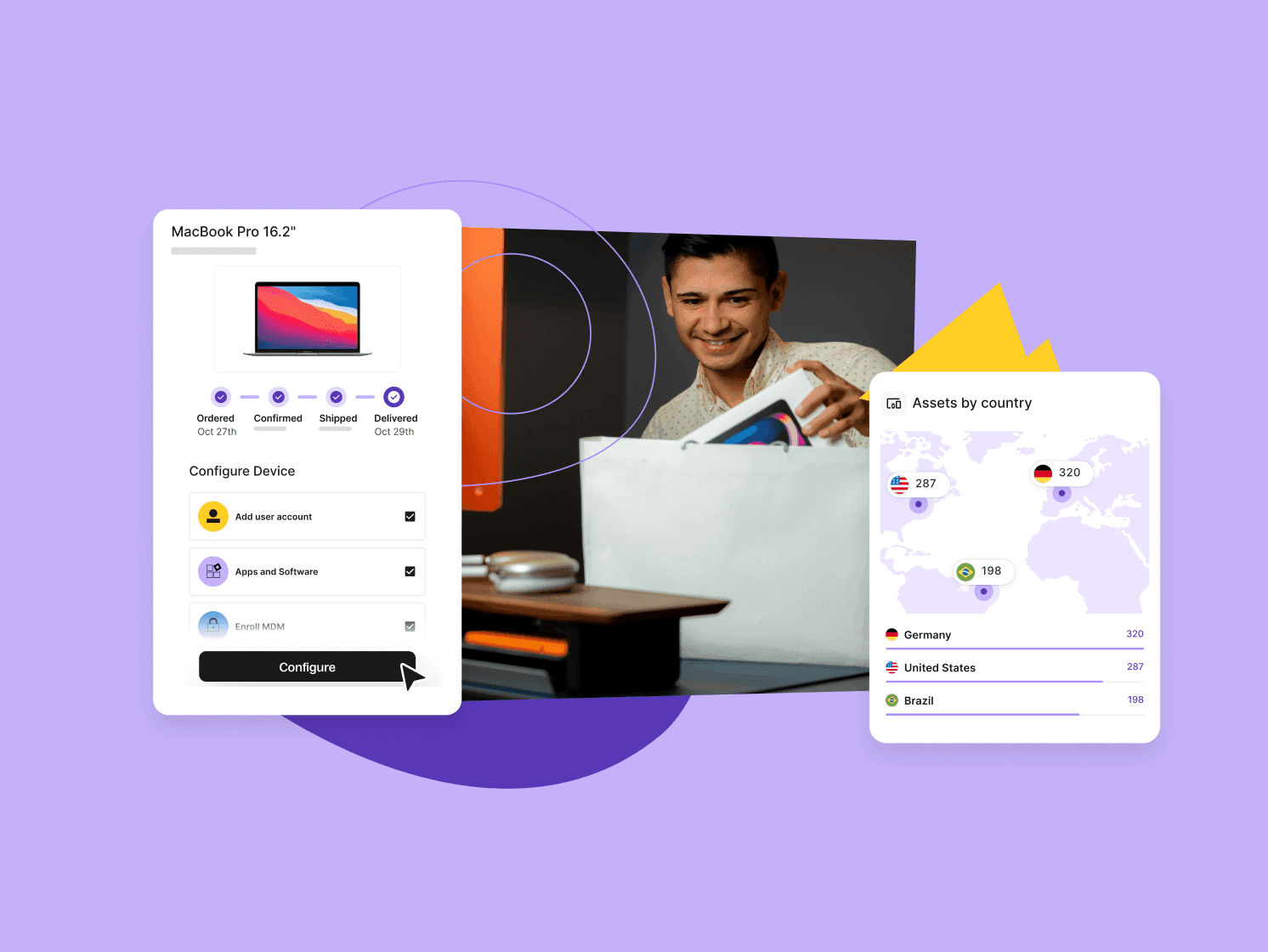
IT owns device provisioning: From there, IT takes responsibility for ordering the device, configuring it, enrolling it in Mobile Device Management (MDM), and making sure it reaches the employee on time.
Where SMBs can get stuck: The handoff is often informal. If IT finds out about a new hire through a Slack message or forwarded email, there may not be enough time to account for procurement, shipping, and configuration. That’s how a simple communication gap can turn into a new hire starting without a working device.
How Deel IT helps: Deel IT helps lean teams manage device procurement, configuration, enrollment, and delivery from one platform, reducing the coordination required to get new hires equipped.
Find out why new hires start without equipment.
Onboarding | Who owns account provisioning?
Setting up email, communication tools, shared drives, and other work applications typically sits with IT. But IT needs to know what access a new hire requires, and that starts with information HR already has: their role, team, manager, and start date.
HR owns the employee information: HR should make sure IT has accurate role and team details before the employee starts. Ideally, those details map to defined access requirements, so employees in similar roles receive consistent access.
IT owns account and access setup: IT creates the necessary accounts, assigns the appropriate permissions, and applies security requirements such as Single Sign-On (SSO) and Multi-Factor Authentication (MFA).
Where SMBs can get stuck: Access decisions are often made case by case. Without a clear connection between an employee’s role and the tools they need, IT may have to piece together access requirements from emails, messages, or individual requests. Missing access then gets discovered on day one.
How Deel IT helps: Deel IT helps SMBs manage application access alongside employee information, reducing the need to coordinate every new account through separate messages and requests.
Onboarding | Who owns day-one readiness?
Day one is where all the earlier onboarding handoffs come together. The laptop needs to be ready, accounts need to work, and the new hire needs to know where to go and what to do. When one of those pieces is missing, the employee often ends up spending their first hours chasing down equipment, access, or information.
HR owns the onboarding experience: HR coordinates the welcome, introductions, role information, and first-day or first-week schedule.
IT owns technical readiness: IT makes sure the device is delivered and configured, required accounts are set up, and the employee has the access they need to start working.
Day-one readiness is shared: Both teams should confirm their part is complete before the employee starts. A simple pre-start checklist can make that handoff explicit and catch missing equipment or access before the new hire has to.
How Deel IT helps: Deel IT helps SMBs manage new-hire devices and access in one place, making it easier for lean teams to get the technical basics ready before an employee starts.
Download this Employee Onboarding Checklist Template to help you onboard employees globally.
Role change | Who owns access updates?
A promotion or team transfer can change what an employee needs access to. New permissions may need to be added, while access tied to their previous role may need to be removed. At SMBs, those updates can be easy to miss when a role change is recorded by HR but doesn’t make its way to IT.
HR owns the trigger: HR records the role change and makes sure IT knows when it takes effect, along with the employee’s new role, team, or manager.
IT owns the access update: IT reviews the employee’s existing permissions, removes access they no longer need, and grants access required for the new role. Where possible, defined Role-Based Access Control (RBAC) policies can make those decisions more consistent.
Where SMBs can get stuck: When role changes and access updates aren’t connected, employees can keep permissions from previous roles. Over time, this access creep can leave people with access to more systems and data than their current role requires.
How Deel IT helps: Deel IT enables lean teams to manage application access alongside employee changes, making it easier to keep permissions aligned as people move between roles.
Read: IAM best practices for distributed teams
Offboarding | Who owns access revocation?
When an employee leaves, timing matters. HR knows when the employment relationship ends, while IT needs that information to remove access at the right time. At an SMB, even a small delay in that handoff can leave a former employee with access to company systems and data longer than intended.
HR owns the trigger: HR confirms the departure and tells IT when the employee’s access should end. For planned departures, that can be built into the offboarding process; more sensitive exits may require tighter coordination around timing.
IT owns access revocation: IT disables accounts and removes access to the applications, systems, and shared resources the employee used. It should also keep a record of what was revoked and when.
Where SMBs can get stuck: Access may be spread across email, communication tools, cloud storage, business applications, and other systems. Without a clear inventory and offboarding process, IT can disable the obvious accounts while leaving others active.
How Deel IT helps: Deel IT connects access management with the employee lifecycle, helping teams coordinate access removal when employees leave and create a more consistent offboarding process.
Discover what happens to company data when an employee leaves.
Offboarding | Who owns device recovery?
Offboarding doesn’t end when access is removed. Company devices still need to be returned, tracked, and prepared for whatever comes next. For SMBs, this can become complicated when employees are remote or spread across different locations.
HR owns the employee communication: HR makes sure the departing employee knows which company equipment needs to be returned, when it’s due, and what the return process looks like.
IT owns device recovery: IT coordinates the return, tracks the device through the process, and makes sure company data is handled appropriately once the device is recovered.
Where SMBs can get stuck: Device returns are often handled case by case, especially with distributed teams. Without a consistent process, IT can lose track of devices, returns can take longer than expected, and company data may remain on equipment that hasn’t been recovered.
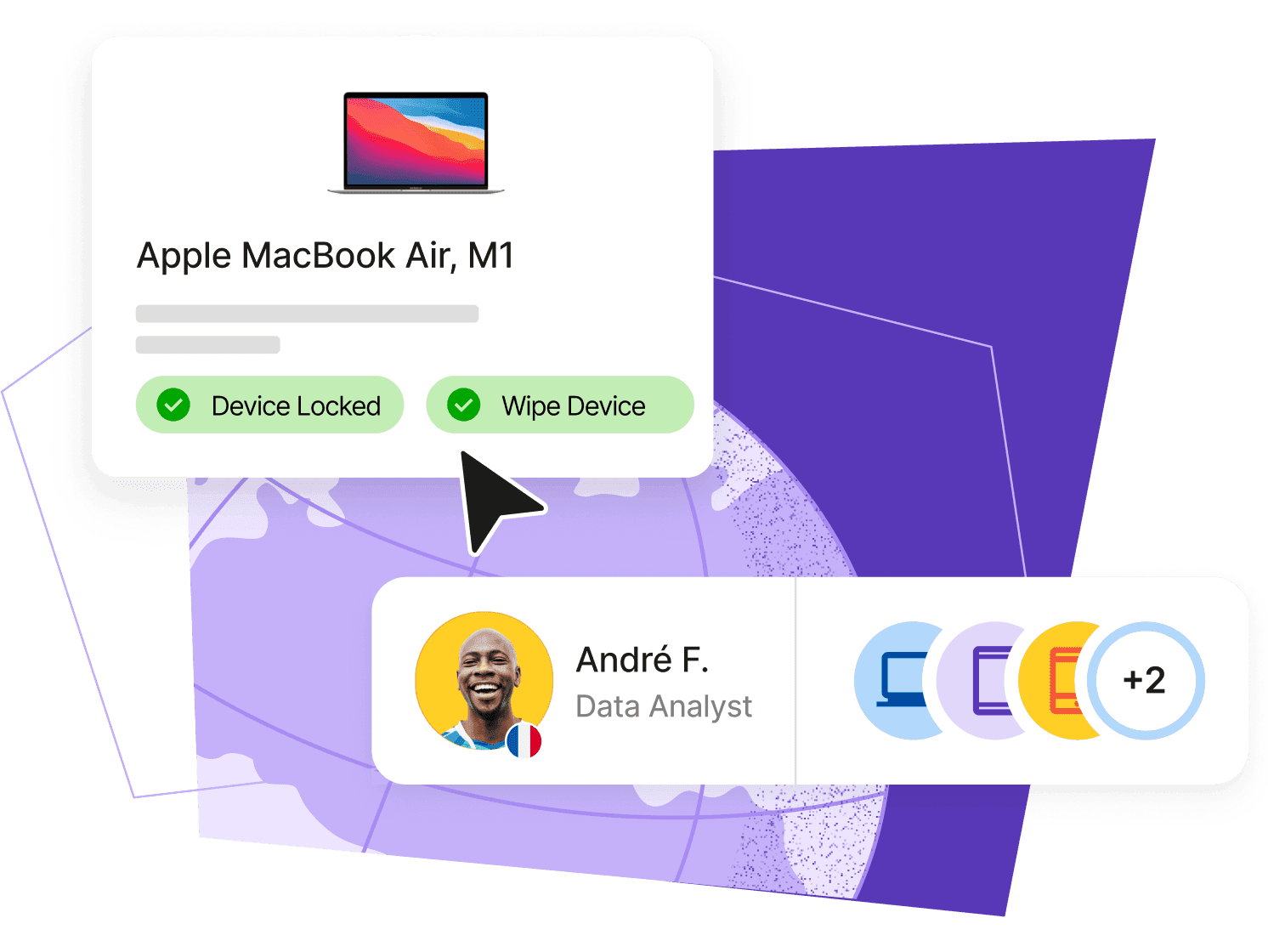
How Deel IT helps: Deel IT supports device recovery across distributed teams, helping coordinate returns, track devices, and securely erase company data as part of the offboarding process.
Read: Certified data erasure for compliant device offboarding
IT vs. HR at SMBs: Who owns what at every stage
The exact split will depend on your team, but the principle is consistent: HR owns employee lifecycle information, IT owns the devices and access that need to change with it, and some outcomes require both teams. Here’s what that can look like across the employee lifecycle.
| Responsibility | Stage | Owner | Handoff / trigger |
|---|---|---|---|
| Confirm hire and start date | Onboarding | HR | Offer accepted and start date confirmed |
| Order device | Onboarding | IT | HR shares start date, location, and device requirements |
| Configure and enroll device | Onboarding | IT | Device is ordered or assigned |
| Provide role and team information | Onboarding | HR | Hire confirmed |
| Set up accounts and access | Onboarding | IT | HR provides the employee information needed for provisioning |
| Confirm day-one readiness | Onboarding | Shared | Before the employee’s start date |
| Record role change | Role change | HR | New role or team confirmed |
| Update access | Role change | IT | HR shares the role change and effective date |
| Confirm departure and timing | Offboarding | HR | Resignation or termination confirmed |
| Revoke access | Offboarding | IT | HR confirms when access should end |
| Communicate device return process | Offboarding | HR | Offboarding begins |
| Recover and process device | Offboarding | IT | Employee returns company equipment |
How Deel IT simplifies the IT–HR handoff for SMBs
Deel IT brings device, access, and employee lifecycle workflows into one platform, giving HR and IT a more connected way to manage onboarding, role changes, and offboarding. Instead of relying on emails, messages, and manual handoffs, teams can coordinate IT tasks around employee lifecycle events.
For SMBs, that means less administrative work as the team grows:
Equip new hires wherever they work: Procure, configure, and ship devices to employees across supported countries, with device management built into the process.
Manage devices from one place: Keep track of company devices and apply security policies throughout the device lifecycle.
Coordinate access with employee changes: Manage application access as employees join, move into new roles, or leave the organization.
Simplify device recovery: Coordinate returns and securely erase company data when devices come back.
Give employees ongoing IT support: Provide IT support without making HR the default point of contact for technical issues.
Manage IT alongside the employee lifecycle: Bring devices, access, and worker information closer together so HR and IT have less manual coordination to manage.
Book a demo to see how Deel IT can support your team.
Deel IT
Procure, deliver, manage, and secure devices anywhere

FAQs
Who is responsible for revoking system access when an employee leaves: IT or HR?
HR typically owns the trigger by confirming the departure and communicating when the employee’s access should end. IT owns the technical work of disabling accounts and removing access to company systems, applications, and shared resources.
What can fall through the cracks during employee onboarding at mid-market companies?
Device and access tasks can become harder to coordinate as the organization adds more employees, roles, applications, and locations. IT may receive the information it needs too late to deliver equipment on time, or a new hire may start without all the access required for their role.
How do you create a clear IT and HR split for onboarding and offboarding?
Start by defining both an owner and a trigger for each step. HR might own notifying IT when someone joins, changes roles, or leaves, while IT owns the corresponding device and access actions. Managers or application owners may also need defined responsibilities for role-specific tools and access.
What are the security risks of a poorly defined IT and HR offboarding process?
Unclear ownership can leave access active longer than intended or cause applications outside centrally managed systems to be overlooked. A defined offboarding process helps IT identify what access needs to be removed, when it should be removed, and who confirms that the process is complete.
Dr Kristine Lennie holds a PhD in Mathematical Biology and loves learning, research and content creation. She had written academic, creative and industry-related content and enjoys exploring new topics and ideas. She is passionate about helping create a truly global workforce, where employers and employees are not limited by borders to achieve success.