Article
3 min read
How to Assess ROI of AI in Global Payroll and Workforce Operations
AI

Author
Ellen Simmonds
Last Update
September 17, 2026

Table of Contents
Why ROI measurement for AI is different
Step 1: Map your current operating model
Step 2: Define your value categories
Step 3: Build your business case
Key questions for your finance team
The bottom line
Key takeaways
AI payroll ROI comes from four compounding sources: direct cost reduction, risk mitigation, operational speed, and financial visibility (not just one).
Most Finance teams discover that vendor fragmentation and manual processes are costing them 15-25% more annually than they should, before any platform implementation.
Deel's consolidated global infrastructure, AI-driven automation, and 2,000+ in-house experts eliminate vendor sprawl without forcing rip-and-replace, letting you move from firefighting to strategy.
Finance leaders know the question well: "What's the return on this investment?"
But when it comes to AI in payroll, HR, and global workforce operations, the answer isn't straightforward. Unlike a capital equipment purchase with obvious depreciation schedules, AI-driven payroll solutions deliver value across multiple dimensions. Cost savings emerge alongside risk reduction. Efficiency gains compound across countries. And the financial impact of prevented compliance failures often goes unmeasured because it never hits the balance sheet as a loss.
Yet the ROI question remains crucial. Finance teams are expected to reduce risk, standardize operations, and control costs. AI-powered payroll platforms are increasingly positioned as solutions to exactly these problems. So how do you actually measure whether they deliver?
Why ROI measurement for AI is different
Traditional payroll or HR software comes with clear metrics. You can measure implementation time, per-transaction costs, and hours saved per payroll cycle. Forecasting ROI is, broadly, straightforward math.
With AI-driven solutions, the value isn't just about speed or cost per transaction. It's about what the system prevents: misclassification penalties, late filings, payroll errors that cascade across 50+ countries, the operational chaos of managing a dozen regional payroll vendors simultaneously.
Then there's the structural problem most enterprises face: fragmented systems. Your global workforce data lives across an ERP system, a legacy local payroll vendor in Germany, an aggregator handling your EOR program in Asia, and spreadsheets nobody quite remembers the logic for. Against this backdrop, an AI system that consolidates data and enforces consistent logic delivers value that's hard to quantify but viscerally obvious to anyone living inside that fragmentation.
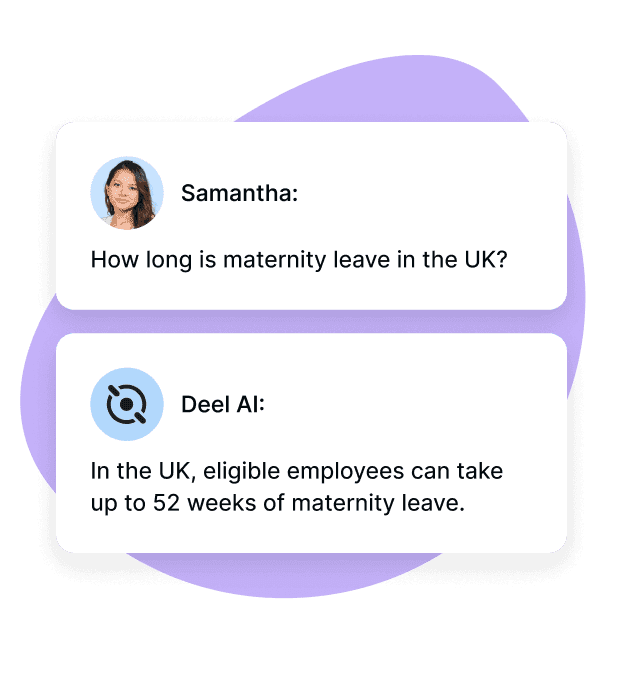
Deel AI
Get global HR insights fast with Deel AI
Step 1: Map your current operating model
Before measuring ROI, you need a baseline. Start by documenting how payroll and workforce operations actually run today.
This means auditing your vendor footprint. How many payroll providers, EOR platforms, contractor payment systems, and local compliance vendors do you use? Document the cost of each. This is often revealing. Enterprise organizations typically discover they're paying 15 to 20% more than they should simply because of vendor redundancy, setup costs, and markup chains.
Next, quantify your current operational overhead. How much of your Finance team's time goes to reconciling data across systems? How many manual steps exist between HR systems, ERPs, and payroll platforms? How often does someone have to recreate data in spreadsheets because systems don't talk to each other? Time this. Convert it to cost.
Then, identify your compliance and risk exposure. How many countries do you operate in? How many potential misclassification scenarios exist in your current setup? How many payroll cycles have been delayed by local compliance issues? What was the cost of the last audit finding related to payroll or employment classification?
Finally, document your reporting gaps. Can you answer these questions in real time:
What is the true cost of your global workforce by geography and worker type?
How much is payroll calculation variance by country, and why?
Which entities have outstanding compliance issues?
What is your month-to-close timeline for global workforce reporting?
This baseline becomes your measurement foundation. It's also your first ROI indicator. Most Finance teams discover that fragmentation and manual processes are costing them far more than they realized.
Step 2: Define your value categories
ROI for an AI-powered payroll platform comes from four places. Financial teams should build their business case around all four, since they often compound.
Direct Cost Reduction
Start here because it's the easiest to quantify. You're consolidating vendors. You're reducing manual process steps. You're eliminating the need for specialist contractors in each country who charge premium rates to decode local compliance.
Calculate the annual spend reduction from vendor consolidation. Then estimate the Finance and HR FTE hours you'll save by eliminating manual reconciliation, data re-entry, and cross-system workarounds. Convert those hours to annual salary cost (use burdened rates). This is your direct cost reduction number.
For enterprises, vendor consolidation alone typically yields 15 to 25% savings on annual payroll-related spend when moving from a fragmented vendor model to an integrated platform.
Operational Risk Mitigation
This is where Finance leadership sits up. Payroll errors, misclassification, late filings, and compliance gaps carry real financial penalties. They also carry reputational and audit risk.
Quantify your current exposure. Have you had misclassification findings? Audit adjustments? Late filing penalties? Add those up over the past three years. Then, research the regulatory risk in the countries where you operate. What is the maximum penalty for late payroll filings? Misclassification? Incorrect tax withholding?
An AI platform that enforces consistent classification logic, automates compliance checks, and eliminates manual data handoffs reduces this exposure significantly. Conservative enterprises quantify this as the avoidance of one major compliance incident per seven to ten year period. That's often a six-figure number. Divide by the implementation term and apply a probability discount for risk reduction (not elimination). You now have a tangible financial value for risk mitigation.
Speed and Agility Value
This is often underestimated in ROI calculations, yet it's where CFOs and CFOs's CFOs pay attention.
When you can hire new teams globally, acquire companies, or restructure workforces without waiting three to six months for entity setup and local payroll vendor onboarding, you reduce your time-to-productivity and increase your optionality during M&A, market entry, and restructuring.
Quantify this by looking at your historical deal timeline. If you acquired a company with 500 employees in a new country, how long did it take to get them onto your payroll infrastructure? If you entered a new market, how many months elapsed between board approval and first hire? An AI-powered platform with EOR and instant global hiring capabilities compresses this timeline by 60 to 80 percent.
Translate that time compression into business value. If a market entry that typically took four months now takes six weeks, what does that mean for revenue realization? If an M&A integration compresses from six months to eight weeks, what is the retention and productivity impact? These numbers tend to be material.
Financial Visibility and Control
This is the CFO-level metric. A consolidated, real-time view of global workforce costs, payroll variance by country, and compliance status reduces forecast risk and tightens budgeting accuracy.
Measure this by looking at your current month-to-close timeline for global workforce reporting. If it takes your team 15 business days to close global payroll and compile reports, you're working with information that's already two weeks old. An AI platform that delivers real-time GL mapping and consolidated reporting across 100+ countries compresses that to 2 to 3 business days.
Quantify the cost of imperfect information. What percentage variance exists in your payroll forecasts quarter to quarter? How many manual reconciliation hours do you spend to close payroll? How often do you discover data issues post-close that require reversals or adjustments? These costs often total 5 to 10 percent of your finance operations budget for global payroll and HR.
Free guide
Optimize HR with AI
Step 3: Build your business case
Now combine these four categories into a single financial model.
Year 1 typically includes:
Direct vendor cost reduction (60 to 80% of baseline year 1)
Implementation costs and learning curve inefficiencies (offset some of the savings)
Risk mitigation value (conservative 30 to 50% of potential)
30 to 40% of the time savings benefit (ramp-up period)
20 to 30% of the financial visibility benefit
Year 2 and beyond typically include:
Full vendor consolidation savings
Full time savings realization as processes stabilize
Full compliance risk mitigation value
80 to 100% of financial visibility benefit
Additional benefits from expanded use cases (contractor management, international assignments, cross-border hiring)
Most Finance teams find that a well-implemented AI-powered payroll platform reaches payback in 12 to 18 months when all four value categories are included.
Key questions for your finance team
As you work through this assessment, use these questions to sharpen your business case:
What is the true cost of your current vendor footprint when you factor in redundancy, markup chains, and integration workarounds?
How much payroll cycle time is consumed by manual reconciliation and data re-entry? How much of that can be automated?
What has been your historical compliance cost in the form of penalties, audit findings, and remediation effort?
How many days does it currently take to close global payroll and produce consolidated reporting? What is the cost per day of delay?
If you could hire or restructure a team globally in weeks instead of months, what opportunities would that unlock?
Build your business case around these questions. The answer you get will be more grounded, more defensible, and more aligned with how your enterprise actually operates.
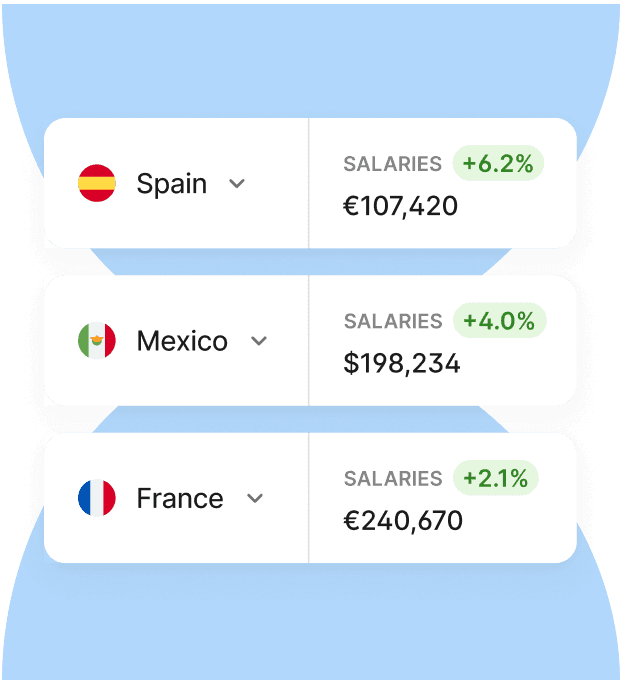
Deel Payroll
Run payroll in Deel. Anywhere. Your way.
The bottom line
AI-powered payroll platforms deliver ROI through multiple, compounding channels: direct cost reduction, risk mitigation, operational speed, and financial visibility. The key is measuring all four, not just the most obvious one.
When you do, most Enterprise organizations find that the return is both material and durable. The platform pays for itself. But more importantly, it transforms how your Finance team operates globally, moving them from execution to strategy.
Deel gives enterprise Finance teams exactly what they need: owned global infrastructure that eliminates vendor fragmentation, AI-driven automation that reduces manual error and compliance risk, and high-touch execution from a dedicated team that understands enterprise complexity.
Unlike aggregators or bolt-on platforms, Deel's in-house payroll engine, 2,000+ local experts across 150+ countries, and native integrations with Workday, SAP, Oracle, and NetSuite mean you're consolidating without rip-and-replace. Your ROI model translates into real operational transformation.
Deel Payroll
Run payroll on one platform, globally

FAQs
How do we account for implementation costs?
Net Year 1 implementation costs (15-25% of platform cost) against Year 1 benefits. Expect break-even to negative ROI in Year 1, then 40-60% ROI in Year 2+.
What's the typical payback timeline?
24-30 months conservatively. Most enterprises see full payback by month 18-24, with Year 3+ showing additional compounding benefits.
How do we quantify risk mitigation?
Research regulatory penalties in your operating countries, estimate likelihood scenarios, and apply conservative probability discount (30-50%). Or calculate as "compliance insurance value."
What's included in the 15-25% vendor consolidation savings?
Elimination of redundant contracts, removal of third-party markup chains, standardized implementation costs, and reduced reconciliation hours. Not head count reduction.
How do we measure M&A speed value?
If acquisitions took 6 months to integrate, and a platform cuts that to 3 months, quantify the retention risk, administrative overhead, and synergy delay costs avoided.
Should benefits be included in ROI?
Only if the platform handles benefits administration. If benefits stay separate, exclude them from payroll ROI.
Does AI really reduce compliance risk?
Yes. It eliminates manual errors, enforces consistent logic, and maintains real-time law updates across countries. But it doesn't eliminate regulatory risk, which still requires human judgment.
Ellen Simmonds is a content marketing manager with a decade of experience in tech, leadership, startups, and the creative industries. A long-time remote worker, she's passionate about WFH productivity hacks and fostering company culture across globally distributed teams. She also writes and speaks on the ethical implementation of AI, advocating for transparency, fairness, and human oversight in emerging technologies to ensure innovation benefits both businesses and society.