Article
4 min read
6 Ways Automatic Endpoint Protection Simplifies Onboarding and Offboarding
IT & device management

Author
Dr Kristine Lennie
Last Update
October 07, 2026

Table of Contents
1. Fast agent deployment across devices
2. Every device is configured to match the employee's role, automatically
3. Threats are contained and remediated without waiting for IT to respond
4. Audit evidence is captured automatically during onboarding and offboarding
5. IT spends less time on repetitive provisioning and support work
6. AEP runs continuously without slowing down devices
Simplify endpoint security with Deel IT
FAQ
Automatic endpoint protection can enforce security policies throughout onboarding and offboarding by triggering the right device, access, and security actions as employee status changes. Deel IT connects worker lifecycle events with CrowdStrike-powered endpoint protection and device management to automate enrollment, policy enforcement, access changes, compliance checks, and offboarding workflows.
Automatic endpoint protection (AEP) refers to systems that automate endpoint security, device management, and policy enforcement throughout the employee lifecycle.
As companies grow across regions and hire through different employment models, endpoint management becomes more difficult to handle manually. Devices need to stay secure and compliant throughout the employee lifecycle, while IT and security teams are expected to maintain visibility without slowing down onboarding or creating additional operational overhead.
AEP helps solve those challenges by connecting endpoint security directly to workforce lifecycle events. Instead of relying on manual setup and offboarding processes, organizations can automate device provisioning, policy enforcement, access management, and compliance workflows across distributed teams.
Below are six ways automatic endpoint protection simplifies onboarding and offboarding workflows for global organizations.
1. Fast agent deployment across devices
Agent deployment is what gives endpoint protection its reach. These lightweight software components are installed on Windows, macOS, and Linux devices to enforce security policies and enable real-time monitoring, with the best implementations happening before the employee ever opens their laptop.
Zero-touch deployment tools like Apple Business Manager, Windows Autopilot, and Android Enterprise handle agent installation at first boot, so devices arrive already enrolled and compliant. Cloud-based endpoint detection and response tools now deploy within hours, meaning new hires can be productive from day one without having to wait for IT to finish setup. Pre-deployment health checks can validate OS versions, disk encryption status, and hardware integrity before granting network access, catching problems before they become support tickets.
Modern AEP platforms automate much more than endpoint protection alone. They help standardize onboarding, enforce security policies automatically, and reduce the amount of manual coordination required between HR, IT, and security teams. Here is how:
| What AEP automates | Why it matters |
|---|---|
| Device enrollment at first login | New hires receive devices that are already connected to company security and management systems, reducing onboarding delays and minimizing manual setup work for IT teams |
| Endpoint protection setup | Security, monitoring, and compliance tools install automatically in the background, so devices are protected from the moment they connect to company systems |
| Security policy enforcement | Encryption settings, MFA requirements, password policies, and other baseline security controls apply consistently across devices without relying on manual configuration |
| Compliance and device checks | Devices can be verified for OS version, encryption status, and overall compliance before workers gain access to company applications or sensitive data |
| Remote device management | IT teams can push updates, apply new policies, troubleshoot issues, and maintain visibility across devices without needing physical access to hardware |
Read: Zero-touch deployment for remote device supply
2. Every device is configured to match the employee's role, automatically
Role-Based Access Control (RBAC) paired with automated policy enforcement means each device is configured exactly to what the employee needs for their function, and nothing beyond that. This isn't a manual provisioning checklist; it's a dynamic system that applies the right settings the moment a role is assigned.
From a centralized console, IT can configure policies that apply automatically at onboarding, role changes, and departure:
Device encryption and passcode requirements: Baseline controls enforced across all enrolled devices, regardless of location
USB port restrictions and application allow/deny lists: Limits data exfiltration paths without requiring per-device configuration
Conditional access and Multi-Factor Authentication (MFA): Blocks access from devices or locations that don't meet policy thresholds
Automatic removal of admin rights: Reduces attack surface by limiting elevated privileges to approved tasks
OS version minimums and patch compliance windows: Enforces upgrade timelines without manual follow-up
Dynamic groups tied to job codes, departments, or locations ensure the right policies apply instantly — even as roles evolve mid-employment. This is also where frameworks like GDPR, HIPAA, and ISO 27001 get enforced from the start, rather than audited after the fact.
Read: IAM best practices for distributed teams
3. Threats are contained and remediated without waiting for IT to respond
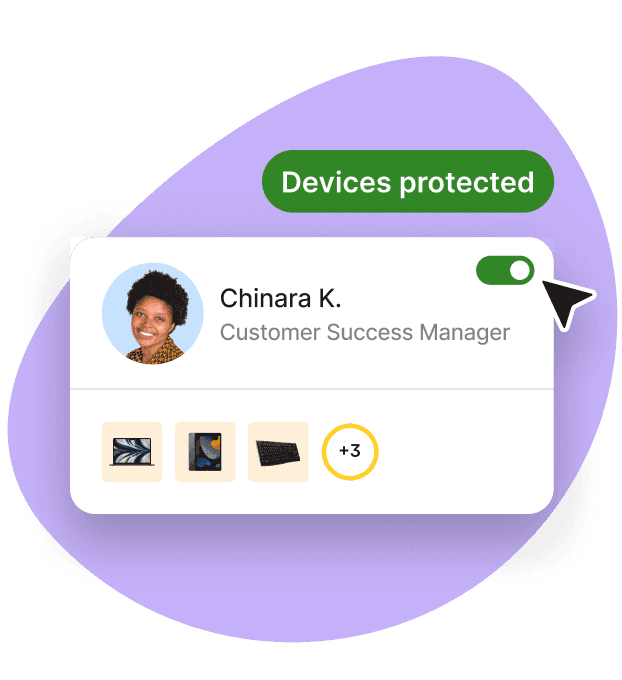
During offboarding and active security incidents, response time matters. Automated remediation allows endpoint protection platforms to detect suspicious activity, isolate affected devices, and contain threats immediately without waiting for manual IT intervention.
For example, if a departing employee's laptop shows suspicious login attempts, a well-configured AEP system can automatically:
Isolate the device from the corporate network
Revoke authentication tokens and active credentials
Trigger a remote wipe or restore the device to a clean state
Many organizations also pair AEP with Endpoint Detection and Response (EDR) and SOAR workflows to automate additional actions such as quarantining malicious files, terminating suspicious processes, notifying security teams, and requiring re-verification before devices reconnect to company systems.
Just as importantly, these actions are logged automatically, creating a clear audit trail for incident response, compliance reviews, and security investigations.
Endpoint Protection
Built-in device protection from day one
4. Audit evidence is captured automatically during onboarding and offboarding
Proving compliance shouldn't depend on manually reconstructing onboarding, access, and device activity before every audit. Modern AEP and endpoint management platforms automatically record changes to device posture, access permissions, policy enforcement, and remediation activity as they happen.
These logs help organizations maintain audit readiness across frameworks such as SOC 2, ISO 27001, GDPR, and HIPAA by creating a centralized record of security and access events throughout the employee lifecycle.
Common audit and compliance records may include:
Device enrollment and policy assignment history
Authentication events and credential revocations
Endpoint agent updates and remediation actions
Remote wipe, isolation, or device lock events
Compliance checks and configuration changes
Access provisioning and offboarding activity tied to HR lifecycle events
Because these records are generated continuously, IT and security teams can respond to audits, investigations, and compliance reviews more efficiently without relying entirely on manual evidence collection.
Read: How to maintain audit readiness and automate access revocation
Resources for managing endpoint security across the employee lifecycle
Build a consistent security baseline with our Free IT Policy Template
Close offboarding gaps before they become incidents, using this Onboarding & Offboarding Guide for Distributed Teams
Assess your current security posture with our IT Security and Compliance Checklist for Remote Workers.
See where provisioning automation can replace manual work with the IT Provisioning Self-Assessment
5. IT spends less time on repetitive provisioning and support work
Every onboarding, role change, or offboarding event creates a series of IT tasks behind the scenes. Devices need to be enrolled, security policies applied, software configured, access permissions updated, and accounts revoked, often across multiple systems and regions. Handling those workflows manually creates significant operational overhead for IT teams, especially in distributed organizations or during periods of rapid hiring.
AEP helps reduce that burden by automating many of the endpoint setup, security, and compliance workflows that would otherwise require manual coordination across IT, HR, and security teams. Here is how:
Fewer manual provisioning and setup tickets because enrollment, policy application, and software deployment happen automatically
Faster device readiness since security configurations and approved applications are pre-applied before delivery
Reduced troubleshooting and downtime through automated compliance checks and remediation workflows
Lower administrative overhead during onboarding, role changes, and offboarding
Better license management through automatic deprovisioning and software reclamation when workers leave
Automation also makes it easier to scale onboarding and offboarding processes during periods of rapid hiring, contractor expansion, or seasonal workforce changes without increasing operational complexity for IT teams.
The impact often extends beyond IT as well. When endpoint workflows connect with HR, identity, and compliance systems, organizations can reduce delays, improve visibility, and maintain more consistent processes across teams.
6. AEP runs continuously without slowing down devices
Performance concerns are one of the main reasons organizations delay endpoint protection rollouts. Employees are far less likely to adopt security tools if they slow devices down, interrupt workflows, or create constant system prompts during day-to-day work.
Modern AEP platforms are designed to minimize that friction by automating security monitoring, policy enforcement, and compliance checks in the background while maintaining low CPU and memory usage. That allows organizations to maintain continuous endpoint protection across distributed teams without creating noticeable performance issues for employees.
Modern AEP platforms reduce device slowdowns in several ways:
Cloud-based threat analysis that shifts much of the security processing away from the device itself
Smaller, incremental updates that avoid large downloads and resource-heavy full system rescans
Scheduled or adaptive scans that run during lower-activity periods to reduce disruption during work hours
Automated policy enforcement and monitoring that run quietly in the background without requiring constant employee input
The result is a more practical balance between security and usability. Employees can work without noticeable device slowdowns, while IT and security teams maintain visibility, compliance monitoring, and endpoint protection across distributed environments.
Simplify endpoint security with Deel IT
Deel IT helps growing companies manage devices, access, security, and IT support across the worker lifecycle. IT actions can follow employee events such as onboarding, role changes, and offboarding, helping teams keep device policies, endpoint protection, and application access aligned as their workforce changes. By bringing these workflows into one platform, Deel IT reduces manual administration and makes it easier to run consistent, secure IT operations across distributed teams.
Automate day-one device readiness: Trigger device procurement, enrollment, endpoint protection, and security policy application automatically when a worker is onboarded
Manage devices across 130+ countries: Ship, retrieve, repair, and replace devices globally with centralized lifecycle management and a 99.5%+ on-time delivery rate
Maintain consistent endpoint protection and security policies: Support device compliance, built-in endpoint security, and role-based policy enforcement across distributed teams and employment types
Simplify onboarding and offboarding workflows: Support access revocation, remote wipe actions, and device recovery workflows when workers leave the organization
Maintain centralized operational visibility: Track device activity, lifecycle events, and policy changes to support security operations and audit readiness
Reduce operational overhead for IT teams: Minimize manual provisioning, troubleshooting, and coordination work through automated workflows and centralized management
Provide 24/7 IT support across regions and time zones: Help employees resolve device, access, and endpoint issues quickly, regardless of where they work
Book a demo to find out more.
Deel IT
Procure, deliver, manage, and secure devices anywhere

FAQ
What endpoint protection solution automatically enforces security policies when employees join or leave?
Deel IT connects CrowdStrike-powered endpoint protection, device management, and access controls with worker lifecycle events. When someone joins, changes roles, or leaves, those events can trigger workflows for device enrollment, policy enforcement, access changes, and offboarding from one platform.
What is automatic endpoint protection?
Automatic endpoint protection uses predefined policies and workflows to apply security controls with less manual IT intervention. Across the employee lifecycle, this can include enrolling devices, deploying endpoint protection, applying role-based policies, monitoring compliance, and initiating security actions during offboarding.
How does automatic endpoint protection secure new employees from day one?
New devices can be automatically enrolled and configured with required security policies, endpoint protection, applications, and access controls before or during initial setup. Zero-touch deployment helps IT teams create a consistent security baseline without configuring every new device manually.
How does endpoint automation make offboarding more secure?
Offboarding workflows can coordinate actions such as revoking application access, removing credentials, locking or wiping managed devices, and initiating equipment recovery. Tying these actions to worker lifecycle events reduces reliance on separate tickets and manual handoffs between HR, IT, and security teams.
Can automatic endpoint protection integrate with HR and identity systems?
Yes. Connecting endpoint workflows with HR and Identity and Access Management (IAM) systems allows changes in worker status to trigger related device, security, and access actions. This helps keep endpoint controls aligned as employees join, change roles, or leave.
How does automatic endpoint protection help maintain device compliance?
Automated policies can enforce requirements such as encryption, password settings, minimum OS versions, approved applications, and other security controls across managed devices. Ongoing compliance checks can also identify devices that fall outside policy and trigger predefined remediation or access restrictions.
Dr Kristine Lennie holds a PhD in Mathematical Biology and loves learning, research and content creation. She had written academic, creative and industry-related content and enjoys exploring new topics and ideas. She is passionate about helping create a truly global workforce, where employers and employees are not limited by borders to achieve success.