Article
15 min read
Why Global IT Can't Scale on Point Tools
IT & device management

Author
Dr Kristine Lennie
Last Update
April 27, 2026

Table of Contents
Reason #1: Point tools are built for individual problems, not connected workflows
Reason #2: Scaling headcount exposes every gap in the lifecycle
Reason #3: Security compliance can't be enforced consistently across a fragmented stack
Reason #4: Global device operations can't run on regional procurement models
Reason #5: IT support at enterprise scale requires context and coverage
Reason #6: Vendor sprawl makes IT costs invisible and growing
What a good global IT infrastructure actually looks like at enterprise scale
Stop stitching it together: how Deel IT powers global IT at enterprise scale
Key takeaways
Point tools solve isolated IT problems but create compounding operational, security, and financial costs when a company scales across multiple countries.
Scaling global IT requires consolidating device management, access control, and support into a unified system that eliminates handoffs and closes the gaps that fragmented stacks leave open.
Deel IT gives enterprise teams a single platform to manage the full device and access lifecycle across 130+ countries, replacing the coordination overhead of point tools with automated, connected workflows.
When a company expands globally, its IT stack tends to expand with it: one tool for devices here, another for access there, a third for support somewhere else. Each addition solves a problem in isolation, and for a while, the seams don't show.
At enterprise scale, those seams become fault lines. What worked at 200 people breaks at 1,000. What functioned across three countries becomes a coordination crisis across fifteen. This article breaks down why point tools fail global IT at scale, and what the path forward looks like.
Reason #1: Point tools are built for individual problems, not connected workflows
Point tools are designed to solve one thing well. That's their strength at a small scale and their fundamental limitation as an organization grows. At enterprise scale, functionality erodes when critical workflows rely on tools that were never designed to work together.
These breakdowns show up in the day-to-day workflows that should be seamless:
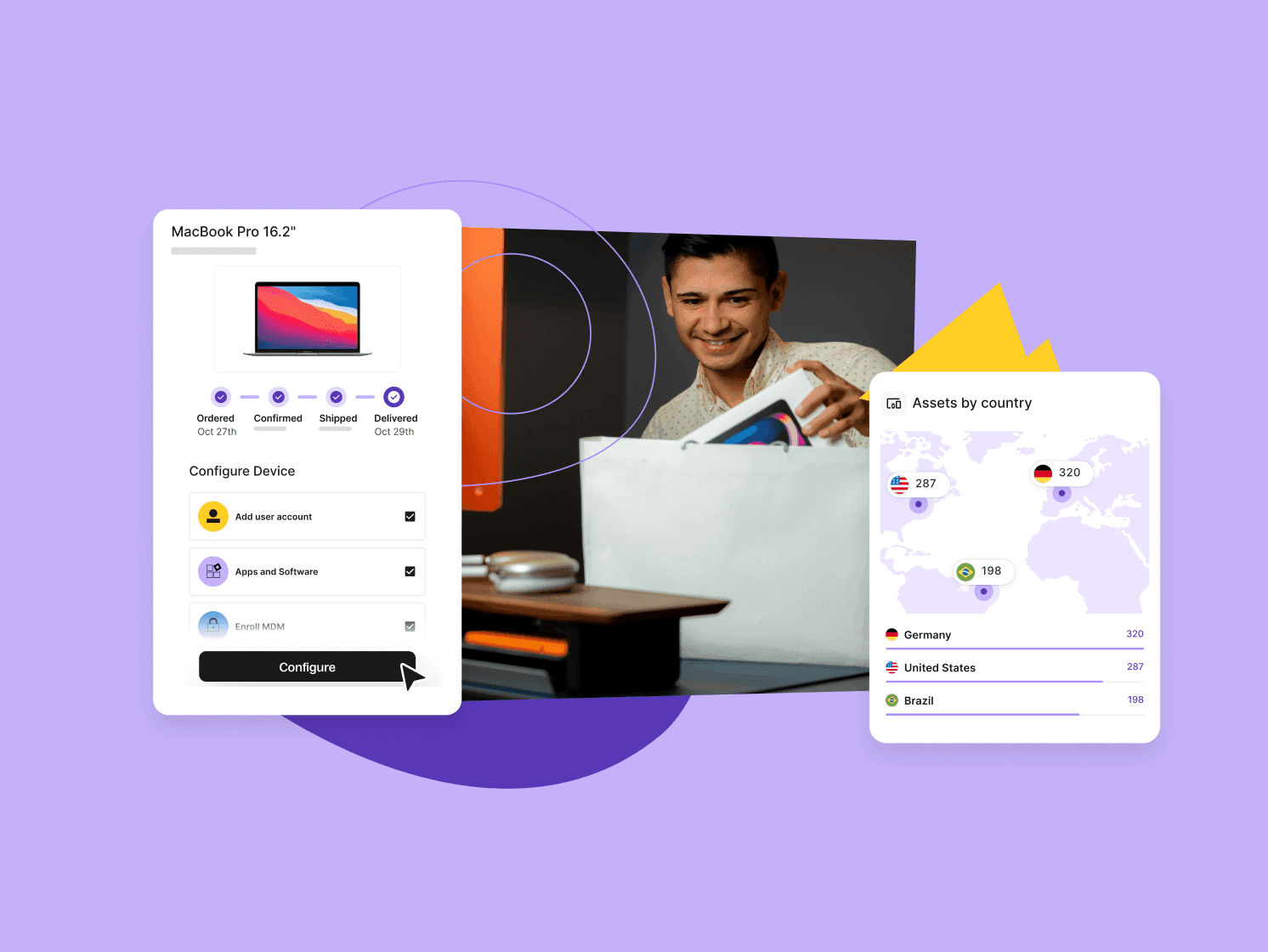
Procurement systems don't connect to Mobile Device Management (MDM): A device ships, but enrollment doesn't happen automatically. Someone has to manually ensure the device is enrolled, configured, and compliant every single time, in every country.
MDM doesn't connect to identity: A device is enrolled, but the user's access profile isn't applied. IT has to cross-reference two separate systems to confirm a new hire is actually provisioned correctly.
Identity doesn't connect to HR: When an employee changes roles or leaves the company, the signal has to travel manually from HR to IT before any access change happens, and in distributed teams, that signal often arrives late, or not at all.
Support tools don't have device or access context: When an employee raises a support ticket, the agent is working blind. They have no real-time view of the device, its compliance state, or what access the employee holds, slowing resolution and increasing escalation rates.
Every handoff is a delay and a risk: At enterprise scale, manual handoffs between disconnected tools translate directly into longer onboarding times, slower offboarding, and access that persists longer than it should, all of which carry measurable security and compliance consequences.
The result: Global IT operations become a coordination exercise rather than a system, held together by human effort that doesn't scale and can't be audited.
The solution: Enterprise IT needs a connected infrastructure in which HR events, device states, identity records, and support context share a common data layer. The goal isn't fewer tools for its own sake, it's eliminating the dead space between them.
How Deel IT helps: Deel IT connects device lifecycle, endpoint management, identity provisioning, and HR data into a single coordinated system, so every action triggered by an HR event flows automatically, with no manual handoffs between platforms. Every layer shares context, which means IT operates on accurate, real-time information rather than disconnected records.
Read: Why onboarding automation breaks down between HR and IT
Reason #2: Scaling headcount exposes every gap in the lifecycle
A point-tool stack can appear functional until hiring velocity increases. At 50 people, IT can manage manual processes. At 500, those processes break. At 1,000+, they become a liability. The inflection point is rarely a dramatic failure; it's a slow accumulation of delays, errors, and workarounds that eventually collapses under its own weight.
These pressures surface across every stage of the employee lifecycle:
Onboarding volumes exceed manual capacity: When a company hires across multiple countries simultaneously, IT can't manually configure, ship, and enroll devices for each new hire without errors compounding across the queue.
Offboarding falls behind hiring speed: At enterprise scale, the volume of departures in any given month can rival the volume of new hires. Point tools with no automated triggers mean offboarding steps are missed, access lingers, and devices aren't recovered.
Role changes create access drift: When employees move between teams or functions, their access profile should change with them. Without automated role-based provisioning tied to HR, old permissions accumulate (privilege creep) across hundreds or thousands of accounts.
Regional variation breaks standardized processes: A procurement workflow that works in the US doesn't automatically work in Germany, Brazil, or Singapore. Point tools built for one market require significant manual adaptation (or separate regional tools) as your geographic footprint grows.
IT headcount grows faster than the business: Without automation, the only way to keep up with scale is to hire more IT staff. Companies operating point-tool stacks at enterprise scale are often staffing to compensate for process gaps rather than to drive strategy.
The result: IT becomes a bottleneck to growth, slowing the hiring velocity it was supposed to support and introducing security risk at the exact moments of greatest organizational change.
The solution: Lifecycle automation in which hire, role change, and departure events automatically trigger coordinated IT actions is the only sustainable answer at enterprise scale. This is not an incremental improvement to a point-tool stack; it requires connected infrastructure.
How Deel IT helps: Deel IT's lifecycle automation connects directly to your HRIS, turning HR events into immediate, coordinated actions across devices, access management, and applications, with no manual IT team intervention required at each step. Onboarding, role changes, and offboarding run as single coordinated workflows, with real-time progress visibility for HR, IT, and managers simultaneously.
Read: The most common offboarding failures on remote teams
Reason #3: Security compliance can't be enforced consistently across a fragmented stack
Enterprise organizations operate under real compliance obligations (such as SOC 2 and ISO 27001) and increasingly complex regional data protection frameworks. Enforcing consistent security policies across a distributed workforce using disconnected tools creates systemic gaps that translate directly into security and compliance risk.
Here is why:
Each tool enforces its own policies in isolation: MDM enforces device-level policies. A separate identity tool enforces access policies. A third tool handles application security. None of them shares a compliance baseline, and none of them can enforce it across the others.
Audit evidence is fragmented across systems: When an auditor asks for evidence of access controls, device compliance, or offboarding completeness, IT has to manually compile records from multiple platforms, increasing audit preparation time and introducing gaps that are difficult to explain.
Regional tools apply regional standards: A point tool selected for a specific market enforces that market's defaults. At enterprise scale, operating different security standards in different regions creates exploitable inconsistency and complicates cross-border compliance reporting.
Policy drift is invisible until it's a problem: When patches are applied inconsistently, encryption configurations vary by region, or Multi-Factor Authentication (MFA) enforcement is uneven, IT often doesn't know until a breach or audit surfaces the gap.
Deprovisioning gaps leave access and data exposed after departure: Without automated offboarding, access revocation and data erasure depend on manual processes, and at enterprise scale, those processes fail. Accounts remain active, devices aren’t reliably wiped, and regulated data can persist beyond legal retention windows.
The result: The enterprise is not operating a unified security posture. It is operating a collection of locally enforced policies with gaps at every boundary, and those gaps are where incidents and audit failures occur.
The solution: Consistent compliance requires consistent infrastructure. Security baselines, access controls, and audit records need to be enforced and captured from a single connected system, not assembled from multiple tool exports after the fact.
How Deel IT helps: Deel IT enforces continuous, automated policy compliance across all enrolled devices globally: from encryption to OS updates and security configurations. Deprovisioning is triggered by employee lifecycle events, revoking access, and initiating device return workflows without manual intervention.
Find out what happens when access is not revoked on time.
Reason #4: Global device operations can't run on regional procurement models
Enterprise organizations with distributed workforces can't rely on regional procurement relationships, local resellers, or country-by-country device strategies. At scale, the inconsistency compounds: different hardware standards, different lead times, different compliance configurations, and no unified view of what the fleet actually looks like.
The typical reasons include:
No single procurement workflow covers every hire location: When a new hire joins in a country where the company has no established procurement relationship, IT improvises, and improvisation at enterprise scale means delays, inconsistent hardware, and devices that arrive without the right configuration.
Fleet visibility breaks across regions: When devices are sourced through multiple regional channels, tracking ownership, compliance status, and utilization becomes a manual effort. At enterprise scale, this typically means IT is operating on an approximate inventory, not an accurate one.
Device refresh cycles are managed manually: Without centralized lifecycle tracking, refresh cycles are driven by individual requests rather than fleet-wide data. Devices stay in service past their useful life, creating security risks and employee experience problems.
Data erasure at offboarding is inconsistent: When devices are recovered through regional processes, certified data erasure is difficult to guarantee. At enterprise scale, across high-turnover roles and multiple jurisdictions, this creates a material data protection liability.
Hardware standards vary by region: Different procurement sources result in different hardware configurations, different OS versions, and different security baselines. At enterprise scale, this variability makes fleet management exponentially more complex and audit evidence harder to produce.
The result: The enterprise fleet is not a managed asset; it is a collection of locally sourced hardware with different standards, different owners, and different compliance states, coordinated by IT effort alone.
The solution: Enterprise device operations require a global procurement infrastructure: a single workflow that works in every country the company hires in, with consistent configuration, enrollment, and lifecycle tracking from day one.
How Deel IT helps: Deel IT provides global device procurement across 130+ countries: sourcing, configuring, and shipping pre-imaged hardware to any new hire, with no regional resellers, no ad hoc procurement, and no gaps in enrollment. Centralized lifecycle tracking gives IT real-time fleet visibility across ownership, status, and cost, and certified data erasure at offboarding generates full audit documentation automatically.
Discover how to create a fair laptop refresh policy.
Reason #5: IT support at enterprise scale requires context and coverage
Enterprise organizations operating across time zones need IT support that is always available and has the full context to resolve issues quickly. At scale, coverage gaps lead to uneven support experiences, while disconnected systems force agents to piece together information, slowing resolution and increasing ticket volume.
When systems are fragmented, this can result in the following failures and inconsistencies:
Agents can't see device state in real time: When an employee raises a ticket, the support agent is operating from whatever context the employee provides. Without real-time device visibility, diagnosis is slow, escalation rates are high, and resolution times suffer across a workforce of thousands.
Access issues require cross-platform investigation: Troubleshooting an access problem in a point-tool environment means checking multiple disconnected systems—the identity platform, the application logs, the HR record—and assembling context manually.
Support coverage is inconsistent across time zones: Enterprise organizations often have strong IT support in headquarters markets but limited or third-party coverage elsewhere. Without consistent global coverage, response times and resolution quality vary significantly by location.
Self-service is unavailable or poorly connected: Many enterprise IT stacks offer self-service theoretically, but the underlying systems aren't connected well enough for automation to work reliably. Employees default to tickets, and ticket volume grows linearly with headcount.
SLAs are defined globally but enforced unevenly: At enterprise scale, global SLA commitments depend on consistent coverage and tooling. Without aligned support coverage across regions, SLAs become difficult to enforce in practice
The result: IT support costs increase, but resolution quality remains inconsistent. Coverage and context are both essential at enterprise scale — without coverage, demand isn’t met; without context, issues aren’t resolved efficiently.
The solution: Enterprise IT support needs both consistent global coverage and a unified data layer, so that when an employee raises a ticket, the agent immediately sees the device, its compliance state, the employee's access profile, and the application context. Coverage and context need to work together for support to scale effectively.
How Deel IT helps: Deel IT provides 24/7 global IT support across all time zones, with support agents operating from a full device and access context per employee, so resolution starts from an accurate picture, not from whatever the employee can describe. SLAs are defined and enforced globally, and self-service automation handles common issues before they become tickets.
Learn about the benefits of 24/7 IT support for distributed teams
Reason #6: Vendor sprawl makes IT costs invisible and growing
At enterprise scale, the financial cost of a point-tool stack is rarely visible in a single line item. It is distributed across department budgets, absorbed into IT headcount, and understated in procurement records. The real cost only becomes legible when someone attempts to consolidate it, and by then, it is often significantly larger than expected.
These costs become visible in how spending accumulates and escapes visibility:
License costs accumulate across tools with overlapping capabilities: Enterprise stacks acquired over time frequently include multiple tools that cover the same function in different parts of the organization. Each is licensed separately, and the overlap is rarely audited.
Usage data is siloed within each tool: Without a centralized view of application and device utilization, IT cannot identify underused licenses, redundant tools, or SaaS subscriptions that no longer match how the organization operates.
IT headcount grows to manage tool complexity: The coordination overhead of a sprawling point-tool stack requires people to manage it. At enterprise scale, a meaningful portion of IT headcount is often functioning as integration middleware, managing handoffs between tools rather than delivering outcomes.
Spend cannot be attributed accurately: When costs are distributed across tools, regions, and procurement channels, IT leadership cannot produce a clear total cost of ownership for the IT function, making it difficult to justify consolidation investment or demonstrate efficiency gains.
Audit and renewal cycles create recurring operational drag: Managing contracts, renewals, and compliance reviews across 10, 15, or 20 point tools is itself a significant operational burden, one that scales with vendor count rather than with business outcomes.
The result: The enterprise is paying a compounding premium for fragmentation in the form of license fees, headcount, coordination time, and audit overhead, without a clear view of what it is getting in return.
The solution: Consolidation is not about reducing vendor count as a goal in itself. It is about achieving a state in which every IT function has a clear owner, connected data, and measurable cost, and the spend required to maintain that state reflects the value it delivers.
How Deel IT helps: Deel IT provides centralized visibility across devices, applications, and spend, helping teams identify unused licenses and reduce software sprawl. Device inventory and utilization are tracked across the fleet, supporting more efficient allocation and reuse. With real-time insights into assets, contracts, and invoices, IT leaders gain clearer visibility into overall spend and the data needed to manage IT more effectively at scale.
Read: How to reduce IT costs without sacrificing service
What a good global IT infrastructure actually looks like at enterprise scale
At enterprise scale, IT infrastructure works when systems are connected well enough to operate as a single, coordinated function. Here's what that means in a nutshell:
HR events drive IT actions automatically: A hire, departure, or role change in the HRIS immediately and automatically triggers device procurement, access provisioning, and application assignment, with no IT team member manually initiating each step
A single fleet view covers every device in every region: IT leadership can see the ownership, compliance state, and utilization of every device in the fleet in real time, regardless of where it was procured, where the employee is located, or which MDM region it falls under
Role-Based Access Control (RBAC) is applied and enforced globally: Access reflects role, and when a role changes, access changes with it—automatically, immediately, and with full audit documentation.
Single Sign-On (SSO) and MFA are enforced consistently across all applications: Authentication is centralized and standardized, eliminating gaps between systems
Compliance evidence is continuous, not assembled for audits: Audit-ready records of device compliance, access controls, and offboarding completeness exist as a byproduct of how IT operates, not as a manual exercise undertaken when an auditor requests them
Support is context-aware, not just globally available: When an employee in any region raises a support issue, the agent has immediate access to device state, access profile, and application context, enabling faster resolution and fewer escalations.
IT cost is visible and attributable: Leadership can see what the IT function costs, what it delivers, and where spend is going, across tools, regions, and headcount, without requiring a manual consolidation exercise.

Guide
The World at Work in 2026: Deel IT
Stop stitching it together: how Deel IT powers global IT at enterprise scale
Deel IT was built to support global IT at scale: connecting device lifecycle, endpoint management, identity and access, lifecycle automation, and IT support into a single coordinated system. No manual handoffs. No fragmented compliance posture. No invisible spend.
Deel IT replaces your point-tool stack with a connected global IT infrastructure:
Global procurement and delivery across 130+ countries: Source, configure, and ship pre-imaged hardware to any new hire, with no regional resellers, no ad hoc procurement relationships, and no gaps in MDM enrollment from day one
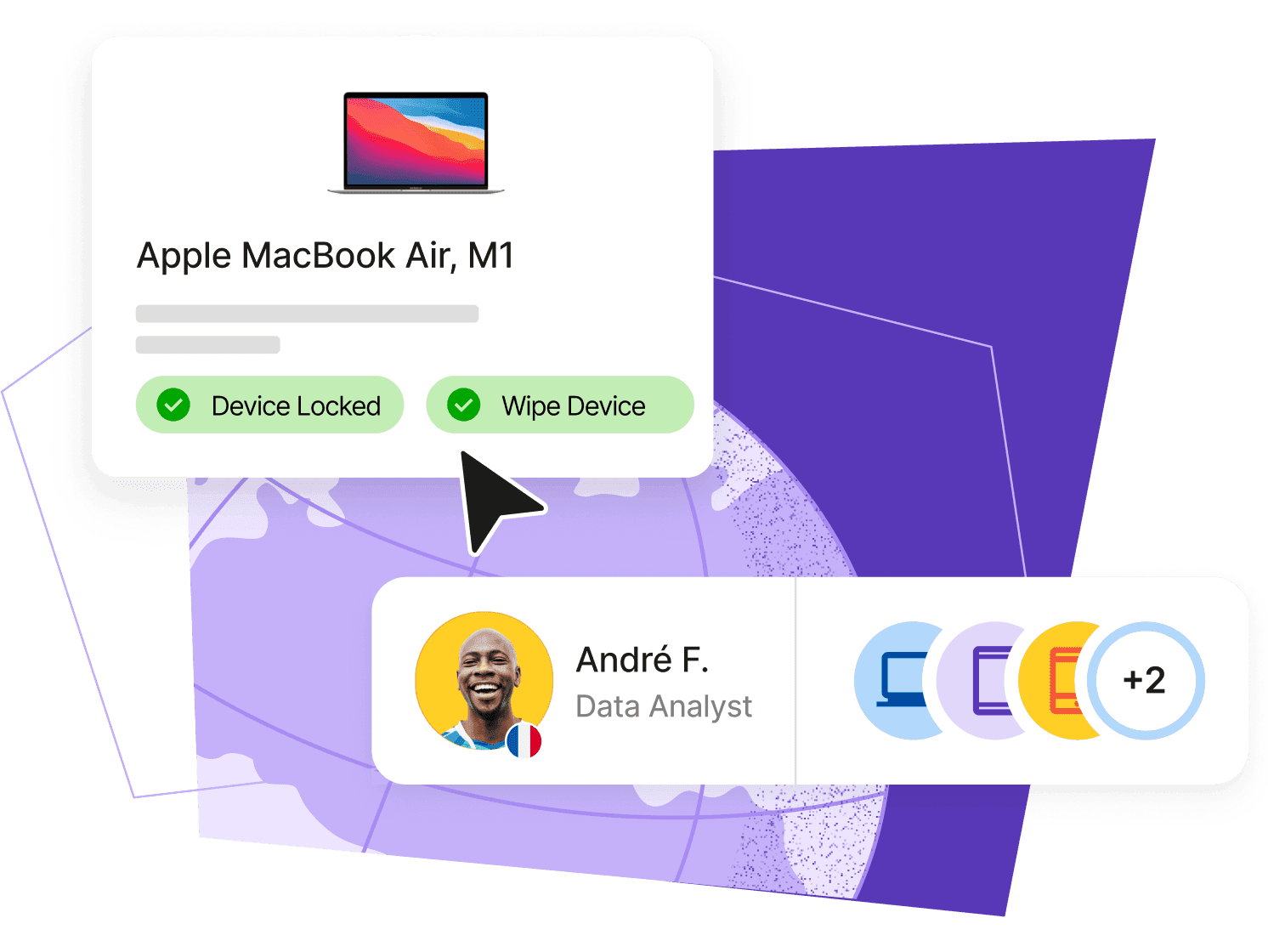
Continuous, automated endpoint compliance: Encryption, OS updates, and security configurations are enforced across every enrolled device in every region, with real-time visibility and remote lock, wipe, and remediation available globally
Role-based access control and identity enforcement: Access reflects role and updates automatically, with SSO and MFA applied consistently across all applications.
Lifecycle automation across devices and operations: HRIS events trigger coordinated workflows across device provisioning, configuration, and offboarding
Centralized spend and license visibility: Full visibility across device utilization, application usage, and IT spend, giving teams the data needed to identify redundant tools, optimize license usage, and manage renewals more effectively
Standardized processes enforced across every entity and region: Consistent policies, workflows, and compliance baselines applied globally, so the enterprise operates as a single IT environment, not a collection of regional stacks held together by coordination overhead
24/7 global IT support: Always-on support ensures repetitive issues are resolved across regions and time zones, reducing downtime and lowering internal ticket load so your global workforce can stay productive
Book a demo to see how Deel IT can support your enterprise.
Deel IT
Automate IT operations in 130+ countries
FAQs
Why do point tools work fine for small companies but fail at enterprise scale?
Point tools are designed to solve specific, isolated problems, which is manageable when your team is small and mostly in one place. As headcount and geography expand, each tool adds its own admin overhead, and the gaps between them — in data, workflows, and accountability — multiply faster than IT teams can manage them.
What are the biggest security risks of running a fragmented IT stack across multiple countries?
Fragmented stacks create inconsistent visibility, meaning devices or access credentials in one region may not be tracked or governed the same way as others. This makes it harder to enforce uniform security policies, respond quickly to incidents, and maintain compliance with regional data protection regulations.
How does managing devices across different countries differ from managing a domestic fleet?
Cross-border device management involves navigating import regulations, varying hardware availability, local repair and support networks, and country-specific compliance requirements — none of which a single-country tool is built to handle. Without a system designed for global operations, IT teams often rely on manual workarounds that don't scale.
What should companies look for when consolidating their global IT tools into a unified platform?
The most important capabilities are end-to-end device lifecycle management, integrated identity and access controls, and support coverage across the countries where employees work. A platform that connects these functions reduces the handoffs that fragment ownership and slow down both onboarding and incident response.
Dr Kristine Lennie holds a PhD in Mathematical Biology and loves learning, research and content creation. She had written academic, creative and industry-related content and enjoys exploring new topics and ideas. She is passionate about helping create a truly global workforce, where employers and employees are not limited by borders to achieve success.