
Global Work Glossary
- Results for ""
Table of Contents
How candidate impersonation fraud works
What risks candidate impersonation fraud poses to employers
Signs of candidate impersonation fraud
Candidate impersonation fraud vs. related threats
Key facts
Detect and prevent candidate impersonation fraud with Deel Security
FAQ
What is candidate impersonation fraud?
Candidate impersonation fraud is a form of employment fraud in which someone other than the actual applicant completes a job interview, pre-employment assessment, or another stage of the hiring process on the applicant's behalf. The employer makes an offer and signs an employment agreement based on a person they never actually met, so the worker who starts the role may have different skills, qualifications, and intentions than the one who applied.
How candidate impersonation fraud works
The most direct form uses a live stand-in: a different person appears on the video call, presents the applicant's documents, and answers interview questions as though they are the applicant. More technically advanced attacks use deepfake video or audio, where AI-generated imagery replaces the real face in real time. Screen-sharing arrangements, in which the applicant is on camera, but a third party feeds answers through a secondary channel, overlap with proxy interview detection territory and can be harder to classify.
Online assessments, coding tests, and skills evaluations are also vulnerable. A third party may complete these stages entirely and then hand control back to the applicant for stages that require a live presence. The result might be a candidate record that does not reflect the applicant's actual abilities.
What risks candidate impersonation fraud poses to employers
The immediate risk that candidate impersonation poses is that an employer onboards someone whose skills or identity were misrepresented. For roles that require specific qualifications, that could create performance and safety problems. Where the role involves access to sensitive systems or data, the risk extends to identity fraud, data breaches, and potential insider threats.
Employment contracts carry an implicit assumption that the person the employer screened is the person they hired. When that breaks down, the legal standing of the relationship might become complicated, and regulated industries may face additional obligations around worker verification. Any access credentials, devices, or permissions the impersonator gains during onboarding may remain active long after detection.
Signs of candidate impersonation fraud
Candidate impersonation fraud may involve warning signs during hiring and onboarding, including:
Appearance inconsistencies: Noticeable differences in a candidate's appearance across interviews or identity documents.
Unusual video or audio: Unnatural facial movements or mismatched lip movements and speech that may suggest a deepfake.
Performance gaps: Significant differences between assessment results and live interview performance.
Inconsistent experience: Difficulty explaining skills or work history listed in an application.
Changes after hiring: A new employee's skills or knowledge differ substantially from those demonstrated during interviews.
These signs do not prove fraud on their own and may have legitimate explanations. However, they can warrant further review to determine whether candidate impersonation has occurred.
Candidate impersonation fraud vs. related threats
Candidate impersonation fraud overlaps with several related threats and detection methods. Understanding how they differ can help employers recognize the different ways hiring fraud may occur.
Deepfake: AI-generated video or audio replaces a real person's face or voice in real time, and some impersonation attacks use deepfakes to defeat video interview screening.
Proxy interview detection: Proxy interview detection identifies when a third party coaches or completes an interview for a candidate, covering a broader range of fraudulent assistance than full identity substitution.
Synthetic identity fraud: Synthetic identity fraud builds a fictitious applicant profile from a mix of real and fabricated data, which differs from impersonating a specific real person.
Social engineering: Social engineering uses manipulation tactics to extract the personal information fraudsters need to build a convincing impersonation profile.
Key facts
Here are some key facts about candidate impersonation fraud, the risks it poses to employers, and how organizations can detect and prevent it.
Candidate impersonation fraud can occur at any hiring stage, from the first screening call through skills tests, final interviews, and onboarding checks.
It differs from proxy interviewing in that impersonation involves a full identity substitution, not just off-screen coaching while the actual candidate is present.
Liveness detection and face matching verify that the person on a video call matches the government-issued ID they submitted. That might reduce the chance a live stand-in passes screening.
Deepfake-based impersonation may require more than visual cues to detect: behavioral analysis, document checks, and device signals together can give a more complete picture.
Employers in regulated industries may carry elevated legal and compliance risk when a worker's identity was not properly verified at each stage of the hiring process.
Detecting candidate impersonation fraud consistently may require a combination of identity verification checks, human review, and monitoring that continues after hire.
Detect and prevent candidate impersonation fraud with Deel Security
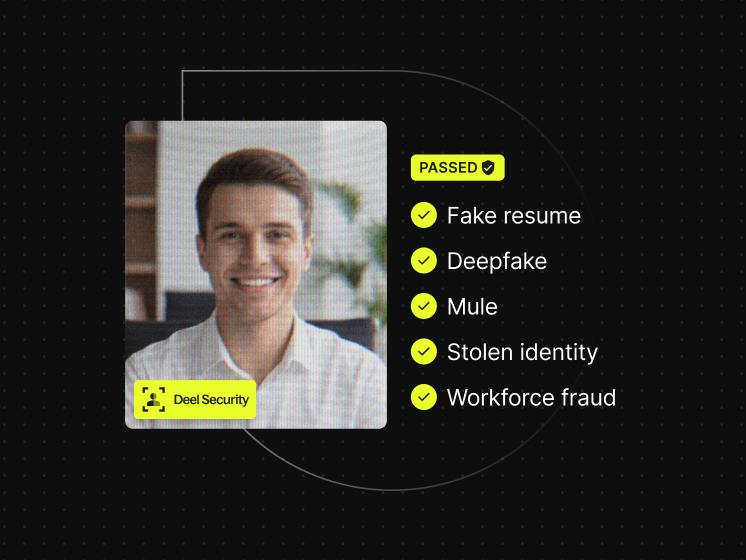
Deel Security enables businesses to detect fake candidates, deepfakes, and impersonation attempts across the full worker lifecycle, from recruitment and onboarding to ongoing employment.
By identifying suspicious identities early, Deel Security helps businesses reduce the risk of hiring fraudulent candidates and ensure greater confidence in who they're hiring and paying.
Book a demo to see how Deel Security helps protect your hiring process.
Deel Security
Hire real people, keep fraud out from hiring to offboarding
FAQ
What is the difference between candidate impersonation fraud and proxy interviewing?
The two differ in scope. Proxy interviewing covers any arrangement where the actual candidate receives outside assistance while present, so the candidate is real but the work is not entirely theirs. Candidate impersonation fraud goes further: a different person claims to be the applicant entirely, so the employer never meets or evaluates the actual hire.
How can HR teams detect candidate impersonation fraud without advanced technology?
Comparing how a candidate communicates across written applications, screening calls, and final interviews might reveal inconsistencies a stand-in may find hard to mask. Cross-referencing the face on a video call against the photo on submitted ID documents and verifying government-issued documents at onboarding add low-tech checkpoints that require no specialist technology. Deel's built-in background checks can automate parts of this verification workflow.
Does candidate impersonation fraud only happen in fully remote roles?
No. Any stage that accepts remote completion is a potential target, including initial phone screens, online assessments, and video interviews for roles that otherwise require in-person work. The risk might be highest where remote or asynchronous stages are unsupervised and unverified, not only where the final role is fully remote.
What should an employer do when they suspect candidate impersonation fraud after hiring?
The immediate steps are to suspend system access and document evidence of the discrepancy. HR, legal, and information technology (IT) teams should assess what access the worker gained and whether any data or systems were affected. The employment agreement may be voidable, and the employer's legal team should advise on termination procedure and any reporting obligations under applicable law.
How does candidate impersonation fraud relate to synthetic identity fraud?
The two threats differ in what the fraudster constructs. Synthetic identity fraud creates a fictitious applicant from a blend of real and fabricated data, so there is no specific real person being impersonated. Candidate impersonation fraud puts a real person in front of the employer while claiming to be a different real individual, which may call for behavioral and biometric checks rather than purely document verification.