
Global Work Glossary
- Results for "undefined"
Table of Contents
Federal payroll compliance requirements
State payroll compliance obligations
Payroll compliance for global employers
Key facts
Managing payroll compliance with Deel
FAQ
What is payroll compliance?
Payroll compliance is the ongoing obligation to meet every legal requirement tied to paying workers: calculating and withholding the correct taxes, remitting those funds on schedule, applying wage-and-hour rules, and keeping the records that regulators require.
In the United States, employers must navigate federal, state, and local layers of payroll requirements, each with its own rules, deadlines, and enforcement authorities. Employers that operate in multiple states, or that pay workers internationally, face additional obligations on top of the federal baseline.
Guide
Global Payroll Compliance Checklist
Federal payroll compliance requirements
US employers face three overlapping federal laws that govern payroll obligations. The US Department of Labor (DOL) enforces the Fair Labor Standards Act (FLSA), which sets the national minimum wage, overtime standards, and the criteria for classifying workers as exempt or nonexempt. Covered nonexempt employees must receive at least one and a half times their regular pay rate for hours worked beyond 40 in a workweek.
The Federal Insurance Contributions Act (FICA) requires both employers and employees to contribute to Social Security and Medicare. Workers and their employers each pay 6.2% toward Social Security and 1.45% toward Medicare. The Internal Revenue Service (IRS) also requires employers to withhold an additional 0.9% Medicare surtax from employees earning over $200,000 in a calendar year.
Employers calculate the federal income tax to withhold each pay period from the employee's Form W-4 and IRS withholding tables. Employers alone fund the Federal Unemployment Tax Act (FUTA), which finances the federal unemployment insurance system at a standard rate of 6%.
State payroll compliance obligations
Every US state adds its own payroll requirements on top of the federal baseline. Most states require employers to withhold state income tax, though nine have no state income tax under their own tax codes.
Depending on the state, employers may also face obligations for:
Paid family and medical leave
Disability insurance
Long-term-care insurance
Workers' compensation contributions
Local jurisdictions may add their own payroll taxes on top. Employers must apply the highest applicable minimum wage at the federal, state, or local level for every worker they employ.
Companies with employees in multiple states face the full set of each state's requirements simultaneously. Our multi-state payroll compliance guide covers practical approaches for managing them at scale.
Payroll compliance for global employers
US payroll compliance rules apply to workers employed in the United States. Companies that pay workers in other countries face a separate layer of local obligations, including tax withholding requirements, social contribution rates, wage floors, and record-keeping mandates that differ by jurisdiction.
Each country typically requires employers to register with local tax and labor authorities, deduct the correct amounts under local law, and file the required periodic reports. Employers that miss local obligations face back-tax assessments, interest, and penalties under each jurisdiction's enforcement regime.
Key facts
FICA contributions split evenly: employees and employers each pay 6.2% toward Social Security and 1.45% toward Medicare.
Employees earning over $200,000 in a calendar year pay an additional 0.9% Medicare tax
Nine US states impose no state income tax withholding requirement: Alaska, Florida, Nevada, New Hampshire, South Dakota, Tennessee, Texas, Washington, and Wyoming
State payroll compliance can include paid family leave, disability insurance, long-term-care insurance, and workers' compensation, on top of unemployment insurance.
Employers must apply the highest applicable minimum wage at the federal, state, or local level for every worker they employ.
Managing payroll compliance with Deel
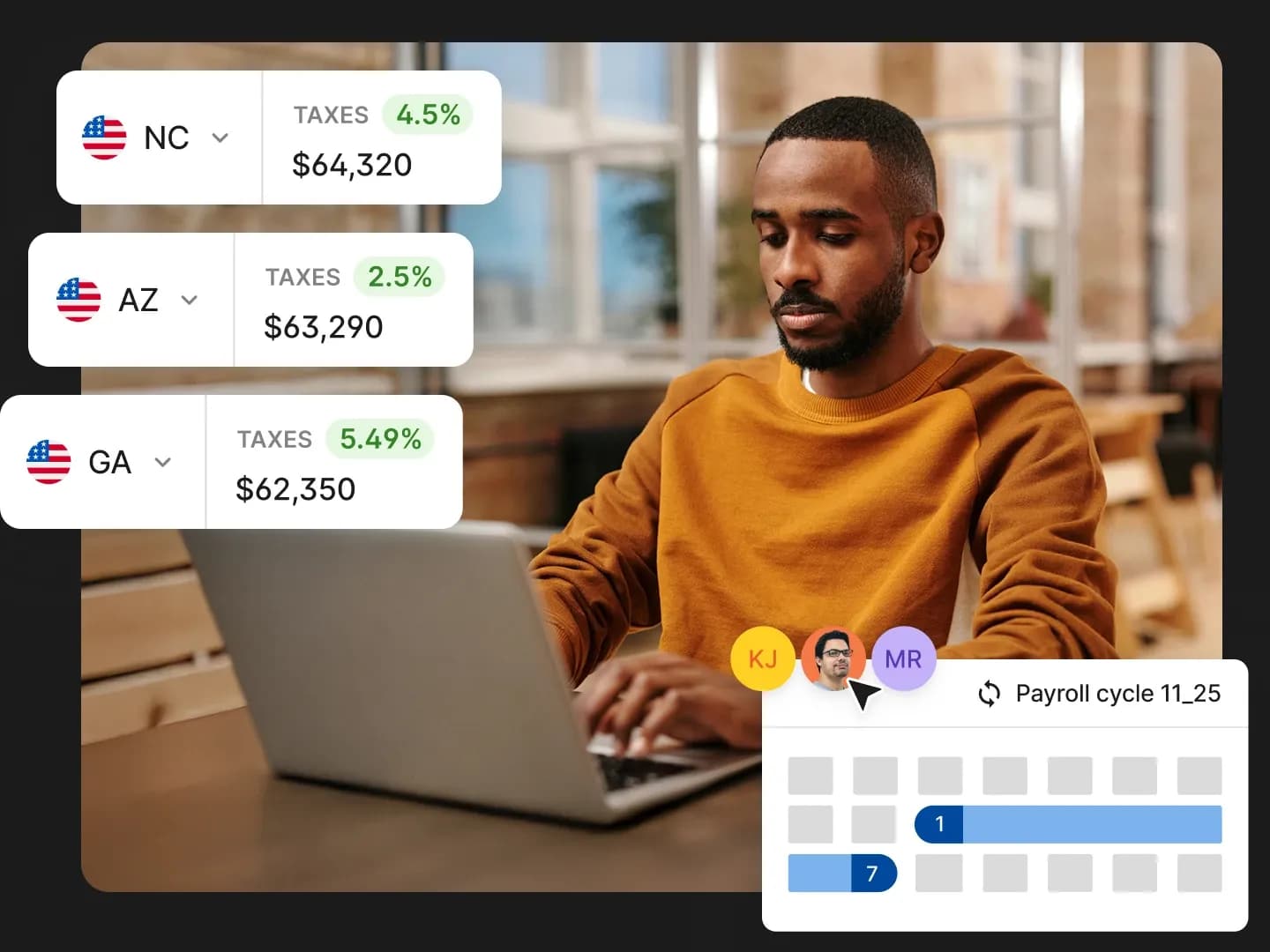
Staying current with federal, state, and local payroll requirements takes constant attention to changing rules and deadlines. Deel Payroll (US) is built for companies that need reliable, automated US payroll and time tracking together without compliance worries. We handle federal, state, and local payroll requirements while giving teams flexibility to run their payroll independently or with expert payroll support from our team.
Deel Payroll - US
Stay compliant, save time, and pay your US team with confidence
FAQ
What is the difference between payroll compliance and payroll processing?
Payroll processing covers the mechanical task of calculating and distributing pay. Compliance determines whether that work meets every applicable legal standard, from tax withholding to wage-and-hour rules to record-keeping. When processing errors are due to a violation of legal requirements, they become compliance failures.
Which agencies enforce US payroll compliance?
Federal enforcement falls to two agencies: the Department of Labor (DOL) for the FLSA's minimum-wage and overtime rules, and the Internal Revenue Service (IRS) for federal income tax withholding and FICA and FUTA obligations. State agencies handle state income tax withholding, unemployment insurance, and additional state-level requirements.
What can happen when an employer misses a payroll compliance obligation?
An employer can face IRS audits, back-tax assessments, interest charges, and civil penalties from federal or state agencies. The DOL also pursues employers for unpaid minimum wages or overtime. The specific payroll tax penalties depend on the type of violation and how long it goes unaddressed.
Does payroll compliance apply to independent contractors?
Employers do not withhold income tax or pay FICA and FUTA for independent contractors. Classification becomes the central question instead. Employers must determine whether each worker qualifies as an employee or a contractor under FLSA and IRS standards. Employers who misclassify workers risk back taxes, penalties, and unpaid benefits claims.
This entry contains general information only and does not constitute legal, tax, or financial advice, and qualified advisers can offer guidance specific to your situation.