
Global Work Glossary
- Results for ""
Table of Contents
How synthetic identity fraud is constructed
How synthetic identity fraud targets employment
How employers detect synthetic identity fraud
Synthetic identity fraud vs. related fraud types
Key facts
Detect synthetic identity fraud with Deel Security
FAQ
What is synthetic identity fraud?
Synthetic identity fraud is a form of deception in which someone combines real data elements with fabricated information to build a fictitious identity. Unlike identity fraud, which misuses a real person's existing credentials, synthetic identity fraud constructs a new persona that doesn't match any single individual in a database.
How synthetic identity fraud is constructed
A synthetic identity typically combines a valid government-issued identifier with a fabricated name, date of birth, and address. Fraudsters design the blend to pass automated checks that validate individual data points in isolation, without comparing them as a coherent whole profile.
Over time, fraudsters build credibility by accumulating records around the synthetic identity, including employment history, references, and financial accounts. By the time fraudsters use the identity to apply for a job, it might pass a surface-level background screen because the underlying identifier is genuine.
How synthetic identity fraud targets employment
Fraudsters may use synthetic identities to apply for jobs and gain access to company systems, payroll, or other workplace resources. They create these identities by combining real personal information, such as an identification number, with fabricated details, such as a name or employment history. Because some of the information is genuine, the inconsistencies might be difficult to detect during recruitment and onboarding.
The risks can continue after hiring. A fraudulent identity may be used to receive salary payments, enroll in employee benefits, or access sensitive company information. If the fraud is discovered later, employers may need to correct payroll and tax records, investigate unauthorized access, and address potential legal or compliance obligations.
How employers detect synthetic identity fraud
Verification tools confirm whether a submitted credential is genuine and whether a live person is presenting it, using document checks and liveness detection. Teams then cross-reference databases to test whether the name, identifier, and address form a coherent whole profile.
Behavioral signals also matter after hire. Unusual payroll account changes, access from unexpected locations, or a gap between stated skills and actual work output can flag a synthetic employee. Automated candidate screening at hiring, followed by identity re-verification at onboarding, may close the window that fraudsters rely on.
Synthetic identity fraud vs. related fraud types
Synthetic identity fraud is related to the threats below, but they are not the same thing. Some are different kinds of fraud, and others are methods that might be used alongside it:
Identity fraud: misuses a real person's complete credentials rather than constructing a new persona, so a known victim exists and may detect the breach.
Candidate impersonation fraud: a real person applies under their own name but has someone else take the interview or do the work.
Deepfakes: artificial intelligence (AI)-generated video or audio that impersonates a real person during live screening and can reinforce a synthetic identity to defeat both document and video verification.
Social engineering: manipulation that persuades hiring staff or security teams to skip verification steps, which lowers the barrier for a synthetic identity to succeed.
Key facts
Here are some key facts about synthetic identity fraud, the risks it creates for employers, and how organizations can detect and prevent it.
Synthetic identity fraud combines genuine identifiers with fabricated details: no single data check reveals the full picture without cross-referencing the whole profile.
Employment is a high-value target because successful fraud delivers system access, regular payroll, and legitimate-looking organizational records.
Verification that tests individual data points in isolation misses a synthetic identity when the underlying identifier is genuine.
Liveness detection and biometric verification add a physical layer that document checks alone can't provide.
A synthetic identity discovered post-hire creates payroll, tax, and legal complications and may trigger regulatory reporting obligations.
Teams detect more when HR shares behavioral flags and the security function shares technical signals: the combined view gives the clearest picture.
Detect synthetic identity fraud with Deel Security
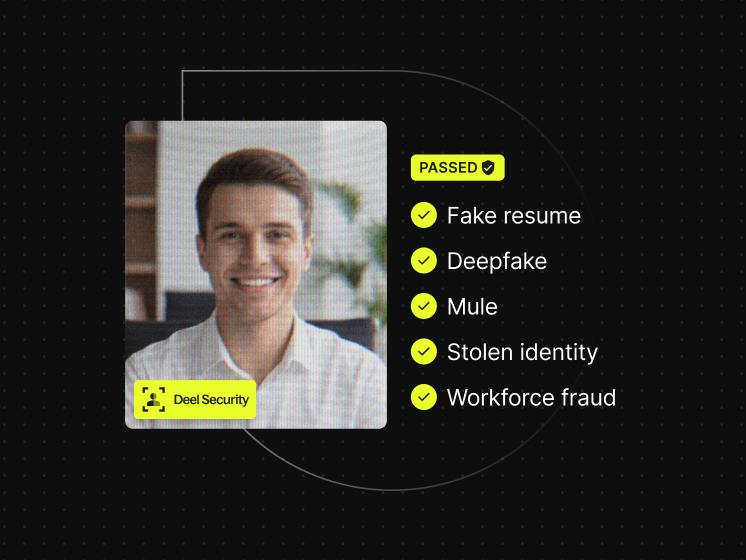
Deel Security helps businesses detect synthetic identities, fake candidates, deepfakes, and impersonation attempts throughout hiring, onboarding, and ongoing employment.
Deel Security works with your existing applicant tracking system (ATS), bringing identity fraud alerts into hiring workflows for human review. This helps HR and security teams investigate potential fraud and reduce the risk of fraudulent hires.
Book a demo to see how Deel Security helps protect your business from identity fraud.
Deel Security
Hire real people, keep fraud out from hiring to offboarding
FAQ
What is the difference between synthetic identity fraud and identity theft?
Identity theft misuses an existing person's complete credentials, leaving a known victim who may notice fraudulent activity. With synthetic identity fraud, no matching real-world individual exists, so detection is slower and the harm is distributed across employers, payroll systems, and potentially financial institutions.
How do fraudsters use a synthetic identity to get hired?
A fraudster submits a job application combining a genuine identifier with a fabricated name, address, and work history. Automated screening may pass the identifier as valid without detecting that the surrounding profile is fictitious. Once hired, the synthetic employee may divert payroll deposits, access sensitive systems, or use organizational credentials for further fraud.
What should HR do if a synthetic identity is discovered post-hire?
HR should suspend access immediately and secure the payroll accounts and systems the person used. The organization should then audit financial transactions and data access events. Depending on the jurisdiction and harm caused, regulatory reporting obligations may apply, and the organization should bring in legal and HR advisers from the start.
How does synthetic identity fraud differ from proxy interview fraud?
Proxy interview detection addresses a distinct attack: a real person applies legitimately but has someone else conduct the interview or perform the work. Synthetic identity fraud involves a wholly fictitious or blended persona at the application stage itself.
Can background checks alone prevent synthetic identity fraud?
Standard background checks validate individual data points against available records, so they might miss a synthetic identity when the underlying identifier is genuine. Cross-referencing tools, liveness detection, and behavioral monitoring during onboarding and employment add layers that background checks alone can't provide.
This article is for general informational purposes only and does not constitute legal or compliance advice: organizations with specific questions should work with qualified legal and HR advisers for guidance specific to their jurisdiction.