
Guide
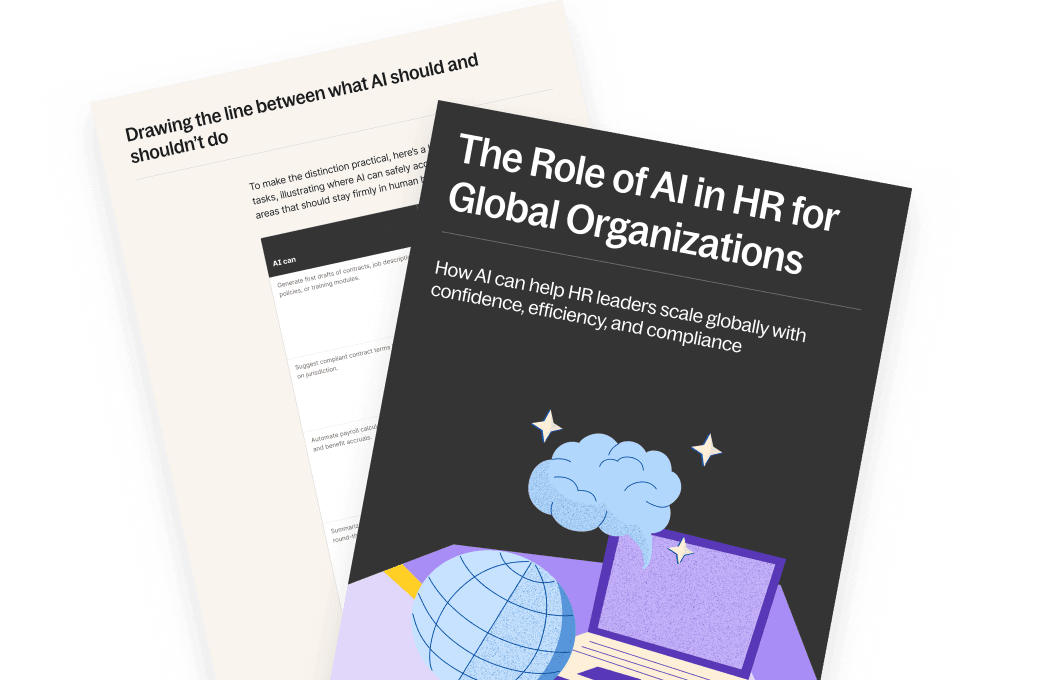
The Role of AI in HR for Global Organizations
AI
Global HR
Get the resource for free
Expanding into new markets is a strategic lever for enterprise growth. However, for HR leaders, it also means navigating a maze of regulations, payroll rules, cultural nuances, and compliance risks. Relying on legacy workflows limits scalability and introduces operational risk.
AI is reshaping the HR operating model. This guide explores how AI in HR can support your global organization by streamlining complex administrative processes, ensuring compliance, and improving operational efficiency and governance across global HR operations.
Can AI really help HR leaders scale with confidence, efficiency, and compliance?
From automating payroll to surfacing compliance insights, AI offers the speed and intelligence HR teams need. But it also raises critical questions:
- Can AI be trusted with sensitive people decisions?
- How do you avoid bias?
- What’s safe to automate?
- What HR processes should always stay human?
This guide provides HR leaders with expert insights. You’ll learn how AI can streamline global HR operations, where it delivers the most value, and the precautions you need in place to use it responsibly.
Those who are open to embracing AI and exploring its capabilities to facilitate talent operations are more likely to succeed. Talent managers have long been pondering over how to optimize their operations and save valuable time. By leveraging AI, they can achieve these goals and scale their operations more efficiently.
—Tianna Johnson,
Head of Talent Acquisition, Render
Guide overview
This guide is designed for HR and business leaders who are navigating the complexity of scaling across borders. It covers:
- Where AI creates real value in HR—from recruiting to payroll
- Practical operational controls to ensure safe and responsible AI use
- What AI can (and can’t) solve for global teams
- How Deel is using AI to simplify HR, IT, and payroll for 30,000+ organizations
Who is this guide for?
- Chief People Officers and HR Directors looking to reduce manual overhead while ensuring compliance in every market
- HR Managers and People Ops teams managing day-to-day global processes like payroll, onboarding, and performance management, and seeking ways to make them faster and smarter
- Enterprise Business and Finance leaders overseeing growth strategy and scaling HR operations while managing compliance and cost risks
- Founders and Executives of global companies driving international expansion and searching for ways to manage people, payroll, and compliance at speed
If you’re asking yourself “Can AI really make global HR easier and safer?”, this guide was written for you.
Download the guide today and learn how to power your global HR with AI, without sacrificing compliance or human judgment.
FAQs
What is AI being used for in HR?
AI is increasingly used to automate and enhance core HR functions, including:
- Recruiting: Resume screening, job matching, interview scheduling
- Onboarding: Auto-generating localized contracts and workflows
- Payroll: Automating tax and benefits calculations, anomaly detection
- Employee performance management: Summarizing feedback, spotting patterns
- Employee development: Recommending personalized learning paths
- Employee self-service: Chatbots answering policy or pay-related questions
The goal is to increase efficiency, reduce errors, improve strategic decision-making, and support global scale.
What is the most common use case of AI in human resource management?
The most common use cases for AI in human resource management are recruitment and talent acquisition. HR teams use AI to:
- Screen resumes and match candidates to open roles
- Automate interview scheduling
- Generate job descriptions or outreach emails
- Analyze salary benchmarks and hiring costs by location
AI speeds up time-to-hire, reduces manual effort, and improves candidate experience. But it also requires governance frameworks to avoid biased outcomes.
Is HR ready for AI?
HR is partially ready for AI. Many HR teams are adopting AI, but readiness varies:
- Enterprise teams often have the tech infrastructure to deploy it effectively
- Lean or solo HR teams may struggle with change management, system integration, or choosing the right tools
That said, AI readiness is growing, especially in global organizations where manual tasks are already overwhelming.
Deel customers like MarqVision rely on Deel AI as a go-to information source:
“Our global team can turn to Deel AI for instant answers to their HR questions, anytime. It’s been a huge time-saver for our People team.”
What are the risks of AI in HR?
Some of the risks of AI in HR include:
- Bias amplification: AI can reinforce patterns in biased training data
- Lack of transparency: Some models are “black boxes” with unclear logic
- Compliance risk: Generic tools may overlook local laws or updates
- Overreliance: Automating sensitive decisions (e.g., promotions) without human review can damage trust
Mitigating these risks requires clear governance, documentation, and oversight.
Is HR still relevant in the age of AI?
Absolutely, HR is more relavant than ever. AI handles repetition, but HR brings judgment, empathy, and strategy. Tasks like coaching, conflict resolution, workforce planning, and DEI leadership cannot be automated meaningfully. AI supports HR by freeing up time for these high-value, human-first responsibilities.
What is a major concern when using AI for recruitment?
Bias and fairness are major concerns when using AI for recruitment. If the training data reflects historical hiring patterns (e.g., favoring certain schools or genders), the AI may replicate or even amplify those biases. This can lead to discriminatory practices or exclusion, even unintentionally.
Which AI tool is best for HR?
The choice of AI technologies depends on your goals. Options include:
- Deel: An AI-powered global payroll and HR platform, with AI embedded at every stage of the worker lifecycle. Deel unifies HR & payroll analytics with AI for real-time insights, instant answers, automated reports, and streamlined admin—boosting efficiency 10x.
- HireVue, Pymetrics: AI in hiring and assessments
- Eightfold, Beamery: AI for talent intelligence and workforce planning
- ChatGPT: Creating first drafts for onboarding emails, job postings, feedback, policies, etc.
What should HR professionals prioritize when using AI technology?
HR professionals should prioritize three key areas when adopting AI:
- Compliance and data security: Ensure the AI tools are trained on up-to-date, localized labor laws and follow data privacy regulations (e.g., GDPR). Especially for global enterprises, compliance must be built in, not bolted on
- Transparency and auditability: HR must be able to explain how AI-generated insights or decisions are made, especially in areas like compensation, hiring, or promotions. Choose tools that document sources, logic, and data inputs
- Human oversight: AI should assist, not replace, human judgment, especially in high-stakes areas like layoffs, performance reviews, or hiring process decisions. HR must own the final call and apply empathy, ethics, and cultural context
How has AI helped HR?
AI has helped HR:
- Scale faster: Automating repetitive admin and HR processes for global teams
- Improve accuracy: Reducing payroll, compliance, and onboarding errors
- Increase operational efficiency: Letting HR teams focus on strategy, not spreadsheets
- Enhance experience: Offering 24/7 support for employees via chatbots or self-service tools
- Leverage accurate data: Using workforce data to power data-driven decisions and recommendations
More resources
- Generative AI in HR: How to Use It for Enhanced People Processes
- Navigating the EU AI Act: Key Takeaways from Deel’s Expert Webinar
- AI Tools for HR: A Comprehensive Guide with 7 Top Picks Compared
- AI-Based Learning Platform: Examples, Features, and Top LMS on the Market
- Free AI Acceptable Use Policy Template – Get EU AI Act Ready
- Webinar: How Deel Uses Deel AI
- AI in Employee Engagement: 7 Applications to Try Yourself