
Guide
Workforce Risks in M&A Deals and Strategies to Overcome Them
M&As
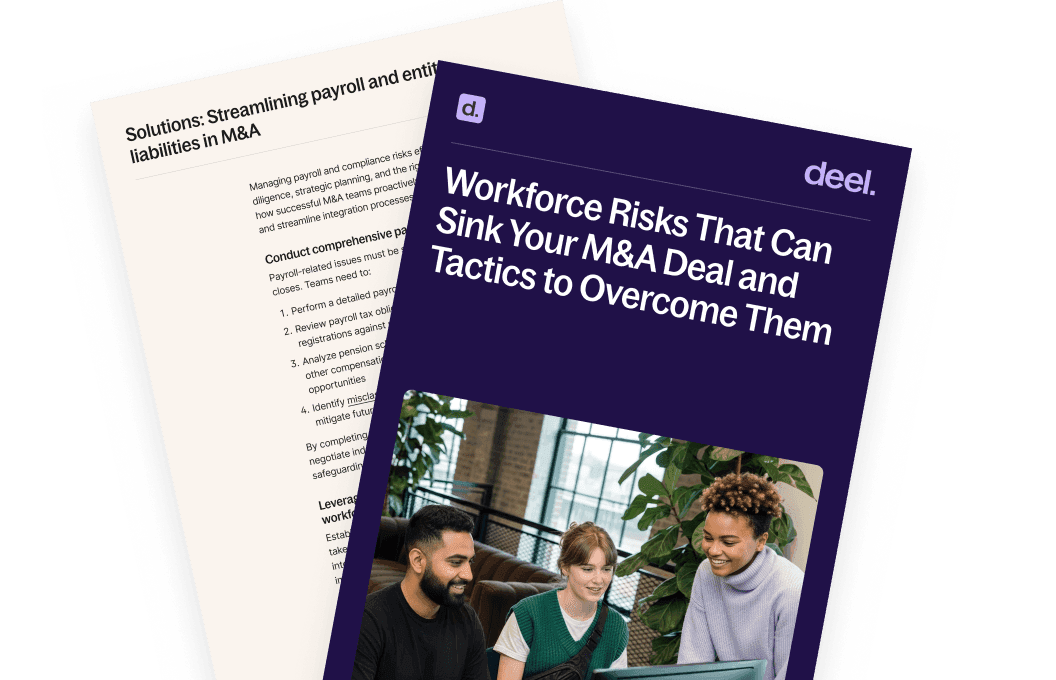
Get the resource for free
Mergers and acquisitions move at speed, but workforce integration often lags behind. While private equity firms and corporate development teams focus on financial modeling and market share, it is the overlooked human capital, payroll, and compliance challenges that surface post-close as costly liabilities.
When workforce misalignment occurs, it doesn’t just slow down operations. It erodes deal value, triggers regulatory penalties, and drives your best people toward competitors. Studies show that over 70% of M&A deals fail to deliver expected returns, and workforce friction is a primary culprit. To protect your investment, you need to identify workforce risks in M&A deals before they derail your integration timeline.
This guide provides a structured approach to mitigating HR, payroll, and compliance risks, ensuring your M&A is seamless and set up for long-term success.
Guide overview
Integrating two distinct workforces is a complex operation that intersects tax obligations, benefit structures, and international employment law. This guide provides strategies and insights to close deals and realize synergies while minimizing friction and attrition.
By downloading this guide, you will gain access to:
Payroll management strategies: Tactics to uncover hidden tax liabilities and streamline fragmented systems
Entity vs. EOR insight: Decide whether to consolidate, maintain, or establish new legal entities in foreign jurisdictions
Talent retention strategies: Learn how to prevent high attrition rates often seen among mission-critical employees within the first year of M&As
Cultural integration frameworks: Gain insights from actionable solutions on how to integrate company cultures to prevent employee turnover and dissatisfaction
Immigration and visa requirements: Navigate visa transfers and misclassification risks for a global workforce
Who is this guide for?
We designed this resource for enterprise leaders who manage high-stakes transitions and need a repeatable framework for success:
Private Equity Operators focused on protecting ROI and accelerating the value-creation plan
Corporate Development Teams tasked with the operational reality of merging global entities
Chief People Officers and HR Directors who need a seat at the due diligence table to flag risks early
Legal and Compliance Officers managing the intricacies of international labor laws and contractor classifications
The high cost of delayed workforce integration
Delaying the alignment of HR and payroll systems is more than a minor administrative hurdle; it’s a direct threat to your M&A’s success. Without real-time visibility into workforce costs across both entities, you cannot accurately track the health of your new organization.
Furthermore, fragmented systems lead to manual errors that damage employee morale. On day one, your new employees are looking for stability. If their first paycheck is incorrect or their benefits are undetermined, you are already losing their trust. Prioritizing the consolidation of HR and payroll systems ensures you reduce redundant overhead, such as duplicate licensing fees, while boosting productivity through a unified employee experience.
How to use the guide
This guide presents actionable solutions to common M&A challenges that arise during pre-close, closing, and post-close phases of a deal. Here is how to best leverage the insights:
1. Conduct a pre-deal workforce audit
Before the transaction closes, perform a detailed payroll and tax analysis. Map current registrations against your post-merger footprint to identify where you might have a tax nexus you did not account for. This allows you to negotiate indemnities or purchase price adjustments before it is too late.
2. Identify and support mission-critical talent
Use the retention section to identify individuals who hold key client relationships or institutional knowledge. Define incentive plans that go beyond simple cash bonuses to support retention. Think structured equity with multi-year vesting to ensure long-term alignment.
3. Deploy interim infrastructure
If you lack a legal entity in a target's country, do not wait months for setup. Use an Employer of Record (EOR) to onboard and compensate employees compliantly from day one. This keeps the workforce stable while you make long-term entity decisions.
4. Implement automated compliance reporting
Move away from manual reconciliations. Integrate your payroll software with your HRIS and finance systems to gain total data visibility. Using AI-driven tools to detect employee misclassification can save your firm millions in potential regulatory fines.
5. Monitor cultural health
Company culture is not a "soft" metric. Use our guidance on cultural due diligence to track voluntary turnover and employee sentiment through real-time pulse surveys. Adjust your integration strategy based on feedback to avoid the "us vs. them" mentality that sinks productivity.
Mitigate workforce risks in M&As by partnering with Deel
Successful M&A is about more than just a signed contract. It’s about the people who will execute your vision. Deel’s enterprise-grade workforce infrastructure provides hiring, payroll, and global mobility solutions to help your organization thrive both now and in the future.
Whether you are managing a small acquisition or a massive global merger, this guide helps you turn workforce integration into a competitive advantage.
Download the guide and secure your deal value today.
FAQs
What are the most common payroll risks in an M&A deal?
The most frequent risks include surprise payroll tax liabilities and system fragmentation. When a company operates across multiple states or countries, it often creates a hidden tax nexus. If the buyer is unaware of these unregistered obligations, they may inherit significant fines and interest charges. Additionally, having decentralized payroll systems causes manual errors and delays that frustrate employees during a sensitive transition period.
How does workforce misclassification impact deal value?
Misclassification occurs when workers are treated as independent contractors but legally qualify as employees. During an M&A deal, this can be a massive liability. If a target company has misclassified a large portion of its workforce, the buyer could be responsible for years of unpaid taxes, benefits, and legal penalties. Proactive M&A teams use AI-driven tools and audits to identify these risks early and adjust the deal terms accordingly.
Why do key employees leave after a merger?
Research shows nearly half of mission-critical employees exit within the first year of a deal. This usually happens due to ambiguity regarding their new career paths, misaligned incentive structures, or company culture shock. When an entrepreneurial culture is suddenly forced into a rigid corporate structure without a proper transition, high-performers often seek more aligned opportunities elsewhere.
When should an EOR be used in an M&A transaction?
An Employer of Record (EOR) is an ideal solution when a deal closes and the acquiring company does not yet have a legal entity in the countries where the target's employees are located. Setting up a new entity can take months. An EOR allows the buyer to compliantly pay and manage those employees immediately, ensuring zero disruption to operations while the long-term legal structure is being finalized.
What is the difference between immediate consolidation and a phased integration?
Immediate consolidation involves moving both companies onto the same HR and payroll systems right at close. This is best if the platforms are already similar. A phased integration aligns systems over 6 to 12 months. While a phased approach increases administrative complexity temporarily, it reduces cultural shock and gives teams more time to adapt to new workflows and policies.
How can cultural integration be measured?
Cultural health is measured through real-time metrics such as voluntary turnover rates, productivity levels, and employee sentiment surveys. Successful acquirers can assign leadership bridge teams from both companies to monitor these indicators. If turnover spikes or engagement drops, the integration strategy should be adjusted to address the specific concerns of the workforce.