Article
6 min read
How to Hire a Worker in Georgia: A Step-by-Step Guide for Employers
US payroll
US payroll

Author
Shannon Ongaro
Last Update
September 18, 2026

Key takeaways
Georgia's at-will employment, right-to-work status, and flat 4.99% income tax rate make it one of the most employer-friendly states in the US.
Employers with 10 or more employees must use E-Verify, report new hires within 10 days, and register with the Georgia Department of Labor for unemployment insurance.
Deel supports hiring, payroll, and worker management in Georgia and across all 50 US states.
Disclaimer: This content is for informational purposes only and does not constitute legal or tax advice. Consult a qualified professional for guidance specific to your situation.
Georgia is one of the most employer-friendly states in the country. Its at-will employment doctrine, right-to-work protections, and E-Verify infrastructure have made it a destination for companies ranging from logistics firms and tech startups to multinational manufacturers. A clear setup for payroll registration, worker classification, and new-hire reporting helps employers avoid back taxes, penalties, and other legal exposure under state and federal law.
This guide walks you through everything you need to know to hire compliantly in Georgia, including employment law basics, payroll tax setup, and the hiring-path decision, whether you already have a Georgia entity or are exploring hiring there for the first time.
Georgia employment law basics
Georgia's legal environment is shaped by a few defining characteristics that every employer should understand before making a first hire.
At-will employment
Georgia is an at-will employment state under O.C.G.A. § 34-7-1, meaning either the employer or employee can terminate the relationship at any time, for any reason or no reason at all, without notice, provided the reason isn't illegal. Exceptions apply when discrimination based on a protected class, retaliation, or a written employment contract with a fixed term is involved. In practice, at-will status gives Georgia employers significant operational flexibility compared to states with stronger termination protections.
Minimum wage
Georgia's statutory minimum wage is $5.15 per hour, but most workers are covered by the federal $7.25 minimum wage under the Fair Labor Standards Act (FLSA), with limited state-law exemptions and coverage rules. If you're a federal contractor, additional wage floors under applicable executive orders may also apply.
Anti-discrimination protections
Federal law covers the essential ground in Georgia. Title VII of the Civil Rights Act and the Americans with Disabilities Act generally apply to Georgia employers with 15 or more employees, while the Age Discrimination in Employment Act generally applies to employers with 20 or more employees. Georgia's own Fair Employment Practices Act, enforced by the Georgia Commission on Equal Opportunity, mirrors these protections for state government employers.
Right-to-work
Georgia has been a right-to-work state since 1947. Employers and unions cannot require employees to join a union or pay union dues as a condition of employment. O.C.G.A. §§ 34-6-20 through 34-6-28 and Georgia Department of Labor guidance establish this rule. For most private employers, it means a union shop arrangement is not a legal option.
Payday frequency
Georgia law doesn't mandate a specific pay frequency for most private employers, but employers must pay wages on time. The standard in practice is semi-monthly or bi-weekly. Employers with irregular or delayed pay cycles risk GDOL inquiries and potential FLSA violations.
E-Verify
Georgia mandates E-Verify participation for all private employers with more than 10 employees. Once you cross that threshold, you're required to verify every new hire's employment eligibility through the federal E-Verify system, in addition to completing the standard Form I-9. Employers with 10 or fewer employees are exempt but must provide a signed affidavit confirming that exemption when obtaining or renewing a business license.
Guide
Step-by-Step Guide to US Payroll
Georgia payroll taxes
Getting Georgia payroll right from day one requires registering with the right agencies, withholding the correct amounts, and meeting filing deadlines. Here's how the main obligations break down.
Federal FICA and FUTA
Every Georgia employer is subject to the same federal payroll obligations as any other US employer: 6.2% Social Security and 1.45% Medicare withheld from employee wages, matched dollar-for-dollar by the employer, plus Federal Unemployment Tax Act (FUTA) tax at 6% on the first $7,000 of each employee's wages (reducible to 0.6% with timely state unemployment insurance (UI) contributions).
Detailed filing requirements are covered in IRS Publication 15 (Employer's Tax Guide). For a broader overview of how federal and state payroll taxes interact, see Deel's US payroll tax guide.
Georgia state income tax withholding
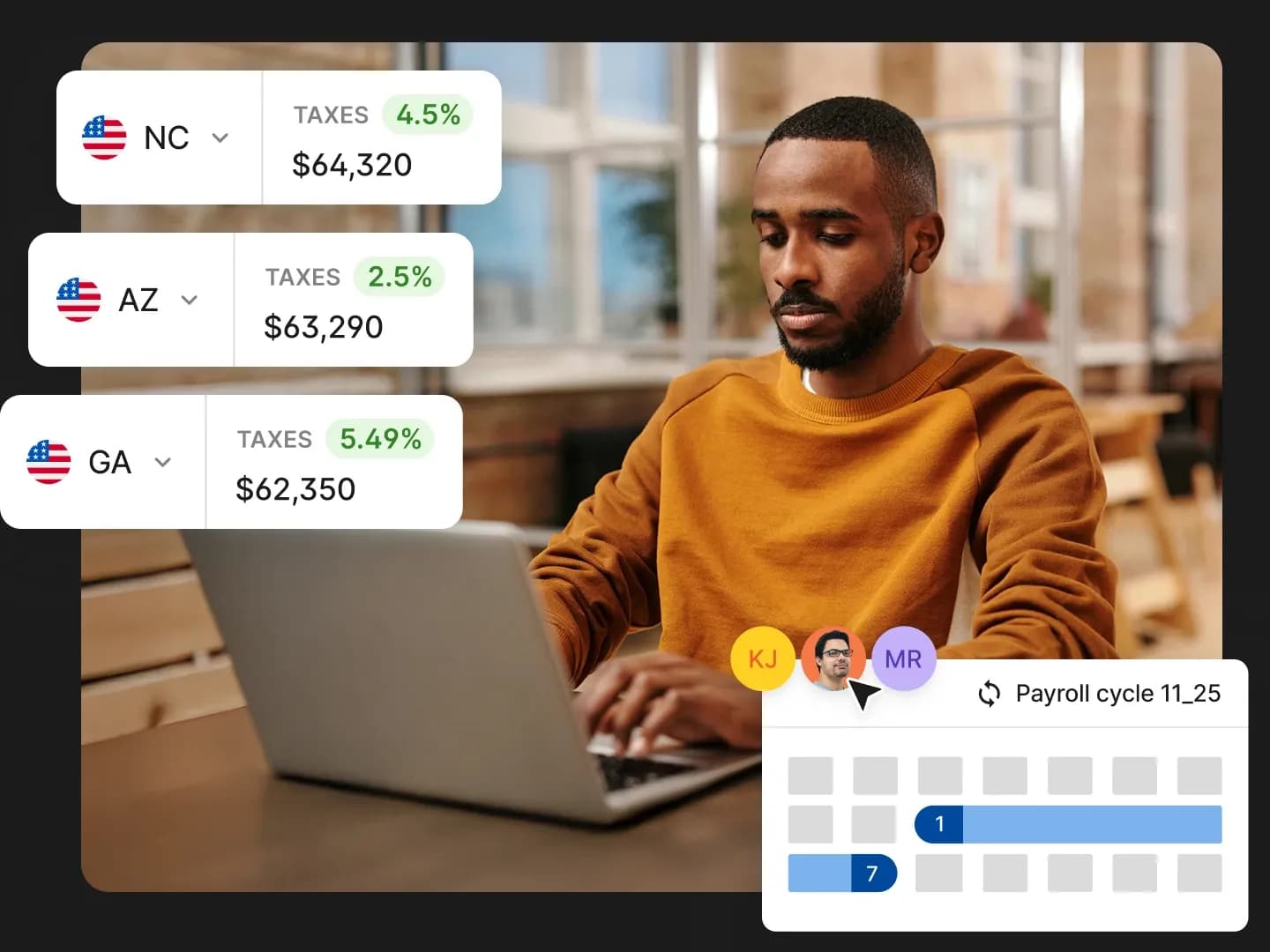
Georgia uses a flat income tax rate of 4.99% for 2026, reduced from 5.19% in 2025 by HB 463, which Governor Kemp signed in May 2026 retroactive to January 1, 2026. Employers withhold this amount from employee wages and remit it to the Georgia Department of Revenue via the Georgia Tax Center.
Every new hire must complete Form G-4 (Georgia Employee's Withholding Allowance Certificate) so you can calculate the correct withholding. There are no city or county income taxes in Georgia, so one flat state rate applies statewide.
Georgia Unemployment Insurance (UI)
Employers must register with the Georgia Department of Labor to receive a GDOL account number and begin remitting state unemployment tax (SUTA) contributions. New employers pay a SUTA rate of 2.70%, which already includes a 0.06% administrative assessment (2.64% base rate + 0.06% assessment), applied to a wage base of $9,500 per employee per year.
The 0.06% assessment is set by law through December 31, 2026 (O.C.G.A. § 34-8-180) and may change after that date. The GDOL assigns experienced employers rates from 0.04% to 8.10% based on claims history. Quarterly tax and wage reports are due by the last day of the month following each calendar quarter.
For employees hired through your own entity, Deel Payroll calculates and supports withholding and employer payroll-tax obligations, including Georgia income tax, SUTA, and federal FICA, and updates automatically when the flat rate steps down under HB 463's reduction schedule. Learn how Deel Payroll works.
Georgia payroll filing reminder
All Georgia employers must report every newly hired and rehired employee to the Georgia New Hire Reporting Center within 10 days of the hire date, under Georgia Statute 19-11-9.2 and the federal Personal Responsibility and Work Opportunity Reconciliation Act (PRWORA). This applies to full-time, part-time, and temporary employees alike, with no employer-size exemption.
Worker classification in Georgia
Misclassifying an employee as an independent contractor can lead to back wages, state UI tax liability, interest, and civil penalties. Understanding the classification standards before you make a first hire protects you from these risks.
Federal classification tests
The primary federal frameworks are the IRS's "behavioral and financial control" test and the Department of Labor's economic reality test under the FLSA. Both ask, in different ways, who controls the work: the worker or the company hiring them. An independent contractor typically sets their own hours, uses their own tools, and works for multiple clients. By contrast, an employer typically directs an employee's schedule and methods.
Georgia's workers' compensation context
Under O.C.G.A. § 34-9-1, Georgia's workers' compensation statute defines "employee" for the purpose of coverage obligations. Correct classification and appropriate workers' compensation coverage help ensure eligible workers are protected and reduce the risk of uninsured claims.
Material misclassification risks in Georgia
If the GDOL or IRS reclassifies your contractor as an employee, you can owe back payroll taxes (employer and employee share), accrued SUTA contributions for every year of the engagement, interest on those amounts, and civil penalties. The reputational and litigation risks compound the financial ones, particularly when the misclassified worker files a back-wages claim under the FLSA.
If you're unsure how to classify a Georgia worker, Deel's misclassification risk guide walks through the key factors that courts and regulators use and how to structure engagements that reduce classification risk.
Deel Payroll - US
Compliantly run payroll in all 50 states
How to choose the right hiring model for Georgia
The right hiring model depends on more than entity status. Company size, growth plans, and your team's HR and payroll skills also matter. A small startup with one Georgia hire has different needs than an enterprise that enters the state as part of a national rollout. Ask four questions before you pick a path:
How big is your team today, and how fast will it grow?
Do you have a US entity, or will you set one up?
Do you plan to hire long-term staff, or short-term project help?
Can your internal team run payroll, benefits, and compliance, or do you need expert support?
Direct hire through your own entity
Direct hire means you register your own Georgia entity as an employer and run payroll yourself, or through a payroll platform.
How it works: You register with the Georgia Department of Labor (GDOL), withhold and file federal taxes, and pay state unemployment insurance (SUTA). Your team owns every part of the process, from onboarding to tax filings.
When it works best: This path suits companies that already have a US entity and want full control over HR and payroll. It fits best when your team has payroll expertise in-house, or when you plan to build a large, permanent Georgia workforce.
Deel solution: Deel Payroll is built for companies that need reliable, automated US payroll and time tracking together without compliance worries. We handle federal, state, and local payroll requirements while giving teams flexibility and dedicated payroll support. The solution easily integrates with external partners for HR, 401(k), and benefits admin—all on one scalable platform. Manage and pay all your US and global employees in one Deel system.
Employer of Record (EOR)
An Employer of Record (EOR) lets you hire the best talent anywhere in the world without the cost or delay of setting up a local entity.
How it works: The EOR acts as the legal employer, taking full responsibility for compliant contracts, local tax filings, and statutory benefits. You keep control over the employee's daily work and performance.
When it works best: This path suits companies without a US entity, or companies that want to hire fast without the cost and delay of entity setup. It also fits well for a first Georgia hire, a pilot team, or a short-term project, since there is no long-term entity commitment.
Deel solution: Deel's EOR lets you hire employees in Georgia and across the US without opening an entity. Deel handles compliance, payroll, and benefits, so your team does not need deep knowledge of Georgia labor law.
Professional Employer Organization (PEO)
A PEO is a US-only, co-employment model. You keep your Georgia entity, but Deel shares employer responsibilities with you.
How it works: Deel becomes the co-employer of record for payroll tax and compliance purposes. Deel manages payroll, tax filings, workers' compensation, and benefits administration. Your company keeps control of hiring decisions, day-to-day management, and company culture.
When it works best: This path fits companies with a US entity that want to offload HR admin and compliance risk without building a large internal HR team. It works especially well for SMB and mid-market companies hiring across multiple states, or companies that want access to better employee benefits than they could negotiate alone.
Deel solution: Deel's PEO gives you a dedicated HR Business Partner, automated compliance across all 50 states, and access to competitive benefits plans, all while you keep your own entity and operational control.
Independent contractor engagement
Engaging an independent contractor means hiring someone for defined project work, not as an employee.
How it works: The contractor controls how, when, and where the work gets done. There is no employment relationship, so no payroll taxes, benefits, or GDOL registration apply. Classification must meet both IRS and Georgia standards, or the company risks misclassification penalties.
When it works best: This path fits genuinely project-based, non-core work with a clear scope and end date. It is not a substitute for hiring when the role requires ongoing direction or does core business work. Companies at any size can use this model, but it works best when legal or compliance teams review each engagement first.
Deel solution: With Deel's Contractor offering, you can engage contractors in the US or globally through a single platform, with two engagement models based on risk tolerance. It replaces fragmented tools and manual workflows with compliant onboarding, localized contracts, automated invoicing, global payments, time tracking, and ongoing compliance monitoring.
Deel Hire
Planning to expand into the US?
Managing Georgia workers after hire
Hiring the worker is the beginning of the compliance obligation, not the end. Once someone is on your Georgia payroll, you take on a set of ongoing responsibilities, from benefits administration to immigration support, that shape retention, compliance, and daily operations.
Benefits administration
Georgia has no state mandate for paid sick leave, paid vacation, or general paid time off. Under the ACA's employer shared-responsibility rules, applicable large employers (generally those averaging at least 50 full-time employees, including full-time equivalents) may face penalties if they do not offer qualifying coverage to sufficient full-time employees.
For smaller employers, benefits are voluntary but essential for talent retention in a competitive market. Deel Benefits supports enrollment and administration for available health, dental, vision, and other benefit plans, helping employers streamline carrier and employee workflows.
IT provisioning
For distributed or remote-first teams hiring in Georgia, device provisioning and endpoint management become critical from day one. Workers need hardware that's ready to use, secure, and configured for your systems before they start. Deel IT helps teams procure, configure, and deploy devices for new Georgia hires without managing every shipment manually.
Mobility support
If you're hiring non-citizens in Georgia, E-Verify enrollment is only the beginning. Work authorization across visa categories such as H-1B, OPT, STEM OPT, H-1B1, and E-3 requires ongoing monitoring and renewal. Deel Mobility supports US immigration workflows, including application management, document procurement, and government fee tracking across these visa types, so your immigration obligations don't create bottlenecks in your hiring process.
HRIS and time-tracking integration
As your Georgia workforce grows, managing employee records, time-off requests, and performance data across spreadsheets becomes unsustainable. Deel HR centralizes employee records, org charts, and compliance documentation in one system, integrated with your payroll and benefits data for a single source of truth.
Deel Payroll - US
Stay compliant, save time, and pay your US team with confidence
Hire and pay Georgia workers with Deel
Deel brings compliant hiring, payroll, benefits, and worker management together into one platform. You can start where you need to, and scale without re-implementing, whether you're hiring one independent contractor, a handful of employees, or expanding an enterprise into additional states.
Book a demo below to see how Deel can help you hire and pay Georgia workers compliantly.
Compliance
Unlock Continuous Compliance™ with Deel
FAQs
Does Georgia require workers' compensation insurance?
Yes. Georgia employers with three or more employees are generally required to carry workers' compensation insurance under O.C.G.A. § 34-9-1. Coverage must be in place before workers begin. Employers who self-insure must qualify separately through the State Board of Workers' Compensation.
How does new-hire reporting work in Georgia?
All Georgia employers must report every newly hired and rehired employee to the Georgia New Hire Reporting Center at ga-newhire.com within 10 days of the hire date. This applies regardless of employer size, employment type, or how long the worker stays.
Can a foreign company hire in Georgia without a US entity?
Yes. A foreign company without a US entity can hire Georgia workers through an Employer of Record like Deel. As the legal employer under the EOR arrangement, Deel manages the employer-side payroll setup, tax withholding, workers' compensation, and new-hire reporting for that employment, while the foreign company directs the worker's day-to-day responsibilities.
What's the difference between a PEO and an EOR in Georgia?
With EOR, the EOR becomes the legal employer, allowing you to hire that worker without establishing your own local employing entity. With a PEO, you keep your existing Georgia entity and co-employ workers alongside the PEO, which handles payroll administration and compliance. If you don't have a US entity, EOR is typically the right path. If you do have one and want to outsource HR operations, a PEO may be the better fit.
Shannon Ongaro is a content marketing manager and trained journalist with over a decade of experience producing content that supports franchisees, small businesses, and global enterprises. Over the years, she’s covered topics such as payroll, HR tech, workplace culture, and more. At Deel, Shannon specializes in thought leadership and global payroll content.