Article
5 min read
What Is a Specialist AI? Why Generic Intelligence Breaks Down in Payroll and HR
AI
Global HR
Global payroll

Author
Deel's Content team
Last Update
October 20, 2026
Table of Contents
What is specialist AI?
How generalist AI fails in specialized workflows
What Deel's approach does differently
From query mode to action mode: where generalists stop working
Why Deel built its own AI instead of buying off the shelf
When to use a specialist AI vs. a generalist AI
Automate global payroll with Deel AI
Key takeaways
Generalist AI models are trained on broad, internet-scale data, which dilutes precision on specialized domains like payroll law and human resources (HR) compliance.
When AI moves from answering questions to executing decisions, hallucinations and retrieval delays stop being inconveniences and start causing compliance failures.
Deel AI applies domain-specific intelligence across Deel's HR, payroll, and compliance workflows — so teams act accurately on vetted global knowledge rather than relying on unverified web results.
HR and payroll practitioners need AI grounded in authoritative, current payroll and compliance knowledge rather than one that relies on retrieving unverified public-web information. The difference isn't cosmetic. It determines whether a tool can reliably handle the rules that matter most in payroll operations: jurisdiction-specific statutes, withholding thresholds, and employment law requirements that change across 150+ countries.
This is the core tension in the AI debate playing out inside HR and finance teams right now: generalist models are widely available and impressive in demos, but specialist systems are what actually hold up when the stakes are real. Understanding what separates them helps practitioners make a practical decision about where each type of AI fits in their workflows.
What is specialist AI?
Specialist AI is designed and grounded for a defined domain, using relevant knowledge, rules, tools, and workflow controls rather than relying only on broad, general-purpose training. A generalist large language model (LLM) trains on billions of documents spanning science, history, pop culture, and everything in between. A specialist model draws its knowledge from a concentrated source: the rules, regulations, contracts, and operational data of a single domain.
In payroll and HR, that distinction matters immediately. Payroll compliance law, tax withholding rules, jurisdiction-specific leave entitlements, and employment contract requirements are not evenly distributed across the internet. They exist in official government sources, regulatory updates, internal legal documentation, and highly specialized databases. A model trained on the open web sees them only in proportion to how often they appear, which is a small fraction of a vast, general-purpose corpus. A model specifically grounded in that domain treats those rules as foundational rather than incidental.
The result is a different kind of knowledge: not just awareness that a concept exists, but accurate knowledge of how each rule applies in a specific case.
Deel's HRIS
Manage your global workforce compliantly
How generalist AI fails in specialized workflows
Deploying a generalist AI in payroll or HR isn't like deploying the wrong tool. It's like deploying a confident tool that doesn't know when it's wrong. That's a materially different and more dangerous failure mode than a tool that simply can't do the job.
Generalist LLMs hallucinate. According to the Stanford HAI 2026 AI Index, hallucination rates across 26 frontier models range from 22% to 94% on a new accuracy benchmark. In general knowledge tasks, a hallucination might produce a mildly incorrect summary. In payroll, it might produce the wrong withholding rate, the wrong notice period, or the wrong statutory leave entitlement, stated with full confidence and no caveats.
The problem with training on everything
Generalist models are optimized for breadth. They can discuss quantum physics, write a cover letter, and summarize a Supreme Court ruling in the same session. That breadth is genuinely useful for general tasks. But in payroll and HR, breadth is the wrong optimization.
Payroll law is jurisdiction-specific, frequently updated, and concentrated in a small slice of the broader web. A model trained on internet-scale data has been exposed to those rules, but only at roughly the rate they appear relative to everything else online. High-frequency training signals (entertainment, social media, general news) crowd out the low-frequency but high-stakes signals that payroll compliance depends on. The model learns to sound authoritative on tax law without having proportionally deeper knowledge of it.
Scaling up the model doesn't fix this structural problem because its training data remains broad rather than payroll-specific.
The latency problem in action mode
Retrieval-based systems add a search step before generating an answer. When a generalist model faces a question it isn't confident about, it retrieves relevant documents first, a lookup that adds latency between the query and the response. For a chatbot answering general questions, this is an inconvenience. For a system executing payroll workflows, it's a structural bottleneck.
Payment validation, real-time anomaly detection, and automated compliance checks don't wait for retrieval. An AI that needs to search before it can act is a fundamentally different system from one that already has the answer. When the AI is making decisions rather than producing text, latency and accuracy failures compound.
Hallucination rates in frontier AI models
According to the Stanford HAI 2026 AI Index, hallucination rates across 26 frontier models range from 22% to 94% on a new accuracy benchmark. In payroll operations, where a wrong withholding rate or incorrect leave entitlement carries real compliance consequences, this range is not an acceptable tolerance.
What Deel's approach does differently
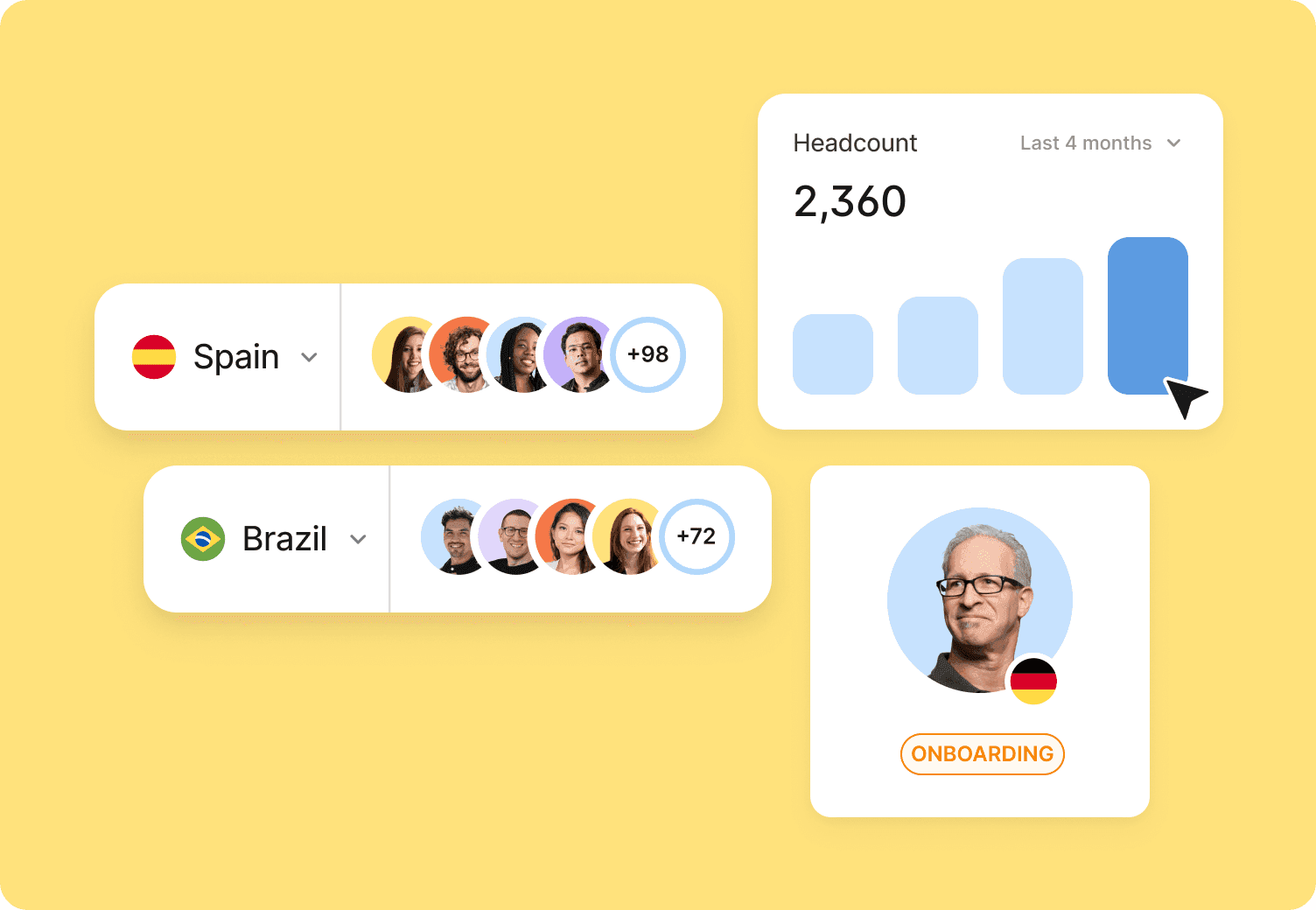
Deel AI and the Deel AI Workforce apply domain-specific intelligence across HR, payroll, and compliance workflows. Rather than deploying a general-purpose LLM on top of HR and payroll queries, Deel's AI is grounded in a proprietary knowledge layer: legally vetted global HR data, compliance guidance across 150+ countries, and workforce information informed by Deel's own in-country expert network of 2k+ specialists.
This is what domain-specific AI means in practice. Deel's AI is grounded in a curated global knowledge base rather than relying on unverified open-web results. The knowledge it acts on is informed by Deel's global compliance knowledge and in-country expertise, which is what allows it to operate consistently across jurisdictions.
Deel AI Workforce operationalizes this as a suite of specialized agents. The Payroll Detective flags anomalies before payout runs. The Border Buddy helps teams identify cross-border work and assess potential compliance implications. The Hiring Guru helps teams evaluate hiring considerations across markets. Each agent is purpose-built for a specific workflow, designed to assist with defined workflow actions, surface exceptions, and reduce manual review while preserving appropriate human oversight and approval controls.
Live Demo
Get a live walkthrough of the Deel platform
From query mode to action mode: where generalists stop working
The moment AI shifts from answering questions to executing decisions, the tolerance for error drops to near-zero. This is the threshold where the generalist/specialist distinction stops being a preference and becomes a functional requirement.
Agentic AI in HR is no longer theoretical. Gartner predicts that 40% of enterprise applications will have task-specific AI agents by the end of 2026, up from less than 5% in 2025. That adoption curve is already underway in enterprise HR and finance, which means the question isn't whether to use AI agents in payroll workflows, but which AI architecture those agents are built on.
For consequential payroll actions, specialist systems should combine reliable domain grounding with validation, exception handling, approval controls, and human oversight before payment. Enterprise HR teams adopting agentic AI are learning that the teams that maintain control deploy specialist systems with narrow task scope and clear verification checkpoints, rather than general-purpose models given broad autonomy over consequential workflows.
Why specialist AI matters for agentic workflows
Domain grounding: Specialist AI uses vetted, jurisdiction-specific knowledge rather than broad web data, reducing the chance of a confident wrong answer in a compliance-sensitive task.
Narrow task scope: Agents built for specific workflows (payroll anomaly detection, cross-border compliance flags) are less likely to produce high-consequence errors than general-purpose models given broad autonomy.
Human oversight: The strongest agentic deployments combine specialist grounding with defined approval controls and exception handling, so AI reduces manual work without removing the appropriate human decision points.
Why Deel built its own AI instead of buying off the shelf
Deel's approach to AI reflects the same reasoning behind building its payroll and compliance infrastructure in-house: when the stakes of getting it wrong are regulatory, reputational, and financial, you don't outsource the knowledge layer.
Deel operates across 150+ countries, managing EOR arrangements, local entity payroll, contractor compliance, and immigration workflows, each with its own regulatory regime. Plugging a general-purpose LLM into that operating environment would mean trusting a system grounded in public data to make decisions about rules that require deep, current, jurisdiction-specific knowledge.
Introducing Deel's AI Workforce is the public expression of this approach: a system where the knowledge base is Deel's, the agents are purpose-built for specific workflow tasks, and compliance considerations are incorporated into the agents' knowledge, workflows, and controls rather than treated as an optional add-on. Gartner forecasts domain-specific language models to grow 210% in 2026, and the enterprise AI market's direction is toward that specialization, not away from it.
For a company that has built its core value proposition on owning the compliance and payroll infrastructure that its customers depend on, building the AI knowledge layer in-house is consistent, not exceptional.
Deel Payroll
Run payroll in Deel. Anywhere. Your way.
When to use a specialist AI vs. a generalist AI
The right choice depends on the task and the consequences of an error. The same reasoning that makes generalist AI inadequate in payroll contexts also clarifies when it's perfectly appropriate to use one. The following table maps four key signals to the right system:
| Signal | Generalist AI | Specialist AI |
|---|---|---|
| Query type | Broad tasks: drafting communications, summarizing documents | Narrow, high-stakes tasks: compliance questions, payroll anomaly detection, contract verification |
| Stakes | Inconvenient errors are manageable | Errors trigger compliance failures or financial liability |
| Verification need | Output reviewed before acting, works as a drafting tool | Built on vetted knowledge, reducing the verification burden |
| Workflow integration | Exploratory or creative workflows where output is easy to review | Deterministic workflows (payroll runs, compliance checks) where deviation is costly |
For HR and payroll teams, the practical answer is often both: generalist tools for drafting and low-risk research; specialist systems for anything that touches compliance, payments, or workforce data.
Automate global payroll with Deel AI
Payroll and HR operations demand precision because confident errors can cause compliance and payment failures. As AI moves from answering questions to executing payroll decisions and validating compliance, the architecture powering those decisions matters more than ever.
Deel AI applies specialist-grade intelligence to global workforce operations. Its specialized agents are grounded in Deel's global compliance knowledge and supported by a network of 2k+ in-country experts, purpose-built for the payroll and HR workflows where accuracy isn't optional.
Book a demo to see how Deel AI can bring specialist-grade intelligence to your global workforce operations.
Live Demo
Get a live walkthrough of the Deel platform
FAQs
What is the difference between specialist AI and generalist AI?
A specialist AI is designed and grounded for a defined domain (for example, global payroll law, HR compliance, and employment regulations), while a generalist AI is trained on broad, internet-scale data spanning many fields. Specialist models deliver higher accuracy on narrow, high-stakes tasks; generalist models are more versatile but less precise in specialized domains.
Why does generalist AI give wrong answers in payroll?
Payroll law is jurisdiction-specific, frequently updated, and represents a small fraction of the internet-scale data generalist models train on. This produces a model that can discuss payroll concepts confidently but lacks the proportional depth of knowledge those rules require, which leads to hallucinations (confident wrong answers) in practice. The Stanford HAI 2026 AI Index found hallucination rates of 22-94% across 26 frontier models on a new accuracy benchmark.
What is Deel AI and how does it work for HR?
Deel AI applies domain-specific intelligence across Deel's HR, payroll, and compliance workflows, and Deel AI Workforce provides specialized agents for defined workflow tasks. It is grounded in Deel's proprietary global knowledge base, including compliance guidance and in-country expertise across 150+ countries, rather than relying solely on open-web information.
How does frequency learning improve AI accuracy for HR?
Frequency learning refers to a model's ability to distinguish recurring facts from one-off edge cases. Rules that apply consistently across payroll cases (statutory deductions, withholding thresholds, leave entitlements) are recurring and well-defined, but a general model trained on the internet treats those signals as low-frequency data relative to the broader corpus. A domain-specific model grounded in payroll and HR knowledge treats those signals as foundational.
When should a payroll team use a specialist AI vs. a general-purpose tool?
Use a specialist AI when the workflow involves jurisdiction-specific compliance, payment validation, anomaly detection, or any task where a wrong answer triggers a regulatory or financial consequence. Use a general-purpose tool for drafting, summarizing general documents, or research tasks where output quality is easy to verify and the cost of error is low.
What happens when AI gets a payroll answer wrong?
When AI supports consequential payroll workflows, errors can propagate unless the system includes validation, defined permissions, exception handling, and appropriate human approvals. The downstream consequences can include underpayment, overpayment, missed statutory contributions, and incorrect tax withholding, all of which require manual remediation.
This article is provided for general informational purposes and should not be treated as legal, HR, or professional advice. Consult qualified legal or HR professionals for guidance specific to your situation and jurisdiction.
Deel's content team covers topics that matter most to global businesses, from workforce trends and compliance to HR technology and the future of work.