
Article
10 min read
Agentic AI Adoption for Enterprise HR Teams: Your FAQs Answered
AI
Global HR

Author
Lorelei Trisca
Last Update
December 16, 2025

Key takeaways
- More and more large companies are turning to agentic AI in HR to manage workflows in place of traditional AI and automation.
- Agentic AI offers enterprises a way to simplify governance of complex, cross-border operations and gain extra insight into workforce trends, giving you a competitive edge.
- Implementing agentic AI doesn’t require technical expertise. HCMs like Deel HR have embedded the technology across all their features to simplify roll and enhance efficiency whenever you’re ready to start.
Large companies are rapidly adopting agentic AI and incorporating it into their workflows. In a recent survey, leaders said they expect their use of the technology to increase by 800%.
The competitive advantage is clear: agentic AI solutions can manage entire processes like recruitment, onboarding, and payroll autonomously to increase overall productivity. What’s more, AI agents can handle the complexity of a large workforce across multiple divisions and locations without breaking down.
However, momentum often stalls when it comes to agentic AI in HR. Only 13% of businesses say they use the technology in their daily operations, significantly less than other functions. Leadership often hesitates over the lack of measurable ROI, perceived compliance risks, and potential impact on employees.
At Deel, we understand global enterprise teams' challenges and their concerns about agentic AI adoption. Let us answer your most frequently asked questions so you can make a compelling case for your C-suite and move forward with confidence.
Why agentic AI matters for enterprise-level HR and what problems it solves
Enterprises face layers of complexity as HR must coordinate distributed teams while maintaining compliance with shifting regulations. These dynamics often create bottlenecks, delay execution, and increase legal risks.
Agentic AI simplifies global operations by intelligently automating HR processes from end to end. It alleviates the administrative burden on your team, ensures consistency wherever you hire, and accounts for variables. Just as importantly, it reduces risk by flagging risks and supporting proactive decisions.
While we’re still in the early stages of enterprise AI adoption, experts believe it has the potential to transform operations. They say the technology will enable up to 15% of workplace decisions to be made autonomously by 2028.
In practice, this means solving challenges such as:
- Slow, inconsistent onboarding: International hiring requires local background checks and region-specific documents. Agentic AI handles the onboarding process while tailoring specific elements to individual hires’ circumstances
- Compliance gaps: Constantly shifting labor laws make it challenging to stay compliant, but agentic AI can easily monitor a large workforce and apply safeguards automatically
- Fragmented workforce data: Files are scattered across HCM and payroll, making your forecasting unreliable. Agentic AI can integrate with your system and pull this data from everywhere for comprehensive, intelligent analysis
- Missed opportunities for internal mobility: Finding the ideal candidate to fill roles is challenging when you have thousands of distributed employees. With the help of agentic AI systems like Deel, you can map career pathways and identify skills gaps to facilitate promotions
- Overloaded HR teams: Thousands of employees means thousands of queries about PTO policies, benefits, and more. Agentic AI trained on your company data can handle routine questions, freeing up your team to focus on more complex challenges
- Difficulty scaling governance: As your organization grows, ensuring consistent approvals, audit trails, and escalation paths becomes harder. You can outsource some governance to agentic AI with clear points for human intervention
- Limited insight into the employee experience: Disengagement, burnout, and attrition risks are difficult to detect in a large workforce. Agentic AI analyses data to flag risks, letting you get proactive about employee engagement
Deel hasn’t just simplified our processes—it empowered our teams to manage their own workflows. We’ve gained efficiency, cut down on admin work, and freed up time to focus on growth.
—Florian Marette,
Marketing Manager, Feedier
Your FAQs about agentic AI in enterprise HR answered
Agentic AI is gaining ground fast, but comes with unique considerations for enterprises. Here, we address the questions we most often hear from large companies considering adoption.
1. How is agentic AI different from existing HR automation?
Traditional HR automation is rules-based and only handles simple, repetitive tasks. By contrast, agentic AI in HR has the autonomy to manage entire workflows like onboarding, payroll, and training with minimal intervention. It can make decisions, act based on results, and learn from the outcomes.
Plus, HR automation usually lives inside one platform. Agentic AI can integrate with your entire system, including payroll and performance management, to share data and run processes.
2. What is the ROI of using agentic AI in enterprise HR teams?
Implemented well, agentic AI can bring you returns of up to 55%. Bear in mind that companies are still in the early stages of adoption, so we can expect this number to rise.
Agentic AI leads to such high returns in large part because of the significant productivity gains. You have fewer handoffs and approvals to worry about and can onboard new hires faster. Processes become more streamlined without compromising your accuracy or quality.
While harder to measure, agentic AI also provides extra foresight. You can detect risks to your company sooner and take preventative measures rather than reacting as issues arise. For example, Deel’s AI contract generator can ensure new hires are compliant with the relevant employment laws and potentially save you thousands in penalties.
3. Who owns AI usage within an enterprise HR function?
Everybody shares responsibility for agentic AI in HR processes. Your processes overlap with multiple systems and departments throughout your organization. Without this shared responsibility, AI implementation becomes fragmented, leading to more bottlenecks and delays.
However, HR should play a strategic role in initiatives. Reports show that 92% of HR leaders take the lead in implementation and contribute to high-stakes decisions.
As the lead in the AI strategy, you must coordinate with departments such as IT, Finance, and Security. They can bring their expertise to the table and ensure policies reflect legal and ethical considerations that affect your company. For example, IT can check that your new AI HR tools integrate securely with your existing tech stack.
4. What is the biggest risk associated with adopting agentic AI in enterprise HR?
According to a recent McKinsey survey, enterprises have found the following to be the biggest risks associated with AI:
- Inaccuracy: AI-generated errors in contracts or payroll can lead to costly rework and lost productivity
- Regulatory compliance: In some cases, mistakes can incur penalties and legal action
- Cybersecurity: HR data is highly sensitive, and the wrong tools can create vulnerabilities in your system, leading to breaches
- Privacy violations: Mishandling employee records can violate laws like the General Data Protection Regulation (GDPR)
- Workforce displacement: AI causes major shifts in job responsibilities, causing you to redefine roles
- Equity and fairness: Software trained on biased data could perpetuate stereotypes and discrimination
- Reputational harm: Major issues with AI misuse can become public and damage trust with stakeholders
The truth is that agentic AI can make mistakes. To minimize these risks, choose an HR system like Deel that includes powerful failsafes. Deel has a range of high-standard security features, gives the option for human checkpoints, and continuously trains its data on the latest compliance insights.
5. Will agentic AI scale with our global workforce?
Yes, agentic AI can adapt as your global organization continues to evolve. It can handle more employees, more regions, and more complexity without compromising its output quality.
Here’s how it addresses the unique needs of enterprise HR:
- Multi-country readiness: Agents like Deel’s are built with global rules baked in, supporting region-specific workflows (e.g., leave, contracts, benefits)
- Role-based access: Enterprise-grade permissions ensure the right data is accessible to the right people, which is critical at scale
- Orchestration across tools: Agents can coordinate across systems like Workday, SuccessFactors, or internal apps, reducing the silos that slow enterprise HR
- Customizable logic: You can design agents to reflect complex, multi-layered org charts, approval flows, or regulatory rules—meaning it’s not one-size-fits-all
6. What AI agents does Deel offer for enterprise organizations?
Deel provides a growing suite of pre-built agents designed to streamline complex HR, IT, and payroll processes at scale. For enterprises, this includes:
- The Hiring Guru: Recommends the best countries to hire based on role, budget, and available talent
- The Schedule Sheriff: Coordinates shift planning across global time zones, preventing coverage gaps
- The Payroll Detective: Flags anomalies and errors before they impact paychecks
- The Goodbye Genie:Crafts compliant, location-specific offboarding plans
- The Border Buddy: Tracks where your team works to help maintain global tax compliance
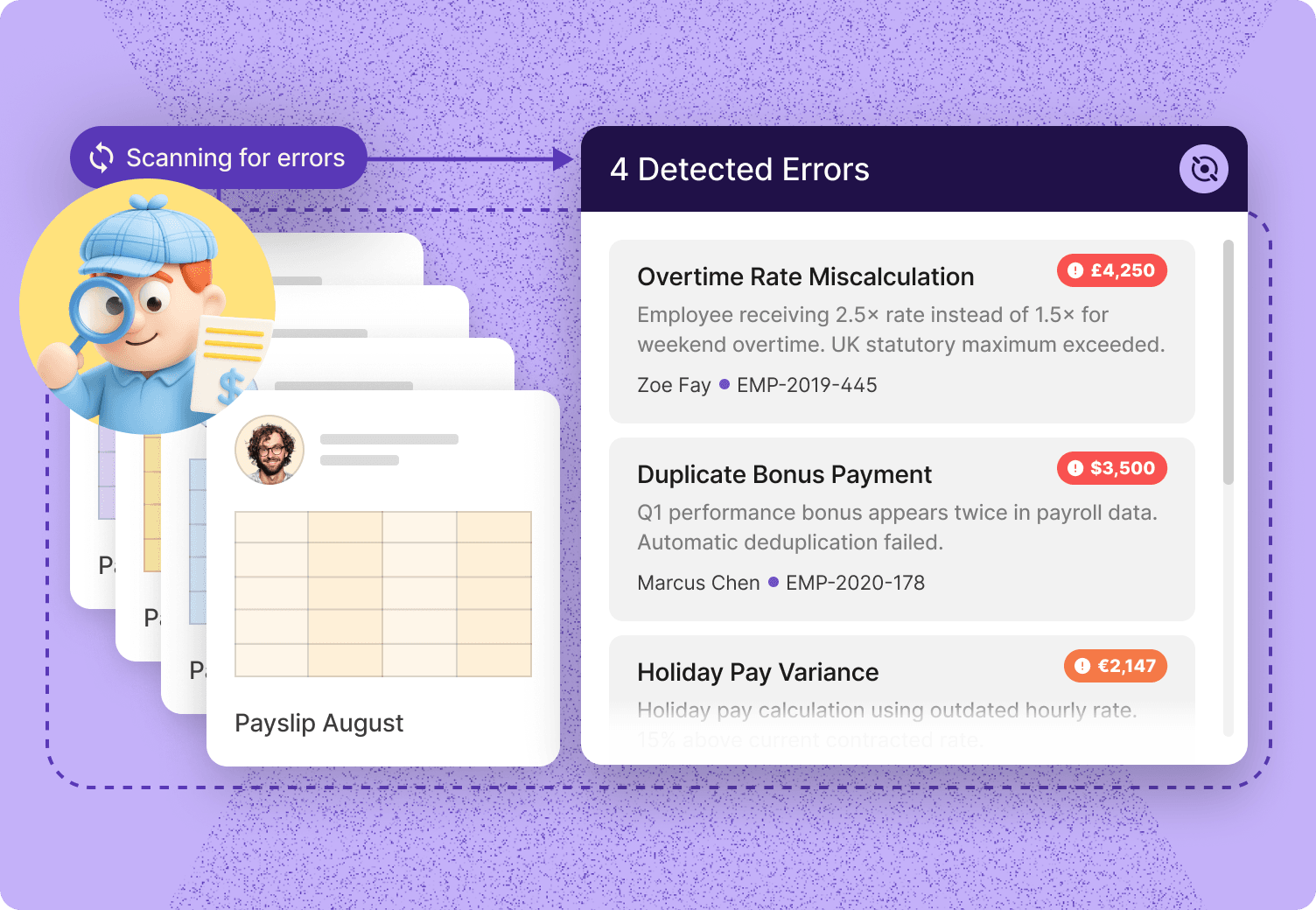
"The Payroll Detective," Deel's AI agent for payroll audits
7. Can Deel’s AI agents be customized to match our enterprise workflows and approval structures?
Yes. Deel’s AI agents are built to flex around your organization’s complexity. Whether you operate across multiple countries, departments, or approval hierarchies, the agents can be tailored to follow your specific workflows, mirroring conditional logic, escalation paths, and compliance checkpoints that match your existing processes. This ensures you gain automation without losing the control or governance large enterprises require.
8. How do we choose the right agentic AI tool for enterprise needs?
There’s a lot of hype surrounding agentic AI. You must thoroughly evaluate providers to ensure they both deliver on their promises and align with your organizational needs.
Here’s what to look for:
- Extensive international coverage
- Seamless integrations with your existing HR tech stack
- Compliance certifications like SOC 2 and ISO 27001
- Flexible, no-code interface for easy setup and regular use
- Transparent decision-making logic
- Granular access and permissions for security
- Predictable fixed monthly pricing
- 24/7 customer service to provide guidance and handle issues
- An extensive knowledge database to train the AI agent
- A strong track record with similar businesses
Ask providers for a full walkthrough of their agentic AI features before committing. You should carefully review any contracts and negotiate terms and conditions that don’t favour your organization.
9. How do Deel’s AI agents maintain data integrity and compliance at scale?
Each Deel AI agent operates with enterprise-grade security standards, including SSO, role-based access controls, SOC 2 & ISO certifications, and detailed audit logs. Agents are also grounded in Deel’s Compliance Hub, which continuously updates based on local labor laws and regulatory changes across 150+ countries. That means every automated task, whether time-off approvals or payroll insights is compliant by design and auditable.
Our global team can turn to Deel AI for instant answers to their HR questions, anytime. It’s been a huge time-saver for our People team.
—Yunjung (Rina) Bae,
Director of People, MarqVision
10. How must we prepare before deploying AI agents for HR processes?
The first step before deployment is cleaning up your system. Agentic AI is only as effective as the data it works with. If your system is inconsistent or fragmented, it will amplify these issues instead of fixing them.
Here are some steps to take in the cleanup process:
- Unify job architecture: Standardize roles, responsibilities, and pay structures so they’re easier for AI to recognize
- Clarify onboarding paths: Create basic workflows to give AI a framework to automate and personalize onboarding at scale
- Define performance criteria: Develop structured evaluation data, even if there’s variation between roles and departments, to help AI monitor your system for issues more effectively
- Delete duplicates and errors: Ensure you only have one copy of each file, so the AI agents don’t get confused between similar versions
- Update employee information: Ask teams to check that profiles are complete and up to date because incorrect details like addresses, tax IDs, and benefits can lead to significant errors
Updating thousands of employee files is a long process. Deel makes it easier with its self-serve capabilities, enabling teams to update their own profiles and upload documents. All your HR team has to do is check their status via the centralized dashboard.
11. What are the key steps in ensuring a successful rollout?
Successful rollout is less about speed and more about building trust and ensuring alignment. After all, your team must learn how to use these tools and incorporate them into their daily workflows. They’re also likely to feel the direct impact of any AI initiatives in HR processes.
This involves creating a detailed plan and going slowly as you drive adoption. Here are some questions you can ask yourself to check you’ve covered all bases:
- Who will manage rollout? What are their roles and responsibilities?
- What must we achieve by specific dates?
- When will we announce our decision to employees? How will we deliver this information? What channels will we provide to field questions and receive feedback?
- What audit trails, access logs, and fallback protocols do we need in place?
- Who needs training before agent rollout?
- Do teams understand AI capabilities, aka what they will and won’t do?
- How will we evaluate AI output? When shall we expect employees to flag issues?
12. Why do AI initiatives in HR fail?
Agentic AI initiatives fail for a number of reasons. Gartner predicts that over 40% of projects will be cancelled by 2027 due to budgetary constraints, unseen ROI, or poor risk mitigation.
While businesses are right to be cautious, AI initiatives aren’t necessarily destined for failure. Gartner experts note that many projects are experiments or driven by hype and lack any real strategy. Some companies also fall victim to “agent washing” where existing solutions rebrand themselves as agentic AI without upgrading their features.
The lesson here is that AI initiatives fail without proper research, structure, and support. Only invest in agentic AI after calculating measurable returns, investing in strategy, and thoroughly vetting your provider of choice.
13. Will agentic AI displace HR jobs?
No, agentic AI isn’t intended to replace HR. While it can handle some complexity, it can never substitute human judgment, empathy, or ingenuity.
Agentic AI works best when it augments your workflows. For example, Deel’s career progression feature can map skills, analyze workforce trends, and generate pathways. But decisions about who to promote, which roles to open, and how best to support employees remain with HR leaders.
Headlines sometimes suggest that AI leads to job cuts, but business practices show otherwise. 77% of employers are upskilling teams to work alongside AI better, while 44% are transferring declining roles into new areas.
More resources
Read more in our article on Will AI Replace HR? for a deeper look at how the technology supports teams and where human expertise remains essential.
How Deel supports enterprise AI-powered HR scaling
For global enterprises, HR challenges don’t stop at ensuring efficiency. They span countries, involve thousands of employees, and carry high stakes for compliance. That’s where agentic AI can make the difference by coordinating multi-step processes across regions, surfacing risks early, and guaranteeing employees everywhere have a consistent experience.
Deel is purpose-built for this complexity. Our platform combines agentic AI with powerful automation for managing the entire worker lifecycle, from workforce planning and hiring to offboarding, and deep compliance expertise to help enterprises manage HR at scale.
Here’s what this looks like in practice:
- Global compliance automation across 150 + countries
- Knowledge base developed by a vast team of local experts
- AI-assisted automations for everything from job descriptions and offer letters to expense management
- AI-powered HCM, Deel HR, with core modules for workforce planning, compensation management, and talent management
- Deel AI chatbot, ready to answer your team’s questions
- Custom AI workflows to meet your specific needs
- Seven custom AI agents to manage scheduling, PTOS, and more
Want to explore AI further? Contact a Deel specialist to learn how agentic AI and automation can help you bring efficiency and strategic value to global HR operations.
We explored several providers, but Deel stood out due to its seamless integration, compliance expertise, and speed. Their partnership approach gave us the right ecosystem to expand internationally without operational bottlenecks.
—Gerhard Jansen,
Co-Founder, Cocoroco.com
Lorelei Trisca is a content marketing manager passionate about everything AI and the future of work. She is always on the hunt for the latest HR trends, fresh statistics, and academic and real-life best practices. She aims to spread the word about creating better employee experiences and helping others grow in their careers.


