
Article
24 min read
AI in Employee Engagement: 7 Applications to Try Yourself
Global HR

Author
Lorelei Trisca
Last Update
January 20, 2026

Table of Contents
What are the potential benefits of incorporating AI in employee engagement strategies?
Applications of AI in employee engagement
The challenges and risks of AI in engagement
Factors you should consider before investing in an AI engagement solution
Engage your workforce with Engage
Key takeaways
- AI transforms employee engagement by automating repetitive tasks, facilitating personalized growth paths, and providing real-time feedback.
- Leveraging AI allows HR and leadership teams to focus on more high-impact, human-centered initiatives.
- AI-powered tools offer actionable insights into employee satisfaction, preferences, and development needs, fostering better alignment between employees and organizational goals.
15% of employees are actively disengaged in the workplace. Such low engagement results in a global GDP loss of over $8.9 trillion.
You don’t want this to be the case for your company. Yet, from managing repetitive administrative tasks to ensuring personalized growth opportunities, leaders are stretched thin.
At Deel, our global experience shows that leveraging AI can empower organizations to tackle engagement barriers. Whether you’re an HR manager or a team leader, AI-powered solutions provide actionable insights and save precious time.
In this guide, we’ll walk you through seven popular applications of AI in employee engagement so you can learn how to use AI coaches, bots, and other processes.
What are the potential benefits of incorporating AI in employee engagement strategies?
Artificial intelligence is already used in HR for various use cases, including recruiting, onboarding, training and development, performance assessment, and more. One of the core use cases, though, remains employee engagement.
Not only can using AI improve employee satisfaction and productivity, but it also helps you ensure that you meet your people’s requirements (remote and onsite).
You can use AI-based HR tools to:
- Automate day-to-day processes such as feedback sharing or facilitating team member connections
- Automatic event scheduling reduces the burden on your HR team. This way, they can focus on the tasks that require human involvement, like one-on-one meetings or live coaching
- Streamline conflict resolution by providing objective third-party insights and improving learning and development initiatives. Specifically, these AI tools use existing employee data to make better employee training recommendations and connect specific employees to growth opportunities (like new roles or departments)
- Gain deeper insights into employee preferences and proactively address any discontent across the organization
Ultimately, AI can foster organizational alignment, help you retain employees, and improve future performance. That’s simply because you’ll have more time to dedicate to every person on your team.
Tip: Taking the time to listen to your employees, gather feedback, and sit down face-to-face to discuss everything helps you build better relationships and provide a better work experience.
Deel HR
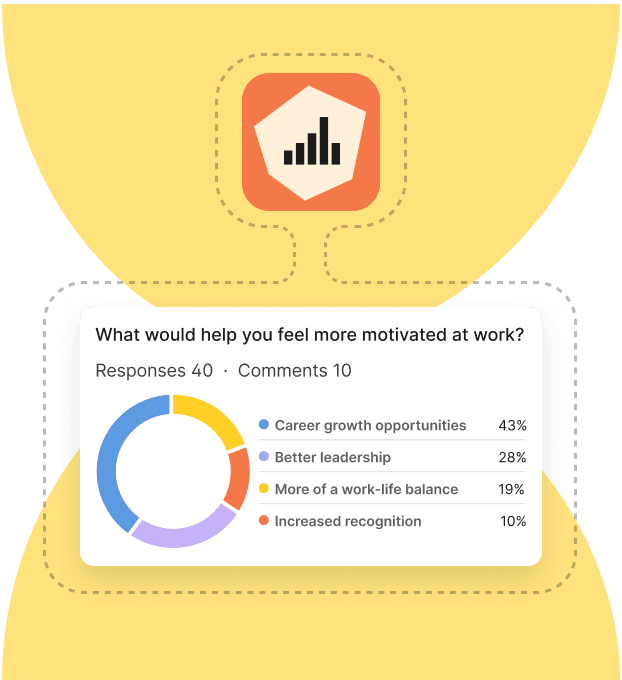
Applications of AI in employee engagement
To start using AI solutions to improve employee engagement levels for good, let’s consider seven typical applications.
How to use them: Each artificial intelligence application and solution caters to a different need or challenge you’re dealing with or might bump into in the future.
Most AI-powered tools won’t be able to help you with all scenarios. So take the time to prioritize your immediate needs and gradually test these applications with your employees.
Tip: Use an engagement action plan to document your priorities and track critical to-dos.
Chatbots and virtual assistants for employee support
Your HR team is asked the same questions dozens of times each week. “When’s open enrollment?” “How do I request time off?” “Who handles equipment requests?” Meanwhile, employees wait hours or days for answers to simple questions that could be resolved instantly.
AI-powered chatbots, like Leena AI, Happyfox, and Deel AI (although Deel AI is much more than a chatbot), completely change this dynamic. They’re available 24/7, never get frustrated with repetitive questions, and can handle multiple conversations simultaneously. Think of them as your always-on HR assistant that scales infinitely without burning out.
How to use AI chatbots and virtual assistants for employee support:
- Answer frequently asked questions
- Provide on-demand training and guidance
- Automate repetitive and administrative tasks
- Speed up communication between employees and HR
When to avoid using AI chatbots and virtual assistants for employee support:
- When an issue requires a personal touch or human empathy
- When a topic is highly complex and requires a high level of expertise or knowledge that cannot be provided by AI
- When an issue requires people to be physically present (like technical support)
- If you didn’t have the time or resources to train the bot properly
Thanks to Deel AI, I no longer need to open support tickets. My HR questions get instantly answered, which lets me focus on what truly needs attention.
—Ihor Hovenko,
Global Mobility Manager, Welltech
Sentiment analysis for monitoring employee satisfaction
Many times, the insights from traditional employee surveys get stale before you can apply them. That is where tools like Leapsome and Lattice, that monitor employee satisfaction, could help.
AI sentiment analysis monitors the pulse of your workforce in real-time. It analyzes communication patterns, email tone, chat messages, and feedback to spot satisfaction trends as they develop. You’ll catch problems while they’re still fixable, not after half your team has mentally checked out.
How to use AI for sentiment analysis:
- Collect data from employee feedback surveys, social media, and other sources
- Help managers find areas where employees are satisfied or dissatisfied
When to avoid using AI for sentiment analysis:
- If you’re unable to gather consent before collecting and analyzing employee feedback
- If biased results are likely to occur
Use case spotlight: AI-based sentiment analysis tools offer data-driven insights into employee sentiment and behaviors. Managers can use this data to examine their team’s preferences, motivations, and performance drivers.
Gamification to ultimately boost engagement
Most workplace motivation systems feel forced. Badges for attending meetings, points for submitting reports on time, and leaderboards that pit colleagues against each other. They create temporary excitement but don’t drive lasting engagement because they’re not connected to what actually matters to each person.
AI-powered gamification works differently. It learns what motivates each employee individually and creates personalized challenges that align with their goals and interests. The result? Game mechanics that feel natural and meaningful rather than gimmicky.
How to use AI for gamification:
- To create and maintain a rewards system
- To incentivize employees to complete tasks (e.g., by sending notifications when peers complete their tasks for a dose of healthy competition)
- To gather new (sometimes unique) data on employee behavior and preferences
When to avoid using AI for gamification:
- If gamification practices do not align with your company’s culture or values
- If the company or department is facing significant financial challenges
Use case spotlight: Use Engage’s AI assistant to create quizzes for your training courses to improve learning engagement.
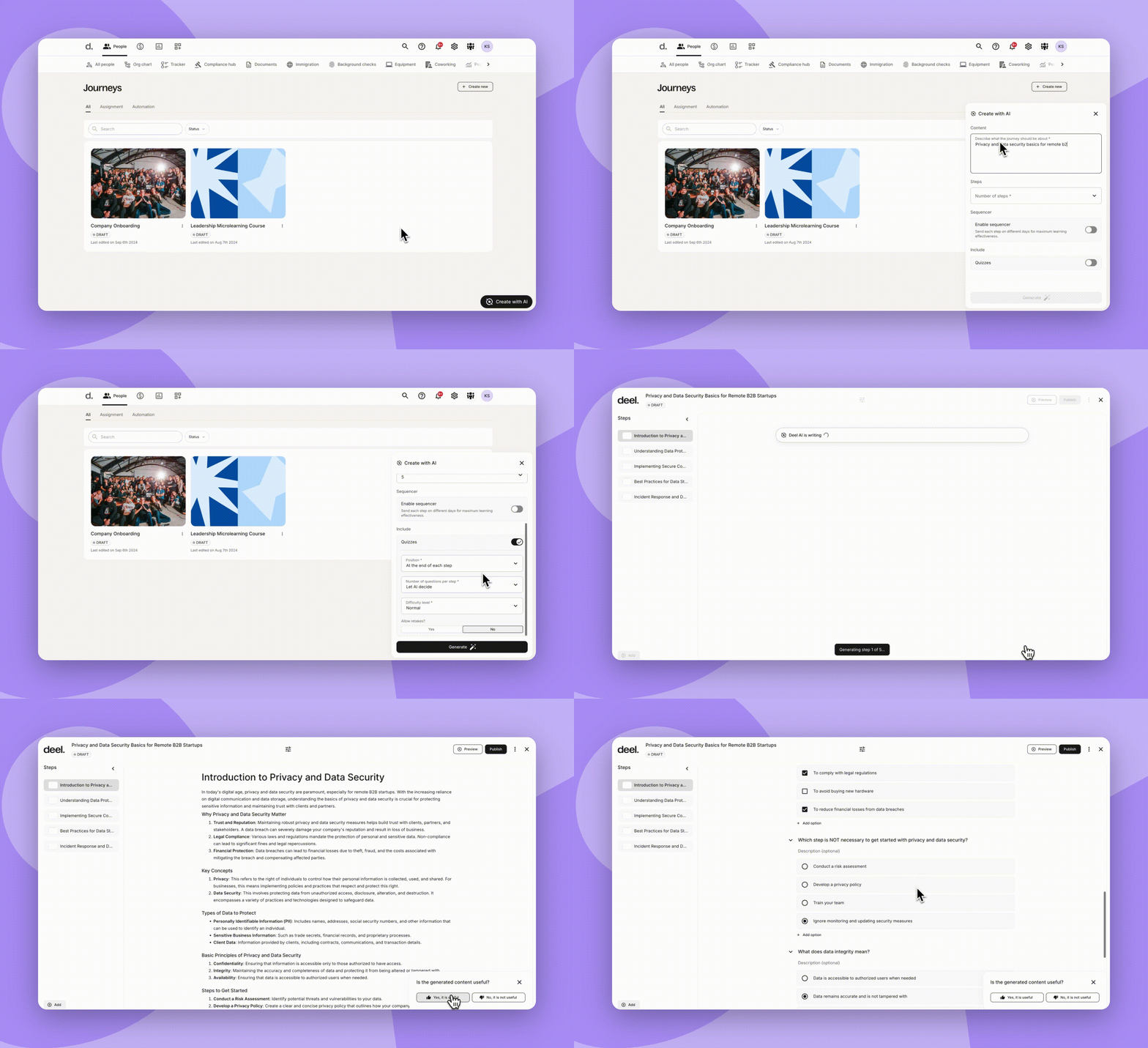
Deel Engage: Accelerate learning content creation with AI. Add quizzes in just a few clicks for a boost of learner engagement
Personalized learning and development programs
Standard training programs treat all employees as if they learn at the same pace. As a result, some people get bored while others feel overwhelmed. At the end of the day, most learning content remains unused due to a mismatch between individual goals and learning methods.
AI personalizes the entire learning experience. It assesses each person’s current skills, identifies knowledge gaps, and creates custom learning paths. The system adapts as people progress, suggesting relevant content when they need it most. It’s like having a personal career coach who knows exactly what each employee should learn next.
How to use AI for personalized learning:
- Create individualized programs for each employee
- Gather data on employees’ skills and interests
- Find and recommend the best materials or activities to match the skills and interests of each employee
- Keep track of the employee development progress
When to avoid using AI for personalized learning:
- When the content of a learning program is sensitive or confidential and requires human discretion and judgment
- If the learning and development program is meant to build interpersonal skills or emotional intelligence (since human interaction is more effective in these cases)
Engage has everything. We went from cobbling forms together to running reviews, learning, and surveys in one click.
Through the AI incorporated in the learning development module, I am able to build fantastic courses in half an hour.
—Lucía Rodriguez,
Head of HR, Ladonware

AI-driven communication and collaboration tools
AI-enhanced communication tools actively facilitate better collaboration. They surface relevant information when you need it, connect you with the right people for specific questions, and help teams coordinate more effectively. The technology works behind the scenes to make communication smoother and more purposeful.
How to use AI-driven communication and collaboration tools:
- Improve communication efficiency and collaboration
- Automate repetitive or time-consuming tasks
- Analyze data and gain insights into employee engagement
- Provide customized feedback to your employees faster
When to avoid using AI-driven communication and collaboration tools:
- If you want to build a stronger sense of community among your employees, relying solely on AI-driven tools may not be effective
- If you can’t provide transparency in the communication process, your employees might not trust your AI tools
Use case spotlight: Set up communication training as your priority, and let AI record and track your team’s performance. An impactful communication training program will help your employees learn how to communicate effectively through methods like active listening or empathetic understanding.
Building an engaging onboarding experience
New hire onboarding typically follows a standard checklist for all employees. Read the handbook, watch training videos, attend orientation sessions, and hope for the best. By week three, most new employees still don’t understand their role clearly or feel connected to their team.
AI creates personalized onboarding journeys that adapt to each person’s background, role, and learning style. It delivers relevant information at the right pace, connects new hires with appropriate mentors, and tracks progress to ensure nothing falls through the cracks.
How to use AI for onboarding:
- To create highly personalized content in your onboarding checklist
- Provide real-time feedback
- When there are large amounts of data to handle, curate, and summarize
- If you need to automate repetitive tasks (e.g., sending new hires resources, setting up accounts)
- When automatically connecting employees to onboarding buddies
- For running a self-service center for new hire issues
When to avoid using AI for onboarding:
- If you need a human connection at every single step of the employee onboarding process
- If you haven’t had the time to test the AI-generated onboarding flow
- If your onboarding process involves highly technical or complex information
Recognition and rewards systems
AI-powered recognition systems spot patterns human managers might miss. They track contributions across different projects, identify when someone goes above and beyond, and suggest appropriate recognition opportunities. The result is more frequent, fair, and meaningful acknowledgment of good work.
Implementing AI in your recognition and rewards system will enable you to:
- Accurately track employee performance
- Send regular rewards or recognition cues to your employees
- Interpret performance data and offer recommendations for improvement (especially relevant when you’ve got large teams where manually keeping up with employee performance is impossible)
When to avoid using AI for recognition:
- If your team is generally hesitant to rely on artificial intelligence for decisions like these because they believe it’s not transparent or inclusive
- If you don’t have a person in charge of monitoring this system to ensure fairness
Use case spotlight: AI recommendations for growth based on past feedback results. For example, their last mid-year review highlighted a gap in presentation skills. In that case, they can get an automatic recommendation to sign up for a public speaking course.
For more ways of using artificial intelligence in HR, read our complementary guides:
The challenges and risks of AI in engagement
While AI offers tremendous potential for improving employee engagement, you must navigate several significant challenges to use it successfully.
Understanding the risks upfront can help you make informed decisions and develop mitigation strategies.
Employee skepticism about monitoring
Many employees worry that AI engagement tools are actually sophisticated surveillance systems designed to monitor their productivity and behavior. This skepticism isn’t unfounded: some AI tools do track employee activity in ways that can feel invasive.
Employees who don’t trust AI engagement tools will either avoid using them entirely or provide sanitized, inauthentic responses that defeat the purpose of gathering genuine feedback. The result is skewed data that does not accurately reflect actual employee sentiment.
How to address this challenge: You can address this challenge by being completely transparent about your AI systems. Explain exactly what data is collected, how it’s analyzed, who can access it, and who and how makes decisions.
Show employees the specific benefits they’ll receive, not just the organizational advantages. When people understand that AI is designed to help them find relevant resources or get better support, they’re more likely to engage authentically.
Risk of bias in recommendations
AI systems learn from historical data, which means they can perpetuate existing biases in the work environment. For example, an AI system analyzing recognition patterns might learn that technical contributions get more praise than collaborative work. As such, it might recommend recognition for similar technical achievements while overlooking essential teamwork.
The bias risk extends to personalization features. AI might recommend different development opportunities to different employees based on biased assumptions about their capabilities or interests. These algorithmic decisions can reinforce inequalities even when human managers are trying to be more inclusive.
How to address this challenge: To mitigate bias risks, regularly audit your AI systems with diverse teams that can spot potential blind spots. Test algorithms across different demographic groups to ensure fair treatment. Establish clear guidelines for when humans should override AI recommendations, and train managers to recognize and correct biased outputs.
Over-reliance on automation vs. human connection
There’s a risk that managers might lean too heavily on AI insights instead of having direct conversations with their team members. An AI system might flag that someone seems disengaged based on their survey response. Still, only a human conversation can uncover the underlying issues and build the trust needed to address them.
How to address this challenge: The key here is finding the right balance. Use AI to handle administrative tasks, surface insights, and suggest actions. However, preserve human judgment for important decisions and meaningful interactions. AI should augment human managers, not replace them.
Factors you should consider before investing in an AI engagement solution
Before you choose an AI engagement solution, take the time to test them all while keeping an eye on these seven core factors:
- The return on investment (ROI): Will the AI tool you’ve picked save you money and time? How scalable is it? For instance, will it keep up with your needs as your business grows, or as your team’s size doubles?
- Ease of use: Your team comes first. So you’ll want to ensure the platform and its integrations are easy to get accustomed to and use daily (if needed)
- Analytics: Insights provide the capacity to measure success and identify areas for improvement. Some of the best AI and machine learning solutions offer real-time analytics that use past trends and data to predict future business outcomes
- Key stakeholders: Think about everyone involved in using this app. Consider who will own it, who is in charge of managing day-to-day operations using the tool, and if any stakeholders should be informed, onboarded, and invested in this new addition to your tech stack
- Ethical implications and bias: Make sure to take into account any ethical or legal consequences of using these AI tools
- Building internal trust: This new tool is yet another addition to the various solutions that already occupy employees’ days. Hence, your team should understand the power of this app and how they can use it without wasting time or being distracted
- Maintenance and support: Simply put, someone will have to manage all this. Prepare accordingly and ensure the solution you pick has a support team always available to help you fix issues or find new use cases
Engage your workforce with Engage
AI solutions are here to help you keep your people engaged and enable HR professionals. Whether we’re talking about helping them gain new skills or just staying motivated, you can turn to a tool like Engage to do it all. Our suite of tools lets you engage and grow your organization’s talent by:
- Getting people insights to help you engage meaningfully, spot and facilitate better development opportunities, and create stronger remote relationships
- Running training, one-on-ones, onboarding, and training faster with the AI assistant
Additionally, Deel AI is included with every Deel product, so you can get the answers you need faster than ever. Whether you’re stumped about local laws, want to generate a report, or need tech support, Deel AI is always ready to help.
Schedule a free demo to learn more about all AI functionalities of the Deel platform, and how they will help you manage and engage a modern global workforce.
FAQs
How does AI motivate employees?
You can use AI to collect accurate, timely, and actionable data about an employee’s performance, allowing you to track employee progress in real-time and even make future predictions.
AI and machine learning can also be useful for automating work processes and providing feedback on employees’ tasks.
Finally, you can turn to AI for real-time insights into employee behavior so managers can offer custom motivation and rewards based on results.
AI can also analyze vast data points to help map potential career paths for employees based on their skills, experiences, aspirations, and company needs. This visibility into possible career progression can be a strong motivator.
What are AI employee engagement tools?
AI employee engagement tools are software platforms that use artificial intelligence to help HR teams understand, support, and improve the employee experience. These tools go beyond traditional surveys by using data-driven insights and automation to identify trends, flag risks, and recommend actions.
Some of the best AI tools you can use for employee engagement include:
- Deel Engage
- Slack (AI integrations)
- Microsoft Teams (Copilot)
- Ebb, an AI mental health companion by Headspace
- Worktango
- Paradox’s Olivia
How is AI used to improve employee motivation and satisfaction?
AI personalizes recognition by analyzing what motivates each employee and suggesting tailored rewards or development opportunities. It identifies engagement patterns from surveys and communication data, helping managers understand team sentiment in real-time.
AI also automates routine tasks like scheduling and administrative work, freeing up time for more meaningful interactions that boost job satisfaction.
Can AI predict disengagement or attrition?
Yes, AI can analyze multiple data points, including survey responses, communication patterns, performance metrics, and behavioral changes to identify early warning signs of disengagement.
These systems can flag employees at risk of leaving before traditional indicators become obvious. However, predictions aren’t perfect. They’re best used as prompts for human managers to have conversations rather than definitive forecasts.
What risks should HR leaders be aware of when using AI in engagement?
Key risks include employee privacy concerns and skepticism about monitoring, algorithmic bias that reinforces existing workplace inequalities, and over-reliance on automation that reduces human connection.
There’s also the risk of misinterpreting data. AI might flag normal behavior changes as concerning or miss important context that humans would catch.
How do you balance AI insights with human interaction?
Use AI to handle routine tasks, surface insights, and suggest actions, but reserve important decisions and meaningful conversations for humans.
AI should flag potential issues or opportunities, then managers should follow up with direct conversations. Set clear boundaries about what AI can and cannot do, and train managers to interpret AI recommendations as starting points for human judgment, not final answers.
Lorelei Trisca is a content marketing manager passionate about everything AI and the future of work. She is always on the hunt for the latest HR trends, fresh statistics, and academic and real-life best practices. She aims to spread the word about creating better employee experiences and helping others grow in their careers.


