
Article
20 min read
AI in Employee Retention: 6 Applications to Nurture a Long-Tenured Workforce
Global HR

Author
Lorelei Trisca
Last Update
September 25, 2025

Table of Contents
Employee engagement monitoring
Performance management for retention
Personalized career development
Employee skill development
HR support and AI chatbots
Personalized onboarding journeys
Predictive modeling for turnover prediction
Employee sentiment analysis
Improve staff retention with Deel Engage
Key takeaways
- AI uses data analysis and predictive modeling to spot flight risks before they escalate, enabling targeted interventions that prevent attrition.
- AI gauges workforce sentiment in real-time by analyzing feedback and emotions, allowing organizations to address concerns and foster trust.
- AI-powered tools, like internal talent marketplaces, match employees with opportunities that align with their skills and career goals, boosting satisfaction and retention.
Your best employee has just given her two weeks’ notice. The exit interview reveals that she has been unhappy for six months, feeling undervalued and seeing no clear path forward. Sounds familiar?
The frustrating part was that there were warning signs all along. Her Slack activity dropped by 30%, and she stopped volunteering for high-visibility projects. But by the time HR noticed these patterns, she’d already accepted an offer elsewhere.
Most retention strategies are reactive. HR teams throw money at the problem after people announce they’re leaving or roll out company-wide perks (those pizza parties won’t help), hoping something sticks.
Artificial intelligence (AI) changes this game entirely. Instead of waiting for the exit interview to understand what went wrong, you can identify risks and gauge employee sentiment months in advance. And instead of one-size-fits-all retention programs, you can deliver personalized interventions that address each employee’s specific needs.
In this article, we’ll show you eight concrete ways AI can transform your retention strategy—from identifying at-risk employees before they start job hunting to creating career paths that keep your top performers engaged.
Employee engagement monitoring
Employees often feel disengaged and unmotivated due to the lack of career development or advancement opportunities. Additionally, according to a NectarHR study, 71% of employees are more inclined to quit if they think their hard work goes unrecognized and unappreciated.
Other factors contributing to employee departures include feeling burnt out, dealing with challenging bosses, and looking to realign their work, knowledge, and capabilities.
According to Gallup, 37% of employees cite a company’s engagement and culture as the reason for leaving their last job. Clearly, you need to do something about employee engagement.
The data highlights one of the issues with traditional engagement tools. These tools capture how engaged people were weeks or months ago, not how they are today.
Fortunately, that’s not the case with AI-powered solutions. Here’s what real-time engagement monitoring looks like with AI:
- Digital behavior analysis: AI tracks patterns in how employees interact with work systems like Slack, meeting contributions, and project completion rates. When an employee who typically responds to emails within an hour starts taking half a day, that’s a signal
- Communication sentiment tracking: Natural language processing analyzes the tone and sentiment in employee communications. For example, it could pick up when an employee’s messages are becoming shorter, if they’re using collaboration language, and so on
- Individualized training programs: AI analyzes employee learning history, skills, and career aspirations to create personalized development plans, aligning training with professional goals
- Data-driven insights: AI gathers and analyzes data from multiple sources, including performance reviews and self-assessment surveys, to identify strengths, weaknesses, and interests
- Tailored recommendations: AI algorithms suggest suitable learning materials and activities based on each employee’s competency profile and interests, enhancing engagement and learning effectiveness
- Real-time progress tracking: AI-powered platforms monitor employees’ development progress, enabling timely interventions and adjustments for optimal learning outcomes
Read more
Discover more AI-driven employee engagement techniques you can implement remotely and on-site, effectively meeting your people's requirements.
Performance management for retention
Performance reviews have typically been annual events that employees dread and managers rush through. By the time issues surface in these reviews, they’d have festered for months.
Research from McKinsey shows that companies that focus on employee performance are 4.2 times more likely than companies that don’t.
By leveraging advanced algorithms and data analysis, AI automates the process of generating feedback, primarily based on goal completion. This automation streamlines the feedback process, providing a holistic view of an employee’s performance, and facilitates personalized growth opportunities.
This results in more effective employee progress and performance reviews that contribute to a culture of continuous improvement within your organization.
- AI-generated feedback summaries: AI-powered performance management compiles feedback from multiple sources, including peers, managers, and self-assessments. This multi-rater feedback provides a comprehensive view of an employee’s performance, highlighting strengths and areas for improvement
- Personalized feedback based on goals: AI goes beyond performance goals and analyzes progress towards development objectives. It then offers personalized feedback tailored to each employee’s aspirations and growth areas, fostering a sense of ownership and commitment to professional development.
- Objective and unbiased evaluations: AI’s automation and data-driven nature ensure more objective and accurate evaluations. By focusing on measurable outcomes rather than personal impressions, AI ensures that evaluations are fair and consistent across teams
Read more
To learn more about how to harness the transformative capabilities of AI in performance management, check out our guide now.
Performance Management

Personalized career development
AI-powered employee career development platforms leverage advanced algorithms and machine learning to analyze employee data, such as skills and career aspirations. By doing so, they can intelligently match employees with internal job postings that align with their individual preferences and capabilities.
One standout example is Spotify’s Echo, an internal talent marketplace that uses AI to recommend relevant job opportunities to employees based on their unique skill sets.
Through AI-powered career development, Spotify has strengthened internal mobility, elevated employee engagement, and curbed turnover rates.
Moreover, with AI’s assistance, employees can access a wealth of opportunities they may have overlooked otherwise. They also receive personalized career trajectories, suggesting growth paths tailored to each employee’s strengths and interests.
As a result, organizations can foster a culture of continuous learning and career advancement, keeping employees engaged and motivated.
Learn more about employee development at Spotify, including how the leadership ensures continuous growth and improvement aren't just isolated events but ingrained in the company's DNA.
Employee skill development
In an episode of The Modern People Leader podcast, Learnerbly Founder Rajdeep Dey correctly points out:
“One cannot be a subject matter expert in every business function of business—it’s an impossible task. So why not lean on technology that can help augment and automate several tasks within the L&D function?”
One such remarkable resource is setting up a competency and skills coach, driven by generative AI and cutting-edge learning science insights. These AI coaches expertly guide employees, empowering them to embark on successful skill development and career growth journeys.
Centralized knowledge repositories further make accessing training materials a breeze for your employees.
AI also provides training content translation into multiple languages, promoting inclusivity and accessibility for your diverse workforce.
The revolution continues with AI-based learning management systems (LMS), which simplify and accelerate the training process.
Deel’s AI-powered LMS, for example, streamlines training by handling repetitive tasks and expediting the creation of engaging courses, on-demand content, and more up to 10 times faster. It’s as easy as defining a topic, defining the number of steps in the training journey, and the number of quizzes, and the AI takes care of the rest.
Additionally, you can leverage existing PDF content and ask the AI to transform it into learning journeys. The AI can even add quizzes to the existing content to enhance learner engagement and knowledge retention.
You can also add survey steps to the learning journeys to assess training effectiveness and learner satisfaction. Ask your people to provide valuable feedback, directly influencing the creation of future courses and suggesting potential improvements.
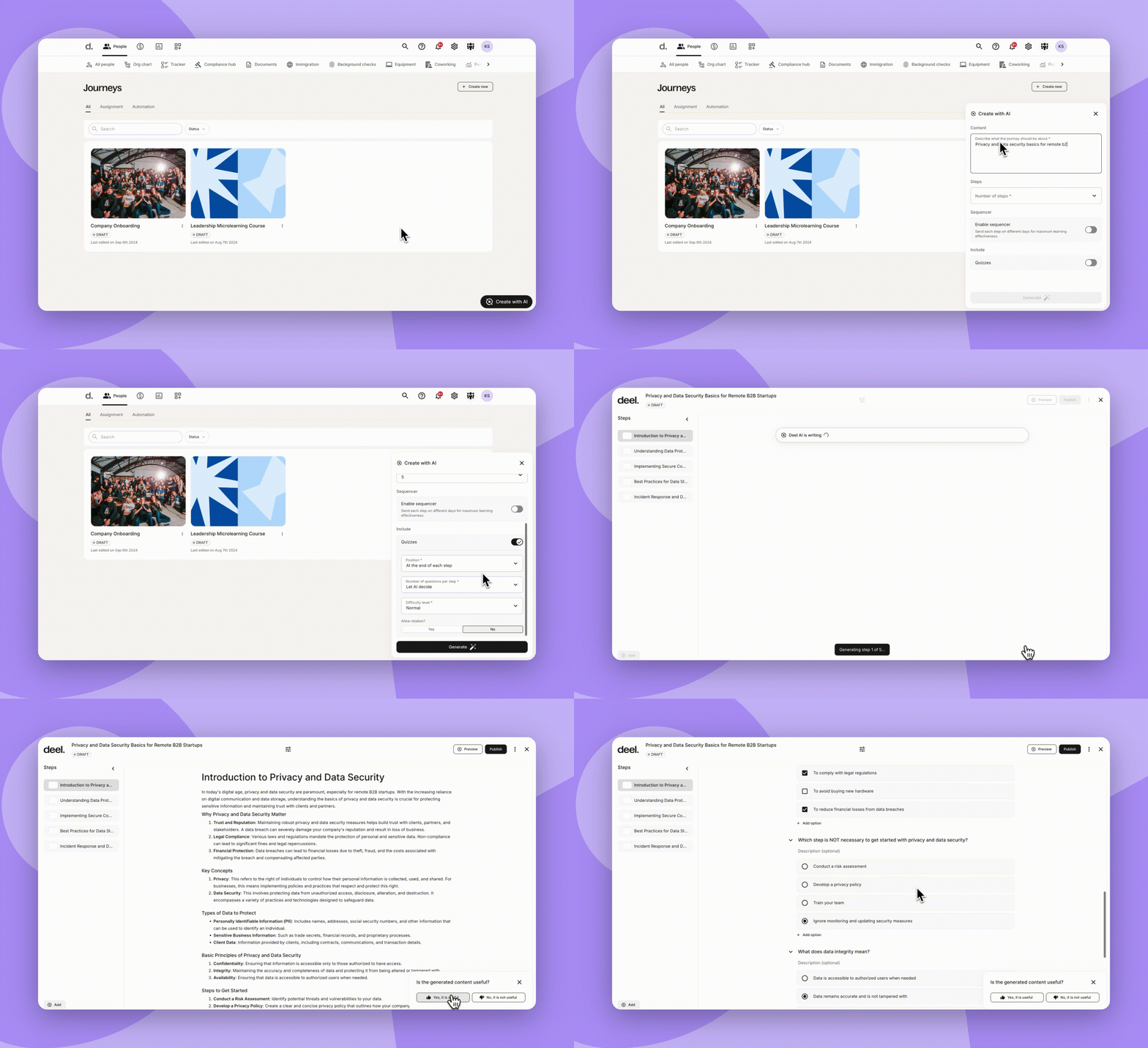
Accelerate learning content creation with AI on Deel Engage
Learning Management

Further reading
Explore more AI-powered use cases in employee growth by diving into our comprehensive AI in L&D guide.
HR support and AI chatbots
Employee frustration with HR processes is a significant but often overlooked driver of turnover. When employees can’t get timely answers to benefits questions, struggle to navigate company policies, or wait days for responses to simple requests, dissatisfaction builds.
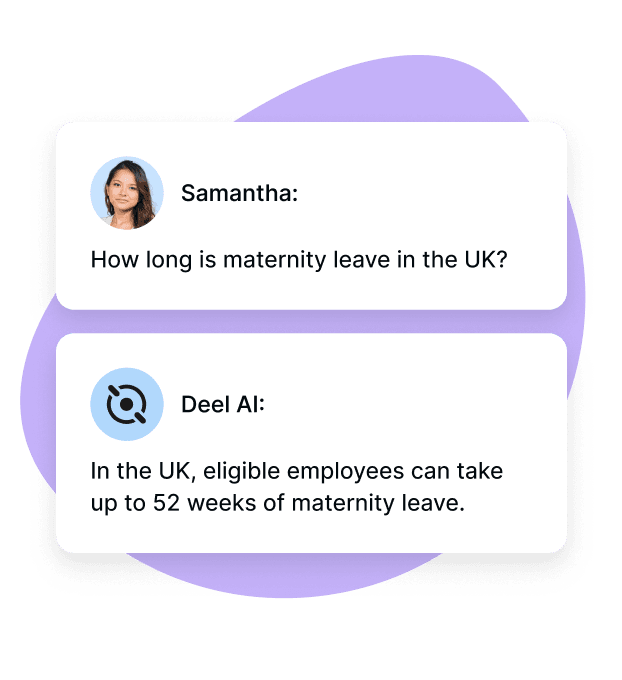
AI-powered chatbots have significant potential to enhance your employees’ productivity, wellness, and overall work experience. As versatile assistants, these chatbots provide easy access to information from vast knowledge bases, enabling your workforce to be more efficient and effective in their roles.
AI chatbots can handle routine inquiries like checking vacation balances, explaining health insurance options, or guiding employees through expense reimbursement processes. This immediate accessibility prevents minor frustrations from escalating into larger dissatisfaction issues.
Beyond productivity, AI chatbots also support employee wellness and a better work-life balance. With empathy and understanding, these chatbots help employees manage their well-being by providing guidance and resources for achieving a healthy work-life balance. This, in turn, leads to increased job satisfaction and improved retention rates.
For example, proactive employee outreach uses AI to identify when employees might need HR support based on life events, performance changes, or policy updates.
The system can automatically reach out to new parents about childcare benefits, remind employees of unused vacation days, or notify workers about relevant policy changes that affect their specific situation.
HR-support chatbots are also gaining swift popularity in the digital workplace. Specifically designed to support HR policies and procedures, they provide quick and accurate answers to queries about time-off requests, benefits eligibility, and other related matters. This comprehensive support improves the employee experience, making your workforce feel valued and supported.
Deel AI
Personalized onboarding journeys
AI-powered tools can help organizations deliver tailored onboarding experiences using data-driven insights. As a result, HR managers and leaders can meet each new employee’s unique needs and preferences, setting them up for success from day one and significantly improving new hire retention.
Here’s how:
- Personalized learning paths: AI analyzes skills, knowledge, and background to create tailored learning paths, addressing gaps and enhancing confidence
- Customized training materials: AI generates role-specific resources, ensuring relevant and engaging content for onboarding
- Easy translations: Offer various language options for your global workforce. AI helps you translate your learning content in a few clicks
- Real-time feedback and support: AI chatbots offer instant guidance, reducing uncertainty and fostering a supportive experience
- Continuous performance monitoring: AI tracks new hire progress, enabling proactive intervention for retention
- Social integration and cultural fit: AI assesses cultural fit, aiding in fostering a sense of belonging and job satisfaction
Predictive modeling for turnover prediction
With their extensive historical data analysis, AI algorithms uncover subtle patterns and trends that are often missed by traditional methods. They provide invaluable insights into employee performance, job satisfaction, tenure, and organizational interactions, bolstering employee retention efforts.
Leveraging AI brings multiple advantages to employee retention efforts. For instance, it can help you recognize behavioral patterns and common traits among past employees who left and proactively identify employees with a high risk of leaving your company.
As a result, people ops can design interventions and execute retention strategies, gaining a deeper understanding of turnover’s root causes to create a conducive work environment.
Also, AI’s real-time data processing ensures organizations remain agile and adaptable to their workforce’s evolving needs. By embracing AI for analyzing and predicting retention data, businesses can make data-driven decisions that enhance employee engagement, loyalty, and overall success.
Surveys
Employee sentiment analysis
Employee sentiment often changes gradually, with subtle shifts in attitude and communication that can be easily overlooked during busy workdays.
Catching these shifts when they happen is crucial because your employees’ emotional well-being and job satisfaction significantly impact their productivity, commitment, and loyalty.
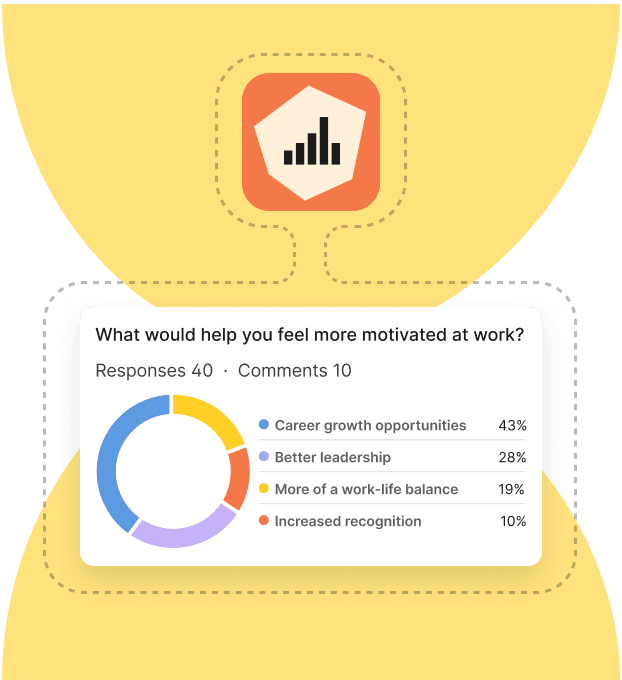
Sentiment analysis algorithms examine language patterns, tone, and emotional indicators across multiple communication channels to gauge employees’ feelings about their work, colleagues, and the organization as a whole.
This ongoing assessment helps identify when positive employees begin experiencing frustration or when struggling team members start to re-engage. It also enables early detection of potential issues related to work concerns, company culture, or managerial practices.
Armed with these insights, you can proactively address emerging issues, fostering a positive work environment through targeted interventions and continuous monitoring. This approach fosters a culture of open communication, trust, and empathy, thereby enhancing employee engagement and retention.
Improve staff retention with Deel Engage
Deel is at the forefront of future-of-work technologies, including AI, offering globally compliant contracts, worker mobility solutions, and a comprehensive HR management suite. Now, both workers and employers can concentrate on their critical work while entrusting the intricacies of HR management to Deel.
With Deel Engage, our AI-based talent management suite, you can:
- Create career frameworks
- Build an extensive learning library of courses, certifications, and training programs
- Populate your organization’s competency library
- Creating a review cycle with the AI assistant and getting help from AI when writing reviews (coming soon)
In addition, Deel also offers a Global HRIS to manage all worker types in 150+ countries.
Book a demo to explore how to incorporate AI in employee retention to give your organization a competitive edge.
Deel Engage has everything. We went from cobbling forms together to running reviews, learning, and surveys in one click.
Moreover, through the AI incorporated in the learning development module, I am able to build fantastic courses in half an hour.
—Lucía Rodriguez,
Head of HR, Ladonware
FAQs
What are the 4 pillars of employee retention?
The four pillars of employee retention are rooted in competitive confidence. They encompass:
- Competitive compensation and benefits
- Providing enticing opportunities for career growth and development
- Nurturing a supportive work-life balance
- Fostering a positive organizational culture with effective leadership.
By focusing on these foundational aspects, organizations cultivate a committed and motivated workforce, fueling their success.
How does AI affect employee turnover?
With data-driven insights, personalized development opportunities, and predictive analytics, AI-powered tools enable organizations to analyze vast amounts of data, including employee feedback, performance metrics, and engagement levels. This empowers companies to identify key factors contributing to turnover and take proactive measures to address them effectively.
How can AI help in reducing employee attrition?
AI is a powerful tool for reducing employee attrition. By monitoring employee performance and harnessing predictive analytics, it identifies turnover risks and takes proactive measures to address them head-on. Through personalized employee development, real-time feedback, and recognition, AI boosts job satisfaction and motivation, fostering a dedicated and committed workforce.
Moreover, AI assesses candidates' cultural fit during the hiring process, ensuring the selection of individuals who align perfectly with the company's values and culture. This strategic approach maximizes the chances of long-term employee satisfaction and retention, ultimately contributing to the organization's success and growth.
How can I measure employee retention improvement from AI?
Track key metrics before and after AI implementation to quantify the improvements in retention.
Monitor voluntary turnover rates by department, role level, and tenure length to identify where AI has the greatest impact.
You should also measure time-to-intervention metrics, such as how quickly you identify and address flight risks compared to traditional methods.
Employee engagement scores provide another measurement layer. Compare engagement and pulse survey results before and after implementing AI tools.
Track the percentage of at-risk employees who remain with the company after receiving AI-recommended interventions.
What is the long-term value of AI in reducing staff turnover?
AI’s long-term value extends beyond immediate cost savings to create sustainable competitive advantages. Organizations develop predictive capabilities that become more accurate over time as algorithms learn from historical patterns and outcomes. Predictive analytics creates a compounding effect where retention strategies become increasingly precise and effective.
The technology also enables proactive workforce planning. Instead of reactive hiring to replace departures, companies can identify skill gaps, succession planning needs, and development priorities years in advance. This strategic approach reduces recruitment urgency and associated premium costs while maintaining team stability.
Cultural benefits accumulate over time as employees recognize the organization’s investment in their success. When people see personalized development opportunities and proactive support, it builds trust and loyalty that extends beyond individual retention interventions.
How can AI search help in knowledge retention when employees leave?
AI-powered knowledge management systems automatically capture and organize institutional knowledge before employees depart. These systems identify key documents, processes, and relationships associated with departing employees, ensuring that critical information is transferred to remaining team members.
The technology also creates searchable knowledge bases from emails, meeting recordings, project documentation, and informal communications. This prevents the common scenario where departing employees take unique insights and problem-solving approaches with them.
How can AI help reduce attrition by guiding employees to growth opportunities?
AI systems analyze employee skills, performance patterns, and career interests to identify internal advancement opportunities before employees look elsewhere.
The technology also identifies skill development priorities that position employees for future opportunities. By recommending specific training, certifications, or project experiences, AI helps people build qualifications for roles they want while meeting organizational needs.
How can AI-driven insights lower employee attrition?
AI insights can help you identify the optimal moments for salary discussions, development conversations, or role adjustments when employees are most receptive to retention efforts and before they’ve committed to leaving.
Lorelei Trisca is a content marketing manager passionate about everything AI and the future of work. She is always on the hunt for the latest HR trends, fresh statistics, and academic and real-life best practices. She aims to spread the word about creating better employee experiences and helping others grow in their careers.


