
Article
15 min read
The Best AI Tools for HR: 11 Tools Compared
Global HR

Author
Lorelei Trisca
Last Update
September 29, 2025

Table of Contents
11 AI tools for HR that can take your people processes to the next level
Summary and comparison table: 11 AI tools for HR
Types of AI tools for HR
How to choose the best AI tools for HR
What to consider when implementing AI tools in HR
Enjoy the benefits of AI-powered HR tools with Deel
Key takeaways
- AI tools transform HR by automating recruitment, onboarding, performance management, and compliance while giving HR teams actionable, data-driven insights.
- Different types of AI tools serve different needs, from generative AI for training content to predictive analytics for turnover risk, making matching solutions to your organization’s goals vital.
- Successful adoption requires responsibility, with attention to data quality, system integration, scalability, and ethical safeguards like bias reduction and worker data privacy.
- HR leaders who start small, pilot new tools, and focus on worker adoption are best positioned to unlock the full value of AI in their people processes.
Human resources is at a turning point, with artificial intelligence (AI) reshaping how teams attract, manage, and develop talent. From recruitment to performance management, AI-powered tools are no longer merely nice-to-haves. AI-powered automation has become essential for organizations that want to work smarter, faster, and with greater confidence in their decisions.
In this guide, we’ll explore the different types of AI tools available for HR. We’ll compare 11 leading solutions (including Deel’s own AI suite) and share practical tips on choosing and implementing them responsibly.
11 AI tools for HR that can take your people processes to the next level
As the AI tools landscape has evolved rapidly, HR leaders are now spoiled for choice between dedicated HR platforms and general-purpose AI assistants.
1. Deel AI
Deel AI is embedded in all Deel products and works around-the-clock, included at no additional cost for every Deel customer.
Trained on Deel’s Knowledge Hub and data from HR and legal experts across 150+ countries, it delivers fast, contextual insights drawn from your team’s own data and global compliance expertise.
With Deel AI, you can:
- Instantly answer HR and policy questions, from payslip clarifications to local labor laws
- Generate data-rich reports, like org charts or payroll compliance snapshots
- Provide context-aware help, based on where you are in the Deel platform
- Generate job scopes and compliant contracts in seconds
- Customize offer letters
- Check visa eligibility in 38++ countries
- Use natural language filters to query and filter your worker data
For your HR teams, using Deel AI means fewer support tickets, less time searching for accurate answers, and more time focused on strategic priorities.
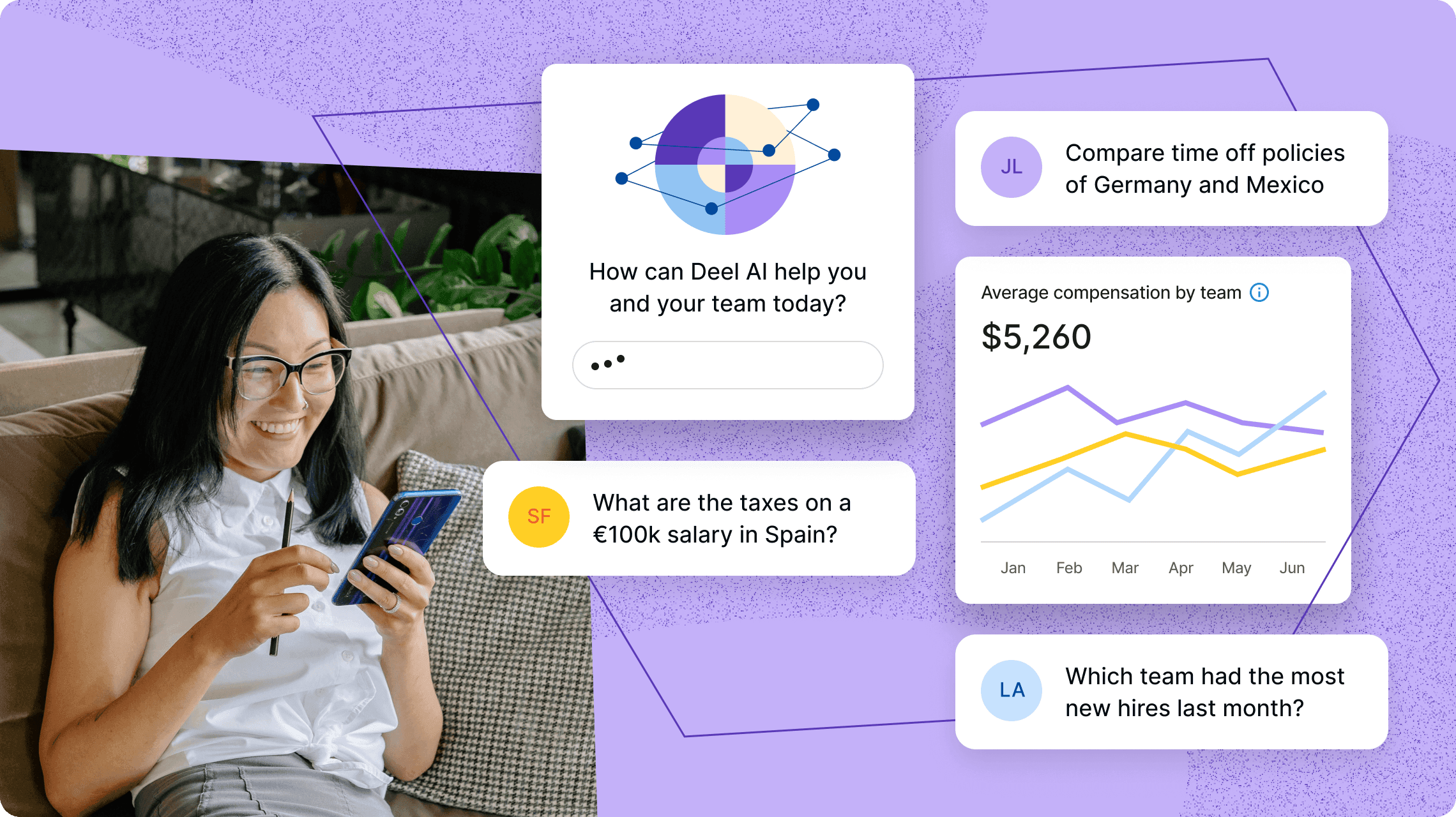
Some of the many use cases of Deel AI
Thanks to Deel AI, I no longer need to open support tickets. My HR questions get instantly answered, which lets me focus on what truly needs attention.
—Ihor Hovenko,
Global Mobility Manager, Welltech
2. Engage
Engage is a comprehensive talent development platform that integrates generative AI directly into performance management, career growth, and learning, at no additional cost for customers.
Unlike many third-party platforms, where AI is an add-on, Engage weaves AI into every stage of talent development, simplifying the work of your HR teams and giving your people clear, personalized growth opportunities.
With Engage’s generative AI assistant, your HR teams can:
- Automatically build competency frameworks and career paths tailored to every role and level
- Generate personalized development plans from feedback and performance data
- Create immersive, multilingual training libraries in minutes without the need to build content from scratch

Deel Engage: Creating career paths and frameworks with AI
These AI-driven features help HR teams increase consistency across teams and save hours of manual work.
For global organizations, Engage doubles as an LMS and a performance hub, centralizing otherwise scattered tools from multiple vendors.
The result is a more transparent, structured approach to people development, making it easier for workers to monitor their growth path and for managers to track progress in real time.
By embedding generative AI throughout, Engage allows your HR leaders to focus less on admin and more on building a culture of continuous learning and performance.
Engage has everything. We went from cobbling forms together to running reviews, learning, and surveys in one click.
Through the AI incorporated in the learning development module, I am able to build fantastic courses in half an hour.
—Lucía Rodriguez,
Head of HR, Ladonware
Deel Engage

3. Deel AI Workforce Agents
The newest piece of Deel’s AI ecosystem, Workforce Agents, represents the next level of HR automation. These pre-built agents plug into your payroll, compliance, IT, and onboarding workflows without requiring coding.
Deel’s AI Workforce Agents include:
- The Hiring Guru: Compares markets, job costs, visa options, and creates compliant job postings
- The Time-Off Fairy: Automates leave requests, balance checks, and approvals
- The Border Buddy, Payroll Detective, and Goodbye Genie: Designed for offboarding, cross-border checks, scheduling, and more
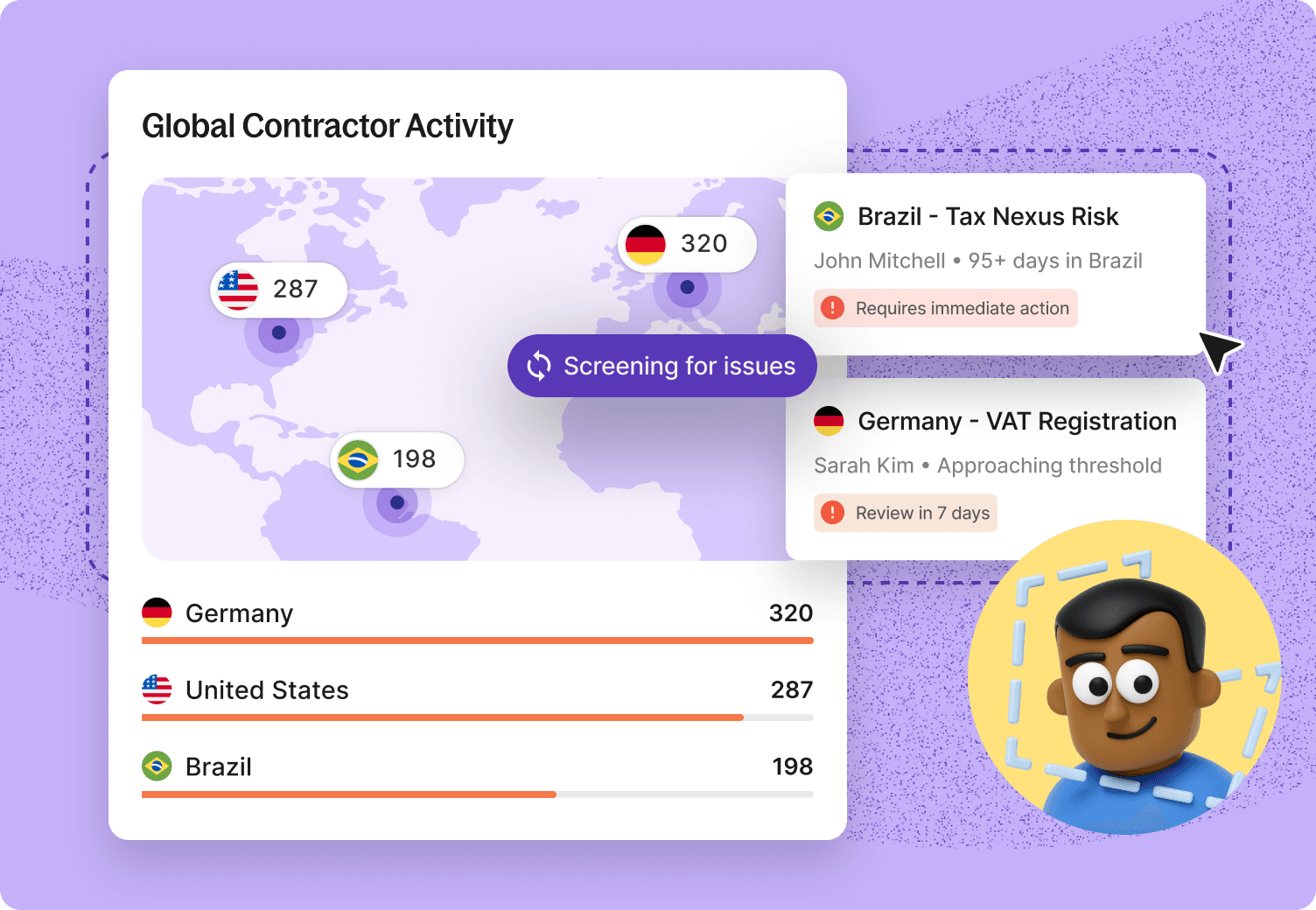
Deel AI Workforce: “The Border Buddy”
Each agent tracks time saved, errors caught, and overall ROI through an intuitive dashboard.
You can also build custom agents tailored to your team’s specific workflows, with all training grounded in vetted compliance data and paired with enterprise-grade security.
Deel’s agents are easy to use. Instead of requiring technical expertise, your HR teams simply provide natural language instructions, and the agents handle the tasks.
4. Olivia (Paradox)
Olivia is a leading conversational AI assistant for hiring, especially in candidate engagement and recruiting workflows. It is designed to improve the recruiting experience, acting as a 24/7 recruiting coordinator by automating candidate communication and scheduling:
Olivia:
- Engages candidates in real time using SMS, WhatsApp, or chat
- Answers candidate queries in more than 100 languages
- Schedules interviews automatically, syncing with recruiter calendars
- Guides candidates through applications and status updates
- Provides analytics dashboards to identify bottlenecks in the hiring funnel
By automating repetitive tasks and keeping candidates engaged, Olivia allows your recruiters to focus on strategic hiring decisions and relationship building.
Following Paradox’s recent acquisition by Workday, Olivia is likely to gain even tighter integrations with enterprise HR systems.
5. iMocha
iMocha specializes in skills assessment and pre-employment testing, particularly in technical roles. It helps companies hire with confidence and reduce bias in recruitment.
Its features include:
- Thousands of domain-specific and technical skills tests
- AI-based remote proctoring to maintain fairness and security
- Skills gap analysis and benchmarking dashboards
- Integrations with ATS and LMS systems for smoother workflows
- Actionable reports that speed up hiring decisions
With a focus on efficiency and inclusivity, iMocha allows HR to evaluate candidates objectively while saving time in the hiring process.
6. Effy
Effy is a performance management platform designed to make reviews and feedback cycles seamless for HR teams and workers. It brings AI into performance management and provides:
- 360-degree feedback from peers, managers, and direct reports
- Easy-to-use templates with curated review questions
- AI-generated summaries that highlight worker strengths and development needs
- Slack integration for reminders and feedback collection
- GDPR and CCPA-compliant data protection
By automating reminders and surfacing actionable insights, Effy helps organizations build a culture of continuous feedback without overwhelming HR teams with manual admin.
Recent updates have improved its analytics, giving managers better visibility into feedback patterns and performance trends.
7. Lattice
Lattice is a people management platform that combines performance reviews, engagement surveys, and goal setting into one system. With AI support, it helps HR teams:
- Identify teams or individuals at risk of disengagement or turnover
- Align company, team, and individual OKRs with measurable outcomes
- Provide managers with structured 1-on-1 tools and coaching prompts
- Analyze worker sentiment and feedback through dashboards
Lattice enables organizations to connect engagement directly to performance, ensuring their people strategies support business growth. It is especially valuable for HR leaders looking to combine predictive analytics with people development in a single, easy-to-use platform.
8. Eightfold.ai
Eightfold.ai is a talent management platform that leverages AI to optimize recruitment and internal mobility. It provides:
- Deep learning models that match candidates to roles based on skills and potential
- Internal mobility recommendations that help workers explore new career paths
- Skills gap analysis to guide training or reskilling initiatives
- Diversity and bias-reduction features to ensure fairer hiring decisions
By combining predictive analytics with actionable insights, Eightfold.ai helps HR leaders future-proof their workforce and make more informed, data-driven decisions about talent.
9. Leena AI
Leena AI is an AI-powered HR assistant that enhances worker experience by automating HR support and engagement tasks. Its key features include:
- Resolving worker queries in real time using conversational chatbots
- Running surveys, pulse checks, and sentiment analysis
- Offering multilingual support for global workers
- Centralizing HR touchpoints and worker information
By acting as a 24/7 help desk, Leena AI reduces HR service requests, increases worker satisfaction, and creates a continuous feedback loop for ongoing improvement. It is particularly valuable for global or remote teams, where round-the-clock support ensures consistent worker experiences across time zones and geographies.
10. Talmundo
Talmundo specializes in transforming the onboarding experience for workers through AI-driven automation. It allows HR departments to:
- Deliver personalized onboarding journeys and interactive content
- Track new-hire progress with intuitive dashboards
- Provide chatbot support to answer common questions
- Integrate onboarding workflows with existing HR systems
By combining consistency with personalization, Talmundo helps organizations support new hires and engage them from day one, improving retention and productivity.
11. ChatGPT (general-purpose AI tool)
ChatGPT is a general-purpose AI assistant that uses natural language processing to streamline everyday tasks. Its conversational interface makes it extremely versatile across various HR applications.
Key uses of ChatGPT in HR include:
- Drafting clear, inclusive job descriptions with the right keywords
- Preparing interview questions tailored to specific roles and seniority levels
- Assisting managers in phrasing constructive performance feedback
- Summarizing and analyzing worker surveys, feedback, or exit interviews
- Creating policies, handbooks, and internal communications in a consistent tone
Because ChatGPT is adaptable and constantly improving, HR leaders should implement guidelines to ensure responsible use. This means checking outputs for accuracy, protecting data privacy, and monitoring for bias in generated content.
Summary and comparison table: 11 AI tools for HR
| Tool | Primary use case(s) | Key features | Estimated pricing |
|---|---|---|---|
| Deel AI | HR & legal insights, compliance, self-service | - Information derived from an expert-built Knowledge Hub (150+ countries) - Contract and offer letter generation - Data-rich reports (e.g., payroll compliance snapshots, org charts) - Visa eligibility tool - Q&A for managers and workers - Natural language filters for data querying - 24/7 support |
Included for all Deel customers at no additional cost |
| Engage | People development, performance, learning | - Generative AI-powered competency frameworks - Career paths - Multilingual training libraries - OKRs and feedback integration - Learning journeys - Engagement surveys - Global performance analytics |
Included for Engage users at no additional cost |
| Deel AI Workforce Agents | Workflow automation and HR operations | - Pre-built agents (e.g., Hiring Guru, Time-Off Fairy, Border Buddy, Payroll Detective) - Natural language prompt activation - Option to build own HR agents - Customizable workflows ROI tracking dashboard |
Custom pricing based on the number of agents to be deployed |
| Olivia (Paradox) | Candidate engagement and recruiting automation | - Conversational AI assistant (“Olivia”) - Multi-language chat - Candidate screening via chat - Interview scheduling - Analytics dashboards - ATS integration - Event recruiting |
Custom-quotes available |
| iMocha | Skills assessments and recruitment | - Technical and non-technical skill tests - AI proctoring - Skill gap analysis - Benchmarking dashboards - ATS/LMS integration |
From $999/yr (free trial available) |
| Effy | Performance management and feedback | - 360-degree reviews - Customizable review templates - AI-generated summaries - One-on-one notes - Meeting agendas - Slack integration - Reminders - Real-time dashboards - Reporting and analytics |
Free for up to 5 users, then from $3/seat/mo |
| Lattice | Performance, engagement, and manager effectiveness | - OKRs and goals - Performance reviews - Continuous feedback - Engagement surveys - Predictive analytics (e.g., turnover risk) - Coaching prompts - Sentiment reporting - Mobile interface |
From $11/seat/mo |
| Eightfold.ai | Talent intelligence and internal mobility | - Candidate matching with AI - Skills gap analysis - Deep learning candidate-role matching - Internal mobility recommendation - Diversity and bias reduction tools - Career pathing |
From $7/seat/mo |
| Leena AI | HR support and employee engagement | - Conversational HR chatbot - Real-time query resolution - Pulse surveys - Centralized HR touchpoints and worker information - Sentiment analysis - Multilingual support - Knowledge base integration |
Custom quotes available |
| Talmundo | Onboarding and employee experience | - Personalized onboarding journeys - Interactive checklists - Milestone tracking - AI-powered chatbots for new hires - Feedback loops - Integration with HRIS |
Custom quotes available |
| ChatGPT | General-purpose HR assistant | - Drafting job descriptions - Policies, handbooks, and internal communications support - Interview questions - Summarizing feedback Communications - Tone-appropriate messaging |
Free version available (“Plus” version $20/mo) |

Types of AI tools for HR
AI in HR spans many kinds of tools, each addressing different challenges across the worker lifecycle. These solutions are built on technologies such as large language models (LLMs), natural language processing, deep learning and machine learning algorithms, each powering distinct use cases.
Here are the major types of AI tools being used by HR teams today:
1. Recruitment and talent acquisition tools
These tools help HR teams automate and improve the talent acquisition process, making it faster and more efficient to find the right candidates with:
- Candidate sourcing and screening: AI systems that sift through large volumes of resumes, match them to job criteria, identify candidates with specific skill sets, and reduce bias. For example, Unilever uses AI in its recruitment processes to handle large volumes of applications, reducing time-to-hire, and improving candidate experience.
- Job description optimization: Tools like Textio that help ensure inclusive and effective language in job postings to attract more diverse candidates. T-Mobile uses Textio to optimize its recruiting messaging as part of their diversity, equity, and inclusion efforts.
- Interview scheduling and candidate communication: Conversational AI assistants help with managing communications, automated messaging, and scheduling to improve candidate experience and reduce recruiter administrative load.
2. Onboarding and HR support tools
These tools help smooth the transition during a new hire’s early days and provide ongoing support by answering HR-related queries throughout their lifecycle.
- Onboarding assistants: Delivering tailored onboarding journeys, including interactive content, checklists, and chatbots to help new hires navigate company policies.
- AI-powered worker self-service / help bots: Chatbots that answer HR questions in real time (e.g., about benefits, leave, payroll) so HR teams can focus on higher-level tasks. Moveworks offers an AI platform that resolves workplace requests from staff using natural language understanding across tools like Slack, MS Teams, or internal knowledge bases.
3. Performance management and engagement tools
Tools to help HR teams assess, nurture, and improve employee performance and experience.
- 360-degree feedback and continuous improvement tracking: Continuous, real-time feedback, rather than annual reviews, including check-ins, manager coaching, and performance metrics dashboards.
- Engagement and sentiment analytics: AI tools that analyze survey responses, pulse checks, and other feedback to detect trends, disengagement risks, and cultural issues. People Insight, for instance, offers AI tools to monitor worker wellbeing through survey analysis.
- Worker retention and turnover prediction: AI tools that model data (engagement scores, performance trends, sentiment, and tenure) to predict which workers might be at risk and prompt preemptive action.
4. Learning and development (L&D) tools
AI tools in L&D that help personalize learning and scale up capability building.
- Adaptive learning systems: Assess skill gaps and recommend or curate relevant content.
- Course generation and content localization: Using AI to create training content, e.g., slides, modules, quizzes, and translate or localize content
- Microlearning and nudges: Small, frequent learning prompts to reinforce skills. Many companies are now using AI-powered “nudging” techniques (i.e., alerts or reminders) to encourage their people to complete training, reflect on goals, or engage in learning regularly.
5. HR operations and process automation tools
These tools reduce manual admin, integrate systems, and streamline internal workflows.
- Workflow automation: AI agents that handle tasks like time-off approvals, dynamic group assignments, immigration or visa eligibility checks, and contract or offer generation.
- Knowledge and compliance management: Centralized hubs or knowledge bases with AI search, compliance guidance, policy lookup tools, etc.
- Expense, payroll, and scheduling automation: AI-driven systems that validate expenses, manage payroll compliance across jurisdictions, and handle scheduling shifts or meetings automatically.
6. Data-driven and predictive analytics tools
Tools to help HR leaders make forward-looking decisions.
- Turnover risk modeling: Using historical data to predict where attrition rates may rise.
- Skills forecasting: Mapping current skills across an organization and identifying gaps for future needs.
- Scenario planning: Modelling what hiring pace or retention changes mean for costs or organizational structure.
- Bias detection and fairness tools: Ensuring algorithms and screening tools don’t unintentionally discriminate, e.g., flagging features in recruiting dashboards that help with transparency.
How to choose the best AI tools for HR
Use this checklist to find the best tool for your organization’s needs.
- Data and integrations: Can the AI tool handle, process, and analyze your volume and type of data? Can the tool integrate with your existing systems and databases?
- Functionality and features: Can the tool perform all the tasks you need? For instance, if you’re looking for a tool to streamline the recruitment process, it should have capabilities like resume screening, candidate ranking, and interview scheduling.
- User-friendly interface: Is the tool easy to use and intuitive for your HR team? The less training required, the better.
- Customizability: Can the tool adapt to your organization’s needs and processes?
- Scalability: Can the tool grow with your organization? It should be able to handle increasing amounts of data and users over time.
- Vendor reputation: Do they have a proven history of delivering what they promise? Check reviews and case studies to understand the vendor’s track record.
- Security and compliance: Does the tool comply with the data privacy regulations applicable to your region (e.g., GDPR in the EU)? Does it have robust security measures in place to protect your data?
- Technical support: Will the vendor provide reliable customer service and technical support in case of any issues or queries?
- Pricing structure: What are the total costs of implementing the tools? Are there any hidden costs? Finding a tool that offers good value for money and fits within your budget is important.
- Trial period: Is there a trial period where you can test the product comprehensively before committing to a long-term contract? This allows you to test the tool’s capabilities in a real-world setting.
What to consider when implementing AI tools in HR
Successful adoption of AI in HR depends on planning, alignment, and trust. Before rolling out new tools, consider these essentials:
- Define clear objectives: Identify the HR challenges you want AI to solve, whether reducing time-to-hire, improving feedback cycles, or automating compliance tasks. Align the tool’s role with your broader HR strategy.
- Ensure data readiness and privacy: AI needs accurate, clean data to be effective. Review your data quality, and prioritize compliance with regulations like GDPR or CCPA to protect sensitive employee information.
- Check integration and scalability: Confirm that the tool fits into your existing HRIS/ATS and can scale as your workforce grows, especially if you’re operating globally.
- Address ethics and bias: Ask vendors how they mitigate bias in algorithms and ensure their models are transparent, fair, and explainable.
- Prepare your people: Gain stakeholder buy-in early and provide training so HR teams and managers feel confident using the tools. Start with a pilot project so you can build momentum and surface issues before a full rollout.
Enjoy the benefits of AI-powered HR tools with Deel
Deel brings AI directly into the flow of work, helping HR leaders cut through complexity and focus on what matters most: growing their people and their business.
From compliance to onboarding, performance management to global payroll and mobility, Deel weaves AI into every stage of the worker lifecycle.
With Deel, you get:
- Deel AI: Your always-on HR and compliance assistant, delivering instant answers, salary insights, and visa eligibility guidance across 150+ countries
- Engage: A talent development system with built-in generative AI to create career frameworks, personalized development plans, and multilingual training libraries in minutes
- Deel AI Workforce Agents: Pre-built and customizable AI “co-workers” that automate repetitive HR workflows like time-off requests, payroll checks, and global hiring tasks
Book a demo to see how Deel can transform your organization’s HR function into a lean, data-driven operation and a strategic growth engine, powered by cutting-edge, innovative AI.
Deel AI is a game-changer for me. I get accurate answers to simple questions without having to ask the customer success team.
—Pascal Erlach,
Senior Talent Acquisition Manager at Outfittery
FAQs
What are AI tools in HR?
AI tools in HR are software applications that use artificial intelligence (AI) to automate, streamline, and enhance HR processes like recruitment, onboarding, performance management, and employee engagement. They help HR teams save time, reduce bias, and make informed, data-driven decisions.
What are generative AI tools for HR?
Generative AI tools in HR create new content or outputs, such as job descriptions, training materials, career paths, or personalized development plans, based on prompts and existing data. They save HR teams time, improve consistency, and provide workers with tailored experiences.
What are the 4 types of AI tools?
The main types of AI tools are:
- Predictive analytics (forecasting outcomes like turnover)
- Natural language processing (chatbots and text analysis)
- Machine learning (pattern recognition for hiring or performance)
- Generative AI (creating content like job descriptions or training plans)
Together, these types of AI tools cover most HR use cases, from automation to worker development.
What is the use of AI in HR analytics?
AI automates the tasks involved in HR analytics, such as data collection, data cleaning, and data analysis. It also improves the accuracy and reliability of HR analytics. For example, it can identify patterns in data that would be difficult to identify manually.
What is responsible AI in HR?
Responsible AI in HR means using AI tools in ways that are ethical, transparent, and fair. It involves protecting worker data, avoiding bias in algorithms, and ensuring that decisions made with AI are explainable and compliant with regulations.
Disclaimer: The data outlined in this content is accurate at the time of publishing and is subject to change or updating. Deel does not make any representations as to the completeness or accuracy of the information on this page.
Lorelei Trisca is a content marketing manager passionate about everything AI and the future of work. She is always on the hunt for the latest HR trends, fresh statistics, and academic and real-life best practices. She aims to spread the word about creating better employee experiences and helping others grow in their careers.


