
Article
14 min read
Agentic AI: 5 Top Use Cases in HR to Try Yourself
Global HR
AI

Author
Lorelei Trisca
Last Update
October 01, 2025

Key takeaways
- Agentic AI is a form of artificial intelligence that acts with autonomy by making decisions, adapting to changing conditions, and completing HR workflows without step-by-step human input.
- Unlike earlier AI versions, agentic AI can link multiple tasks into a single outcome, such as connecting compliance checks with onboarding or workforce planning.
- To start with agentic AI, HR leaders can focus on low-risk, repetitive processes and track measurable outcomes. Only once value is proven should they scale further.
65% of HR leaders anticipated they would be working with decreased budgets this year, according to Gartner. Yet, the expectations of what they must deliver with those reduced resources haven’t scaled back. If anything, they’ve expanded. “Achieve more with less” has become a business mantra as HR teams are asked to drive global hiring, manage compliance, and improve the employee experience while proving a clear return on every dollar they spend.
Naturally, many are looking to offload some of their workload to agentic AI. In May 2025, the HR Executive reported that 82% of HR leaders plan to implement some form of agentic AI capability within the next 12 months. Similarly, Gartner projects that half of all HR activities will be AI-automated or handled by AI agents by 2030. The implications are significant: HR leaders themselves predict that agentic AI could replace 9% of their workforce within two years.
This guide explores how agentic AI in HR can make the biggest impact today, with five example use cases to illustrate. We’ll also show you how to prioritize the right pilots to show ROI quickly and safely.
What is agentic AI, and what makes it different from standard AI in HR?
Much of the AI in HR conversation so far has revolved around generative AI. Namely, how quickly can we produce something useful from a simple prompt? But it’s important to recognize that agentic AI is a very different subspecies from its generative counterpart. Nevertheless, it can be confusing for HR leaders to understand exactly what they’re working with when there’s no single definition of the agentic AI concept.
Prem Natarajan, chief scientist and head of enterprise AI at Capital One, explains, “Everybody’s touching a different part of the elephant. Their description of it is different.”
What makes agentic AI distinct from other types of AI is autonomy. Unlike rule-based automation or even generative AI copilots, agentic AI decides exactly what to do next in pursuit of a goal. Instead of focusing on producing an answer, it takes action, adapts in real time as conditions change, and even carries out multi-step HR workflows without a human nudging it at every step.
Gartner analyst Tom Coshow describes a simple test to determine if AI is agentic: “Does the AI make a decision, and does it take action?”
To further explore the spectrum of AI capability and how it impacts HR, the following table explores three levels of AI maturity.
| AI assistant | AI agent | Agentic AI | |
|---|---|---|---|
| Core function | Provides answers or guidance on a single request (e.g., “What’s our PTO policy?”) | Completes a defined task end-to-end (e.g., schedule an interview) | Orchestrates multi-step, goal-driven workflows without step-by-step programming (e.g., run global hiring compliance, update onboarding, escalate exceptions) |
| Autonomy | Low – reactive only, responds to prompts | Medium – can take actions but within a narrow scope | High – can adapt, decide next steps, and operate unattended |
| Context awareness | Limited memory of a single query | Retains process context for the duration of a task | Persistent memory across workflows; integrates with HR knowledge bases, regulations, workforce data |
| Adaptability | Static; needs retraining for new data | Some adaptability within task rules | Dynamic – adapts to new conditions (e.g., law changes, rehires vs. new hires) |
| HR example | Q&A chatbot answers benefits questions | Agent schedules interviews, sends reminders, updates candidate status | AI workforce monitors visa compliance, adapts onboarding tasks by country, triggers workforce planning alerts |
| Risks and limitations | Accuracy depends on training data; may give generic answers | Breaks if systems or rules change | Possible hallucinations or overreach; requires governance and oversight |
5 examples of agentic AI use cases in HR
With a firm understanding that agentic AI is more than “just” an assistant, or even a sparring partner, here are five ways you might benefit from incorporating agentic AI into your HR function.
1. Recruiting and talent acquisition use cases
Recruitment is one of the most time-consuming and resource-heavy areas of HR. Teams juggle drafting job descriptions, managing postings across multiple platforms, screening hundreds of applicants, and coordinating interviews with busy managers. For global organizations, the complexity multiplies significantly when hiring across borders.
Unsurprisingly, then, 30% of recruitment teams already use AI agents for high-volume hiring and early-stage screening. Agents prove especially valuable when handling larger candidate pipelines or repetitive workflows that are easy to hand off to AI in HR.
Here’s how agentic AI supports recruiting:
- Creating job postings directly from workforce plans
- Sourcing and screening candidates across multiple platforms
- Conducting initial interview questions or assessments
- Coordinating interview scheduling and follow-ups with managers and candidates
- Managing background checks
- Verifying compliance with local hiring rules in cross-border recruitment
Agentic AI in action
Imagine a multinational organization opening a sales role in three markets at once. An AI agent could pull the requisition details from the workforce plan, generate localized job ads, and publish them to the right platforms in each country. As applications roll in, the agent would then screen for required skills, rank the candidates, and automatically set up first-round interviews with those meeting the threshold. At the same time, the agent cross-checks local regulations, confirming whether to classify the role as employee or contractor in Germany, before advancing a candidate further.
Like a human team, this is unlikely to be the work of a single agent. Instead, Bryan Hancock captured this multi-agent orchestration on the McKinsey Talks Talent podcast:
“A separate agent goes through and scores candidates and does the ranking and the sourcing process. A separate agent reaches out to gain contact and schedule interviews. And then I’ve seen a coordinating agent that sits on top of the overall process, interacting with those underlying agents.”
Recruitment: Risks and ROI
| Risks | ROI |
|---|---|
| - Screening agents may reinforce bias if not carefully monitored - Handling candidate data raises privacy and security considerations - Compliance checks carry higher stakes; errors in visa eligibility or labor law application can lead to fines, for example |
- Teams using AI-driven screening and scheduling report up to 50% faster time-to-hire - Reduced dependency on external recruiters lowers hiring costs - Automated compliance checks avoid costly mis-hires and regulatory penalties |
2. Onboarding and offboarding use cases
How you welcome and bid farewell to workers has a tremendous impact on their overall experience and affects your employer brand (how others perceive you as an employer). The need for robust onboarding is critical. Some 29% of workers have quit a job within 90 days of starting, according to Nectar’s research. Meanwhile, early attrition comprises 40% of all turnover, according to the Work Institute.
At the other end of the worker lifecycle, exit interviews offer a chance to understand a departing employee’s reasons for leaving. The Work Institute finds that ex-team members will be more likely to provide accurate answers when this interview happens after they have officially left the organization, and when conducted by an objective third party. AI is a prime candidate for both.
Here’s how agentic AI can handle both onboarding and onboarding:
- Orchestrating multi-department tasks, including IT setup, payroll enrollment, and compliance training
- Delivering tailored welcome workflows by location, role, and seniority
- Tracking paperwork, including tax forms, signatures, and benefits enrollment automatically
- Managing equipment return and account deactivation during offboarding
- Triggering exit surveys and final payouts
Agentic AI in action
The AI onboarding agent takes over from the talent acquisition agent once a new joiner has signed their employment offer. Agentic AI automatically tailors the workflow by issuing SAT tax forms, enrolling employees in the correct local benefits, and triggering mandatory labor law training. If the employee later leaves, the system closes the loop by revoking access and generating legally compliant final pay documentation.
Onboarding and offboarding: Risks and ROI
| Risks | ROI |
|---|---|
| - Onboarding risks are mostly operational, such as missing documents or delayed provisioning - Offboarding carries a higher risk if payroll isn’t reconciled correctly or if IT access lingers after termination - Oversight is essential, but automated checklists can reduce human error |
- Streamlined onboarding reduces HR and IT workload while cutting errors in the crucial first days, helping new hires become engaged and productive faster - Automated offboarding closes compliance and security gaps by revoking access and handling final pay and paperwork correctly - Deel customers have already experienced the gains of automation. Finder has cut its onboarding time in half; Awesomic hit 95.5% onboarding completion. Agentic AI extends these results by eliminating manual hand-offs altogether. |

3. Performance and development use cases
Performance management and development is a responsibility that shapes the future of individual learners and the overall organization. But HR teams can struggle to keep development on an upward trajectory due to the sheer volume of check-ins and the complexity of updating skills inventories.
The solution? Agentic AI can close performance gaps by aggregating data to spot skill shortages and recommending relevant training or career moves. Ironically, one of its main jobs will be helping the human workforce keep up with the latest AI developments.
According to Salesforce, more than four in five CHROs are reskilling their workforce to stay competitive in a market shaped by AI agents. And with agent adoption projected to grow 327% in just two years, these systems are set to play a significant role in how organizations build skills and manage performance.
How agentic AI can support performance and development:
- Aggregating continuous performance data from multiple systems
- Generating personalized learning pathways based on role, goals, and skill gaps
- Updating succession plans dynamically as employees demonstrate readiness
- Detecting early performance risks by flagging downward trends in engagement, output, or feedback before they escalate.
- Providing real-time coaching prompts to managers, suggesting when to check in or how to tailor feedback.
Agentic AI in action
A manager’s review shows strong team engagement but weak financial reporting. An agentic system assigns targeted training and updates the company’s succession plan to reflect the gap. When business priorities shift toward global experience, agentic AI redirects the manager’s development toward an overseas project instead.
Performance and development: Risks and ROI
| Risks | ROI |
|---|---|
| - Sensitive performance data could be misinterpreted, leading to poor recommendations - Bias in algorithms may reinforce existing inequities if not closely monitored - Misuse of data or lack of transparency can erode employee trust in the process |
- Automates data collection and analysis, freeing HR and managers for high-value coaching - Delivers personalized learning plans that accelerate skill building and improve retention (thereby reducing recruitment costs) - Supports dynamic succession planning, reducing the risk of leadership gaps |

4. Compliance and workforce planning use cases
Compliance and workforce planning are tightly connected. You can’t build accurate workforce models if the underlying rules on classification, taxation, or labor costs are outdated. And for global HR teams, a new regulation in one country can instantly change the financial picture across multiple functions like payroll and benefits. Agentic AI strengthens this link by monitoring regulations in real time and feeding the results straight into workforce planning models. Instead of waiting for HR or legal teams to manually update spreadsheets, the agent checks that every “what-if” scenario reflects the latest compliance requirements.
Importantly, the agentic AI performing this monitoring is itself part of the workforce picture. Salesforce research finds that 80% of executives expect humans and AI agents to work side by side within five years, and 86% of CHROs say integrating digital labor will be a critical part of their role. In other words, workforce planning must account for digital agents too, applying the same compliance standards and cost models whether the work is done by a person or by AI.
What agentic AI does in compliance and workforce planning:
- Scanning labor laws and tax updates across multiple jurisdictions
- Updating workforce cost models automatically when rules change
- Flagging worker classification or visa issues before they disrupt hiring plans
- Simulating workforce scenarios (employee vs. contractor, human vs. digital, onshore vs. offshore) with compliance built in
- Alerting HR and finance leaders when compliance shifts alter budget forecasts
Agentic AI in action
A new overtime law in Spain comes into effect. Agentic AI flags the change, identifies which employees are affected, and updates payroll projections. At the same time, HR’s workforce model automatically recalculates to show the budget impact. As the compliance agent is itself a “digital worker,” it also appears in the planning model, giving leaders a unified view of how both human and AI labor contribute to operations.
Compliance and workforce planning: Risks and ROI
| Risks | ROI |
|---|---|
| - Compliance mistakes can lead to fines or legal liability; the risk is high if unmanaged, but drops with proactive monitoring - Poor data quality could feed inaccurate planning models, but errors are manageable with human oversight - Over-reliance on automation without legal review may miss jurisdictional nuance |
- Avoiding penalties often pays for the system many times over - Eliminates hundreds of hours of manual policy tracking and compliance checks - More accurate cost modeling can significantly reduce overall labor spend |
5. Employee support and engagement use cases
Answering day-to-day HR questions and managing routine requests can eat up disproportionate amounts of HR’s time. Employees often wait days for answers about policies, benefits, or payroll, which hurts their engagement and overall satisfaction. The opportunity for using agentic AI across the employee journey is huge: IBM recently reported that 94% of typical HR questions are now answered by its AI agent, freeing HR headcount to be redeployed to more strategic areas like sales and engineering. How agentic AI supports employees and increases their engagement:
- Delivering proactive benefits nudges, like reminding employees to use expiring perks
- Triggering employee lifecycle surveys at key moments, such as onboarding, promotion, and exit
- Routing HR support tickets intelligently to the right person or policy answer
- Escalating complex issues automatically when employee sentiment drops or dissatisfaction is detected
- Maintaining 24/7 responsiveness across channels like chat, Slack, or email
Agentic AI in action
An employee asks about parental leave eligibility through Slack. Agentic AI confirms eligibility, pre-fills the request form, and schedules a check-in survey for after leave ends. If the survey response signals dissatisfaction, the system escalates to HR before the issue becomes a retention risk.
| Risks | ROI |
|---|---|
| - Responses may come across as impersonal or miss emotional nuance - Sensitive queries (e.g., around leave, pay, or grievances) raise privacy and trust considerations - Over-reliance on automation without clear escalation paths could frustrate employees |
- Reduces HR ticket volume by handling the majority of routine questions autonomously - Proactive nudges and lifecycle surveys surface issues before they escalate into disengagement or turnover - Faster, context-aware support improves employee satisfaction and frees HR capacity for high-value work |
How to prioritize implementation of your agentic AI use cases
With so many potential applications, it can be challenging to know where implementing agentic AI will add the most value to your people function. The biggest question is “where do we start?” While the answer to this question varies from company to company, a few principles help HR leaders prioritize it in the right areas.
Start with low-risk, high-value workflows
Early wins build confidence and buy-in across the organization. To do so, choose processes that are repetitive, rules-based, and well-documented so it’s easier for agentic AI to stay on course.
Interview scheduling, onboarding checklists, or benefits reminders, for example, are safer starting points than visa approvals or performance reviews, which carry much higher stakes.
Involve IT, legal, and compliance early
Agentic AI touches sensitive employee data and often makes decisions with regulatory implications. Getting IT, legal, and compliance leaders involved from day one installs clear guardrails for data security, privacy, and governance. It also speeds up scaling later on.
Align agentic AI with strategic HR goals
When AI projects tie directly to business priorities, securing executive sponsorship and measuring ROI is easier. With this in mind, pick pilots that support your core HR objectives, whether using AI to improve retention, expanding internationally, or cutting hiring costs.
Define success metrics upfront
It’s tempting to launch a pilot and “see how it goes.” But without clear measures of success, it’s hard to build a business case for scaling.
Decide in advance what outcomes matter most to your team. For recruiting, it might be reducing time-to-hire or agency spend. For onboarding, it could be the percentage of new hires fully set up by day one. For employee support, you might track average ticket resolution time or employee satisfaction with HR services.
Even simple before-and-after comparisons work: How many hours per week did HR spend on this process before the pilot? How many after? Having that baseline makes it easy to show value and highlights where the agent still needs refining.
How Deel can help HR teams adopt agentic AI
Agentic AI can feel abstract in theory, but Deel makes it real. As the system of record for both your human and AI workforce, Deel gives HR, IT, and finance leaders one place to hire, pay, manage, and scale global teams. Now, this includes the ability to create, deploy, and track autonomous AI agents alongside employees. Here’s what Deel offers:
- AI Agent Hub: Onboard and manage AI agents from inside Deel, just like your workers. Assign them roles and tasks and connect them with human counterparts, scaling output without scaling headcount.
- End-to-end onboarding and offboarding orchestration: Use agentic AI to automate the entire employee journey, from IT setup and payroll enrollment to compliant offboarding and equipment return.
- Integrated workforce cost modeling: Factor in employees, contractors, and AI agents to build accurate cost models and plan for growth globally.
- Global compliance built-in: With 2,000+ in-country experts across 150+ countries, every agent operates with an understanding of local labor laws, reducing compliance risk automatically.
- Proven ROI: Track every agent’s output in hours saved, errors avoided, and results delivered, for a clear view of the bottom-line impact.
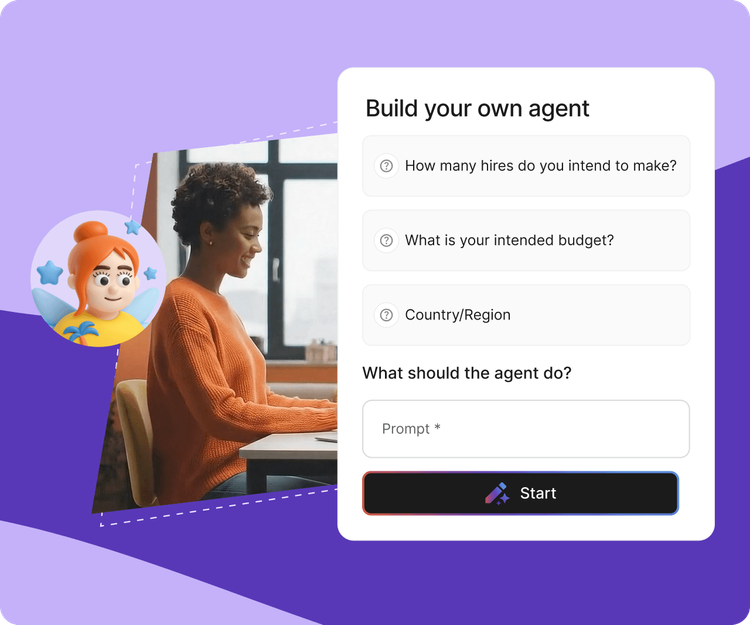
- Custom agents in minutes: Build agents for any HR, payroll, or operations workflow, from onboarding to benefits, with just a few clicks.
Meet Deel’s agents
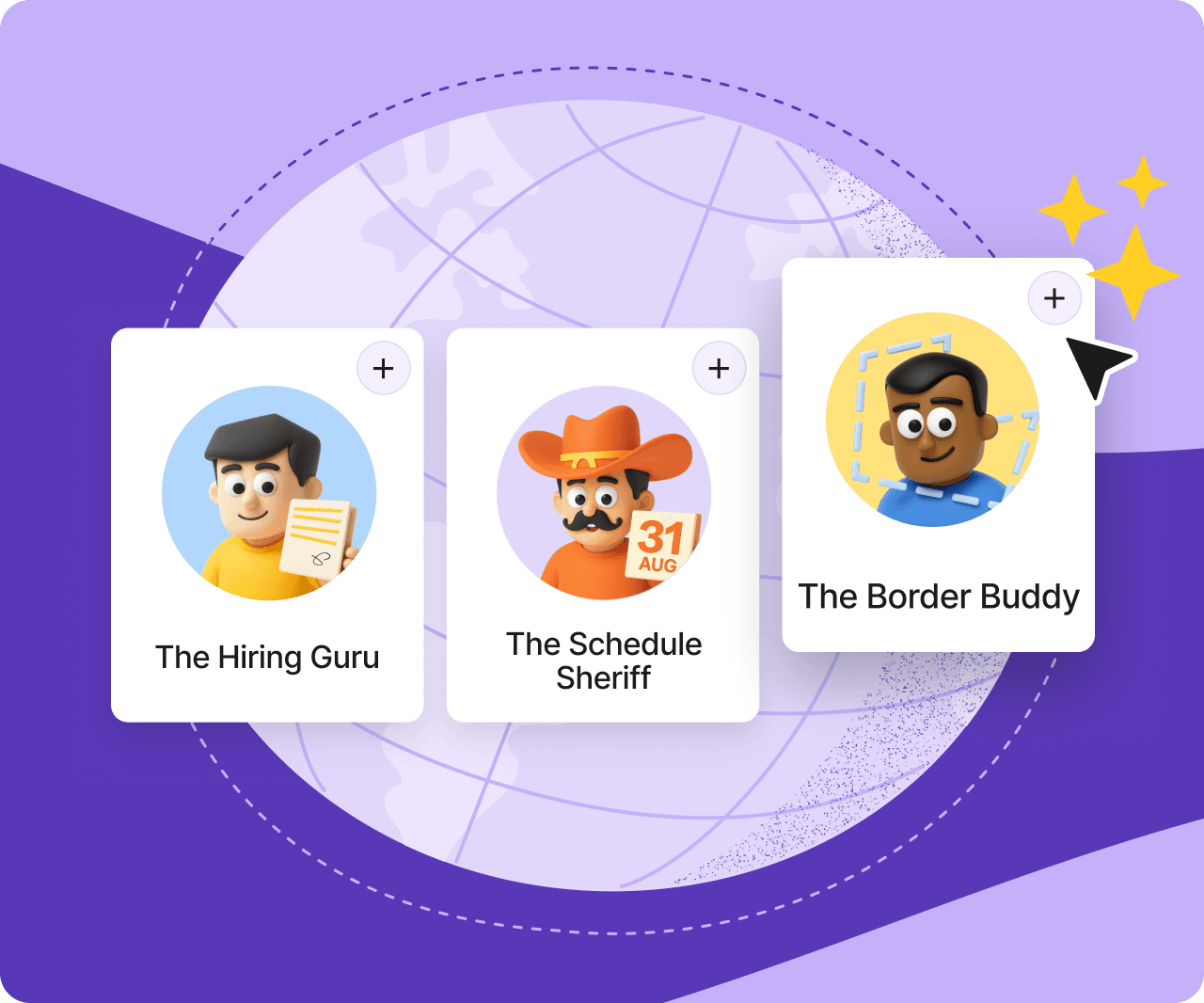
Deel offers several ready-to-deploy agents designed to take on specific HR, payroll, and compliance workflows. Each has a clear role, plugs directly into your existing processes, and delivers measurable outcomes from day one.
- The Hiring Guru recommends the best countries to hire from based on role, budget, and talent availability.
- The PTO Fairy consolidates leave requests, checks coverage, and updates Deel instantly.
- The Border Buddy geolocates remote workers and ensures local tax compliance.
- The Schedule Sheriff maps shifts across time zones and flags blind spots before they become problems.
- The Payroll Detective catches anomalies before payout, checking every variable against set rules.
- The Offboarder guides compliant terminations based on location, worker type, and tenure.
Ready to see what agentic AI looks like in practice? Book a demo with Deel today and explore how we’ll help you do more with less in HR.
Lorelei Trisca is a content marketing manager passionate about everything AI and the future of work. She is always on the hunt for the latest HR trends, fresh statistics, and academic and real-life best practices. She aims to spread the word about creating better employee experiences and helping others grow in their careers.


