
Article
16 min read
Beginner’s Guide to AI in HR: Smarter, Faster Processes
Global HR

Author
Lorelei Trisca
Last Update
September 30, 2025

Table of Contents
How different types of AI improve HR
Examples of where to leverage AI in HR
Why HR leaders are adopting AI
The risks and challenges of implementing AI into HR processes
Lead the next era of HR with Deel
Key takeaways
- AI is transforming HR from admin-heavy to strategic. By automating routine tasks and surfacing insights, AI frees HR leaders to focus on culture, engagement, and growth.
- Practical AI applications are already here. From chatbots and generative AI to predictive analytics and AI Workforce agents, HR teams can boost recruitment, learning, and retention today.
- With 92% of companies planning to increase AI investment in HR by 2028, now is the moment to explore how these tools can give you a competitive edge.
AI is the biggest change to happen in HR in decades, reshaping the very foundation of how companies attract, manage, and retain talent. For years, HR teams have been burdened with manual processes, delayed decision-making, and limited visibility into workforce needs. Now, AI offers a way forward: faster operations, smarter insights, and more personalized employee experiences.
At Deel, we’ve seen firsthand how AI can turn these challenges into opportunities, which is why we’ve built AI into every part of our platform to help HR leaders move faster and make better decisions.
And the shift is already well underway. By 2028, 92% of companies are expected to increase their investment in AI for HR, showing just how central this technology will be to the future of people operations.
Whether you’re curious about how AI fits into your HR strategy or just starting to experiment with it, this guide will walk you through the most impactful applications—from recruitment and onboarding to learning, engagement, and retention—so you can save time, cut costs, and elevate your people operations with confidence.
How different types of AI improve HR
AI in HR encompasses a range of technologies, each serving different purposes across the employee lifecycle. Here’s a breakdown of the main types of AI used in HR and what they help with:
Chatbots and virtual assistants
AI-based chatbots and virtual assistants handle FAQs, onboarding questions, policy lookups, and basic HR support.
Example: “What’s our parental leave policy?” or “How do I request time off?”
Common tools: ChatGPT integrations, HR-specific bots like Deel AI or Leena AI.
Thanks to Deel AI, I no longer need to open support tickets. My HR questions get instantly answered, which lets me focus on what truly needs attention.
—Ihor Hovenko,
Global Mobility Manager, Welltech
Generative AI
Generative AI is what most of us are familiar with thanks to ChatGPT. It creates original content like job descriptions, policy drafts, onboarding guides, or performance summaries.
Example: “Write a 90-day onboarding plan for a product manager in Brazil.”
Tools: ChatGPT-powered HR copilots or integrated features in tools like Deel, such as Engage’s assistant that helps HR teams accelerate content creation, Notion, or Google Gemini.
Through the AI incorporated in the Engage learning development module, I am able to build fantastic courses in half an hour.
—Lucía Rodriguez,
Head of HR, Ladonware
Read more
See how you can start using ChatGPT for eight core HR tasks, including writing job descriptions and HR policies.
Agentic AI (autonomous agents)
AI agents go beyond suggestions to take multi-step actions across systems. These agents execute tasks like updating records, assigning equipment, or scheduling training autonomously.
The key strength of agentic AI is that it automates workflows across tools, not just inside one app.
Tools: Deel’s AI Workforce agents (e.g., the Goodbye Genie for offboarding or the Time Off Fairy for managing PTO requests).
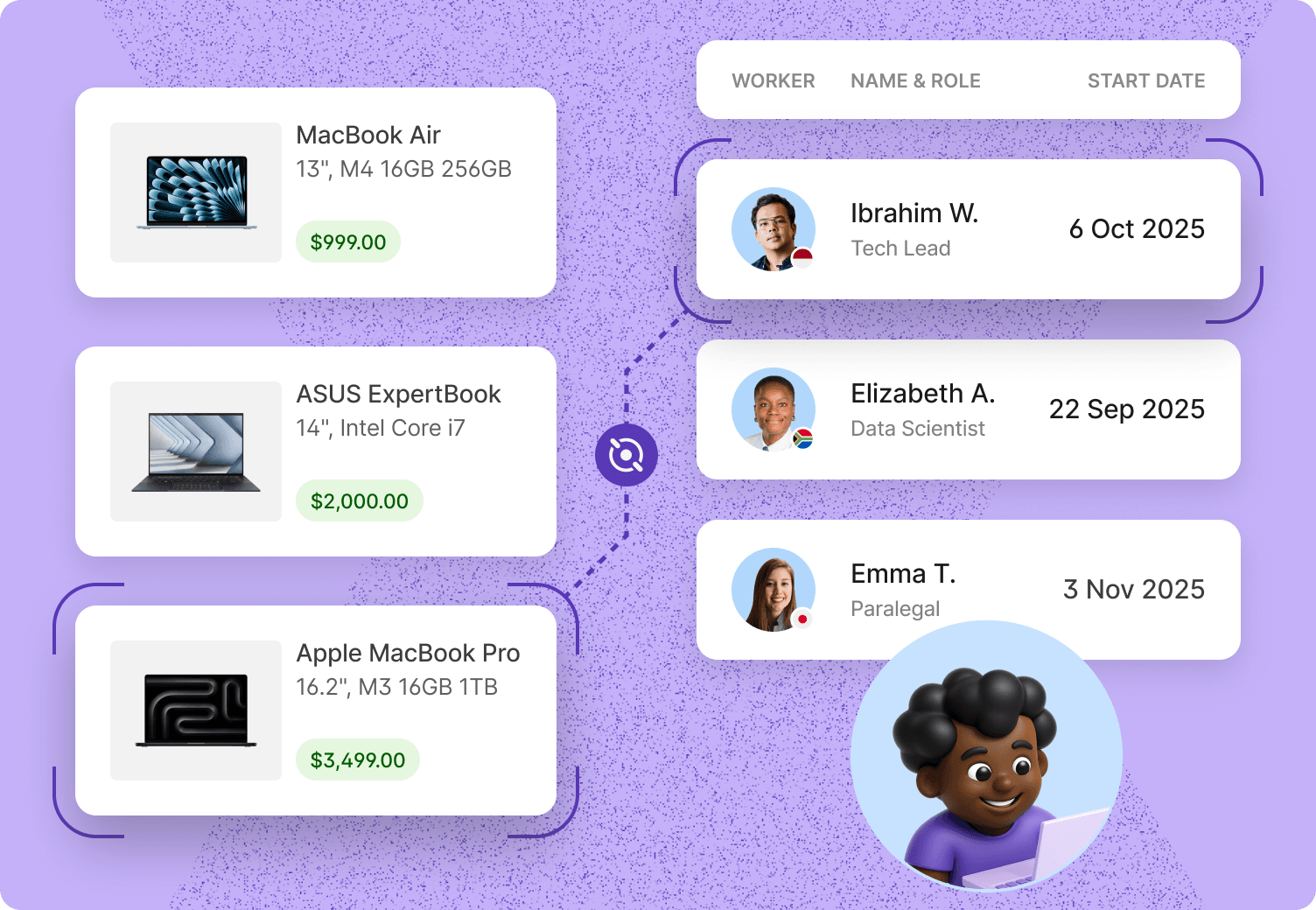
Deel AI Workforce: “The IT Guy”
Predictive and prescriptive analytics
Predictive and prescriptive analytics use historical data to forecast outcomes (e.g., attrition risk, cost of hire) and recommend next steps.
Example: Predict which employees are likely to leave or who is ready for promotion.
Common tools: People analytics platforms or embedded AI in HRIS tools.
Natural language processing (NLP)
NLP analyzes unstructured text data to extract meaning, which is useful for surveys, feedback, or performance reviews.
Example: Identifying sentiment in open-ended employee feedback.
Tools: Engagement platforms like Culture Amp, Lattice, or survey tools.
Recommendation engines
Recommendation engines suggest learning modules, job openings, or mentors based on individual profiles and goals.
Example: Recommending a leadership course to an employee flagged as high-potential.
Tools: L&D platforms and internal mobility tools.
AI, automation, and traditional HR technology: What’s the difference
HR leaders often use these terms interchangeably, but they’re not the same. AI learns and adapts, automation follows preset rules, and traditional HR systems require manual input. Each plays a role in modern HR, but understanding their differences helps you choose the right tool for the right challenge.
- Artificial intelligence (AI): AI refers to machines and systems that emulate human behavior and intelligence. They can learn, adapt, and change as time goes on, and predict or determine the future. This is a way of using AI for HR decision-making or pattern recognition. Some examples of AI in HR include recruiting tools that come with virtual assistants (or agentic AI tools) or generative AI to create content
- Automation: Automation simply refers to using software to complete repetitive, rule-based tasks without needing a person behind them. For HR, this can look like a typical workflow automation process or just sending automatic email notifications
- Traditional HR technology: Examples of traditional HR technology include HR information systems (HRIS), applicant tracking systems (ATS), and payroll software. They don’t necessarily come with smart or AI-based features, but are still used to collect and manage data, although manual data input is needed
| Feature | AI | Automation | Traditional HR Tech |
|---|---|---|---|
| Learning & adaptation | Learns from data and feedback | No, follows pre-set rules | No, manual input required |
| Decision support | Handles complex predictions & recommendations | Limited to rule-based actions | Minimal or none |
| Task examples | Candidate screening, chatbots, predictive analytics | Notifications, scheduling, data entry | Payroll, HRIS, ATS |
| Human-like interaction | Often via NLP & virtual assistants | Rare | None |
| Flexibility | High | Medium | Low |
Examples of where to leverage AI in HR
AI simulates human intelligence using machines or systems programmed to think like people do. Over time, as more data input falls into AI tools, these technologies become better at problem-solving, learning from past interactions. This means you’ll be able to rely on them to make complex predictions without worrying you’ve missed out on the important details.
Today, AI is mainly seen as a cost-effective sidekick. Helping with automating everyday tasks, analyzing vast datasets, and extracting insights for better decision-making, AI in HR can assist with a wide range of tasks:
Scaling hiring processes with AI
Finding qualified job candidates can be a hurdle when dealing with hundreds or even thousands of applicants. AI tools can handle the heavy lifting of sourcing candidates, analyzing resumes, scheduling interviews, and conducting initial screenings to locate top talent.
Here’s how using AI in HR makes the hiring process more efficient:
- Streamlined recruitment: AI tools can identify qualified candidates, narrowing the candidate pool to those who best meet the criteria for a given position
- Quality new hires: AI algorithms pore over historical hiring and employee performance data to make predictions on candidate success in specific roles. Additionally, AI for HR solutions source passive candidates who may be open to new positions
- Real-time applicant analysis: AI in HR tech accelerates hiring timelines, saving time by assessing candidates’ profiles, resumes, salary requirements, geographic locations, and career aspirations
AI in talent management and employee engagement
Engaged employees stay longer and perform better, and AI gives HR leaders the tools to understand sentiment, predict retention risks, and design more fulfilling career paths.
AI-powered solutions help HR leaders improve talent management and employee engagement programs, from identifying and hiring top talent to fostering employee development, engagement, and retention.
AI empowers HR leaders to deliver exceptional candidate and employee experiences through:
- Greater employee engagement: Reducing attrition starts with knowing how people feel about their roles and organizations. AI comes in to help leaders share surveys, gather feedback, analyze employee sentiment, predict retention risks, and identify problem areas to address
- Improved talent management: Limited career progression opportunities are often reported as a reason for employee attrition. AI can help design career paths according to individual goals and skill sets, whether identifying upskilling opportunities, delivering feedback, or assisting with succession planning
AI-driven learning and development
Upskilling and reskilling are top priorities for future-proofing your workforce, and AI enables personalized, scalable learning experiences that meet individual career goals.
In L&D, AI algorithms can analyze employee feedback, performance reviews, and previous learning engagements to assist with:
- Personalized learning experiences: Every employee is unique, so a one-size-fits-all approach to learning won’t be beneficial. With AI systems, you can adapt learning programs for individual learning styles, skill gaps, and career goals
- Competency mapping and career progression: AI algorithms can also help anticipate future talent needs and pinpoint upskilling opportunities. With the help of AI-driven skills databases, HR and talent acquisition leaders can design career pathways that optimize internal talent while predicting future needs
Reducing human error in payroll and benefits admin
You’ll instantly see the positive impact once you use AI in HR benefits and payroll administration. AI can automate many routine tasks, allowing HR professionals to focus on strategic activities requiring human expertise.
Moreover, AI enables enhanced accuracy, automating tasks such as payroll processing and benefits administration while reducing the likelihood of human error. Additionally, AI systems can automate compliance checks, reducing the risk of errors, penalties, and legal issues.
And yes, when it comes to payroll, human errors happen. Common mistakes include missing or incorrect time punches, according to EY research. There are also many direct and indirect costs involved with fixing each type of error, with an average cost per incident of $291. Some errors incur even higher costs as mistakes related to employee onboarding average $635/incident.
Improving employee retention and satisfaction with AI
Turnover drains budgets and culture alike. AI helps identify early warning signs and delivers proactive solutions to keep employees engaged and supported. AI algorithms are adept at gathering and analyzing data, predicting employee turnover, and crafting retention strategies addressing workers’ needs.
Key areas where AI can assist retention include:
- AI-assisted flexible scheduling systems, allowing employees to self-schedule shifts that promote work-life balance
- AI-managed time-off requests, approving paid time off or sick time in real-time
- AI-powered recommendations to engage employees with new challenges, additional training, and other growth-promoting strategies
- Data analysis and predictions, identifying behavioral patterns like deadline tardiness, so managers can intervene to understand employees’ needs and pain points better
AI-backed decision-making
When HR leaders can move from reactive to predictive decision-making, they gain the agility to align people strategy with business needs in real time. AI makes that shift possible.
Making faster, more accurate decisions is a superpower many HR leaders want to possess. With AI enabling better data and insights, HR professionals can save time, improve recruitment, and reduce costs.
For example, AI-powered recruitment platforms offer real-time insights on job postings, candidate sourcing, and hiring processes. This allows HR teams to refine strategies based on applicant feedback and improve the candidate experience and conversion rates. Meanwhile, AI algorithms can analyze workforce data and market trends to forecast future needs, allowing HR teams to adjust staffing levels and recruitment strategies in real-time.

Why HR leaders are adopting AI
Everyone’s on board to some extent. HR leaders are turning to AI in people operations to see greater changes across their entire people function, generating efficiency and improving decision-making.
According to SHRM research, AI in HR is growing by leaps and bounds, allowing greater agility in various aspects of HR:
- Talent acquisition: With a 64% adoption rate, companies are turning to AI to make hiring faster and smarter. Tools that generate job descriptions, refine interview questions, and review resumes help HR teams reduce time-to-hire while improving candidate quality
- Learning and development: HR leaders know upskilling is critical for retention and growth. AI makes it possible to personalize learning paths, track progress, and create new content at scale, benefits that traditional training programs can’t match
- Performance management: Though still emerging, AI is already helping managers make fairer, data-driven evaluations, set clearer goals, and automate repetitive review tasks, improving both consistency and employee trust in the process
The reason behind these investments is clear. AI reduces manual work, sharpens decision-making, and creates more personalized employee experiences. That’s why 92% of companies say they’ll increase their investment in AI for HR by 2028. The return on efficiency, engagement, and retention is simply too valuable to ignore.
The risks and challenges of implementing AI into HR processes
Although AI for HR teams comes with plenty of benefits, it’s best to be aware of the risks you’ll face without a proper change management plan.
- One of the largest dangers is algorithmic bias. AI models are still trained on historical data. So often, they may simply reflect those inequalities without taking into account diversity, equity, and inclusion principles. Miss out on a single step of the process, and you’ll end up running ineffective candidate screening processes, biased evaluations of performance, and inequitable talent decisions
- Data protection and privacy concerns are other concerns you might ignore if you rush into using AI tools for HR management. When handling sensitive personal information, you need to make sure you collect, store, and analyze employee data securely and responsibly. That’s also what gets both employees and applicants to trust you with handling their information
- Transparency and explainability are musts to consider next. Many HR AI solutions simply work like “black boxes,” where it’s basically impossible to understand how decisions are made. So it’s up to your HR team to ensure applicants and employees understand how AI impacts hiring, managing, and evaluating people
- Related to this, you should never forget human oversight. AI should enhance, not replace, human judgment for critical decisions like recruitment or layoffs. Maintaining this balance should minimize errors, unintended consequences, and the lack of empathy and fairness that have somehow been linked to the growth of AI’s use in HR
- From an implementation perspective, you’re in charge of setting the policies around how your team will use AI in the first place. Beyond internal rules, new laws and international disclosures (such as the EU AI Act set the requirements for transparency, fairness, and accountability about any AI used within an organization.
If you're just using the technology to do all of the work, it can be a detriment to you and your team members, as there could be misinterpretations, work that goes against company policies, or errors as a result of bias within AI.
—Nadie Alaee,
Senior Director of HR, Deel
To learn more about the challenges that the EU AI Act may bring, check out our expert webinar recap here.
Lead the next era of HR with Deel
Adopting AI in HR can feel both exciting and overwhelming. On one hand, there’s the promise of faster hiring cycles, personalized learning paths, and real-time insights that make decision-making sharper than ever. On the other hand, leaders worry about bias, privacy, and losing the “human” touch in human resources. The key is balance, using AI to enhance, not replace, human expertise.
That’s where Deel comes in. We’ve built AI directly into our products, powered by our expert-curated knowledge base, so you can rely on trusted insights while keeping your people at the center of every decision. From automating compliance and payroll to drafting policies, generating job descriptions, and even supporting employee development, Deel’s AI tools free your team from repetitive work so you can focus on what matters most: creating a thriving workplace.
And with the AI Workforce, you can go even further, onboarding ready-made AI agents or creating and launching your own to automate multi-step HR workflows across systems, not just within one app.
If you’ve been waiting for the right moment to bring AI into your HR function, the time is now. With Deel, you don’t have to choose between speed, accuracy, and empathy. You get all three, working together to future-proof your people operations.
Get in touch to learn more about our AI-powered HR solutions.
Lorelei Trisca is a content marketing manager passionate about everything AI and the future of work. She is always on the hunt for the latest HR trends, fresh statistics, and academic and real-life best practices. She aims to spread the word about creating better employee experiences and helping others grow in their careers.


