Article
10 min read
How to Expand from the US to Canada: A Nearshoring Playbook for Mid-Market HR Teams (2026)
Global hiring
Employer of record
Legal & compliance
Global expansion

Author
Jemima Owen-Jones
Last Update
November 24, 2026

Table of Contents
Why mid-market companies are nearshoring to Canada
Step 1: Build your business case for Canadian expansion
Step 2: Choose the right employment model
Step 3: Understand Canadian employment law and provincial differences
Step 4: Source and hire Canadian talent with Deel Hire
Step 5: Set up compliant payroll and benefits
Step 6: Onboard and integrate your Canadian team
Costs and timelines for US-to-Canada expansion
Expand into Canada with Deel Hire
Key takeaways
Canada's time-zone alignment and deep professional talent pools make it a practical nearshoring option for many US mid-market teams.
Choosing the wrong employment model early can be a costly mistake in US-to-Canada expansion.
Deel Hire guides the employment-model decision for US teams hiring in Canada, from offer to compliant onboarding.
Mid-market HR leaders expanding from the US to Canada face a problem that looks straightforward but rarely is. Canada is geographically close and operates in overlapping time zones, and its legal tradition is recognizable to US companies. Employment rules vary across 13 provinces and territories, though, and each jurisdiction sets its own minimum standards, notice periods, and payroll obligations. Hiring two engineers in Ontario and a finance lead in British Columbia means navigating two separate employment environments from the first contract.
The teams that struggle with Canadian expansion share a common pattern: they treat it as an administrative extension of domestic hiring. A worker goes on a service agreement when they should be an employee. Entity setup gets underfunded. Recruiting tools stop at the offer stage and hand off to a spreadsheet. The compliance exposure catches up quickly: misclassified workers, provincial shortfalls, payroll errors.
This playbook walks mid-market HR teams through every stage of US-to-Canada expansion: building the business case, selecting the right employment model, navigating Canadian employment law, sourcing and hiring compliantly, setting up payroll and benefits, and integrating Canadian employees into existing HR workflows from day one.
Deel operates employer of record (EOR), payroll, and HR infrastructure across every Canadian province. The platform processes CPP and EI remittances, maintains province-specific employment agreements, and tracks provincial standard changes on an ongoing basis. That operational experience of running actual Canadian employment at scale, not just advising on it, is what informs this playbook.
Why mid-market companies are nearshoring to Canada
BCG projected in January 2025 that annual US-Canada trade would grow by $147 billion by 2033 as companies serving North American markets shift supply chains and operations closer to home. That projection predates the 2025 US tariff changes, which BCG says can change the magnitude and direction of trade flows. Professional hiring is following the same logic.
Time-zone alignment
Ontario and Quebec run on Eastern Time and BC on Pacific Time, matching US business hours. Canadian employees join existing standups, hand off work at the end of the day, and collaborate without the asynchronous drag that accompanies offshore alternatives.
Familiar employment frameworks
While Canadian employment law has its own provincial complexity, its structure is recognizable to US-trained HR teams: common law foundations in most provinces, defined statutory obligations, and federally administered payroll programs. That familiarity shortens the learning curve on onboarding design, performance management, and compliance processes.
Deep professional talent pools
Technology, engineering, finance, and operations talent concentrates in clusters like the Toronto-Waterloo corridor, Metro Vancouver, and Montreal. Mid-market employers competing against large US tech companies can often source strong candidates faster and more cost-effectively in Canadian markets.
Competitive employer costs
Canadian total employment costs include mandatory contributions, the Canada Pension Plan (CPP), Employment Insurance (EI), and provincial workplace insurance programs, rather than a simple overhead percentage. For many mid-market roles, all-in costs remain competitive with equivalent US talent once benefits structures are factored into the comparison.
Guide
Independent contractors or full-time employees?
Step 1: Build your business case for Canadian expansion
A solid business case answers three questions before you make any hiring decision: which roles, which provinces, and what does it actually cost?
-
Define target roles. Start with the two to three role types driving the expansion decision. Roles requiring deep Canadian market knowledge, such as legal, finance, or regulatory functions, have a different profile than engineering or operations roles, where the rationale is primarily talent availability and cost
-
Map candidate provinces. Ontario, British Columbia, and Quebec contain large concentrations of mid-market professional talent. Each has a distinct employment environment. Ontario and BC follow common law traditions. Quebec's civil law system and French-language obligations add a layer of complexity worth factoring into hiring timelines. The employee's work location determines which provincial employment standards, notice requirements, and payroll obligations apply
-
Calculate total employment cost. A realistic cost model includes base salary, employer CPP and EI contributions, provincial payroll taxes or levies, and supplemental benefits beyond statutory minimums. Use this model to anchor stakeholder approval before the first offer goes out
The table below shows the main cost drivers to include in that model.
| Cost driver | What to include |
|---|---|
| Salary | Market-rate plus any signing premium |
| CPP/EI | Employer portion (contribution rates and caps set annually by federal government) |
| Provincial payroll tax | Varies by province. Ontario, BC, and Quebec each have distinct structures |
| Workers' compensation | Province-administered. Rate depends on industry classification |
| Supplemental benefits | Health, dental, and retirement beyond statutory minimums |
Step 2: Choose the right employment model
The employment model you choose determines how quickly you can hire, how much compliance risk you carry, and whether you can reverse course if the expansion doesn't scale as planned. For mid-market teams, the EOR versus owned-entity decision typically comes down to three variables: headcount, timeline, and risk tolerance.
The table below maps the most common Canadian hiring scenarios to the appropriate model.
| Scenario | Recommended model |
|---|---|
| 1–10 employees, first hire within weeks | Employer of record (EOR) |
| 10–30 employees, testing a market | EOR with entity setup in parallel |
| Scaling to larger team, long-term commitment | Local entity with Deel Payroll |
| Independent professionals on defined projects | Contractor via Deel |
Employer of record (EOR)
An EOR employs workers on behalf of a foreign company, handling local employment contracts, payroll, statutory contributions, and compliance without requiring the client to register a local legal entity. For mid-market companies running their first Canadian hire, EOR is typically the fastest and lowest-risk starting point. Deel's EOR solution covers Canada's federal and provincial employment requirements, including CPP contributions, EI, provincial standards, and compliant employment agreements.
Deel Hire
Hire employees globally with the #1 Employer of Record
Canadian entity
Setting up a legal entity in Canada, typically a federally incorporated corporation or a provincial registration, requires ongoing compliance overhead: annual returns, provincial registrations, CRA payroll accounts, and local accounting support. It makes sense once a team reaches a size where per-employee entity overhead becomes smaller than EOR service fees, though the right threshold depends on headcount trajectory, service costs, and operational needs. Deel's entity setup service manages the incorporation and registration process for teams ready to establish a local Canadian presence, removing the need to source a separate legal vendor or coordinate the formation steps independently.
Entity Setup
Entity setup and management, done right

Contractor
Engaging Canadian workers as independent contractors is fast but high-risk without a clear, fact-based rationale. Misclassification exposes companies to retroactive employment obligations, back wages, and CRA penalties. Step 3 explains how Canadian authorities assess worker classification, so review it before you engage any contractor.
Deel Hire's model-guidance function routes mid-market teams to the right model for their specific headcount, timeline, and location. Deel Hire guides the employment-model decision before the offer goes out, so the right legal structure is in place from day one.
Deel Contractor of Record
Minimize misclassification risk
Step 3: Understand Canadian employment law and provincial differences
Canada's employment law operates at two levels: federal and provincial. The federal Canada Labour Code covers federally regulated industries like banking, telecommunications, and interprovincial transport. For most mid-market roles, provincial employment standards govern the relationship, which means Ontario's Employment Standards Act, BC's Employment Standards Act, or Quebec's Act respecting labour standards each apply separately depending on where the employee works.
The federal Employment and Social Development Canada (ESDC) publishes national labour standards frameworks, but each province sets the operational rules, including minimum wage, notice periods, termination pay, and statutory leaves.
The table below covers key structural differences across Canada's three major mid-market hiring provinces.
| Province | Legal tradition | Key distinction |
|---|---|---|
| Ontario | Common law | Employment Standards Act governs. Termination and severance obligations scale with tenure |
| British Columbia | Common law | BC Employment Standards Act. Provincial health tax applies above certain payroll thresholds |
| Quebec | Civil law | Act respecting labour standards. French-language contract and workplace obligations under Charter of the French Language |
Minimum wages, vacation entitlements, and notice requirements change annually in most provinces. Verify current rates with the relevant provincial authority before extending an offer, as figures vary by year and jurisdiction.
Worker classification
The CRA first asks what the parties intended the working relationship to be, then checks that intent against the facts. Its guide, RC4110, lists these factors: control, tools and equipment, subcontracting or hiring helpers, financial risk, investment and management, and opportunity for profit. No single factor is determinative, and courts look at the substance of the relationship rather than what the contract says. Quebec applies the Civil Code test instead. Misclassification can expose a company to unpaid wages, vacation pay, retroactive statutory benefits, and regulatory fines. Building a clear, fact-based file for any contractor engagement isn't optional.
Provincial leaves and termination
Ontario, BC, and Quebec all require statutory notice or pay-in-lieu on termination, parental leave provisions, and sick leave entitlements. Notice obligations scale with length of service, and mass-layoff notice rules apply above certain headcount thresholds. HR teams managing employees across multiple provinces need separate tracking for each province's specific obligations.
With Deel, HR teams don't need to become Canadian employment law specialists to hire compliantly. The EOR solution applies the correct provincial standards, mandatory contributions, and notice requirements for each hire automatically. Deel's Compliance Hub provides continuously updated guidance on Canadian regulatory changes, so teams aren't tracking evolving obligations on their own.

Guide
Stay compliant while expanding globally
Provincial differences to watch
Quebec stands out as the most distinct hiring environment for US teams: civil law tradition, French-language workplace obligations under the Charter of the French Language, and QPP (not CPP) for pension contributions. Ontario and BC share a common law base but differ on provincial payroll levies and employer health tax structures.
Step 4: Source and hire Canadian talent with Deel Hire
Deel Hire acts as the front door to employment, guiding the hiring decision and routing each role into the appropriate EOR, Deel Payroll, or Deel Contractor workflow without the manual handoffs that slow cross-border hiring.
AI-assisted sourcing
Deel Hire connects to Deel ATS, which supports AI-generated job descriptions and sourcing from internal and external talent pools. For mid-market teams without large talent acquisition functions, this compresses the top-of-funnel work that otherwise takes weeks.
Employment model routing
Once a candidate is identified, Deel Hire routes the hire into the appropriate employment model: EOR for most first Canadian hires, Deel Payroll for owned-entity teams, or Deel Contractor for independent engagements. The selected model then determines the contracting, compliance, and payroll workflow before onboarding proceeds.
Background verification
Deel Hire supports background verification as part of the hiring flow. Where appropriate for the role and permitted by applicable law, verification checks can be requested before employment begins.
Compliant employment agreement
Once the employment model is selected, the downstream EOR or payroll workflow generates a province-specific employment agreement covering probation, termination notice, and vacation entitlements. For EOR hires in Quebec, the agreement accounts for relevant French-language requirements under the Charter of the French Language.
Step 5: Set up compliant payroll and benefits
Canadian payroll for employees involves mandatory federal contributions that the CRA administers: CPP, EI, and income tax withholding. For teams hiring in Quebec, the provincial equivalent of CPP is the Quebec Pension Plan (QPP), which Retraite Québec administers separately. Quebec employees also benefit from the Quebec Parental Insurance Plan (QPIP), which runs alongside federal EI contributions.
CPP and EI
Both employer and employee contribute to CPP and EI up to annual contribution limits set by the federal government each year. Rates and caps change each January. Running your own entity means tracking and updating these figures annually and remitting on schedule to avoid CRA penalties. Deel's EOR solution handles all contribution calculations and remittances automatically, without the HR team managing CRA deadlines directly.
Provincial payroll taxes and levies
Ontario, BC, and Quebec each administer separate employer health taxes or payroll levies in addition to federal obligations. Each levy applies to gross payroll and varies by province and employer size.
Supplemental benefits
Canadian employees expect health, dental, and in many cases vision benefits beyond statutory minimums. EOR providers typically offer access to group benefit plans that mid-market companies can offer without setting up their own plan. For teams running payroll through a local entity, benefit plan sourcing requires a separate broker engagement.
Running payroll with Deel
For teams with a Canadian entity or planning entity setup, Deel Payroll handles CPP and EI calculations, provincial income tax withholdings, remittances to the CRA, and year-end T4 documentation across all provinces. The platform integrates provincial payroll levies and updates contribution rates annually, so HR teams aren't manually tracking federal and provincial changes each January. For teams using Deel's EOR solution, payroll is built into the service. The EOR workflow handles statutory contributions, remittances, workers' compensation requirements, and year-end tax documentation, alongside supplemental benefits administration.
Deel Payroll
Run payroll in Deel. Anywhere. Your way.
Step 6: Onboard and integrate your Canadian team
A compliant hire is only as good as the onboarding experience that follows it. For mid-market teams managing cross-border teams, three elements determine whether a Canadian employee starts strong.
Day-one workflow
Deel HR supports the post-hire lifecycle and the human resources information system (HRIS) record. Connected Deel IT workflows can support device provisioning and access management, while HR system entry and documentation completion happen in Deel HR from day one. For Canadian employees, this includes confirming right-to-work documentation and completing any province-specific forms required at hire.
HRIS integration
Once an employee starts, their data flows into Deel HR, where it sits alongside the rest of the global workforce. Mid-market HR teams get a single system of record for headcount, compensation, leave tracking, and performance, without rebuilding their HRIS setup for Canadian hires specifically.
Manager enablement
Cross-border managers need to understand the basics: what Canadian statutory leaves look like, how termination differs from US at-will employment, and what communications require an HR or legal review. HR teams should provide managers with a province-specific briefing on key differences and seek legal review where appropriate.
Ongoing compliance
Canadian employment standards change. Minimum wages update annually, leave policies evolve, and CRA deadlines require accurate tracking. Deel continuously applies compliance across the relevant workflows as requirements and workforce circumstances change, so teams stay current as Canadian employment standards evolve.
Compliance
Unlock Continuous Compliance™ with Deel
Costs and timelines for US-to-Canada expansion
Understanding what Canadian expansion costs and how long each phase takes is what moves the conversation from strategy to budget approval.
Employer of record for Canada is the fastest path to a first compliant hire. An EOR can onboard a Canadian employee without the client establishing a legal entity. Platform setup can move quickly once the required information and documents are complete. Total time from signed offer to active employee depends on documentation readiness and the specifics of the hire.
Entity setup in Canada, by contrast, involves incorporation, provincial registrations, CRA payroll accounts, and payroll system implementation. Total timelines vary depending on provinces of operation and operational readiness. For teams with a confirmed long-term Canadian presence, the entity route can become more cost-effective over time, though the right decision depends on headcount trajectory, service fees, and operational needs.
Budget for employer costs on top of base salary. Employer payroll overhead typically runs around 15 to 20% of salary, depending on province and pay level. With an EOR, Deel's fee is $599 per employee per month. Compare that fee against the overhead of running your own entity, including incorporation, a payroll system, and accounting support.
The table below maps typical milestones for a mid-market EOR expansion.
| Phase | Timeline | Key milestone |
|---|---|---|
| Business case and model selection | Weeks 1–2 | Employment model confirmed, budget approved |
| First offer and contract | Weeks 3–4 | Province-specific agreement generated, offer accepted |
| Onboarding complete | Weeks 4–6 | Day-one ready, HR system active, payroll enrolled |
| Second and third hire | Months 2–3 | Same EOR flow, provincial replication |
| Entity evaluation (if scaling) | Month 4+ | Decision: continue EOR or begin entity incorporation |
For mid-market teams planning a Canadian team of ten or more employees, the 90-day milestone typically covers first hire onboarded, payroll running, and the entity decision in progress or resolved.
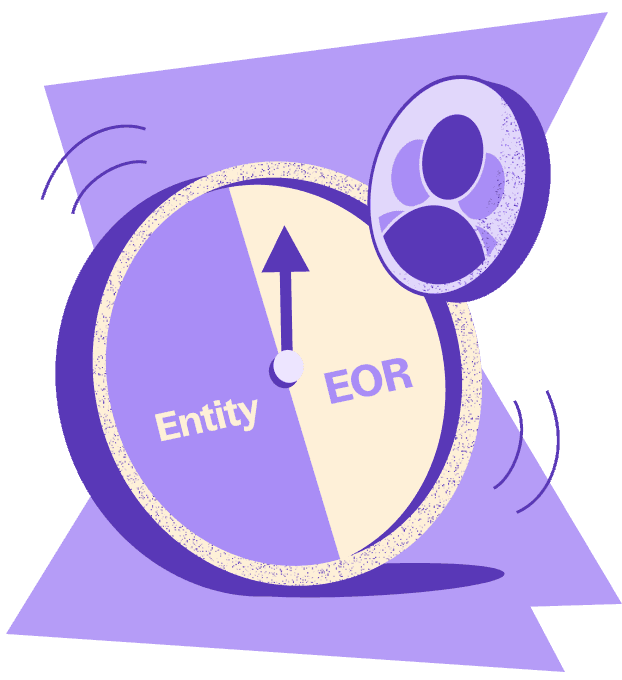
EOR vs. entity: how to decide
EOR is the fastest path to a first Canadian hire with no entity required, and compliance handled by Deel's EOR solution. The entity route becomes worth modeling once a team is planning long-term scale, though the right decision depends on headcount trajectory, operational needs, and a comparison of total costs. Deel Hire can guide teams through both paths.
Global Hiring Toolkit
EOR vs. Entity Calculator
Expand into Canada with Deel Hire
Mid-market HR teams don't need a larger legal team or a longer runway to expand to Canada compliantly. They need a system that makes the right decisions at the right stages: employment model, provincial compliance, offer, and onboarding, without manual rework at every handoff.
Deel Hire is the front door to employment for US companies hiring in Canada. It guides the employment-model decision and routes each hire into EOR, Deel Payroll, or Deel Contractor as appropriate, then connects to Deel HR for a complete post-hire workflow. The connected platform applies compliance continuously as Canadian employment requirements evolve, so teams aren't left tracking obligation changes on their own.
Book a demo below.
Deel Hire
Find, hire, and manage anyone, anywhere

FAQs
Do mid-market US companies need a Canadian entity to hire there?
No. An employer of record (EOR) employs workers on your behalf, handling payroll, benefits, and compliance without requiring a local entity, which makes it a practical starting point for mid-market teams.
What is the CRA's test for worker misclassification in Canada?
The CRA first asks what the parties intended the relationship to be, then checks that intent against the facts. Its guide, RC4110, lists these factors: control, tools and equipment, subcontracting or hiring helpers, financial risk, investment and management, and opportunity for profit. No single factor is determinative, and the substance of the relationship matters more than what a contract says. Quebec applies the Civil Code test instead.
How quickly can I hire my first Canadian employee via EOR?
Platform setup can move quickly once required information and documents are complete. Total time from signed offer to active employee depends on documentation readiness and the specifics of the hire, including verification and agreement completion.
Which Canadian provinces are top markets for mid-market professional hiring?
Ontario, British Columbia, and Quebec contain the largest concentrations of mid-market professional talent in Canada. Each has distinct employment standards: Ontario and BC follow common law traditions, while Quebec operates under a civil law system with additional French-language workplace obligations.
How does Deel Hire connect sourcing, EOR, and onboarding into one flow?
Deel Hire routes the hiring decision into the appropriate EOR, Deel Payroll, or Deel Contractor workflow. For an EOR hire, Deel's EOR solution supports the employment agreement, payroll, and compliance administration. After the hire, Deel HR supports ongoing lifecycle management.
This article is provided for general informational purposes and should not be treated as legal or HR advice. Employment laws and regulations vary by jurisdiction and change frequently. Consult a qualified legal or HR professional for advice specific to your situation.
About the author
Jemima is a nomadic writer, journalist, and digital marketer with a decade of experience crafting compelling B2B content for a global audience. She is a strong advocate for equal opportunities and is dedicated to shaping the future of work. At Deel, she specializes in thought-leadership content covering global mobility, cross-border compliance, and workplace culture topics.