Article
3 min read
What a 1000-Person Company Needs (and Doesn't Need) From IT
IT & device management

Author
Dr Kristine Lennie
Last Update
June 22, 2026

Table of Contents
Why IT gets harder to manage as headcount crosses four digits
IT consolidation: what you need when disconnected systems become the bottleneck
Device management: what you need before reactive procurement becomes a structural problem
Identity and access: building consistency at enterprise scale
SaaS management: what you need to control spend and shadow IT before it scales further
Onboarding and offboarding: what you need to run lifecycle at volume without adding headcount
IT support: what you need to maintain service quality as ticket volume grows
Security: what you need to reduce risk as your attack surface grows
Compliance and audit readiness: what you need when governance becomes an operational requirement
IT requirements at a glance: what you need—and what to watch for
Bringing enterprise IT together in a single platform
Key takeaways
At 1,000 employees, the challenge isn't whether IT functions exist: it's whether they operate consistently across teams, regions, and systems.
Companies at this size need a consolidated IT approach that connects procurement, MDM, identity, and support instead of managing them as separate, disconnected tools.
Deel IT helps enterprise teams standardize and automate the employee lifecycle globally, bringing device operations, identity, support, and compliance together in a single platform.
At 1,000 employees, most IT functions are already in place. The challenge is running them consistently at enterprise scale. Devices, identities, applications, support, and compliance all need to operate across regions, time zones, and business units without creating operational drag.
The problem is that many organizations reach this stage with an IT stack that evolved function by function rather than as a connected system. Procurement lives in one platform, identity in another, support in a third, and critical workflows depend on manual handoffs between them.
This article breaks down what enterprise IT teams actually need at 1,000 employees, which capabilities become critical at this stage, and what to watch for as IT operations become more distributed, specialized, and global.
Why IT gets harder to manage as headcount crosses four digits
At this size, the gap between what IT can handle reactively and what the business actually needs starts to show. Here's where the pressure accumulates:
Vendor sprawl becomes unmanageable: Procurement, Mobile Device Management (MDM), identity, support, and SaaS are often handled by separate tools that don't talk to each other, creating gaps exactly where they're most dangerous
Onboarding and offboarding volume is relentless: At 1,000 employees, even a modest 20% annual churn means 200 joiners and leavers a year, each requiring device provisioning, access setup, and eventually secure offboarding
Security surface area expands with every hire: Distributed teams, personal devices, and inconsistent access policies turn every new employee into a potential risk vector if IT isn't running ahead of headcount
IT headcount doesn't scale linearly: You can't hire one IT person for every 50 employees forever — automation and consolidated tooling are the only path to maintaining service quality without blowing the budget
Compliance requirements become board-level concerns: SOC 2, ISO 27001, and local data residency laws get harder to manage, and the cost of a gap rises with company size
Shadow IT multiplies invisibly: As teams scale, department-level SaaS adoption outpaces IT visibility. By the time you audit, you're managing dozens of apps nobody formally approved
IT consolidation: what you need when disconnected systems become the bottleneck
By the time a company reaches 1,000 employees, procurement, device management, identity, SaaS administration, and support are usually well established. The challenge is that these functions often scale independently, leaving critical workflows dependent on manual coordination between systems.
What starts as a manageable workaround at 100 employees can become a significant operational burden at enterprise scale. The issue isn't having the right tools: it's ensuring they operate as a connected system.
You need:
Connected systems across the employee lifecycle: Changes in one system should automatically update the others, so onboarding, offboarding, provisioning, and support don't depend on manual coordination
A single source of truth for employee data: Employment status, role changes, and team moves should flow consistently across your IT stack rather than being updated in multiple places
Shared visibility across IT functions: Teams should be able to see the devices, applications, access permissions, and support history associated with an employee without jumping between systems
Standard integrations between core platforms: HR, identity, device management, SaaS, and support tools should exchange data reliably as the organization grows
What often adds complexity without adding value:
Adding new tools before fixing integration gaps: Additional platforms can solve individual problems, but they often create more work when core systems still don't communicate effectively
Running different processes across regions or business units: Some variation may be necessary, but excessive differences can make IT operations harder to manage consistently at scale
Maintaining multiple sources of truth: When employee, device, or application data is stored in several systems, reporting, automation, and governance become more difficult
How Deel IT helps with this: Deel IT brings device management, identity, SaaS administration, onboarding, offboarding, and IT support together in a single platform. Employee lifecycle events flow automatically across functions, eliminating the manual handoffs that often emerge between disconnected systems. With a shared source of truth for employees, devices, applications, and support activity, IT teams gain the visibility and consistency needed to scale globally without increasing operational complexity.
Device management: what you need before reactive procurement becomes a structural problem
At enterprise scale, device operations need to be repeatable and globally consistent. Procurement, deployment, asset tracking, refreshes, and retrieval should follow the same process regardless of where an employee is located or which team they're joining.
You need:
A global procurement workflow: A single process for ordering, configuring, and shipping hardware to employees in every country you hire in, without engaging a new regional reseller each time
Pre-imaging at source: Devices should arrive in the hands of employees already configured to company standards, with the right apps, policies, and security settings applied before the box is opened
Asset tracking with ownership visibility: A live inventory of every device — who has it, where it is, what OS version it's running, and when it's due for refresh
A defined refresh cycle: Hardware refresh policies tied to role, device age, and performance thresholds, not to whoever shouts loudest about a slow laptop
Secure retrieval and certified data erasure: A process for recovering devices from departing employees globally and wiping them to a certified standard before redeployment or disposal
What often adds complexity without adding value:
Expanding hardware choice too aggressively: Offering a growing number of device models can increase procurement, inventory, and support complexity before it delivers meaningful employee benefits
Creating highly specialized lifecycle processes by region: Regional requirements matter, but excessive local variation can make device operations harder to manage and govern globally
Introducing additional approval layers into device operations: More stakeholders can improve oversight, but too many handoffs often slow procurement, deployment, and refresh cycles without improving outcomes
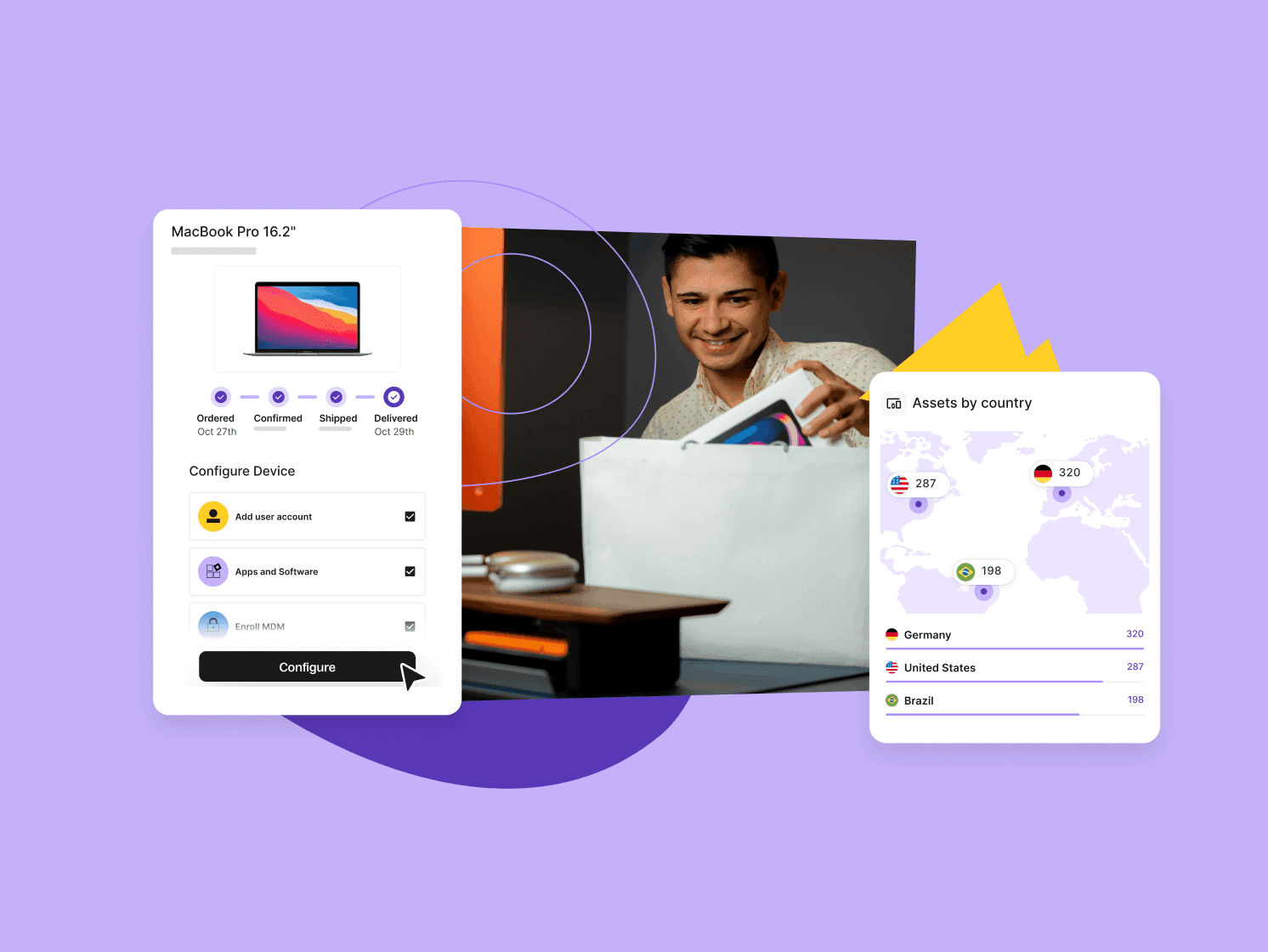
How Deel IT helps with this: Deel IT handles procurement, configuration, and shipping across 130+ countries — with pre-imaged devices dispatched directly to employees and a full asset register maintained automatically. Secure retrieval and certified data erasure are built into the offboarding workflow, so no step in the lifecycle depends on a manual handoff.
Find out how to choose IT equipment for any role.
Device Lifecycle Management
Global device logistics, handled
Identity and access: building consistency at enterprise scale
Identity is both one of the largest attack surfaces in the enterprise and one of the biggest sources of operational friction. Every hire, role change, contractor engagement, and departure creates access decisions that need to be applied consistently across systems. Getting this function right doesn't require the most sophisticated tooling available; it requires consistent processes applied at scale.
You need:
A centralized identity provider: A single authoritative source for user accounts, with provisioning and deprovisioning tied directly to your HR system, so access moves with employment status automatically
Role-Based Access Control (RBAC): Access rights defined by role, not by individual request, so every new hire in a given function gets the right access on day one without a ticket
Multi-Factor Authentication (MFA) enforced universally: No exceptions for senior employees, no opt-outs for legacy apps. MFA is table stakes at this scale
Single Sign-On (SSO) across your core stack: Employees shouldn't be managing separate credentials for each tool. SSO reduces friction and closes credential-based attack vectors simultaneously
Automated deprovisioning on offboarding: Access removal should happen the moment an employee's status changes, not when IT gets around to processing the ticket
What often adds complexity without adding value:
Highly customized access models for different teams: Some roles require unique permissions, but excessive customization can make access governance harder to manage and maintain consistently.
Multi-layered approval workflows for routine access changes: Additional oversight can improve control, but too many approval steps can slow operations without significantly improving security outcomes.
Separate identity processes across regions or business units: Local requirements may justify some variation, but maintaining multiple identity models can increase administrative overhead as the organization grows.
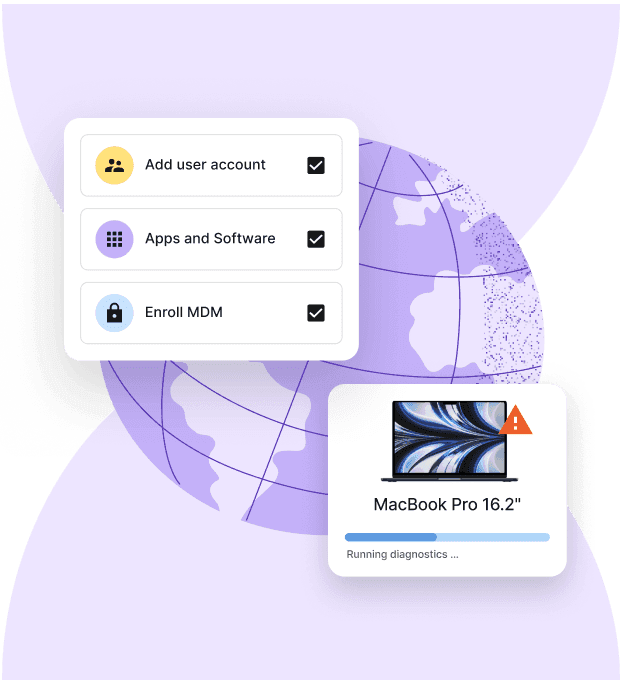
How Deel IT helps with this: Deel IT integrates directly with your HR data to automate access provisioning and deprovisioning based on employment status — so identity hygiene is tied to the employee lifecycle, not a separate workflow. RBAC policies, SSO, and MFA enforcement are configurable at the role level, reducing ticket volume and eliminating the access gaps that appear at offboarding.
Read: IAM best practices for teams managing distributed workforces
Identity Access Management
Seamlessly provision device and app access for global teams
SaaS management: what you need to control spend and shadow IT before it scales further
By 1,000 people, your SaaS estate is almost certainly larger than anyone has formally documented. Unmanaged SaaS spend and ungoverned app access are two of the most common sources of wasted budget and compliance exposure at this size.
You need:
A centralized SaaS inventory: A single view of every app in use across the organisation (approved or not) with ownership, cost, and user count visible in one place
Licence utilization tracking: The data to show which tools are underused, which are duplicated, and where consolidation would reduce cost without reducing capability
Procurement approval workflows: A lightweight process for evaluating new SaaS requests against security, data residency, and cost criteria before the tool is adopted — not after
Access connected to identity: App access tied to your identity provider so that role changes and departures automatically update SaaS permissions, eliminating orphaned accounts
Renewal visibility: Contract and renewal dates visible in advance, so you're not auto-renewing tools you've already decided to retire
What often adds complexity without adding value:
A standalone SaaS optimization platform separate from your identity layer: At this size, SaaS management integrated into your identity and lifecycle tooling is sufficient; a separate dedicated platform adds overhead before it adds value
A formal SaaS centre of excellence: Governance committees and cross-functional SaaS boards are enterprise constructs; a clear procurement policy with IT sign-off achieves the same outcome at 1,000 people
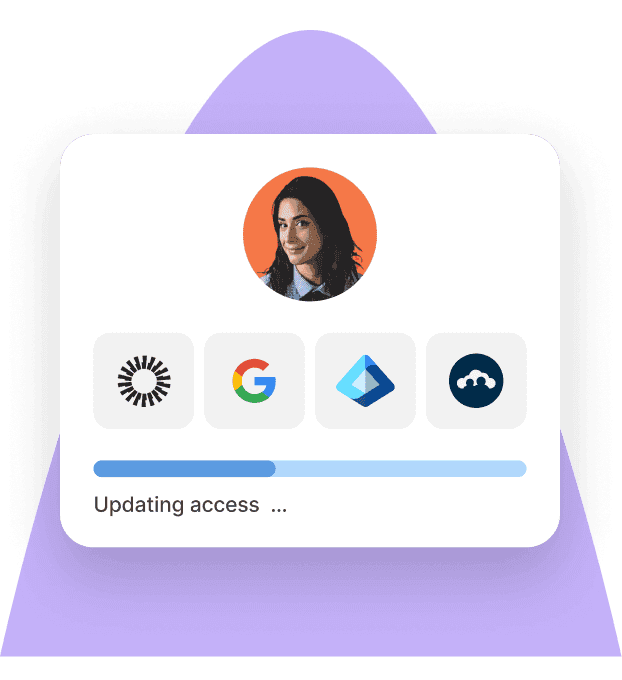
How Deel IT helps with this: Deel IT provides visibility into your SaaS estate alongside device and identity management — so licence data, access status, and lifecycle events are connected rather than siloed across separate tools. Procurement workflows and renewal tracking are built into the same platform, giving IT a single control surface for the entire software estate.
Discover these 5 ways to reduce IT costs without cutting corners on security or experience.
Onboarding and offboarding: what you need to run lifecycle at volume without adding headcount
Onboarding and offboarding at 1,000 people aren't occasional events but continuous operations. The question isn't whether you have a process; it's whether that process can run at volume without IT becoming the bottleneck.
You need:
HR-to-IT automation: Employment status changes in your HRIS should automatically trigger device orders, access provisioning, and onboarding tasks — without a human in IT needing to relay the information.
Pre-boarding device dispatch: Hardware should be ordered and shipped before the start date, arriving configured and ready so the employee is productive on day one.
A structured offboarding workflow: Device retrieval, access revocation, data backup, and licence reallocation should run in sequence from a single trigger — not as a checklist that depends on someone remembering each step.
Audit trails for every lifecycle event: Every access grant, device assignment, and permission change should be logged and attributable — both for internal governance and for compliance reporting.
Cross-functional visibility between HR and IT: HR needs to know when IT tasks are complete; IT needs reliable notice of start and end dates. Both teams working from the same system eliminates the gaps that create first-day failures and offboarding security risks
What often adds complexity without adding value:
Building separate onboarding experiences for every employee population: Some tailoring may be necessary, but excessive variation can make lifecycle operations harder to manage consistently as hiring volumes increase.
Extending lifecycle workflows beyond operational requirements: Additional tasks, training paths, and stakeholder involvement can improve the employee experience, but can also make onboarding and offboarding harder to execute reliably at scale.
Creating dedicated lifecycle programs before core automation is in place: More advanced employee experience initiatives tend to deliver greater value when the underlying provisioning, access, and device workflows already run consistently.
How Deel IT helps with this: Deel IT connects directly to HR workflows so that device procurement, access provisioning, and onboarding tasks trigger automatically when a new hire is added . Offboarding runs the same way in reverse, with device retrieval, access removal, and data erasure handled from a single workflow.
Download this strategic IT onboarding and offboarding guide for HR and IT leaders.
IT support: what you need to maintain service quality as ticket volume grows
At 1,000 people, IT support isn't a nice-to-have — it's a business continuity function. An hour of lost productivity across a distributed team costs more than it did at 100 people, and the tolerance for slow or inconsistent support is lower.
You need:
24/7 support coverage: Distributed teams span time zones. Support that ends at 6 pm local time for the IT team is unavailable for a significant portion of your workforce on any given day
Tiered resolution with clear escalation paths: Level 1 issues — password resets, connectivity problems, access requests — should be resolved without escalation. IT's time should be reserved for problems that actually require it
Self-service for common requests: A knowledge base and automated resolution for the most frequent ticket types reduces volume without reducing the quality of experience
Device-aware support: When an employee raises a ticket, the support team should have immediate visibility into their device spec, OS version, and recent configuration changes — not start from scratch each time
SLA tracking with reporting: Resolution time data by issue type and team is the foundation of a support function that can improve, not just react
What often adds complexity without adding value:
Expanding VIP support beyond genuinely business-critical users: Priority support can improve responsiveness for critical stakeholders, but extending special service levels too broadly can undermine consistency across the support function.
Creating dedicated support channels for every team or function: Specialized support paths can improve service for groups with unique requirements, but excessive segmentation can make support operations harder to manage and navigate.
How Deel IT helps with this: Deel IT provides 24/7 IT support with access to employee device and identity data through connected IT systems, helping resolve issues without starting every investigation from scratch. Support is available across time zones as standard, meaning distributed teams get the same quality of experience regardless of where they're based.
Discover how to manage IT support for remote and distributed teams.
Security: what you need to reduce risk as your attack surface grows
As organizations grow, every new employee, device, application, and access permission expands the potential attack surface. The goal isn't to build a large security function—it's to apply consistent security controls across the organization so risk doesn't scale alongside headcount.
You need:
Endpoint management with policy enforcement: Encryption, screen lock, and OS update policies should be enforced automatically across every managed device
Identity and Access Management (IAM) tied to the employee lifecycle: Access should be granted and removed automatically as employees join, move roles, and leave the organization
A defined incident response process: Employees and IT teams should know exactly what happens when a device is lost, an account is compromised, or suspicious activity is detected
Visibility into device and access risk: Security teams should be able to quickly identify unmanaged devices, inactive accounts, missing controls, and other common sources of exposure
What often adds complexity without adding value:
Expanding the security stack faster than supporting processes evolve: New tools can improve visibility and control, but they deliver the most value when paired with clear ownership, workflows, and response processes
Applying highly customized security controls across different parts of the organization: Some variation may be necessary, but excessive exceptions can make security operations harder to manage consistently
Treating security as a standalone function separate from employee lifecycle processes: Many security risks originate in onboarding, offboarding, and access management, making coordination across teams essential
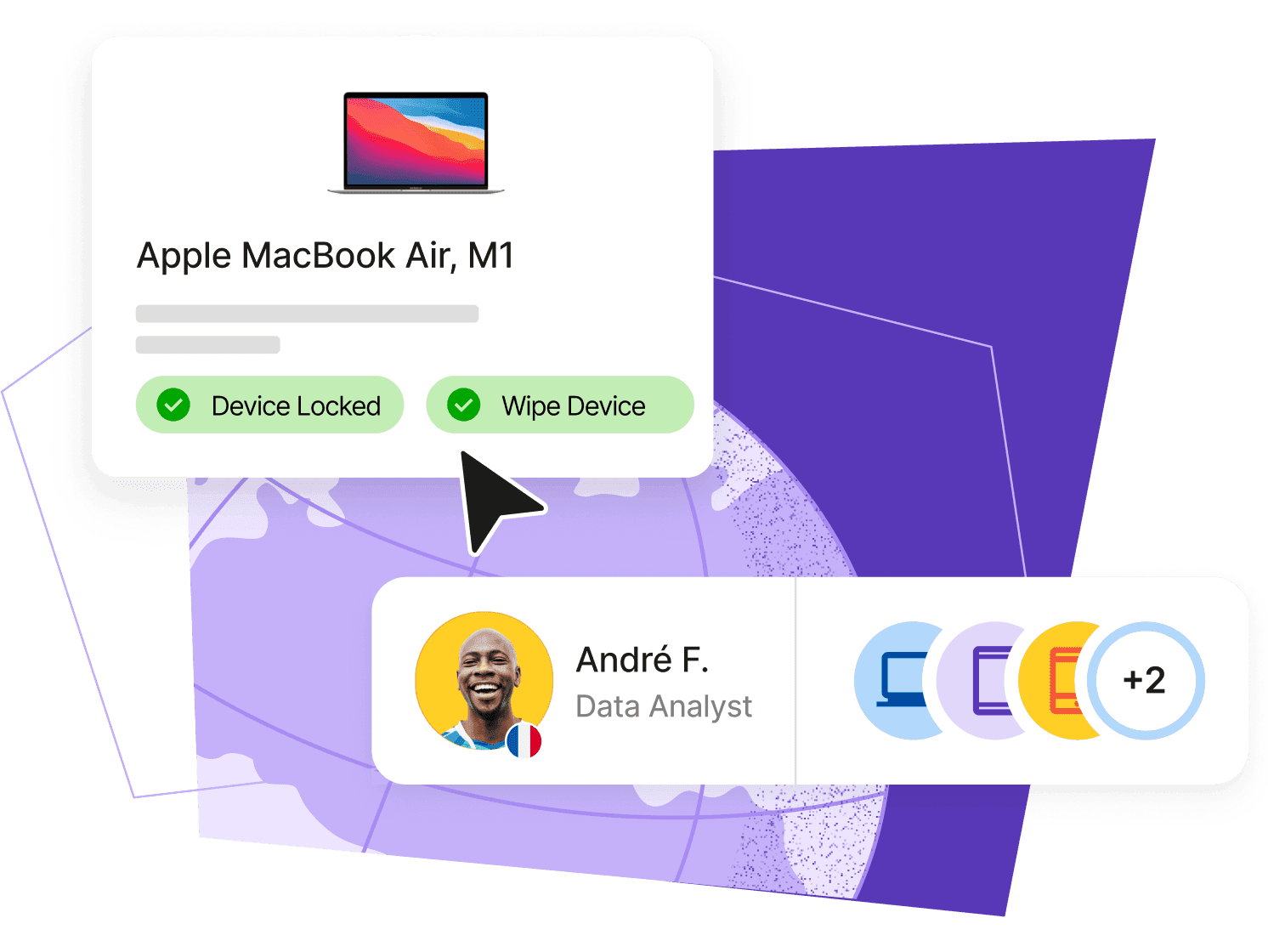
How Deel IT helps with this: Deel IT enforces security policies across managed devices through MDM, including encryption, OS compliance, patch management, and device controls. IT teams gain visibility into device inventory, access status, and compliance data from a single platform, while identity management is connected directly to the employee lifecycle to automate access changes and support consistent responses to common security events.
Download: The complete IT security and compliance checklist for remote workers
Compliance and audit readiness: what you need when governance becomes an operational requirement
As organizations become larger and more geographically distributed, compliance shifts from a periodic exercise to an ongoing operational requirement. New markets, larger customers, and increasing regulatory obligations often bring additional frameworks such as SOC 2, ISO 27001, GDPR, and industry-specific standards into scope. At the same time, the growing number of systems, employees, and processes makes demonstrating compliance significantly more complex.
The challenge isn't documenting policies—it's proving that controls are being applied consistently across the organization.
You need:
Audit-ready records: Device assignments, access changes, onboarding activities, and offboarding actions should be logged automatically and easy to retrieve for audits, customer due diligence, and frameworks such as SOC 2 and ISO 27001
Centralized compliance reporting: The information needed for audits, customer security reviews, and regulatory requirements should be available without pulling data from multiple systems
Evidence that controls are operating: Audit records, access reviews, device status, and lifecycle activity should be available when needed rather than collected manually before every audit
Clear ownership of compliance activities: Teams should know who is responsible for reporting, reviews, and maintaining key controls as requirements grow
What often adds complexity without adding value:
Pursuing additional compliance frameworks before they're tied to a business requirement: Frameworks such as ISO 27001, NIST, or regional standards can strengthen governance, but they also introduce ongoing reporting, audit, and operational requirements
Expanding reporting requirements faster than underlying processes mature: More reporting can increase visibility, but only when the controls being measured are operating consistently
How Deel IT helps with this: Deel IT automatically records device, identity, access, and lifecycle activity in a single system, making compliance-related evidence easier to collect and review. The platform provides visibility into the records commonly required for frameworks such as SOC 2 and ISO 27001, helping teams respond to audits, customer due diligence requests, and internal reviews without relying on fragmented records across multiple systems.
IT requirements at a glance: what you need—and what to watch for
As companies reach 1,000 employees, the challenge is no longer deciding which IT functions matter. It's scaling those functions efficiently without expanding headcount at the same rate. The table below summarizes the capabilities most organizations need at this stage, and the operational complexities that can begin to emerge as IT matures.
| IT function | What you need | Watch out for |
|---|---|---|
| IT consolidation | Connected systems, a single source of truth for employee data, shared visibility across IT functions, and reliable integrations between core platforms | Integration gaps, fragmented processes across regions, and multiple sources of truth |
| Device management | Global procurement, pre-imaged devices, asset tracking, refresh programs, and secure device retrieval | Hardware sprawl, excessive regional variation, and unnecessary approval layers |
| Identity and access management | A centralized identity provider, RBAC, MFA, SSO, and automated provisioning and deprovisioning | Identity exceptions, access-by-request models, and fragmented identity processes |
| SaaS management | Centralized SaaS visibility, licence governance, procurement controls, identity-linked access, and renewal management | Disconnected SaaS ownership, shadow IT, and unnecessary governance overhead |
| Onboarding and offboarding | HR-to-IT automation, pre-boarding workflows, structured offboarding, lifecycle audit trails, and HR/IT coordination | Excessive process variation, overengineered workflows, and manual lifecycle management |
| IT support | Global coverage, tiered support, self-service resources, device-aware troubleshooting, and SLA visibility | Expanding VIP support too broadly and fragmented support experiences |
| Security | Endpoint management, IAM tied to the employee lifecycle, incident response processes, and visibility into device and access risk | Security tooling that outpaces operational maturity, excessive exceptions, and disconnected security processes |
| Compliance and audit readiness | Audit-ready records, compliance reporting, evidence of control operation, and support for frameworks such as SOC 2 and ISO 27001 | Unnecessary framework expansion, fragmented compliance evidence, and reporting requirements that outpace process maturity |
Bringing enterprise IT together in a single platform
At 1,000 people, IT is no longer a support function — it's infrastructure. And infrastructure that relies on manual processes, disconnected tools, and reactive workflows doesn't just slow the business down; it creates security and compliance exposure that compounds with every new hire.
Deel IT consolidates device lifecycle, identity and access management, SaaS oversight, onboarding automation, and 24/7 support into a single platform — so the functions that need to be connected actually are, and the team managing them isn't stretched across a dozen vendor relationships to keep the lights on.
Here's what that means in practice:
Global procurement across 130+ countries: Source, configure, and ship pre-imaged hardware to any new hire anywhere — no regional resellers, no delays, no exceptions
Automated onboarding and offboarding: Device orders, access provisioning, and SaaS assignment trigger automatically from HR data — so every joiner is productive on day one and every leaver is fully off-boarded the same day
MDM with policy enforcement at scale: Encryption, patch compliance, screen lock, and OS version policies applied to every managed device — enforced by the platform, not the team
IAM is integrated with the employee lifecycle: RBAC, SSO, and MFA configured at the role level, with access granted and revoked automatically as employment status changes
SaaS visibility and licence management: A live view of every application, every licence, and every renewal — with procurement workflows that catch ungoverned spend before it accumulates.
24/7 support staffed by real people: Context-aware IT support available across time zones, with full device and access history visible to the agent before the first response.
Visibility into compliance-related records: Device activity, access changes, and employee lifecycle events are recorded in a single system, making it easier to support frameworks such as SOC 2 and ISO 27001 and respond to audits, customer reviews, and internal compliance requests
Book a demo to see how Deel IT handles the full IT stack for companies at this scale.
Deel IT
Procure, deliver, manage, and secure devices anywhere

FAQs
What IT infrastructure does a 1,000-person company actually need?
At this scale, companies need integrated systems that connect device procurement, MDM, identity management, and helpdesk support rather than running each as a separate tool. The priority shifts from adding new software to consolidating what already exists into a coherent, manageable stack.
Why does IT complexity increase so sharply around 1,000 employees?
Most companies reach this size with an IT stack that was assembled reactively, adding tools as problems arose rather than building toward a unified system. The result is compounding overhead: more vendors to manage, more integration gaps to patch, and more inconsistent experiences across teams and geographies.
How should a company manage IT for employees in multiple countries?
Global IT management at this scale requires standardized processes for device procurement, onboarding, and offboarding that work across regions without relying on local improvisation. The key is having a system that can handle international logistics, local compliance requirements, and remote support from a single workflow.
What IT tools or systems can a 1,000-person company safely cut or consolidate?
Point solutions that only address one part of the device or employee lifecycle — such as a standalone procurement tool separate from MDM — are strong consolidation candidates. Reducing vendor sprawl lowers both direct costs and the hidden overhead of managing integrations, renewals, and support relationships across multiple providers.
Dr Kristine Lennie holds a PhD in Mathematical Biology and loves learning, research and content creation. She had written academic, creative and industry-related content and enjoys exploring new topics and ideas. She is passionate about helping create a truly global workforce, where employers and employees are not limited by borders to achieve success.