Article
16 min read
What Actually Happens When You Try to Manage IT Across 5+ Countries
IT & device management

Author
Dr Kristine Lennie
Last Update
May 08, 2026

Table of Contents
At a glance: what changes from 1 country to 5+
1. Procurement stops being a single workflow and becomes a country-by-country process
2. Endpoint management stops following a single operational standard
3. Access stops following a single standard as you scale across countries
4. Each country adds compliance requirements that can no longer be enforced from the centre
5. IT stops having a single source of truth across devices, access, and SaaS
6. IT support stops operating as a consistent global function
Why this pattern keeps repeating
Global IT readiness: a checklist for enterprise teams
Streamline global IT operations for enterprise teams with Deel IT
Key takeaways
At five or more countries, IT no longer scales linearly: the systems and processes that worked in one market begin to diverge, and device procurement, MDM enrollment, identity provisioning, and compliance enforcement start to break into systemic gaps.
More often than not, IT teams end up managing parallel workflows across regions, with inconsistent coverage, limited visibility, and growing coordination overhead.
Deel IT gives globally distributed teams a single system to handle device procurement, enrollment, and access provisioning across regions, so IT doesn't have to stitch together country-by-country processes to maintain consistent coverage.
Managing IT across one country means working within a single set of systems: one procurement path, one onboarding flow, one access model. But as hiring expands across five or more countries, those systems don’t extend cleanly. They fragment. Each new market introduces its own vendors, timelines, and workarounds, so instead of a single scaled operation, IT ends up running multiple parallel systems with no shared control layer.
As IT expands across countries, fragmentation sets in: here’s what breaks and how to fix it.
At a glance: what changes from 1 country to 5+
As companies expand globally, IT operations become significantly more complex. Below is a summary of the key differences in how IT operates between one country and five or more.
| IT function | 1 country | 5+ countries |
|---|---|---|
| Device procurement | Single workflow, one vendor relationship | Multiple sourcing workflows by region, with local vendors and procurement paths |
| Mobile device management (MDM) enrollment | Applied at provisioning, consistent fleetwide | Enrollment processes vary by country, with different provisioning and setup approaches |
| Identity & access | Centrally provisioned, one directory | Provisioning is typically managed across multiple systems and regions, with region-specific application access models |
| Compliance | One policy set, one regulatory framework | Multiple overlapping regulatory frameworks, with country-specific policy requirements |
| IT support | Single team, single time zone | Support distributed across regions, with local teams or coverage models |
| Audit readiness | Evidence held in one system | Evidence is often maintained across multiple systems, vendors, and regional processes |
Below is an overview of what typically happens to IT operations when companies start expanding across 5 or more countries.
1. Procurement stops being a single workflow and becomes a country-by-country process
Procurement is usually the first function where global IT stops behaving as a single system. It sits closest to physical infrastructure—vendors, logistics, and import requirements—all of which vary by country.
Here is what typically happens to procurement processes once 5 or more countries are involved:
Device sourcing fragments by region: Procurement starts to run through multiple vendors, resellers, and local arrangements rather than a single workflow, reducing purchasing leverage and consistency
Lead times begin to vary across countries: Shipping timelines start to diverge by carrier, import rules, and local availability, making onboarding timelines unpredictable and harder to forecast at scale
Hardware standards stop being global: A single configuration gives way to per-country variations as keyboard layouts, power requirements, and local compliance constraints are handled separately, increasing the risk of configuration drift and inconsistent security standards
Customs and import handling become an ongoing operational task: Cross-border shipments introduce recurring documentation, duty classification, and clearance steps that must be actively managed for each market, often requiring coordination with finance, legal, or third-party brokers
Fleet visibility breaks at the country level: Devices in transit, storage, or reassignment are no longer all visible in a single, real-time view, limiting reporting, audit readiness, and lifecycle planning
Procurement costs become harder to control and forecast: Pricing, taxes, shipping fees, and duties vary by country, making it difficult to standardize budgets, compare vendor performance, or maintain consistent cost controls across regions
Potential risks: A device ordered for a new hire in a new market can miss the start date if the procurement path isn’t already established. As more countries are added, coordination grows instead of scaling, turning device logistics into an ongoing operational burden.
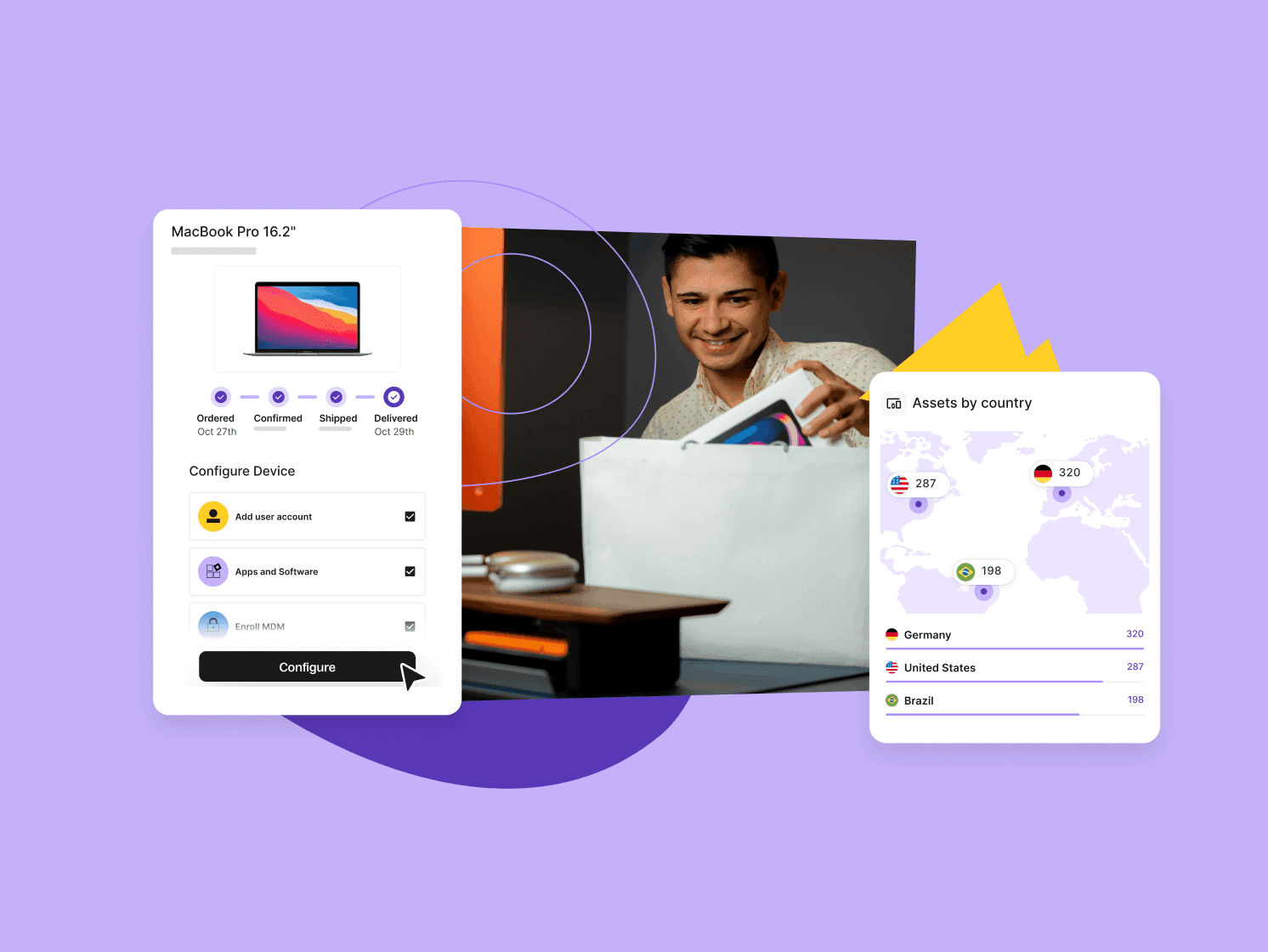
How Deel IT helps: Deel IT handles device procurement and delivery across 130+ countries through a single platform: source, configure, and ship pre-imaged hardware to any new hire without engaging regional resellers or managing customs separately.
Read: Top IT procurement challenges and how to solve them
2. Endpoint management stops following a single operational standard
Endpoint management is critical for determining whether devices are secure, visible to IT, and working under the right policies from day one. For smaller organizations operating in one or two countries, that control is usually maintained through a single workflow. But once IT teams begin managing devices across several countries, keeping enrollment, configuration, and policy enforcement consistent becomes significantly harder, and gaps in visibility and device control begin to emerge.
This typically means:
MDM enrollment no longer happens through a single workflow: Devices are enrolled at different stages of provisioning, creating inconsistencies in when security policies and device controls are applied
Security policies begin rolling out unevenly across the fleet: Encryption, OS configuration, and patching standards depend on whether devices are enrolled correctly and managed through the same systems, making consistent enforcement harder at scale
Endpoint visibility becomes inconsistent across the fleet: Different enrollment and provisioning workflows make it harder to maintain a single real-time view of device status, compliance posture, and lifecycle stage
Unmanaged or partially managed devices begin accumulating over time: Devices that bypass standard enrollment or provisioning workflows operate outside central oversight until manually remediated
Potential risks: At enterprise scale, inconsistent enrollment and endpoint workflows create gaps in device control. When MDM policies are not applied consistently at provisioning, IT teams can no longer assume devices are enrolled, secured, and governed to the same standard across the fleet.
How Deel IT helps: Deel IT applies MDM policies at provisioning, ensuring devices are enrolled, configured, and brought under policy control before they reach employees, with centralized visibility across the global fleet.
Endpoint Protection
Built-in device protection from day one
3. Access stops following a single standard as you scale across countries
In a single-country environment, access is usually managed through one identity provider and one set of access rules. Across five or more countries, regional applications, local IT processes, and disconnected systems begin introducing variation in how access is provisioned, enforced, and reviewed.
The result begins looking something like this:
Single Sign-On (SSO) coverage begins to diverge: Applications adopted in newer markets are not always integrated into the central identity provider, so authentication starts to happen through local credentials rather than a unified standard
Multi-Factor Authentication (MFA) enforcement becomes uneven: Policies defined centrally are not consistently inherited by regional tools or enforced at the application level, creating uneven security controls
Role changes stop propagating across all systems: When employees move roles or teams, access updates are applied in core systems but not in secondary or region-specific tools, resulting in privilege creep building over time
Role-Based Access Control (RBAC) shifts from central policy to local interpretation: Without a single identity layer tied to HRIS data, access decisions are increasingly made by local IT contacts or managers, introducing variation and weakening governance
Access visibility breaks across systems: Access data is spread across multiple tools, so there is no single, reliable view of who has access to what, making it difficult to govern permissions consistently
Potential risks: An access environment that is inconsistent across countries creates a breakdown in control. At enterprise scale, if employees in the same role have different access, the model becomes difficult to defend, with privilege creep, inconsistent MFA, and fragmented SSO making governance and review harder.
How Deel IT helps: Deel IT connects access management directly to HRIS role data, provisioning, adjusting, and revoking access automatically as roles and employment status change, with SSO and MFA enforced centrally across all connected applications.
Read: IAM best practices for distributed teams
4. Each country adds compliance requirements that can no longer be enforced from the centre
Adding a new country to an IT operation does not introduce a single new compliance obligation; it adds another layer. Local data residency rules, device security standards, sector regulations, and employment laws all intersect with how IT assets are managed and how employee data is handled.
At a smaller scale, these requirements can usually be tracked and enforced through a centralized process. But as organizations grow across borders, the obligations begin stacking faster than they can be consistently enforced through a single control layer.
This typically means:
Data residency requirements begin to override global defaults: Countries with strict localisation laws introduce constraints on how data is stored, processed, and transferred, forcing deviations from standard configurations
Offboarding requirements shift based on local employment law: Device return, data deletion, and ownership rules vary by country, increasing the risk of non-compliant data handling or asset recovery
Security framework enforcement becomes uneven across regions: Controls may be defined centrally, but regional processes create inconsistencies in how they are implemented and evidenced during audits
Regional policy exceptions begin accumulating outside central oversight: Local adaptations are made to meet country-specific requirements, but deviations are not consistently tracked or approved centrally
Potential risks: At enterprise scale, compliance is a continuous operational posture that must hold across every entity and every country simultaneously. A policy enforced in eight of ten countries is not compliant. When the evidence for enforcement is distributed across regional IT contacts, MDM logs, and local spreadsheets, the organisation cannot demonstrate what was in place and when.
How Deel IT helps: Deel IT gives IT and security teams continuous visibility across the device lifecycle, with centralized monitoring, audit-ready records, and certified data erasure at offboarding.
Discover how to improve IT compliance with automated device management.
5. IT stops having a single source of truth across devices, access, and SaaS
Keeping IT operations under control becomes increasingly more challenging as organizations expand across multiple countries. Global IT relies on accurate visibility across devices, access, applications, and employee lifecycle data, but that visibility becomes difficult to maintain when systems and workflows evolve separately by region.
Here is what that means:
Device records start to fragment across systems: Fleet data is split between MDM exports, procurement tools, regional spreadsheets, and HRIS fields that are not automatically kept in sync
SaaS licence data becomes disconnected from identity and device state: Application assignment, provisioning status, and actual usage are tracked separately, making it difficult to understand cost, ownership, and access at the employee level
Access updates stop propagating consistently across systems: Changes made in the identity provider are not always enforced in downstream applications, particularly where SSO is not fully implemented, leading to inconsistencies between intended and actual access
Offboarding status cannot be confirmed from a single system: Device return, data wipe, access revocation, and licence recovery are tracked in different places, with no unified view of completion or assurance that all steps have been executed
Shadow IT begins to grow between systems: Employees adopt tools outside the central stack, particularly in under-supported regions, creating applications that are not visible in license, identity, or security records, and therefore operate without oversight
Reporting and planning no longer rely on a single dataset: Metrics on device inventory, access coverage, and SaaS usage are pulled from multiple systems, making it difficult to produce consistent reports or make decisions based on trusted data
Potential risks: When IT cannot rely on a single, accurate view of devices, access, or SaaS usage, planning becomes reactive, and reporting becomes inconsistent. Over time, this creates irreversible information debt: the longer the organisation operates without a unified dataset, the harder it becomes to reconstruct the state of the environment at any given point in time.
How Deel IT helps: Deel IT centralizes device, access, application, and lifecycle management into a single platform, synchronizing automatically with connected HRIS platforms to trigger real-time IT workflows and maintain visibility across the global fleet.
Find out more about why global IT cannot scale on point tools at enterprise scale.
6. IT support stops operating as a consistent global function
IT support is easier to standardize when employees operate within the same region and time zone, using the same workflows and escalation paths. Once teams are distributed across multiple countries, differences in coverage hours, vendors, logistics, and regional processes make consistent support operations much harder to maintain.
This typically means:
Support coverage becomes inconsistent across regions: Employees in different countries experience different response times, escalation paths, and support availability depending on local staffing, vendors, and time zone coverage
Device repairs and replacements take longer to coordinate: Hardware failures are handled through different regional vendors and logistics processes, increasing downtime and making replacement timelines harder to predict globally
Productivity loss becomes harder to contain at scale: Delays resolving device, access, or provisioning issues affect employees differently across regions, creating inconsistent operational readiness and lost working time across the organization
Support history and operational context become fragmented: Device issues, lifecycle events, and prior support actions are tracked across multiple tools and regional teams, making it harder to maintain continuity and identify recurring problems across the fleet
Potential risks: As organizations expand across regions and time zones, inconsistent IT support increases employee downtime, slows issue resolution, and makes it harder to maintain operational visibility and support standards globally.
How Deel IT helps: Deel IT provides 24/7 global IT support through the same platform used to manage devices, MDM, access, and lifecycle workflows, giving distributed teams centralized visibility and consistent support coverage across every region.
Download: Do You Really Need 24/7 IT Support? A Self-Assessment for Global Teams
Why this pattern keeps repeating
Global IT breaks when teams have to rebuild procurement, compliance, device enrollment, and access provisioning separately in every new market. The pattern is not caused by poor execution — it is caused by point tools and regional workarounds that were never designed to work as a system.
Each country is onboarded as a new IT project: There is no standard playbook or repeatable model, so every new market requires the same decisions about procurement, MDM, identity, support, and compliance to be made from scratch
Tools are added to solve specific problems without connecting to the broader stack: MDM covers enrolled devices. The identity provider covers connected applications. Procurement tools cover ordered hardware. None of these systems shares state automatically or operates as a unified system
The seams between tools are where failures concentrate: Device delivered but not enrolled. Access provisioned but not revoked. Licence assigned but not reclaimed. The failure is rarely within a system — it occurs at the handoff between them
Headcount scales to manage the coordination, not the outcomes: As the country count grows, IT teams add resources to manage vendor relationships, chase confirmations, and reconcile records — rather than improving the underlying system
The system works in three countries and breaks in five: The inflection point is not predictable in advance, which means organisations often discover the model has already broken only after the symptoms become visible
There is no underlying platform enforcing consistency across regions: Procurement, identity, device management, and compliance operate as separate systems, without a unifying layer to standardise workflows, data, and control across all countries
The fundamental issue is structural: global IT managed through a collection of regional workarounds will always require more coordination as it scales, not less.
Global IT readiness: a checklist for enterprise teams
Before adding the next country, use this checklist to assess whether your current IT model will hold at scale.
[ ] Device procurement runs through a single standardized workflow across every country you hire in
[ ] Devices are shipped pre-configured and enrolled into MDM before reaching employees
[ ] Security policies, encryption standards, and patching requirements are enforced consistently across the global fleet
[ ] HR hire events automatically trigger device provisioning and access setup through integrated systems
[ ] SSO is enforced consistently across applications and regions
[ ] MFA policies are centrally managed and cannot be bypassed at the application level
[ ] Access rights update automatically when employees change role, team, or location
[ ] IT teams maintain a single real-time view of devices, access, SaaS usage, and employee lifecycle status globally
[ ] Offboarding triggers coordinated device recovery, access revocation, and licence reclamation workflows automatically
[ ] Certified data erasure documentation is generated and centrally stored for offboarded devices
[ ] Compliance evidence, provisioning logs, and policy enforcement records can be exported without manual reconstruction
[ ] Audit logs and lifecycle records are centrally stored, time-stamped, and immutable
[ ] Procurement, logistics, and SaaS costs are visible and comparable across countries
[ ] Employees in every region have access to consistent IT support coverage and response times
[ ] Device repair, replacement, and support workflows can be coordinated globally without relying on regional workarounds
Download: Strategic IT onboarding and offboarding guide
Streamline global IT operations for enterprise teams with Deel IT
Managing IT across five or more countries without a unified system means your team is spending more time on coordination than on outcomes: reconciling records, chasing device returns, verifying access revocations, and rebuilding compliance evidence from scratch each time an audit arrives.
Deel IT was built for distributed enterprise teams. Our all-in-one platform connects devices, MDM, identity, application management, support, and compliance into a single system that operates globally, without regional workarounds.
Deel IT replaces the fragmented stack with one platform that covers:
Global procurement across 130+ countries: Source, configure, and ship pre-imaged, MDM-enrolled hardware to any new hire, with no regional resellers, no customs overhead, no missed start dates
MDM enrollment at provisioning, not as an afterthought: Security policies, encryption standards, and configuration baselines are applied before the device reaches the employee
Automated access provisioning and revocation tied to HRIS events: Access is granted on hire, adjusted on role change, and revoked the moment employment ends, across SSO, MFA, and every connected application simultaneously
Centralized SaaS and licence management: Every application, every user, every licence tier visible in one place
24/7 global IT support, embedded in the same platform: Coverage in every time zone, with centralized ticketing and consistent response times regardless of where your employees are located
Audit-ready compliance records: Timestamped record of all provisioning, access revocation, and device lifecycle events, and certified data erasure
Single system of record across the entire fleet: One dashboard for device status, access rights, application assignment, and compliance posture, updated in real time as lifecycle events occur
Book a demo to see how Deel IT runs global IT operations at enterprise scale.
Deel IT
Automate IT operations in 130+ countries
FAQs
Why is managing IT across multiple countries harder than just scaling up the same process?
When you operate in a single country, your procurement channels, compliance rules, and MDM enrollment workflows are all built around a consistent set of assumptions. Add more countries, and those assumptions break — each region has different hardware suppliers, data protection requirements, and carrier or network constraints, so the same process no longer produces the same outcome.
What are the most common IT gaps that appear when a company expands to five or more countries?
The most frequently reported issues are inconsistent MDM enrollment timing (where devices arrive before enrollment is configured, or vice versa), uneven MFA and SSO coverage across regions, and fragmented procurement that leaves IT without a clear view of what hardware exists where. These gaps often go undetected until a security incident or audit surfaces them.
How does device procurement become a problem on a global scale?
Sourcing hardware locally in each country means dealing with different vendors, lead times, pricing structures, and shipping regulations, which makes it difficult to maintain a standardized device fleet. IT teams often end up managing several separate procurement workflows simultaneously, with no single source of truth for inventory or delivery status across regions.
What compliance risks come with running IT operations across multiple countries?
Different countries impose different requirements around data residency, endpoint encryption, and employee privacy, meaning a policy that satisfies regulations in one region may fall short in another. Without centralized visibility, it's easy for specific locations to drift out of compliance, particularly when new employees are onboarded, and access is provisioned manually or inconsistently.
Dr Kristine Lennie holds a PhD in Mathematical Biology and loves learning, research and content creation. She had written academic, creative and industry-related content and enjoys exploring new topics and ideas. She is passionate about helping create a truly global workforce, where employers and employees are not limited by borders to achieve success.