Article
7 min read
Zero Trust Security for Remote-First IT Teams: A Practical Implementation Guide
IT & device management

Author
Dr Kristine Lennie
Last Update
June 05, 2026

Table of Contents
What is Zero Trust, and why does it matter now?
The problem with perimeter security for distributed teams
Core principles of Zero Trust architecture
The HR-IT access governance gap
Implementing Zero Trust: a phased approach
Endpoint compliance in a distributed environment
Zero Trust across multiple jurisdictions
How Deel IT supports Zero Trust access governance
Key takeaways
Traditional perimeter-based security models were built for employees working from a central office, not distributed teams operating across home networks, personal devices, and multiple countries.
Zero Trust replaces assumed trust with continuous verification of users, devices, and access requests, helping organizations reduce the impact of compromised credentials and unauthorized access.
Deel IT connects hiring, role changes, and offboarding events directly to identity and access workflows, helping IT teams automate the access controls and governance processes required to support a Zero Trust model.
When your team is distributed across a dozen time zones and working from home networks, hotel Wi-Fi, and co-working spaces, the corporate firewall becomes more symbol than shield. The classic security model assumed employees worked inside a protected network perimeter, a reliable assumption when everyone sat in the same building. That assumption hasn't held for years, and remote-first companies still operating under legacy security architectures face unnecessary exposure: slow breach response times, excessive standing access, and manual offboarding gaps that leave accounts open well after someone departs.
Zero Trust is not a product. It is a security philosophy built on one operating principle: never trust, always verify. For IT managers at companies with 100 or more employees operating across multiple countries, adopting Zero Trust requires rethinking not just your tooling, but the entire relationship between your HR systems, identity infrastructure, and device compliance programs.
This guide explains what Zero Trust means in practice, how to structure a phased rollout for a distributed workforce, and how to solve the most persistent implementation challenge: keeping access rights continuously synchronized with your HR system of record.
What is Zero Trust, and why does it matter now?
Zero Trust is an approach to network security that eliminates the concept of a trusted internal network. In a traditional perimeter model, users and devices inside the corporate network are treated as inherently trustworthy. Once someone authenticates to the VPN, they gain broad lateral access to systems. This model was already showing cracks in 2015. After the mass shift to remote work, it became untenable.
The Verizon Data Breach Investigations Report consistently finds that compromised credentials drive the majority of data breaches. In a perimeter model, a single stolen password can give an attacker access to the entire network. In a Zero Trust architecture, the same attacker hits a wall at every subsequent resource, because every request is evaluated independently, regardless of where it originates.
For remote-first companies, Zero Trust is not an advanced-maturity-stage goal. It is a foundational requirement. The perimeter you are trying to protect no longer exists as a physical boundary.
Deel Contractor of Record
Minimize misclassification risk
The problem with perimeter security for distributed teams
Traditional network security assumes a clear inside and outside. Firewalls, VPNs, and network segmentation were designed to enforce that boundary. When employees work remotely, that boundary dissolves:
Devices operate outside corporate networks. Home broadband, public Wi-Fi, and mobile connections give IT no direct visibility into what is happening on those endpoints.
SaaS applications live entirely outside your infrastructure. Identity controls are the only enforcement layer available.
Access is often granted at onboarding and rarely revisited. A new hire receives access to a system, changes roles two years later, and retains the original access indefinitely.
Offboarding is frequently manual and delayed. An employee leaves, and their accounts remain active for days or weeks.
For globally distributed teams, these problems compound. A contractor in Brazil, a full-time employee in Germany, and a part-time consultant in Singapore may all need access to the same systems, but under different legal frameworks, different data residency requirements, and different risk profiles. Applying uniform perimeter controls to this population is neither practical nor compliant.
The access governance gap is real
A common finding in access governance audits is that a significant number of active user accounts belong to people who have already left the organization. In a Zero Trust architecture, every standing account with unnecessary access is an open attack surface.
Compliance
Unlock Continuous Compliance™ with Deel
Core principles of Zero Trust architecture
Zero Trust frameworks, including NIST SP 800-207 and the Cybersecurity and Infrastructure Security Agency (CISA) Zero Trust Maturity Model, converge on several foundational principles:
Verify explicitly
Every access request must be authenticated and authorized based on all available data points: user identity, device health, location, request context, and behavioral signals. Authentication is not a one-time event at login. It is a continuous process.
Multi-factor authentication (MFA) is a prerequisite, not an enhancement. Conditional access policies that evaluate device compliance state before granting resource access sit on top of MFA.
Use least-privilege access
Users and service accounts should have access to exactly what they need to do their job, and nothing more. This requires moving away from role groups with broad permissions toward granular, just-in-time access grants that expire when no longer needed.
This principle is where the HR-IT integration becomes critical. When someone changes roles, their access permissions should update automatically to reflect their new responsibilities, not accumulate permissions across every role they have ever held.
Assume breach
Design your security architecture as though an attacker is already inside. Segment resources so that a compromised credential for a low-sensitivity application cannot be used to pivot to high-sensitivity systems. Log all access. Build detection and response capabilities that catch lateral movement early.
Deel's HRIS
Manage your global workforce compliantly

The HR-IT access governance gap
The most common reason Zero Trust implementations stall is not technical. It is operational. Identity is the control plane of Zero Trust, and identity in an enterprise is driven by HR data. When someone is hired, their identity needs to be provisioned. When they change roles, their access needs to change. When they leave, all access must be revoked immediately.
In most organizations, this workflow is manual, slow, and error-prone:
HR enters new hire data into an HRIS.
A ticket is opened for IT to provision accounts.
IT provisions access based on role, sometimes correctly and sometimes based on what the previous person in that role had.
When the employee changes roles or leaves, someone needs to remember to open another ticket.
This process breaks down consistently. A common access governance audit finding is that a significant number of active user accounts belong to people who have already left the organization. In a Zero Trust architecture, every standing account with unnecessary access is an open attack surface.
The fix is automating the HR-to-IT handoff. When the HRIS is the authoritative source of truth for employment status, and changes in the HRIS automatically trigger provisioning and deprovisioning actions in downstream identity systems, the access governance gap closes.
Deel IT is built around this integration, connecting HR lifecycle events to identity and access management workflows so IT teams are not manually reconciling access rights on a quarterly basis.
Live Demo
Get a live walkthrough of the Deel platform
Implementing Zero Trust: a phased approach
Zero Trust is not a single deployment. It is a maturity progression. For a remote-first company starting from a traditional perimeter model, a phased approach reduces implementation risk and delivers measurable security improvements at each stage.
Phase 1: Identity and MFA (weeks 1-8)
Begin with the identity layer. Every user should authenticate through a centralized identity provider (IdP) such as Microsoft Entra ID, Okta, or Google Workspace, and MFA should be enforced for all applications, with no exceptions for legacy internal tools.
During this phase, audit your existing accounts. Identify service accounts, shared credentials, and dormant user accounts. Disable or remediate each category. The output of this audit will inform your least-privilege access redesign.
Phase 2: Device health enforcement (weeks 6-16)
Before a user can access sensitive resources, their device should meet a baseline compliance standard: current operating system patches, endpoint detection and response (EDR) software installed and active, disk encryption enabled, and no prohibited software detected.
This is achieved through device management platforms (MDM/UEM) combined with conditional access policies at the IdP. A device that fails the health check is denied access or redirected to a remediation workflow, regardless of whether the user's credentials are valid.
For remote teams where employees may use personal devices, this phase requires a clear policy decision: require enrollment in device management, issue company devices, or restrict access for personally-owned devices to low-sensitivity applications only.
Phase 3: Network segmentation and application access (weeks 12-24)
Replace the VPN with application-specific access controls. Instead of granting network-level access and trusting users to navigate responsibly, route each application connection through an access proxy that evaluates identity and device health at the point of access.
Zero Trust Network Access (ZTNA) solutions, including products like Cloudflare Access, Zscaler Private Access, and BeyondCorp Enterprise, implement this model. They effectively replace the VPN tunnel with per-application authentication, making lateral movement significantly harder for an attacker who has compromised one account.
During this phase, also implement network micro-segmentation for any on-premises or cloud infrastructure that remains. The goal is to ensure that a breach in one segment cannot propagate freely into adjacent systems.
Phase 4: Continuous monitoring and adaptive policy (ongoing)
Zero Trust is not a configuration you deploy and forget. The final phase is operational: build the logging, alerting, and response workflows that make the "assume breach" principle operational.
Centralize logs from your IdP, device management platform, ZTNA proxy, and application audit trails into a SIEM. Define detection rules for anomalous access patterns: off-hours logins from new locations, bulk data downloads, and access to resources outside a user's normal pattern. Train your incident response team on investigation playbooks specific to identity-based attacks.
Adaptive access policies that automatically step up authentication requirements when risk signals are elevated (unusual location, new device, sensitive resource) reduce the burden on users in normal conditions while tightening controls when it matters.
Start with identity — it unlocks everything else
Most organizations stall on Zero Trust because they try to do everything at once. Phase 1 (identity and MFA) delivers immediate security value and creates the foundation for every subsequent control. Establish your IdP and enforce MFA before investing in ZTNA or micro-segmentation.
Global Expansion
Looking to expand your business abroad?
Endpoint compliance in a distributed environment
Enforcing device health is straightforward when IT ships and manages every laptop. It becomes significantly more complex when employees across 40 countries are using a mix of company-issued hardware, BYOD, and contractor-owned devices.
Several practical strategies help:
Standardize on MDM enrollment for company-issued devices. Every company-issued device should be enrolled in your MDM platform (Jamf, Microsoft Intune, Kandji) before reaching the employee. Auto-enrollment policies eliminate the gap where devices operate outside management for days or weeks.
Define a BYOD access tier. For employees or contractors using personal devices, define what they can and cannot access. Browser-based access to low-sensitivity SaaS applications may be acceptable; access to source code repositories, customer data, or financial systems should require a managed device.
Use identity and access management tools to enforce compliance posture at authentication. Modern IdPs can query MDM enrollment status and compliance signals as part of the conditional access evaluation. A device that dropped out of compliance last week will fail the check today, without any manual intervention.
Account for local data privacy regulations. In some jurisdictions, mandatory device monitoring or endpoint scanning intersects with employee privacy rights. Germany, France, and several other countries have specific legal requirements around what IT can collect from employee devices. Build your endpoint compliance policies with input from local legal counsel or a compliance partner familiar with the relevant jurisdictions.
Global Compliance
Automate your compliance needs
Zero Trust across multiple jurisdictions
Global remote teams introduce compliance dimensions that purely technical Zero Trust guidance rarely addresses. Access controls do not exist in a legal vacuum. They interact with data residency requirements, cross-border data transfer rules, and local privacy laws.
Data residency: Some regulations (GDPR, Brazil's LGPD, China's PIPL) impose restrictions on where personal data can be stored and processed. Your access control infrastructure, including IdP logs, device telemetry, and security monitoring data, may contain personal data subject to these rules. Ensure your Zero Trust tooling vendors can comply with data residency requirements for the jurisdictions where your employees work.
Cross-border access: An employee in Germany accessing a system hosted in the US creates a data transfer under GDPR. If that system processes personal data of EU residents, you need a valid legal basis for the transfer: Standard Contractual Clauses, an adequacy decision, or another approved mechanism. Map your critical data flows before deploying access controls that might inadvertently create compliance gaps.
Employment-related monitoring: In some countries, employees have explicit legal protections against disproportionate workplace monitoring. A Zero Trust logging program that captures every access event, device location, and user behavior may require works council agreements in Germany or consultation processes in other countries. Engage HR and legal before deploying user behavior analytics or extended audit logging.
Working with a platform like Deel IT that already manages compliance across multiple jurisdictions gives IT teams a reliable way to understand local regulatory context as they build out their access governance programs.
Deel on G2
G2 reviewers rate Deel #1 in multi-country payroll

How Deel IT supports Zero Trust access governance
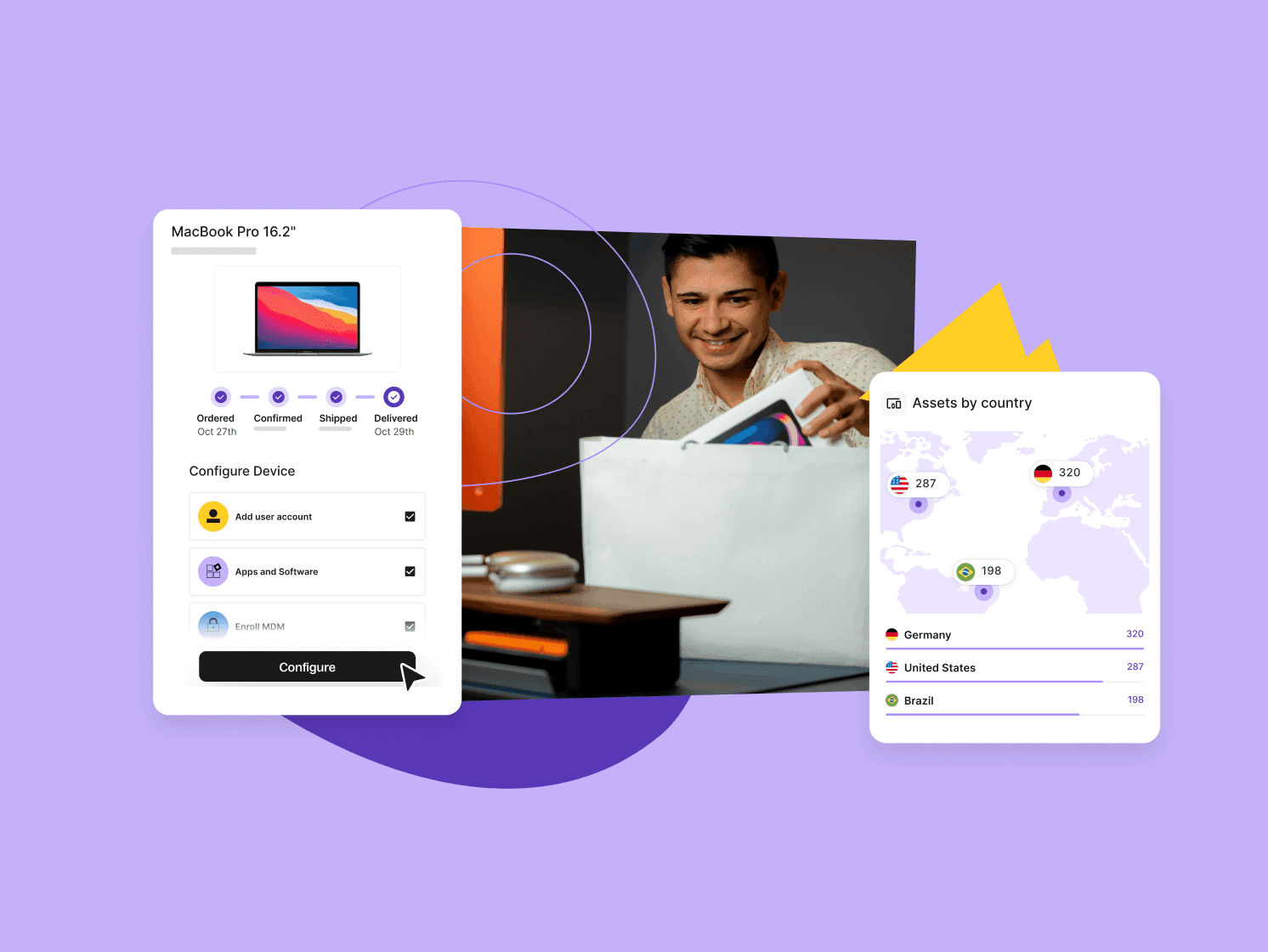
Zero Trust depends on accurate, real-time identity data. Deel IT connects HR events directly to IT provisioning and deprovisioning workflows, helping organizations automate access changes as employees join, change roles, and leave the company.
With Deel IT, organizations can:
Automate provisioning and offboarding workflows based on HR events
Sync hiring, role changes, and departures directly with identity and access systems
Manage identity, access, devices, and lifecycle workflows from one platform
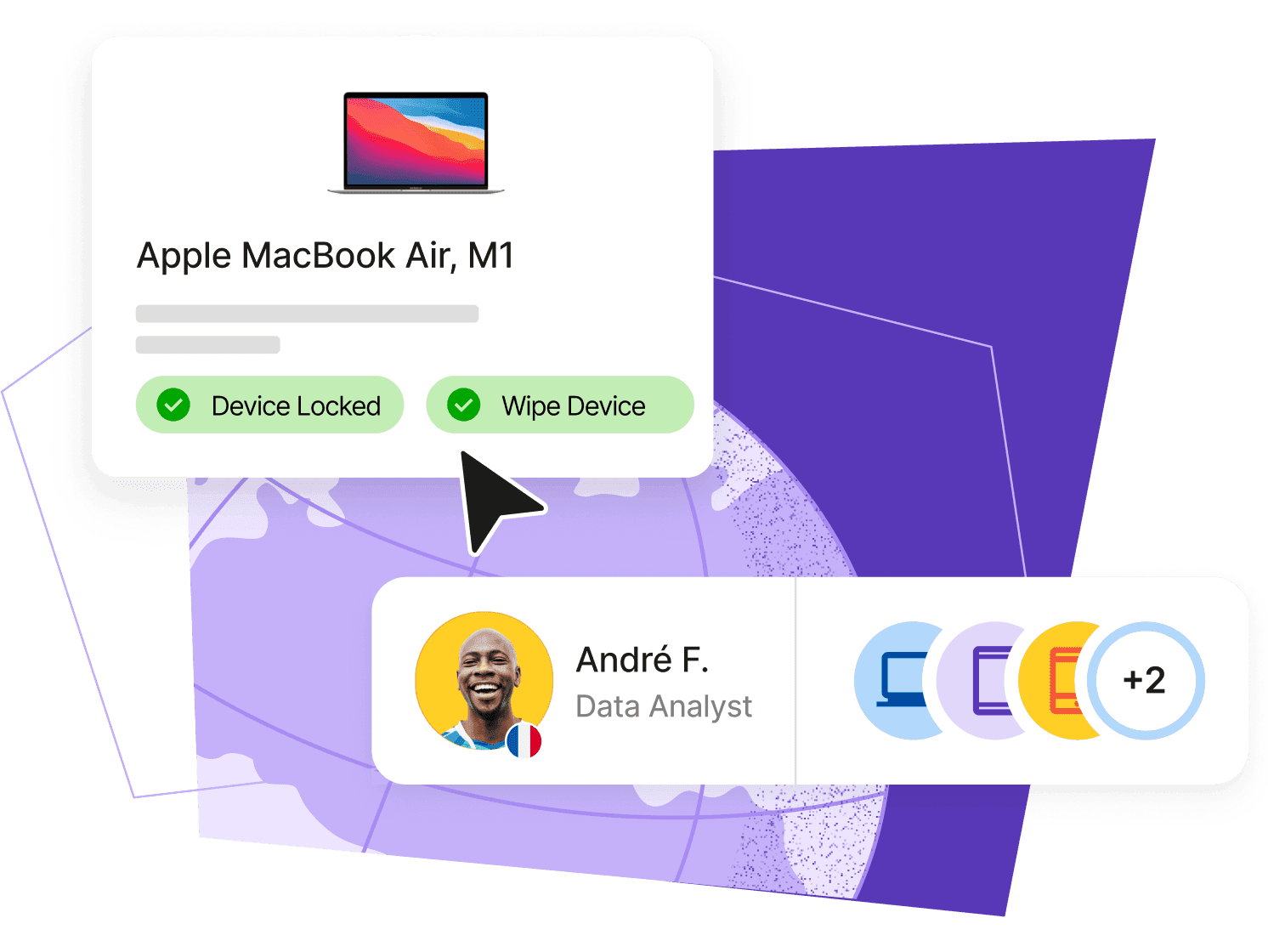
Support global device management, repairs, replacements, and MDM across distributed teams
Give employees access to 24/7 global IT support with native ticketing built in
Book a demo with Deel IT to see how enterprise IT teams can centralize access governance and support Zero Trust operations at scale.
FAQs
Is Zero Trust only for large enterprises?
No. While large enterprises are often early adopters due to compliance requirements, remote-first companies of 100 or more employees face the same fundamental challenge: distributed users and devices that perimeter security cannot protect. The core Zero Trust controls (MFA, conditional access, least-privilege access) are accessible to organizations of all sizes.
Do I need to replace my VPN to implement Zero Trust?
Not immediately. Many organizations run VPN and ZTNA solutions in parallel during transition, gradually migrating application access to Zero Trust Network Access as each application is onboarded. A full VPN replacement is a later-phase goal, not a prerequisite for starting.
How does Zero Trust interact with GDPR and other privacy laws?
Zero Trust generates significant logging and telemetry data, some of which may constitute personal data under GDPR and similar regulations. IT teams should review their monitoring practices with legal counsel, particularly for employees in the EU, Germany, and Brazil, to ensure compliance with local data protection requirements.
What is the biggest implementation risk for Zero Trust?
The most common failure mode is deploying Zero Trust controls without synchronizing them with HR data. If access provisioning and deprovisioning remain manual, least-privilege access degrades over time as permissions accumulate and departed employees retain active accounts.
How does Deel IT support Zero Trust implementation?
Deel IT connects HR lifecycle events (onboarding, role changes, and offboarding) to identity and device management systems, automating the access governance layer that Zero Trust requires. It also manages device enrollment and hardware logistics for globally distributed teams.
Related Deel resources
Set consistent security standards: Use our Free IT Policy Template to establish rules for encryption, updates, and remote wipe procedures.
Prevent offboarding risks: Follow our Onboarding & Offboarding Guide for Distributed Teams to manage device returns, data removal, and remote access across multiple time zones.
Prepare for growth: Align device recovery and data protection with company expansion using the IT Strategy Toolkit: 2026 Guide.
Simplify remote device rollout: Use our Equipment Provisioning Policy Template to make onboarding and hardware distribution smoother for distributed teams.
Dr Kristine Lennie holds a PhD in Mathematical Biology and loves learning, research and content creation. She had written academic, creative and industry-related content and enjoys exploring new topics and ideas. She is passionate about helping create a truly global workforce, where employers and employees are not limited by borders to achieve success.