
Global Work Glossary
- Results for ""
Table of Contents
What is Voice over Internet Protocol (VoIP) fraud?
How VoIP fraud works
Types of VoIP fraud
How VoIP fraud appears in hiring and employment
Warning signs of VoIP fraud for HR and security teams
VoIP fraud vs. related fraud terms
Key facts
Detect impersonation and hiring fraud with Deel Security
FAQ
What is Voice over Internet Protocol (VoIP) fraud?
What is Voice over Internet Protocol (VoIP) fraud?
Voice over Internet Protocol (VoIP) fraud is the deliberate misuse of internet-based phone services to impersonate callers, intercept communications, or deceive individuals and organizations into revealing sensitive information or approving fraudulent actions.
Unlike traditional phone fraud, VoIP fraud is easier to execute at scale because attackers can generate calls from almost any number in any country using inexpensive software. Businesses that rely on phone calls to verify identities, conduct interviews, or authorize payroll changes may face this threat during hiring, onboarding, and ongoing employment.
How VoIP fraud works
Fraudsters exploit VoIP systems by manipulating caller ID data to make a call appear to come from a trusted source, a technique known as caller ID spoofing. They may also gain unauthorized access to a company's private branch exchange (PBX) or Session Initiation Protocol (SIP) trunk to route fraudulent calls through the organization's own phone infrastructure. Once inside a PBX system, attackers could make bulk calls, intercept internal communications, or redirect legitimate callers to numbers under their control.
Types of VoIP fraud
Several distinct methods fall under this category:
Caller ID spoofing: Attackers make a call appear as though it comes from a known and trusted number, such as a company's HR department or a payroll provider.
PBX hacking: Attackers gain unauthorized access to an organization's internal phone system to redirect calls or accumulate fraudulent call charges.
SIP trunk fraud: Fraudsters exploit weaknesses in a company's SIP connections to route unauthorized calls through its infrastructure.
Vishing (voice phishing): Attackers call employees or candidates and use social engineering to extract credentials, personal data, or authorization for financial transfers.
How VoIP fraud appears in hiring and employment
In employment contexts, VoIP fraud may appear at any stage of the worker lifecycle. During recruitment, attackers could impersonate HR personnel to extract personal details from candidates or convince applicants to submit documents to fraudulent addresses. At the onboarding stage, a fraudulent caller might pose as an IT technician or payroll administrator to persuade a new employee to share access credentials or update payment details.
VoIP fraud can also enable candidate impersonation fraud when a third party calls in on behalf of a real candidate during phone screening. Combined with caller ID spoofing, a fraudster might manipulate both an interviewer and a candidate across separate calls so that neither party realizes the other has also been deceived.
Warning signs of VoIP fraud for HR and security teams
HR and security teams could watch for several patterns that may indicate VoIP fraud is in progress:
A caller requests urgent action on payroll, account access, or identity details with no prior notice.
The caller ID matches an internal or trusted number, but the call behavior is inconsistent with the caller's claimed role.
A candidate's or employee's phone number changes to a VoIP-originated number shortly before a verification call.
Calls come from numbers with area codes inconsistent with the caller's stated location.
Interview or verification call audio sounds processed, robotic, or notably inconsistent in quality.
VoIP fraud vs. related fraud terms
VoIP fraud overlaps with several related threats but each uses a different method or channel.
Voice cloning: This technique uses AI to replicate a specific person's voice. VoIP fraud manipulates the call channel itself. The two are often combined, with a cloned voice delivered over a spoofed VoIP call.
Email domain spoofing: This applies the same technique to a different channel, so a message appears to come from a trusted domain. Both approaches target trust in a communication source, and attackers may use them together in coordinated campaigns.
Voice biometric verification: This system analyzes audio characteristics to confirm a caller's identity. Organizations use it as a countermeasure against VoIP fraud and voice cloning attempts.
Key facts
Here are some key facts about how VoIP fraud works, the risks it poses to employers, and how organizations can detect and prevent it.
VoIP fraud is possible because internet-based calling allows callers to set almost any number as their outgoing caller ID, without technical barriers.
Attackers may combine VoIP caller ID spoofing with voice cloning to impersonate a known person convincingly on a call.
Account takeover attacks can begin with a vishing call that tricks an employee into resetting a password or sharing a one-time code.
Multi-factor authentication bypass sometimes relies on VoIP fraud to intercept or redirect Short Message Service (SMS) verification codes sent to a hijacked number.
HR teams are targeted because they routinely handle sensitive personal data and authorize changes to payroll and system access.
Identity verification during phone calls alone, without additional channels or document checks, may not be sufficient to confirm a caller's true identity.
Detect impersonation and hiring fraud with Deel Security
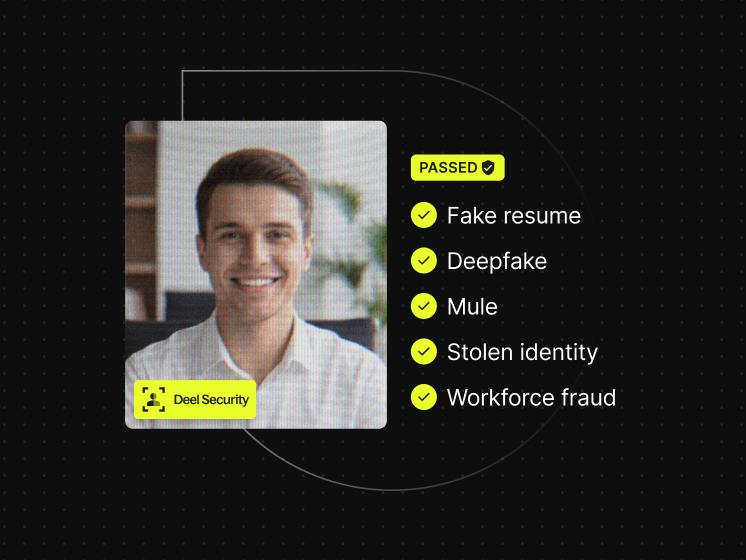
VoIP fraud can be used to impersonate trusted callers during hiring and onboarding. Deel Security helps businesses detect fake candidates, synthetic identities, deepfakes, and impersonation attempts across the full worker lifecycle, from recruitment and onboarding to ongoing employment.
Deel Security works with your existing applicant tracking system (ATS), allowing identity fraud risks to be flagged directly in recruitment workflows. Deel's fraud experts review every high-risk alert and provide findings that hiring teams can use to assess potential impersonation before making a final decision.
Book a demo to see how Deel Security helps protect your hiring process from identity fraud.
Deel Security
Hire real people, keep fraud out from hiring to offboarding
FAQ
Can VoIP fraud affect remote hiring processes?
Remote hiring relies heavily on phone and video calls for screening and verification, which could make it more susceptible to VoIP fraud than in-person processes. Attackers may target organizations that do not use secondary identity checks alongside phone interviews.
How is VoIP fraud different from a standard phishing call?
VoIP fraud specifically exploits internet-based phone infrastructure to manipulate caller identity or intercept calls. Standard phishing calls may use any phone line. VoIP fraud uses technical access to phone systems as part of the attack, alongside social tactics.
What can HR teams do to reduce the risk of VoIP fraud?
HR teams could reduce the risk by verifying caller identity through a second channel before acting on any phone request for sensitive information or account changes. Requiring written confirmation for payroll updates and using identity verification tools alongside phone calls adds a layer of protection.
Is VoIP fraud related to multi-factor authentication bypass?
VoIP fraud can enable multi-factor authentication (MFA) bypass when attackers intercept or redirect SMS-based verification codes to a phone number under their control. Organizations can reduce this risk by using authentication methods that do not rely on phone calls or SMS alone.
This entry is for informational purposes only and is not a substitute for legal, security, or technical advice from qualified advisers.