Article
3 min read
4 Best Device Lifecycle Management Practices for EOR Employees in 2026
IT & device management

Author
Dr Kristine Lennie
Last Update
October 07, 2026

Table of Contents
What is device lifecycle management, and why does it matter for EOR employees and contractors?
1. Streamline provisioning and deployment for global EOR and contractor hires
2. Enforce security throughout the device lifecycle for distributed workers
3. Build a proactive repair and refresh strategy across countries
4. Strengthen offboarding and device recovery processes for global EOR teams
Manage device lifecycle for EOR employees and contractors globally with Deel IT
FAQ
Managing devices for EOR employees and contractors globally means coordinating each stage of the device lifecycle—from provisioning and security to repairs, support, recovery, and reuse—across the countries where they work. Deel IT brings these workflows together across 130+ countries and connects them to worker lifecycle events such as onboarding, role changes, and offboarding.
Global teams increasingly depend on contractors and Employer of Record (EOR) employees to stay flexible and scale quickly. Without a structured approach to device lifecycle management, that complexity shows up as provisioning delays, compliance gaps, and offboarding failures. But managing company devices across those arrangements is more complex than managing devices for a traditional, office-based workforce: workers are spread across countries with different data protection laws, customs requirements, and hardware standards.
This article covers four practices that help IT and HR teams running EOR programs manage devices consistently: from the moment a hire is confirmed to the moment a device is returned.
What is device lifecycle management, and why does it matter for EOR employees and contractors?
An EOR is a company that legally employs workers on behalf of another organization. The employee works day-to-day for your company, while the EOR manages payroll, benefits, tax withholding, and compliance with local labor laws.
However, the responsibility for providing and managing work devices typically remains with your organization. Employees still need laptops, access to company systems, technical support, repairs, replacements, and secure offboarding—regardless of who their legal employer is.
For IT teams, this means managing devices across multiple countries while coordinating with employees, managers, HR teams, and EOR partners. Shipping logistics, local regulations, device support, and asset recovery can all become more complex when employees are distributed internationally.
The table below outlines the main stages of the device lifecycle and some of the challenges organizations commonly encounter when supporting EOR employees.
| Lifecycle stage | What it involves | Common challenge for EOR teams |
|---|---|---|
| Procurement & deployment | Selecting, configuring, and delivering devices to employees | Shipping delays, customs requirements, and inconsistent local availability |
| Security & operations | Managing devices, enforcing policies, and responding to incidents | Maintaining consistent security controls across multiple jurisdictions |
| Repair & refresh | Resolving hardware issues and replacing aging equipment | Long repair times, limited local support, and employee downtime |
| Offboarding & recovery | Revoking access, recovering devices, and preparing them for reuse or retirement | Coordinating device returns and data protection across borders |
The following best practices focus on how organizations can address these challenges and manage devices consistently throughout the lifecycle for EOR employees and contractors.
Read: Device Lifecycle Management Guide
1. Streamline provisioning and deployment for global EOR and contractor hires
Provisioning devices for EOR employees often involves more coordination than onboarding employees in established office locations. Devices may need to be sourced locally, shipped internationally, or configured through third-party logistics providers, all while ensuring employees receive the right equipment before their start date.
The most common cause of onboarding delays is a fragmented provisioning process. HR confirms the hire, IT orders the device, the device ships, and configuration happens later. Each handoff introduces delays, and for international employees, customs clearance and regional logistics can add even more time.
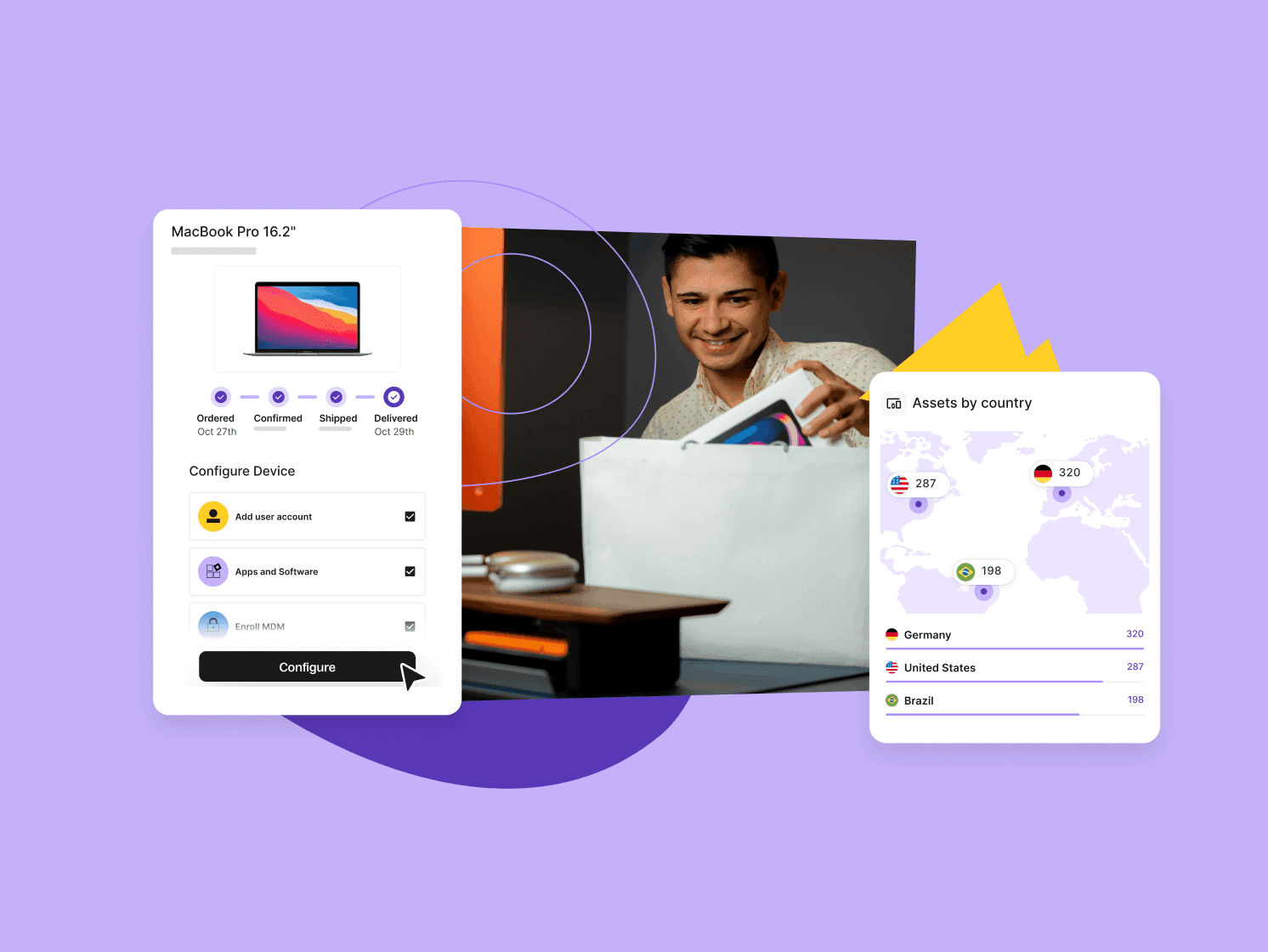
Zero-touch deployment helps eliminate these bottlenecks. Devices enroll automatically on first boot, pulling configuration profiles, certificates, applications, and security policies from your Mobile Device Management (MDM) platform without requiring hands-on IT support.
To support EOR employees at scale, organizations should establish:
Role-based device standards: Define approved hardware, accessories, and configuration profiles for different employee groups.
Automated enrollment workflows: Use MDM to deploy applications, certificates, and security controls automatically at enrollment.
Regionally optimized procurement and logistics: Source devices locally where possible to reduce lead times, customs delays, and shipping costs.
Identity and access controls from day one: Enforce Multi-Factor Authentication (MFA) and Single Sign-On (SSO) before employees access company systems.
Provisioning performance metrics: Track delivery timelines, onboarding success rates, and early support tickets to identify process improvements.
The goal is simple: employees should receive a device that is configured, compliant, and ready to work before they log in for the first time.
Learn why new hires often start without equipment — and how to prevent it.
2. Enforce security throughout the device lifecycle for distributed workers
EOR employees often work from home offices, coworking spaces, and personal networks across multiple countries. In these environments, security can't depend on a traditional office network. The device itself becomes the primary security boundary.
That means security controls should be built into every stage of the device lifecycle rather than applied after deployment. Devices should arrive encrypted, enrolled in management tools, and configured to enforce security policies from the first login.
Key controls include:
Full-disk encryption and secure boot: Protect company data if a device is lost, stolen, or accessed by an unauthorized user.
Automated patching and updates: Ensure operating systems and applications remain protected against known vulnerabilities.
Multi-Factor Authentication (MFA): Add an additional layer of protection beyond passwords alone.
Conditional access policies: Restrict access to company systems from devices that fail security or compliance checks.
Endpoint monitoring and threat detection: Continuously monitor devices for suspicious activity and security incidents.
Least-privilege access controls: Limit administrative permissions and application access to what employees need for their role.
Because EOR employees operate across different jurisdictions, organizations should also ensure security controls align with local privacy, labor, and data protection requirements. Monitoring, telemetry collection, and access management policies should be reviewed regularly to confirm they remain compliant in the countries where employees are located.
Security should be treated as an ongoing operational process rather than a one-time configuration task. Regular access reviews, centralized logging, and documented response procedures help ensure devices remain secure throughout their lifecycle.
Find out how to maintain audit readiness and automate access revocation at enterprise scale.
Resources for managing device lifecycles
Standardize your provisioning and security baseline using this Free IT Policy Template
Fix onboarding and offboarding handoffs before they cause gaps by using this Onboarding & Offboarding Guide for Distributed Teams
Assess whether your provisioning process is actually automated with our IT Provisioning Self-Assessment
Make sure offboarding doesn't leave data behind by using this Employee Offboarding Checklist
3. Build a proactive repair and refresh strategy across countries
Supporting EOR employees doesn't stop once a device is delivered. When hardware fails, IT teams often need to coordinate repairs, replacements, and warranty claims across countries where they have no physical presence. Without a clear strategy, employees can be left waiting days—or even weeks—for a resolution.
The most effective programs focus on preventing disruptions before they occur. Monitoring device health helps IT teams identify issues early and address them before employees experience significant downtime.
To support EOR employees effectively, organizations should establish:
Hardware health monitoring: Track battery health, storage utilization, device performance, and other indicators of impending failure.
Defined repair and replacement workflows: Establish clear processes for break/fix scenarios, warranty claims, and escalation paths.
Regional repair coverage: Use local service providers and repair partners to reduce turnaround times and avoid unnecessary cross-border shipments.
Replacement device programs: Maintain options for advanced replacements or temporary devices when repairs cannot be completed quickly.
Refresh planning based on device health: Use performance and reliability data—not age alone—to determine when hardware should be upgraded or replaced.
Organizations should track metrics such as mean time to repair (MTTR), device failure rates, repair costs, and replacement frequency to identify opportunities for improvement.
The goal isn't simply to repair devices faster. It's to ensure employees can remain productive regardless of where they're located, while reducing downtime, extending device lifespan, and controlling support costs at scale.
Find out how to reduce IT costs by reconditioning devices.
4. Strengthen offboarding and device recovery processes for global EOR teams
Offboarding EOR employees often requires coordination across multiple countries, teams, and service providers. Access must be revoked, company data must be protected, and devices need to be recovered, even when employees are located far from a company office or support center.
The biggest risk is delay. When offboarding actions depend on manual handoffs between HR, IT, managers, and logistics providers, devices can remain unreturned, access may persist longer than intended, and recovery efforts become more difficult to coordinate.
To reduce these risks, organizations should establish:
Automated offboarding triggers: Device recovery, access revocation, and security actions should begin as soon as an employee's departure is confirmed.
Immediate access removal: Disable accounts, revoke active sessions, and remove access to company systems when employment ends.
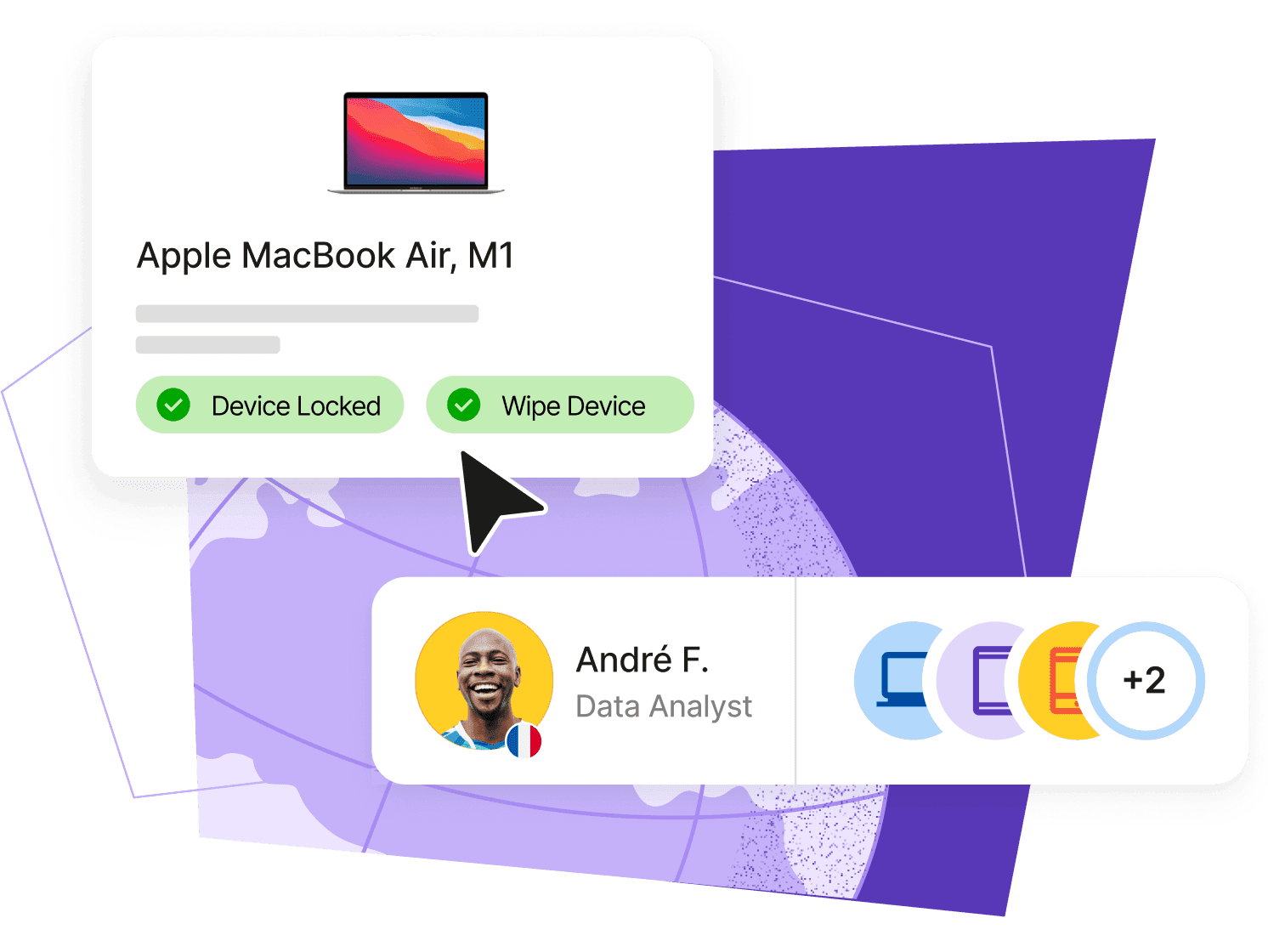
Remote security controls: Use remote lock, selective wipe, or full wipe capabilities to protect company data on unmanaged or unreturned devices.
Standardized recovery workflows: Provide clear return instructions, shipping materials, and local collection options to improve recovery rates across regions.
Device intake and redeployment procedures: Verify device condition, perform certified data erasure, and prepare eligible hardware for reuse.
Organizations should track metrics such as return rates, average recovery times, and the percentage of recovered devices that are successfully redeployed. These metrics help identify gaps in both the offboarding process and the broader device lifecycle program.
A successful offboarding process doesn't end when access is revoked. It ensures company data is protected, devices are recovered efficiently, and hardware is ready for its next stage in the lifecycle.
Read: The Most Common Offboarding Failures for Remote Teams
Manage device lifecycle for EOR employees and contractors globally with Deel IT
Managing devices for EOR employees requires coordinating procurement, deployment, security, support, and recovery across multiple countries. Deel IT combines device procurement, MDM, endpoint protection, identity management, and global logistics in a single platform, helping organizations manage the entire device lifecycle from onboarding through offboarding.
HR-triggered IT workflows from onboarding through offboarding: Device provisioning, access management, security actions, and recovery workflows can be triggered automatically when an employee joins, changes roles, or leaves
Global device procurement and delivery in 130+ countries: Source and ship devices with local specifications, warranty coverage, and customs requirements already accounted for, helping employees receive equipment on time wherever they're located
Day-one productivity through zero-touch deployment: Devices arrive pre-configured with applications, certificates, and security policies already applied, reducing onboarding delays and manual IT effort
Security and access management built into every device: MDM (powered by JumpCloud), endpoint protection (powered by CrowdStrike Falcon), and automated identity provisioning help enforce security controls throughout the device lifecycle
Support for repairs, replacements, and device refreshes: Coordinate break/fix scenarios, replacement devices, and hardware refresh programs while maintaining visibility across your device fleet
Automated offboarding and device recovery workflows: Access revocation, device retrieval, data erasure, and recovery logistics can be triggered automatically when employment ends
Asset redeployment and responsible retirement: Recovered devices can be securely wiped, reused, refurbished, or retired with documented records
Centralized lifecycle visibility and 24/7 support: Track device activity, lifecycle events, and recovery status from a single platform while employees receive around-the-clock IT support wherever they work
Deel IT
Procure, deliver, manage, and secure devices anywhere

FAQ
How do I manage the device lifecycle for EOR employees and contractors globally?
Use a consistent process that covers provisioning, security, support, repairs, replacements, and recovery wherever workers are based. Connecting these processes to onboarding, role changes, and offboarding helps IT manage devices throughout the worker lifecycle. Deel IT coordinates these workflows across 130+ countries.
What does device lifecycle management include for EOR employees and contractors?
It covers the full journey of a company device: procurement and deployment, ongoing security and support, repairs and refreshes, and eventual recovery, redeployment, or retirement. For global workers, it also involves coordinating logistics and support across different countries.
How can I provision devices for EOR employees and contractors in different countries?
Define approved devices by role, configure them with the required applications and security policies, and use local or regional sourcing where practical. Zero-touch deployment can enroll devices in MDM automatically, reducing the amount of manual setup required after equipment reaches the worker.
How do I manage repairs and replacements for workers in countries where we don't have IT staff?
Establish remote support and regional repair or replacement processes so employees don't need access to a company office. Centralized asset tracking also helps IT follow the device through repairs, replacements, and refreshes while maintaining visibility over who has each asset.
How do I securely recover devices when an EOR employee or contractor leaves?
Connect offboarding with access revocation, device security, and equipment recovery so these actions begin when a worker's departure is confirmed. Once recovered, devices can be securely erased and then stored, redeployed, refurbished, or retired according to company policy.
Can device lifecycle management be automated for both EOR employees and contractors?
Yes. IT workflows can be connected to worker lifecycle events so actions such as device provisioning, access changes, security controls, and recovery are triggered when someone joins, changes roles, or leaves. Deel IT supports these workflows for distributed workforces while keeping device lifecycle activity centralized.
Dr Kristine Lennie holds a PhD in Mathematical Biology and loves learning, research and content creation. She had written academic, creative and industry-related content and enjoys exploring new topics and ideas. She is passionate about helping create a truly global workforce, where employers and employees are not limited by borders to achieve success.