Article
3 min read
7 Essential Features to Look for in Outsourced IT Support
IT & device management

Author
Dr Kristine Lennie
Last Update
October 08, 2026

Table of Contents
1. Structured support operations and clear accountability
2. Proactive monitoring and preventive maintenance
3. Security and compliance embedded into service delivery
4. Predictable pricing and transparent service level agreements
5. 24/7 coverage and follow-the-sun staffing for remote and distributed teams
6. Support continuity and institutional knowledge
7. Strategic advisory and vendor management
Deliver global IT support with Deel IT
FAQ
The best outsourced IT support solution for companies without a full IT team depends on their needs. Deel IT is a strong option for global teams, combining 24/7 IT support, device management, access management, and endpoint security in one platform. When comparing providers, look for reliable support, clear SLAs, proactive monitoring, transparent pricing, and security capabilities.
Choosing an outsourced IT support provider isn't just about reducing workload for your internal team. The right partner can improve service reliability, strengthen security, support employees across time zones, and provide strategic guidance as your business grows. The wrong one can create new operational risks, hidden costs, and support gaps that are difficult to fix later.
For companies without a full internal IT team, these risks are amplified — there's no backstop to catch gaps in coverage, security, or accountability. With so many providers offering similar services, it can be challenging to understand what actually separates a capable long-term partner from a basic support vendor. Beyond pricing and marketing claims, organizations need to evaluate how providers deliver support, maintain security, manage growth, and ensure accountability.
This guide covers seven essential features to look for when evaluating outsourced IT support providers, along with practical questions you can ask during the selection process.
1. Structured support operations and clear accountability
The quality of outsourced IT support depends as much on the provider's operating model as it does on their technical expertise. When responsibilities are unclear, tickets bounce between teams, resolution times increase, and users are left chasing updates instead of getting answers.
When evaluating outsourced IT providers, look for structured support operations that define how requests are prioritized, assigned, escalated, and resolved. Documented processes help create accountability and reduce the risk of tickets stalling or changing hands unnecessarily.
The support model should have:
Clearly defined responsibilities at every support tier: Documented ownership reduces delays and prevents tickets from bouncing between teams
Service standards tied to business impact: Critical issues receive the attention they need without low-priority requests competing for the same resources
Objective escalation criteria: Consistent escalation decisions reduce delays and ensure complex issues reach the right specialists quickly
Documented handoff procedures: Support can continue seamlessly when ownership changes, without users having to repeat information or restart troubleshooting
Complete audit trails: Logged actions and escalations improve accountability and make post-incident reviews more effective
Questions to ask providers:
How do you prevent tickets from bouncing between teams?
What does your escalation matrix look like?
How are responsibilities divided across support teams?
How do you ensure accountability throughout the resolution process?
What information is captured when tickets are handed off between teams?
Read: Why most companies get international IT logistics wrong
2. Proactive monitoring and preventive maintenance
The best IT support issues are the ones employees never experience. While reactive support focuses on fixing problems after they disrupt users, proactive support focuses on identifying and resolving issues before they affect productivity.
For distributed teams, this approach is especially important. A small performance issue left unresolved overnight can quickly become a larger operational problem by the start of the next business day in another region. Continuous monitoring and preventive maintenance help reduce that risk by improving visibility into system health and addressing potential issues before they lead to downtime.
Key capabilities to look for include:
Comprehensive monitoring coverage: Broader visibility across devices, infrastructure, cloud services, and business-critical applications makes it easier to identify issues before they affect users
Meaningful alerting and escalation: Well-configured alerts help support teams focus on genuine problems rather than wasting time on unnecessary notifications
Structured maintenance processes: Consistent update, patching, and upgrade procedures reduce the risk of avoidable outages and performance issues
Integrated ticketing workflows: Automated ticket creation and routing help ensure issues are tracked, prioritized, and resolved efficiently
Performance reporting: Regular reporting highlights recurring problems, capacity constraints, and opportunities to improve reliability
Questions to ask providers:
What systems, devices, and applications are included in your monitoring coverage?
How do you prioritize and escalate alerts?
What is your process for deploying updates and patches?
Can you share historical Mean Time to Detect (MTTD), Mean Time to Resolve (MTTR), and uptime metrics?
How do you report on system performance and recurring issues?
Read: How automation replaces 500 hours of IT work annually
3. Security and compliance embedded into service delivery
Reliable support is only one part of a strong outsourced IT partnership. The provider also needs to protect company data, manage access securely, and help maintain compliance as systems, teams, and regulations change.
Organizations should look for providers that build security into everyday service delivery rather than treating compliance as a periodic audit exercise.
Key capabilities to look for include:
Access management: Strong access management controls, including Multi-Factor Authentication (MFA), least-privilege access, and joiner/mover/leaver workflows, help prevent unauthorized access
Device and endpoint security: Managed encryption, endpoint protection, and security policies reduce the risk of compromised or non-compliant devices accessing company systems
Data protection and governance: Clear backup, retention, recovery, and data residency processes help protect sensitive information and support regulatory requirements
Incident response readiness: Documented response procedures, severity classifications, and communication plans help teams act quickly when security incidents occur
Compliance alignment: Controls mapped to frameworks such as SOC 2, ISO 27001, GDPR, or industry-specific requirements make audits and security reviews easier to manage
Questions to ask providers:
Which security frameworks and certifications do you currently support?
How do you manage user access throughout the employee lifecycle?
What endpoint security and device management tools do you provide?
How do you handle security incidents, and what does your incident response process look like?
What evidence can you provide during audits or security reviews?
Read: What happens when access is not revoked on time
4. Predictable pricing and transparent service level agreements
Cost is important, but understanding what you're paying for is just as important. A provider may appear affordable on paper, but unclear pricing structures and vague service commitments can lead to unexpected costs and unmet expectations later.
Pricing and Service Level Agreements (SLAs) should work together to create transparency. Pricing defines what services are included, while SLAs define the performance standards the provider is expected to meet. Both should be clearly documented before any agreement is signed.
Pricing models vary, and each has trade-offs:
| Model | How it works | Best for |
|---|---|---|
| Flat-rate per user/month | Fixed cost regardless of ticket volume | Teams that want budget certainty |
| Tiered support | Cost scales with complexity or headcount | Teams in growth phases |
| Outcome-based | Fees tied to uptime or quality metrics | Teams where IT performance is directly tied to revenue |
Before comparing providers, review both the pricing structure and the service commitments behind it.
Key elements to look for include:
Response and resolution targets by severity level: Clearly defined expectations make it easier to measure performance and hold providers accountable
SLA breach terms: Defined remedies and escalation paths reduce ambiguity when service commitments aren't met
Included services and additional fees: A detailed breakdown helps prevent unexpected costs and makes provider comparisons more accurate
Change management and growth pricing: Transparent pricing for new users, locations, and service requirements makes future costs easier to predict
Performance review cadence: Regular business reviews help ensure service commitments remain aligned with business needs over time
Questions to ask providers:
What services are included in the base price, and what is billed separately?
How are response and resolution targets defined by severity level?
What happens if SLA commitments are missed?
How does pricing change as headcount, locations, or support requirements increase?
How often do you review performance, pricing, and service commitments with customers?
A quarterly business review (QBR) process is often a strong indicator that a provider views the relationship as an ongoing partnership rather than a transactional support contract.
Resources to support your outsourced IT evaluation
Use this self-assessment to find out how automated your IT provisioning is.
Assess whether you need always-on coverage with: Do You Really Need 24/7 IT Support? Self-Assessment
Standardize your security baseline with this Free IT Policy Template
Close offboarding gaps before they become compliance issues with this Onboarding & Offboarding Guide for Distributed Teams.
5. 24/7 coverage and follow-the-sun staffing for remote and distributed teams
"24/7 support" appears in almost every provider's pitch. The real question is how that coverage is delivered. For organizations operating across multiple time zones — including companies without a full IT team relying entirely on an outsourced partner — support availability depends on more than extended hours. It requires the people, processes, and handoffs needed to maintain service continuity around the clock.
Coverage gaps can affect productivity, delay critical work, and increase risk during time-sensitive events such as payroll processing, system outages, or security incidents.
Key elements to look for include:
Regional teams with documented handoff procedures: Issues continue to progress across shifts without users having to repeat information or restart troubleshooting
Multilingual support capabilities: Employees can access support in the languages they use to work
Capacity planning for predictable demand spikes: Planned coverage helps maintain service levels during payroll cycles, product launches, seasonal peaks, and holiday periods
Multiple support channels: Chat, email, phone, and self-service options make it easier for employees to get help in the way that best matches the urgency of the issue
Self-service resources for common issues: Knowledge bases and automated workflows reduce wait times and free support teams to focus on higher-priority requests
Questions to ask providers:
How is support coverage structured across different regions and time zones?
What handoff procedures are used when support shifts change?
Which languages are supported, and during what hours?
How do you handle predictable demand spikes such as payroll runs, product launches, or holiday periods?
Can you share response times, customer satisfaction scores, or service metrics by region?
Read: How to manage remote IT support
6. Support continuity and institutional knowledge
Outsourced IT support works best when the people supporting your environment understand your systems, processes, and business requirements. Frequent staff turnover can lead to slower resolutions, repeated troubleshooting, and the loss of valuable account knowledge.
No provider can eliminate staff turnover entirely, but strong documentation, training, and knowledge-sharing practices help maintain service quality when support personnel change.
Key elements to look for include:
Documented account knowledge: Shared documentation reduces dependency on individual team members and helps preserve critical account knowledge over time.
Cross-training and certification programs: Broader expertise reduces reliance on a small number of specialists and improves coverage when staffing changes occur.
Knowledge management processes: Regularly maintained knowledge bases help ensure support teams are working from accurate and up-to-date information.
Quality assurance programs: Ongoing ticket reviews and coaching help maintain consistent service quality across teams.
Continuity planning for key accounts: Structured transition processes reduce disruption when support personnel change roles or leave.
Mature knowledge management practices help ensure service quality remains consistent as teams, systems, and business requirements evolve.
Questions to ask providers:
How is account knowledge documented and maintained?
What happens when a primary support contact leaves or changes roles?
How do you ensure new team members become productive quickly on existing accounts?
What is the average tenure of your support staff?
Can you share customer satisfaction trends or examples of how account transitions are managed?
Providers with mature support operations should be able to explain these processes clearly and provide supporting data where appropriate.
7. Strategic advisory and vendor management
The strongest outsourced IT relationships extend beyond day-to-day support. In addition to resolving issues and maintaining systems, some providers offer strategic guidance that helps organizations plan technology investments, manage vendors, and align IT decisions with business goals.
Strategic advisory is often delivered through a Virtual CIO (vCIO) function or ongoing business reviews that connect technology decisions to broader organizational priorities.
Key elements to look for include:
Technology roadmaps aligned with business objectives: IT investments are more likely to support growth when recommendations reflect hiring plans, expansion goals, compliance requirements, and long-term business priorities.
Cloud and infrastructure optimization: Regular reviews help identify opportunities to improve performance, reduce waste, and control costs.
Software and license management: Ongoing oversight can reduce duplication, eliminate unused licenses, and improve spending efficiency.
Vendor management support: Structured vendor oversight helps organizations make better purchasing decisions and manage renewals more effectively.
Change management and adoption planning: Employees are more likely to adopt new tools successfully when implementation is supported by communication, training, and rollout planning.
Strategic advisory delivers the most value when it is an ongoing process rather than an occasional consultation. Regular business reviews help ensure technology priorities remain aligned with changing business needs.
Questions to ask providers:
Do you offer strategic planning or vCIO services as part of the engagement?
How often are business reviews conducted, and what is typically covered?
Can you share examples of recommendations that helped clients improve efficiency, reduce costs, or support growth?
How do you help organizations evaluate and manage technology vendors?
What support do you provide for technology planning during periods of growth, expansion, or organizational change?
Read: IT budgeting and workforce planning
Deliver global IT support with Deel IT
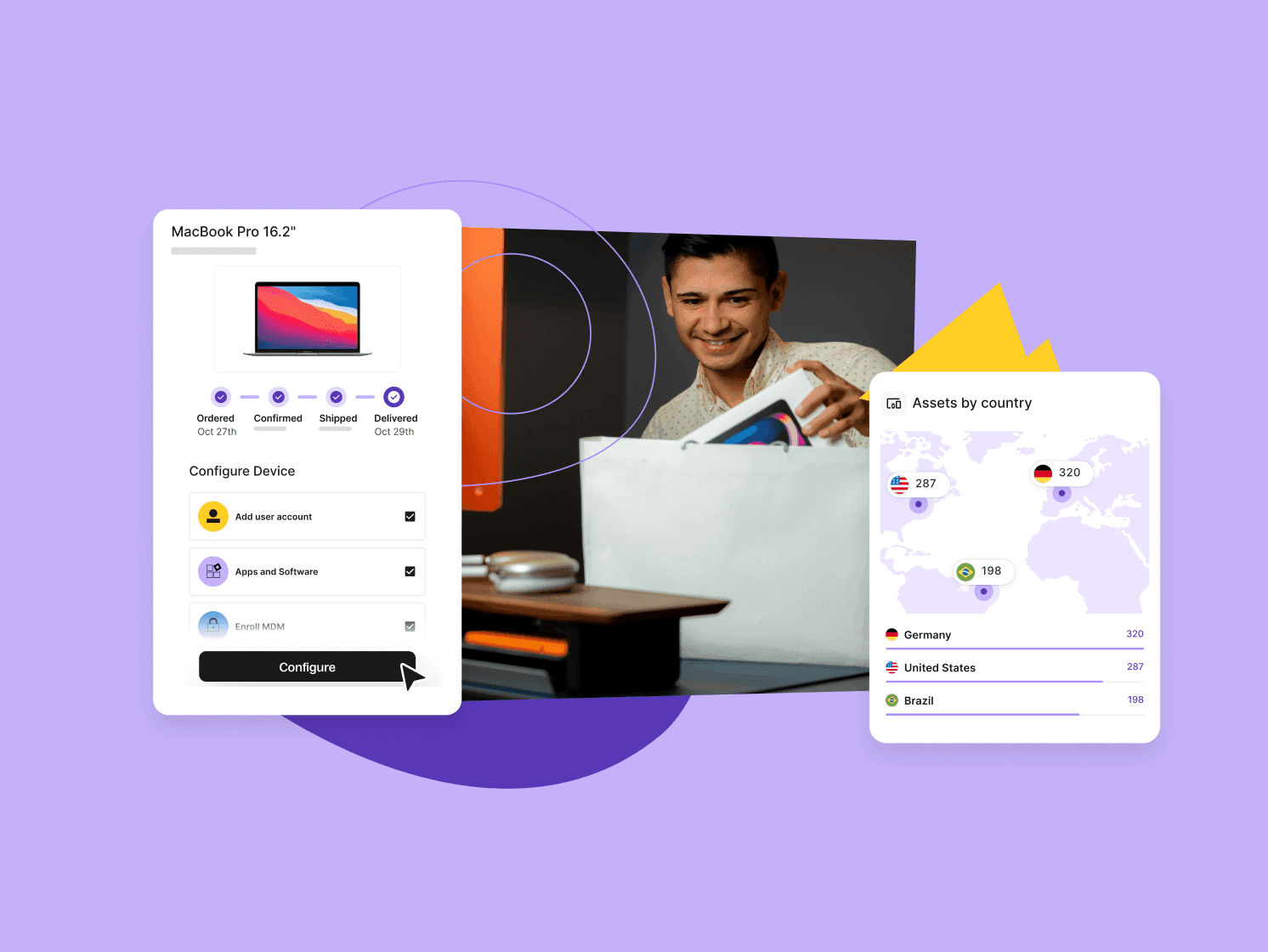
Outsourcing IT support often means coordinating multiple vendors for device management, security, identity management, logistics, and employee lifecycle workflows. Deel IT brings these capabilities together in a single platform, helping organizations support global workforces without increasing operational complexity.
24/7 support for distributed workforces: Deel IT helps organizations provide continuous support across regions and time zones, ensuring employees can get help when they need it, regardless of location or working hours.
Day-one device readiness, no IT tickets required: When a new hire's record is created in Deel, device provisioning, shipping, and account setup trigger automatically—so employees have everything they need before their first login, regardless of where they're based.
Access management tied directly to workforce changes: Offboarding events trigger access revocation across connected systems, while onboarding and role changes update permissions as employees join or move within the organization.
Compliance and security controls embedded into daily operations: Role-Based Access Control (RBAC), MFA enforcement, audit-ready logs, and Identity and Access Management (IAM) workflows help organizations maintain security and compliance at scale.
Enterprise-grade endpoint security built in: CrowdStrike Falcon provides continuous endpoint protection and threat detection, while Mobile Device Management (MDM) powered by JumpCloud helps organizations manage and secure devices globally.
Global device procurement, deployment, and logistics: A catalog of 240+ devices and 99.5% on-time delivery across 130+ countries reduces the operational burden of supporting distributed teams and remote employees.
Manage IT operations from a single platform: Device management, security, access controls, logistics, and workforce lifecycle workflows work together in one system, reducing tool sprawl and improving operational visibility.
Deel IT
Procure, deliver, manage, and secure devices anywhere

FAQ
Which outsourced IT support options work best for companies with limited IT resources?
The right solution depends on your company's size, location, and IT needs. Managed service providers (MSPs) can handle day-to-day technical support, while platforms like Deel IT combine 24/7 support, device management, access management, and endpoint security. For global teams without a dedicated IT department, an integrated solution can reduce the need to coordinate multiple vendors.
What service levels and response times should I expect from outsourced IT support?
Look for clear service level agreements (SLAs) that define response times, resolution targets, and escalation procedures based on issue severity. Critical incidents should receive priority attention, but exact timelines vary by provider. Ask for historical performance data to see whether the provider consistently meets its commitments.
How can outsourced IT providers help maintain security and compliance?
Outsourced IT providers can help manage endpoint security, monitor threats, enforce access controls, and support incident response. Look for capabilities such as multi-factor authentication (MFA), device encryption, and security reporting. Ask about relevant certifications, such as SOC 2 or ISO 27001, and how the provider supports your specific compliance requirements.
What pricing models are common for outsourced IT support?
Common pricing models include fixed monthly fees per user or device, tiered service packages, and custom agreements based on support requirements. When comparing providers, check whether after-hours support, device management, security tools, and implementation services are included or billed separately.
Why is 24/7 IT support important for distributed teams?
Employees working across different time zones may need technical assistance outside standard business hours. Without an internal IT team, delays can affect productivity and leave urgent issues unresolved. A provider offering 24/7 support can help employees get assistance when they need it, regardless of their location.
How does strategic IT advisory help companies without a full IT team?
Some outsourced IT providers offer strategic advisory or virtual CIO (vCIO) services to help businesses plan technology investments, manage vendors, and prepare for growth. This gives companies access to IT planning expertise without hiring a full-time technology leader. Check whether these services are included in the provider's offering or available at an additional cost.
Dr Kristine Lennie holds a PhD in Mathematical Biology and loves learning, research and content creation. She had written academic, creative and industry-related content and enjoys exploring new topics and ideas. She is passionate about helping create a truly global workforce, where employers and employees are not limited by borders to achieve success.